

The UK minimum wage increase remains a major financial consideration for startups, small businesses and employers planning their workforce costs for 2027.
Although searches for a UK minimum wage increase in August have attracted attention, the important distinction is that statutory minimum wage rates normally change in April, not August.
The Government confirmed the latest increases on 28 October 2026, with new rates taking effect from 1 April 2027. The National Living Wage for employees aged 21 and over will rise from £12.71 to £13.21 per hour, representing a 3.9% increase.
For workers, this means higher guaranteed hourly earnings. For employers, the effect goes beyond an additional 50p an hour.
Higher basic pay can also increase employer National Insurance contributions, pension costs, holiday-related expenditure and pressure on existing salary structures.
Our analysis of the confirmed wage rates, Low Pay Commission evidence and published business-sector responses suggests that labour-intensive startups will face the greatest financial adjustment.
For founders already managing tight margins, the challenge is not simply understanding the new rates. It is calculating what the changes will cost and preparing a commercially sustainable response.
Did the UK Minimum Wage Increase in August 2026?
There was no separate nationwide statutory minimum wage increase in August 2026.
The rates that applied during August 2026 had already come into effect on 1 April 2026. These included £12.71 per hour for workers aged 21 and over, £10.85 for those aged 18–20 and £8 for younger eligible workers and qualifying apprentices.
Some confusion arises because Government announcements, consultations and company-specific pay decisions can take place during August.
For example, a supermarket or private employer may announce a pay rise in August, but this does not change the statutory minimum wage across the country.
The National Living Wage is a legal wage floor. Individual employers can increase their own rates at other times of the year.
For those specifically searching for an August 2027 minimum wage increase, the confirmed national rate from April 2027 is £13.21 for workers aged 21 and over. No separate August 2027 statutory increase has been announced as of November 2026.
This distinction is particularly important for small businesses preparing annual payroll budgets. Employers should base their forecasts on confirmed rates rather than assumptions about additional mid-year increases.
What Are the Confirmed UK Minimum Wage Rates for 2027?
The Government has accepted the independent Low Pay Commission’s recommendations for the 2027 minimum wage.
All four main statutory rates will increase by approximately 3.9% from April 2027.
| Employee category | April 2025 | April 2026 | April 2027 | 2027 increase |
| Age 21 and over | £12.21 | £12.71 | £13.21 | 3.9% |
| Age 18–20 | £10.00 | £10.85 | £11.27 | 3.9% |
| Age 16–17 | £7.55 | £8.00 | £8.31 | 3.9% |
| Eligible apprentices | £7.55 | £8.00 | £8.31 | 3.9% |
| Accommodation offset (daily) | £10.66 | £11.10 | £11.53 | 3.9% |
The accommodation offset is a special rule used when employers provide accommodation. It is not an hourly wage rate.
The biggest cash increase applies to employees aged 21 and over, who will receive an additional 50p for every qualifying hour worked at the statutory minimum.
Younger employees will receive increases of between 31p and 42p per hour.
These changes apply throughout England, Scotland, Wales and Northern Ireland under the UK-wide National Minimum Wage framework. Some sectors and locations may have additional contractual or statutory requirements.
Businesses reviewing the previous increases can compare the UK National Living Wage changes for 2026 to understand how wage costs have developed over successive years.
For the official statutory figures, employers can consult the Government’s National Minimum Wage rates.
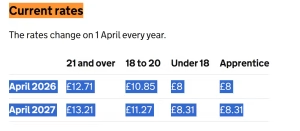
Official UK minimum wage rates for 2026 and 2027, confirming that the National Living Wage rises to £13.21 per hour from April 2027.
Why Is the UK Minimum Wage Increasing Again in 2027?
The 2027 increase reflects the Government’s intention to support lower-paid workers while considering the economic conditions facing employers.
The Low Pay Commission evaluates several factors before recommending statutory minimum wage rates. These include earnings growth, inflation, employment conditions, business profitability and the wider economic outlook.
The Commission submitted its recommendations in October 2026, and the Government accepted them.
The 2027 increase is smaller than some previous annual awards, particularly the increases younger workers received in 2026.
How the 2026 and 2027 Increases Compare?
| Worker category | Increase in April 2026 | Increase in April 2027 |
| Age 21+ | 4.1% | 3.9% |
| Age 18–20 | 8.5% | 3.9% |
| Under 18 | 6.0% | 3.9% |
| Eligible apprentices | 6.0% | 3.9% |
A significant development is the Commission’s more cautious assessment of the employment market.
In previous years, the Government’s minimum wage policy increasingly focused on maintaining the National Living Wage at approximately two-thirds of median hourly earnings.
However, the Commission acknowledged that the recommended £13.21 rate would fall short of that reference point in 2027.
It nevertheless considered the increase appropriate given economic uncertainty and the need to protect employment opportunities.
Baroness Philippa Stroud, Chair of the Low Pay Commission, said in the October 2026 announcement:
“The wider economic picture has been critical in helping decide the increase for 2027.”
This highlights the balance policymakers are attempting to achieve between improving earnings and avoiding excessive pressure on employment.
From our financial perspective, the more moderate 2027 increase does not mean employers can ignore its impact. Wage costs have already risen considerably over recent years, and increases accumulate rather than replace previous obligations.
The changing environment is particularly relevant when examining the real cost of running a UK startup, where payroll, employer taxes and operating expenditure collectively determine commercial sustainability.
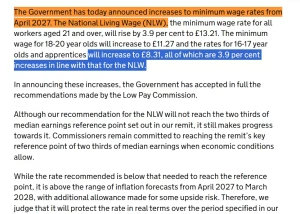
The Low Pay Commission’s October 2026 announcement confirming the minimum wage increases scheduled for April 2027.
How Much More Will Employees Earn Under the 2027 Minimum Wage?
The increase in hourly pay becomes more significant when calculated over a full working week or year.
For an employee aged 21 or over working 37.5 paid hours per week, the 50p increase adds £18.75 to weekly gross earnings.
Over a full 52-week year, that represents an additional £975 in gross pay.
| Pay calculation | April 2026 rate | April 2027 rate | Difference |
| Hourly pay | £12.71 | £13.21 | £0.50 |
| 37.5-hour week | £476.63 | £495.38 | £18.75 |
| Average monthly gross pay | £2,065.38 | £2,146.63 | £81.25 |
| Annual gross pay | £24,784.50 | £25,759.50 | £975.00 |
| Annual gross pay at 40 hours weekly | £26,436.80 | £27,476.80 | £1,040.00 |
Calculations assume the stated paid hours are maintained for 52 weeks. Figures are gross earnings before employee tax, National Insurance and pension deductions.
For many employees, an extra £975 annually will contribute towards increasing household costs.
However, employees receiving more than the statutory minimum are not automatically entitled to the same percentage increase unless their contracts or applicable agreements provide for it.
Employers may still choose to increase pay above the minimum to maintain salary differences between entry-level and more experienced staff.
This has become a consideration in sectors such as retail, where larger employers have already offered pay packages above statutory minimums.
The latest Tesco employee pay increases provide an example of how major retailers manage wage competitiveness alongside changes to the legal pay floor.
How Much Will the 2027 Minimum Wage Increase Cost UK Employers?
The financial implications are more substantial than the headline 3.9% rise might suggest.
Startups must account for the full cost of employing workers, not simply the hourly wages shown on payslips.
Relevant expenses include:
- Basic wages and contractual overtime.
- Employer National Insurance contributions.
- Employer pension contributions.
- Paid holiday and associated cover arrangements.
- Recruitment, training and staff development.
- Payroll administration and compliance.
Employer National Insurance is particularly important.
Under the confirmed 2027–28 tax framework, the standard employer National Insurance rate remains 15% on earnings above the applicable threshold, subject to reliefs and exceptions.
Eligible businesses can also claim Employment Allowance of up to £10,500 annually, reducing their employer National Insurance liability.
Therefore, the increase in an individual employee’s gross wages does not necessarily represent the full increase in business employment costs.
Example: A Startup Employing 10 Full-Time Workers
Consider a business with 10 employees aged 21 or over, each working 37.5 paid hours per week at the legal minimum wage.
| Expense | Additional annual cost |
| Basic wages | £9,750.00 |
| Illustrative employer NI at 15% | £1,462.50 |
| Illustrative employer pension at 3% | £292.50 |
| Total illustrative annual increase | £11,505.00 |
This estimate assumes that all the additional wages attract standard employer National Insurance and 3% employer pension contributions.
The actual increase may be lower where Employment Allowance, age-related National Insurance reliefs, pension eligibility rules or different pension arrangements apply.
The example excludes additional recruitment, operational and administrative costs.
A business employing 10 people could therefore face a wage-related increase exceeding £11,000 annually under these assumptions.
For a mature company, that may be manageable. For a small business operating close to break-even, the same amount could materially affect profitability.
Our assessment is that payroll changes should be evaluated alongside cash flow rather than only annual profit.
The analysis of why some startups succeed while others fail demonstrates why businesses can experience cash shortages even when their long-term revenue forecasts appear promising.
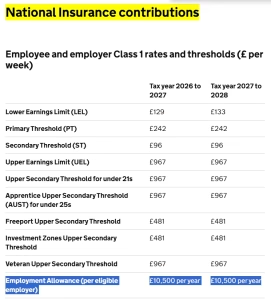
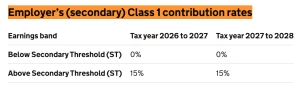
Government-confirmed employer National Insurance rates and thresholds for 2027–28, showing additional payroll considerations beyond basic minimum wage increases.
Which UK Startup Industries Will Be Most Affected by the 2027 Minimum Wage?
The effect of higher minimum wages varies substantially between industries.
Businesses that rely on large numbers of hourly paid employees are generally more exposed than companies whose costs are concentrated in software, intellectual property or highly paid specialist labour.
We assessed the likely exposure of different startup sectors based on typical labour intensity, dependence on minimum-wage roles and flexibility to increase customer prices.
The following percentages are editorial exposure ratings, not official statistics or survey results.
| Startup sector | Our indicative wage-cost exposure rating | Main concern |
| Cleaning services | 95% | Labour-intensive contracts and limited pricing flexibility |
| Hospitality and food services | 90% | High staffing requirements and narrow margins |
| Care services | 90% | Staffing obligations and contracted service prices |
| Retail businesses | 80% | Store payroll costs and competitive customer pricing |
| Warehousing and fulfilment | 75% | Hourly staffing requirements and shift coverage |
| Software and technology startups | 40% | Lower direct exposure where salaries exceed the minimum |
A higher rating indicates greater potential exposure to minimum wage changes under the assessment criteria. It does not predict the actual increase in any particular business’s costs.
Hospitality and Food Businesses
Restaurants, cafés, takeaway businesses and hospitality startups often operate with large numbers of hourly paid employees.
They also face operating expenses related to rent, energy, ingredients, insurance and business rates.
Allen Simpson, Chief Executive of UKHospitality, warned in his published response to the 2027 announcement that the increase:
“will add further pressure for hospitality businesses already grappling with substantial increases in costs.”
The concern is particularly relevant for independent operators that have limited ability to increase prices without affecting customer demand.
Our assessment suggests hospitality founders should monitor total labour cost as a percentage of revenue and compare this against their expected gross margins.
Cleaning Businesses
Cleaning companies are directly exposed because labour is often the largest component of service delivery.
For example, a cleaning business employing five workers for 30 paid hours per week would face an additional £3,900 in annual basic wages from the 50p increase, assuming those workers are aged 21 or over and paid the minimum.
If the business has fixed-price commercial cleaning contracts, recovering these additional costs may require renegotiating customer agreements.
Founders considering this sector should incorporate future payroll increases into their cleaning business startup costs before finalising their pricing.
Care Agencies
Care businesses face a particularly complex combination of wage regulations, staffing requirements and service-delivery obligations.
Some providers cannot easily reduce working hours without affecting care quality or contractual requirements.
Moreover, agency staffing, training, compliance and pension costs can already create considerable financial commitments.
A realistic assessment of starting a care agency in the UK must therefore include payroll projections extending beyond the first trading year.
Retail and E-commerce
Retail businesses face pressure from increasing shop-floor wages, warehouse costs and fulfilment expenditure.
However, the effect depends on whether their existing hourly pay is already above the statutory minimum.
For example, an employer paying £14 per hour is not automatically required to raise that rate simply because the National Living Wage increases to £13.21.
Nevertheless, the gap between minimum pay and experienced-worker salaries becomes narrower.
Businesses may choose to increase other pay grades to maintain retention and progression incentives.
Could Higher Minimum Wages Reduce Startup Profit Margins?
A minimum wage increase does not automatically mean a business will become unprofitable.
However, companies with limited operating margins can experience a disproportionately large reduction in profits.
Consider a small retail business generating £200,000 in annual revenue with an operating profit of £16,000.
Its operating profit margin is therefore 8%.
Suppose the company employs six full-time workers at the National Living Wage, each working 37.5 hours per week.
Using the earlier assumptions, the 2027 wage increase could add approximately £6,903 in annual wages, employer NI and pension expenditure.
| Financial measure | Before increase | After increase |
| Annual revenue | £200,000 | £200,000 |
| Operating profit | £16,000 | £9,097 |
| Operating profit margin | 8.0% | 4.55% |
| Reduction in operating profit | — | 43.1% |
This is an illustrative scenario rather than a forecast. It assumes no changes in customer demand, selling prices, staffing, productivity or other costs and that the modelled NI and pension contributions apply.
The important finding is that a 3.9% minimum wage increase can create a much larger percentage reduction in profit when a business starts with a narrow margin.
From our financial analysis, the correct response is not necessarily to reduce staffing.
Businesses should first examine pricing, service productivity, scheduling and the contribution margin generated by each employee or billable hour.
Founders exploring first-year startup profitability should build these costs into their forecasts before committing to additional hires.
How Should Startups Adjust Their Pricing for the 2027 Wage Increase?
Pricing is one of the most important commercial decisions affected by higher labour costs.
Startups often establish prices by reviewing competitors or applying a simple markup to direct costs.
However, this approach can leave insufficient room for employee expenses and future wage changes.
A more reliable method is to calculate the fully loaded labour cost involved in delivering each product or service.
For example, a service business may charge a customer £25 per hour while paying an employee £13.21.
The difference of £11.79 is not automatically profit.
The business must still cover employer contributions, non-billable working time, travel, equipment, administration, insurance and other operating expenses.
Our assessment suggests that founders should examine three financial measures:
- Labour-cost percentage: Total employee expenditure divided by revenue.
- Contribution margin: Revenue remaining after the direct costs of delivering services.
- Revenue per paid hour: The amount of sales generated relative to staff hours, including non-billable time.
These figures can reveal whether a company is charging enough to maintain profitability after the minimum wage increase.
For businesses growing their workforce, the principles of scaling without losing quality become especially important.
Growth that increases revenue but reduces operating margins may ultimately weaken the business.
What Are the Minimum Wage Rules for Apprentices and Younger Workers in 2027?
The April 2027 changes also affect employers recruiting apprentices, students and younger workers.
Eligible apprentices will receive a minimum of £8.31 per hour, an increase from £8 in 2026.
However, the apprentice rate does not apply to every apprentice for the entire duration of their training.
It normally applies when the apprentice is:
- Under 19 years old; or
- Aged 19 or over and in the first year of their apprenticeship.
Once an apprentice aged 19 or over completes the first year, the applicable minimum wage is normally determined by their age.
For example, a 21-year-old apprentice who has completed their first apprenticeship year would generally be entitled to at least £13.21 per hour from April 2027.
An apprentice aged 20 who has completed the first year would generally qualify for the £11.27 rate.
Employers must also monitor employees moving between statutory age brackets.
The Cost of an Employee Turning 21
A worker aged 20 receiving the statutory minimum of £11.27 in 2027 would become eligible for the £13.21 adult rate after turning 21, from the first applicable pay reference period.
That represents a £1.94 hourly increase, equivalent to approximately 17.2%.
This can create a more substantial payroll change than the annual 3.9% uprating alone.
Startups employing students and younger workers should include birthdays and apprenticeship progression dates in their payroll systems.
Businesses also need to understand the wider employment regulations affecting UK startups, particularly when expanding beyond their first few employees.
What Payroll Mistakes Could Lead to Minimum Wage Penalties in 2027?
Paying the correct advertised hourly rate is only one part of minimum wage compliance.
An employer can still underpay a worker despite setting their contractual hourly rate at the legal minimum.
Problems often arise when businesses overlook additional working time, make certain deductions or incorrectly classify employees.
Common risks include:
- Not paying for compulsory training time that counts as working time.
- Failing to include qualifying opening, closing or preparation duties.
- Requiring workers to purchase uniforms or equipment without accounting for their effect on minimum-wage pay.
- Treating customer tips as part of the statutory minimum wage.
- Incorrectly applying the apprentice rate after the first qualifying year.
- Failing to update an employee’s minimum wage following a relevant birthday.
- Allowing salary-sacrifice arrangements to reduce minimum-wage pay below the legal threshold.
- Overlooking additional hours worked by salaried employees.
Example of an Underpayment Caused by Uniform Costs
Consider an employee aged 21 or over who works 40 paid hours per week and receives the 2027 minimum wage of £13.21 per hour.
Their weekly gross wages would be £528.40.
However, suppose the employer requires the employee to pay £15 each week for a compulsory uniform, and this expense reduces pay for minimum-wage purposes.
The calculation becomes:
| Calculation | Amount |
| Weekly gross wages | £528.40 |
| Qualifying uniform expense | £15.00 |
| Pay counted for minimum-wage purposes | £513.40 |
| Counted hourly pay | £12.84 |
| Required minimum hourly pay | £13.21 |
Despite being paid the correct headline hourly rate, the employee would be underpaid for minimum-wage purposes in this example.
The treatment of particular deductions depends on their nature and the applicable minimum-wage rules.
This illustrates why employers should monitor deductions and expenses as carefully as wages.
The risk is particularly relevant when dealing with HMRC minimum wage and payroll checks, where compliance is assessed using more than contractual pay rates.
What Penalties Could Employers Face?
Minimum wage breaches can result in repayment of wage arrears and financial penalties.
Under the statutory enforcement framework, penalties can amount to 200% of the relevant underpayment, subject to a maximum of £20,000 per worker. Reductions can apply where the employer meets specified prompt-payment conditions.
Employers may also be publicly named for non-compliance.
The Government requires relevant minimum wage records to be retained for at least six years.
For startups, accurate timekeeping, payroll calculations and employee documentation are essential.
Employers should also recognise that statutory wage rights can apply even where an employee does not have a formal signed contract. The legal position is explored further in employment rights without a written contract.
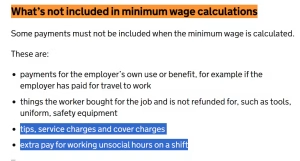
Official minimum wage guidance explaining how deductions and payroll errors can cause employers to breach statutory wage requirements.
When Must Employers Apply the April 2027 Minimum Wage Rates?
The confirmed rates take effect from 1 April 2027.
However, the timing of an individual employee’s entitlement depends on their pay reference period.
When statutory rates change, the new rate applies from the first pay reference period beginning on or after the date of the change.
For example, an employee paid for the period from 16 March to 15 April 2027 would generally become entitled to the new minimum rate from the pay reference period starting on 16 April.
If the employee’s pay reference period begins on 1 April, the new rate applies from that date.
This distinction matters for businesses using weekly, fortnightly or monthly payroll cycles.
Employers must ensure their systems apply the correct rate to the relevant period rather than assuming that every payment made after 1 April must use the new rate for all hours covered.
Using suitable payroll software for small businesses can help automate rate changes and reduce administrative mistakes.
However, software does not remove the employer’s legal responsibility to ensure workers receive the correct minimum wage.
Will the Government Introduce a Single Adult Minimum Wage in 2027?
The Government has expressed an ambition to move towards a simpler adult minimum wage structure.
Nevertheless, the confirmed rates for April 2027 retain separate statutory bands for workers aged 18–20 and those aged 21 and over.
The difference between these rates will remain substantial.
From April 2027, the adult National Living Wage will be £13.21, while the 18–20 rate will be £11.27.
This means the younger adult rate will be approximately 85.3% of the main adult rate.
For businesses employing younger workers, the structure still permits different statutory minimum rates according to age.
However, paying only the legal minimum is not always commercially advantageous.
In competitive labour markets, employers may need to offer higher wages to attract reliable candidates or retain trained employees.
Our assessment suggests that founders should separate legal compliance from their recruitment strategy.
The cheapest legally permissible hourly rate is not necessarily the most cost-effective wage when employee turnover, recruitment expenses and productivity are considered.
How Can Small Businesses Prepare for the 2027 Minimum Wage Increase?
Startups should treat the 2027 wage changes as an opportunity to review their financial model rather than simply updating payroll figures.
The most effective preparation combines compliance, operational planning and cash-flow management.
1. Review Current Employee Pay
Identify employees currently earning below the incoming statutory rates.
Check age categories, apprenticeship status, contractual working hours and expected pay changes.
Pay particular attention to workers approaching their 18th or 21st birthday.
2. Calculate Fully Loaded Employment Costs
Do not calculate the wage increase using hourly pay alone.
Include employer National Insurance, pension contributions and any contractual costs linked to salary.
Check whether the business qualifies for Employment Allowance and whether other payroll reliefs apply.
3. Update Cash-Flow Forecasts
Model the additional wage expenditure from April 2027.
Prepare forecasts showing expected monthly revenue, operating expenditure, payroll requirements and available cash.
Businesses should calculate whether their existing working capital can absorb the increased expenditure.
Where cash reserves are inadequate, founders may need to reassess growth plans or financing requirements.
A well-prepared application for startup business funding should explain how increased employment costs affect future repayment affordability.
4. Reassess Service Prices and Contracts
Businesses operating on fixed-price contracts should identify agreements that may become less profitable.
Consider whether contract renewal dates permit price changes and whether customers will accept revised charges.
Pricing decisions should reflect the full cost of delivery rather than applying a uniform increase without examining margins.
5. Improve Workforce Productivity
Review shift scheduling, employee training and administrative processes.
The objective should be to reduce unnecessary costs without breaching wage rules or undermining service quality.
Businesses may benefit from improving stock management, reducing duplicated administration or investing in technology that supports employees.
6. Review Payroll Systems and Financial Reporting
Ensure payroll settings are prepared for April 2027.
Check that systems correctly record working hours, statutory rate changes, employee ages, pension contributions and National Insurance.
Businesses can also review their small-business accounting software to determine whether payroll and financial reporting are adequately integrated.
7. Protect Working Capital
A startup can remain profitable on paper while experiencing difficulty paying wages on time.
Businesses should maintain realistic cash reserves and avoid hiring based entirely on optimistic revenue forecasts.
A practical startup business plan should include downside scenarios involving weaker sales, slower customer payments and higher operating costs.
Could the 2027 Minimum Wage Increase Benefit Startups?
Although higher statutory wages increase employment costs, the effects are not exclusively negative.
More competitive wages can support employee retention and recruitment, potentially reducing the expense of repeated hiring and training.
Higher earnings may also increase spending capacity among lower-paid workers, supporting demand in consumer-facing sectors.
However, these outcomes vary according to the business model and wider economic conditions.
From our analysis, startups that rely heavily on experienced frontline employees may benefit from workforce stability if improved pay reduces turnover.
Meanwhile, businesses with limited pricing power may find it difficult to recover additional payroll expenditure.
The key is assessing the relationship between wages, productivity and profitability rather than assuming that higher wages always improve or weaken business performance.
Our overall financial assessment is that the 2027 increase is manageable for businesses with healthy margins and flexible pricing, but more challenging for labour-intensive operators with weak cash reserves.
What Is the Difference Between the National Living Wage and the Real Living Wage?
The National Living Wage and the voluntary Real Living Wage are different.
The National Living Wage is a statutory minimum set by the Government. Employers must pay eligible workers at least the applicable rate.
The Real Living Wage is a voluntary rate promoted by the Living Wage Foundation, based on living costs.
Businesses accredited under the voluntary scheme commit to paying its applicable rates, which can differ between London and the rest of the UK.
For startups, the distinction is important because the statutory £13.21 rate from April 2027 establishes the legal minimum for workers aged 21 and over, not necessarily the amount required under a voluntary accreditation scheme.
Some founders may choose to pay above the statutory minimum to strengthen recruitment and retention.
However, higher pay commitments should be included in financial projections before they are introduced.
What Does the 2027 Minimum Wage Mean for the Future of UK Startups?
The confirmed increase signals a continuation of rising statutory wage costs, although at a more moderate percentage than in some previous years.
For startups, it reinforces the importance of developing business models that can support sustainable employment costs.
We consider three areas particularly important for 2027.
First, businesses need to understand unit economics. Revenue growth should translate into adequate contribution margins after paying employees and other direct costs.
Second, companies should maintain flexible financial forecasts. Employment costs, borrowing costs and customer demand can change within relatively short periods.
Third, employers should treat payroll compliance as an ongoing operational responsibility.
A business that manages wage increases effectively can protect its margins while maintaining a stable workforce.
In contrast, a company that postpones financial planning may face reduced profitability, cash-flow problems or unexpected compliance liabilities.
The goal for founders should therefore be to build sufficient financial resilience to accommodate predictable statutory changes without compromising long-term growth.
Conclusion
The UK minimum wage increase for 2027 represents another important change for workers and businesses. From 1 April 2027, the National Living Wage will rise to £13.21 per hour, while younger workers and eligible apprentices will also receive higher statutory rates.
Although there is no separate August increase, employers should use the confirmed 2027 figures to prepare their payroll budgets, review contract pricing and strengthen compliance.
Our analysis indicates that businesses with substantial hourly paid workforces will experience the greatest cost pressure. Startups that forecast expenditure accurately, improve productivity and protect working capital will be better positioned to manage these changes while sustaining profitable growth.
Frequently Asked Questions
Is the UK minimum wage increasing in August 2027?
No separate statutory increase for August 2027 has been announced. The confirmed increase takes effect from 1 April 2027, when the National Living Wage rises to £13.21 per hour.
What is the UK minimum wage in August 2026?
Workers aged 21 and over are entitled to at least £12.71 per hour, while those aged 18–20 receive £10.85. Eligible younger workers and apprentices receive £8 per hour.
How much will the UK minimum wage increase in 2027?
The main statutory minimum wage rates will rise by approximately 3.9%. For workers aged 21 and over, this represents a 50p hourly increase from £12.71 to £13.21.
How much will someone working 40 hours earn in 2027?
An employee aged 21 or over working 40 paid hours per week at £13.21 will earn £528.40 weekly, equivalent to £27,476.80 annually over 52 weeks before deductions.
Will apprentices receive a minimum wage increase in 2027?
Yes. The eligible apprentice rate will increase from £8 to £8.31 per hour. Apprentices aged 19 or over who have completed their first year generally qualify for the relevant age-based minimum wage instead.
Do employers have to increase everyone’s wages in 2027?
No. Employers must ensure eligible workers receive at least the applicable statutory minimum, but employees already earning more are not automatically entitled to a 3.9% rise unless another contractual obligation applies.
Can employers pay less than the National Living Wage?
Employers can use the lower statutory rates only for workers who qualify for them, such as younger employees or eligible apprentices. Other deductions or arrangements must not unlawfully reduce minimum-wage pay.