

Tesco’s latest pay rise has increased hourly wages for thousands of employees across its UK stores and online fulfilment operations.
Following negotiations with retail trade union Usdaw, the supermarket introduced a 5.1% pay increase from 29 March 2026, raising its standard hourly rate from £12.64 to £13.28.
For colleagues working within the M25, the rate increased from £13.85 to £14.55 per hour, including the London Location Allowance.
The latest agreement represents an investment of more than £200 million in colleague pay and follows Tesco’s £180 million investment announced in 2025.
We analysed Tesco’s published pay announcements, union statements, recruitment information and wider supermarket wage trends to understand how the increase affects employees.
The most important question is not simply how much the hourly wage has increased, but whether employees are financially better off after considering contracted hours, deductions, location allowances and changes to premium payments.
What Is the Latest Tesco Pay Rise in 2026?
Tesco implemented its latest retail pay increase on 29 March 2026, introducing a standard hourly rate of £13.28 for eligible store and online fulfilment colleagues.
The increase follows the previous two-stage agreement introduced during 2025.
| Pay Details | 2025 Rate | 2026 Rate |
| Standard hourly pay | £12.64 | £13.28 |
| London/M25 hourly pay | £13.85 | £14.55 |
| London Location Allowance | £1.21 | £1.27 |
| National hourly increase | — | £0.64 |
| Annual pay increase | 5.2% in 2025 | 5.1% in 2026 |
| Investment announced | £180 million | Over £200 million |
The 2026 agreement means employees receiving the standard rate earn an additional 64p for every paid hour.
An employee working 37.5 hours weekly would receive approximately £24 more in gross weekly wages, equivalent to £1,248 over 52 weeks if their paid hours remain unchanged.
Tesco has also confirmed that its hourly-paid colleagues have experienced cumulative pay growth of approximately 43% over the previous five years.
Ashwin Prasad, Tesco UK Chief Executive, described the agreement as another investment in colleague pay and highlighted the importance of supporting employees’ long-term careers.
The agreement was negotiated with Usdaw, which represents a substantial proportion of Tesco’s hourly-paid workforce.
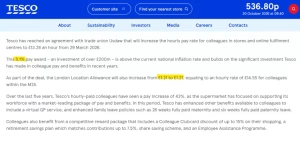
Tesco confirms a 5.1% pay increase, raising its standard hourly rate to £13.28 from 29 March 2026.
How Has Tesco Employee Pay Changed Between 2024 and 2026?
Tesco has introduced several wage increases over recent years, reflecting rising employment costs, changes to minimum wage legislation and competition between major retailers.
The supermarket’s 2025 agreement introduced two separate increases, rather than a single immediate uplift.
The first took effect on 30 March 2025, followed by another on 31 August 2025.
The latest 2026 increase built on both changes.
| Effective Date | Standard Hourly Rate | Change |
| 2024 established rate | £12.02 | — |
| 30 March 2025 | £12.45 | 3.6% |
| 31 August 2025 | £12.64 | 1.5% from March |
| 29 March 2026 | £13.28 | 5.1% |
Between the established 2024 rate of £12.02 and the current £13.28 rate, Tesco’s hourly pay increased by approximately 10.5%.
The company’s longer-term investment is also significant. Its 2025 announcement reported that hourly-paid employees had experienced a cumulative 32% increase since April 2022.
By March 2026, Tesco reported pay growth of 43% over the preceding five years.
These figures use different comparison periods and should not be treated as directly interchangeable annual increases.
From a workforce cost perspective, consecutive pay awards are important because permanent increases raise the employer’s ongoing payroll expenditure.
Unlike temporary bonuses, an increase in the standard hourly rate continues to benefit eligible employees during subsequent pay periods.
However, higher hourly wages do not automatically guarantee an equivalent increase in take-home income.
How Much Do Tesco Employees Earn Per Week, Month and Year?
One of the most useful ways to assess the Tesco pay rise is to calculate actual earnings based on contracted hours.
At the standard hourly rate of £13.28, earnings vary significantly depending on whether an employee works part-time or full-time.
| Weekly Paid Hours | Weekly Gross Pay | Approx. Monthly Gross Pay | Annual Gross Pay |
| 16 hours | £212.48 | £920.75 | £11,048.96 |
| 20 hours | £265.60 | £1,150.93 | £13,811.20 |
| 25 hours | £332.00 | £1,438.67 | £17,264.00 |
| 30 hours | £398.40 | £1,726.40 | £20,716.80 |
| 37.5 hours | £498.00 | £2,158.00 | £25,896.00 |
| 40 hours | £531.20 | £2,301.87 | £27,622.40 |
Calculations assume 52 paid weeks, consistent weekly paid hours and no additional premiums. Monthly figures are annual gross earnings divided by 12.
For employees working 37.5 hours each week, the increase from £12.64 to £13.28 produces an additional £1,248 in annual gross earnings.
That is a meaningful improvement, particularly for employees managing regular household costs.
However, gross income is not the same as take-home pay.
Income Tax, National Insurance, pension contributions and other applicable deductions can reduce the amount received.
Employees who want to confirm what their employer has reported can check their wages through HMRC and compare the information against their payslips.
Our assessment is that employees should compare annual earnings rather than focusing exclusively on the headline hourly increase.
A worker receiving more per hour but fewer paid shifts may not experience the expected improvement in monthly income.
How Much Is the Tesco Pay Rise for London Employees?
Tesco employees working within the M25 receive an additional location allowance because of higher regional living costs.
Under the 2026 agreement, the London Location Allowance increased from £1.21 to £1.27 per hour.
This takes the standard rate for qualifying locations to £14.55.
| Pay Component | 2025 | 2026 |
| Standard hourly rate | £12.64 | £13.28 |
| M25 allowance | £1.21 | £1.27 |
| Combined hourly rate | £13.85 | £14.55 |
| Weekly pay at 37.5 hours | £519.38 | £545.63 |
| Annual pay at 37.5 hours | £27,007.50 | £28,372.50 |
The latest change adds approximately £1,365 to annual gross earnings for an eligible colleague working 37.5 paid hours per week throughout the year.
The London premium is particularly important because housing, commuting and everyday expenses can be considerably higher than in many other parts of the UK.
Nevertheless, employees should not assume that every London-related job automatically receives the same allowance.
Tesco’s published rate applies to the specified M25 location allowance area. Individual vacancies, contracts and specialist roles may have different arrangements.
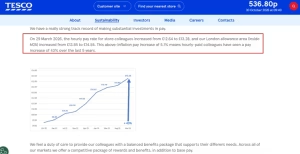
Tesco’s published hourly pay rates for standard store colleagues and employees working within the M25.
What Happened to Tesco’s Sunday Pay Premium?
The removal of Tesco’s historic Sunday premium was one of the most significant changes associated with its 2025 pay agreement.
Before the change, certain established employees received additional pay for working Sundays.
The 2025 agreement removed those remaining Sunday premium arrangements, while providing eligible affected colleagues with a one-off compensatory payment.
For employees who previously qualified for the premium, the effect could be different from the headline wage increase.
An employee regularly working Sundays may have benefited from the new standard hourly rate but simultaneously lost a recurring premium.
The one-off payment was intended to recognise the impact of removing that benefit. However, a single payment is not the same as retaining an ongoing Sunday enhancement.
This distinction matters when assessing whether an employee’s total earnings have improved.
Does Tesco Still Pay Extra on Bank Holidays?
Bank Holiday payments should be considered separately from the withdrawn Sunday premium.
Employees should check their contractual terms and the applicable pay agreement to establish whether enhanced Bank Holiday payments apply.
Not every Tesco role, employment contract or recruitment arrangement necessarily has identical premium entitlements.
Employees should also examine the treatment of overtime and overnight shifts.
The most reliable approach is to compare actual payslips before and after the changes and ask the People team about any unexplained differences.
Does Tesco Pay Extra for Night Shifts and Specialist Roles?
Tesco’s standard £13.28 rate is not necessarily the total hourly compensation received by every employee.
Additional payments may apply for qualifying overnight shifts, specific locations, skills or responsibilities.
For example, a Tesco night colleague vacancy published in September 2026 advertised an additional £2.35 per hour for hours worked between midnight and 6am.
This means eligible hours could attract a combined rate of £15.63 before any other applicable additions.
However, the premium applies to qualifying hours, not automatically to every hour within a shift.
Other specialist roles may have separate arrangements.
| Role Category | Pay Position |
| Standard store colleague | Published starting rate of £13.28 |
| M25 store colleague | Published starting rate of £14.55 |
| Night colleague | Basic pay plus applicable night premium |
| Shift leader | Contract-specific rate and premiums |
| Delivery driver | Role and location-specific rate |
| Distribution employee | Separate negotiated pay arrangements |
| Salaried management | Individual salary bands and employment terms |
We found that treating the standard store rate as a universal Tesco wage can produce misleading comparisons.
In particular, warehouse operatives and drivers should not be assigned estimated rates derived from store employee increases.
Their pay depends on separate agreements, responsibilities and individual contracts.
Are Tesco Distribution Workers Getting a Pay Rise in 2026?
Yes. Separate agreements covering Tesco distribution employees were announced during September 2026.
These should not be confused with the 5.1% increase implemented for eligible retail and online fulfilment colleagues in March.
On 10 September 2026, Unite announced a negotiated 4.5% pay increase for more than 3,000 Tesco warehouse workers and HGV drivers across Belfast, Didcot, Doncaster and Thurrock.
Later, on 28 September, Usdaw confirmed that members in other Tesco distribution locations had accepted a separate agreement.
Under that deal, employees on new contracts secured a 4.8% increase, with an equivalent settlement for employees on legacy contracts.
The Usdaw-negotiated rates are scheduled to take effect on Sunday 8 November 2026.
| Employee Group | Agreed Increase | Implementation |
| Store and online fulfilment colleagues | 5.1% | 29 March 2026 |
| Certain Unite-represented distribution workers | 4.5% | September agreement; contractual dates apply |
| Usdaw-represented distribution workers covered by the new deal | 4.8% or equivalent | 8 November 2026 |
Mark Todd, Usdaw National Officer, welcomed the distribution settlement and emphasised the contribution made by employees working around the clock to maintain supermarket supplies.
This development highlights why Tesco employees should identify the correct collective agreement before calculating their pay increase.
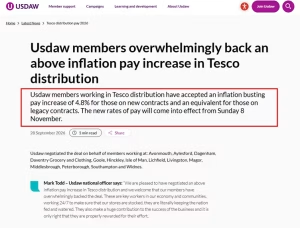
Usdaw confirms the separate 4.8% Tesco distribution pay agreement, effective 8 November 2026.
How Does Tesco’s 2026 Pay Compare With the National Living Wage?
The UK National Living Wage increased to £12.71 per hour on 1 April 2026 for eligible workers aged 21 and over.
Tesco’s standard rate of £13.28 is 57p higher.
This means Tesco pays approximately 4.5% above the statutory National Living Wage for employees receiving that standard rate.
| Comparison | Hourly Amount |
| National Living Wage, age 21+ | £12.71 |
| Tesco standard hourly rate | £13.28 |
| Hourly difference | £0.57 |
| Percentage above minimum | Approximately 4.5% |
The distinction between the statutory National Living Wage and the voluntary Real Living Wage is also important.
The National Living Wage is a legal minimum, whereas the Real Living Wage is a voluntary benchmark calculated using living-cost estimates.
Employers are legally required to satisfy the applicable statutory minimum wage rules but are not automatically required to pay the voluntary benchmark.
Our analysis suggests Tesco’s 2026 award has maintained a margin above the statutory wage floor.
However, a rate above the legal minimum does not independently establish that earnings are sufficient for every household.
The affordability of wages depends on contracted hours, location, dependants, housing costs and other financial commitments.
For employers, accurate wage calculations are equally important. Businesses must ensure that deductions and working-time arrangements do not create minimum-wage underpayments.
This is particularly relevant to HMRC minimum-wage and payroll compliance checks, which examine more than the headline hourly rate.
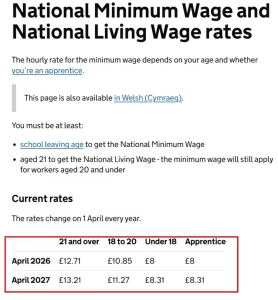
UK National Living Wage rates from April 2026, confirming the £12.71 hourly minimum for workers aged 21 and over.
How Does Tesco’s Pay Compare With Aldi, Lidl and Other Supermarkets?
Competition for retail employees has encouraged major UK supermarkets to increase wages.
Several retailers announced above-inflation awards during the first half of 2026.
The following figures compare published standard starting rates for store colleagues rather than specialist positions.
| Supermarket | National Hourly Rate | London/M25 Rate |
| Aldi | £13.50 | £14.88 |
| Lidl | £13.45 | £14.80 |
| Tesco | £13.28 | £14.55 |
| Sainsbury’s | £13.23 | £14.54 |
| Asda | £13.10 | £14.35 |
These are published 2026 starting rates at the relevant implementation dates. London eligibility areas, job roles, paid breaks and additional benefits may differ.
Tesco’s national starting rate is 22p below Aldi and 17p below Lidl.
However, it remains 5p above Sainsbury’s and 18p above Asda’s published standard rate.
Aldi and Lidl both offer higher advertised basic starting rates, making them attractive options for employees who prioritise immediate hourly earnings.
Nevertheless, comparing employers solely on basic hourly rates can overlook important differences.
Paid breaks, guaranteed hours, holiday arrangements, employer pension contributions and contractual premiums can all influence total employment value.
For example, Aldi has publicly highlighted paid breaks as part of its employee reward package.
Tesco, meanwhile, offers collective bargaining arrangements and a range of employee benefits.
We would therefore assess supermarket employment packages using both gross wages and the wider conditions attached to the role.
What Employee Benefits Does Tesco Offer in 2026?
Tesco’s pay strategy includes more than its standard hourly wage.
The supermarket offers a range of benefits intended to support employee finances, wellbeing and career retention.
Colleague Clubcard Discounts
Eligible employees can receive a Colleague Clubcard following their initial qualifying service period.
Tesco offers a standard 10% colleague shopping discount, increasing to 15% during payday weekends.
In 2025, the supermarket removed the previous annual discount savings cap.
According to Tesco, more than 95% of colleagues hold a Colleague Clubcard.
Pension Contributions
Tesco offers a retirement savings arrangement with employer matching contributions of up to 7.5%, subject to scheme conditions.
Employees who participate may therefore benefit from pension contributions in addition to their take-home earnings.
Family Leave
Tesco provides enhanced family-related leave arrangements, including up to 26 weeks of fully paid maternity leave and six weeks of fully paid paternity leave for qualifying colleagues.
Healthcare and Wellbeing
Employee benefits include access to a virtual GP service, confidential wellbeing assistance and financial support resources.
The company also operates employee share-saving arrangements, allowing eligible staff to save towards potential share purchases.
New Paid Safe Leave in October 2026
In October 2026, Tesco introduced guaranteed paid Safe Leave for employees experiencing domestic abuse.
Developed alongside Usdaw, the policy provides up to three days, or 21 hours, of paid leave to help affected colleagues access support and take practical steps towards safety.
This is a significant addition to Tesco’s employment support arrangements and reflects the importance of assessing the wider employment package alongside wages.
What Do Tesco’s Employee Survey Results Reveal About Pay and Benefits?
Tesco’s published 2026 employee engagement results provide useful insight into how colleagues perceive their employment experience.
The company reported several findings through its Every Voice Matters employee survey.
| Survey Measure | Reported Result |
| Colleagues agreeing that total reward is competitive | 65% |
| Colleagues regarding Tesco as a great place to work | 82% |
| Colleagues reporting they can work flexibly | 82% |
| Colleagues feeling supported with mental and physical wellbeing | 71% |
These are employer-reported survey findings, not independently collected review ratings.
The figures suggest that Tesco performs positively in some areas of colleague experience, although the 65% reward assessment indicates that satisfaction with compensation is not universal.
This is an important distinction.
While Tesco has increased wages by 43% over five years, employees’ perceptions of pay may still be influenced by household expenses, shift arrangements, responsibilities and workload.
In our assessment, the strongest indicator of a competitive employer is not simply a high percentage wage increase.
It is whether employees receive sustainable earnings, fair conditions and meaningful opportunities for career development.
Why Is Tesco Continuing to Increase Employee Pay?
Several economic and operational factors help explain Tesco’s recent wage decisions.
One is the continuing upward movement of the statutory National Living Wage.
As minimum wage rates increase, supermarkets need to review their own pay structures to maintain competitiveness and comply with legal requirements.
Another factor is competition for experienced retail employees.
Supermarkets depend on employees across customer service, stock management, online fulfilment and distribution operations.
Maintaining an experienced workforce can help reduce recruitment and training costs.
Tesco’s partnership with Usdaw also creates a structured process for negotiating employee pay and working conditions.
Daniel Adams, Usdaw National Officer, said the 2026 agreement delivered a real-terms wage increase while extending the gap between Tesco’s rates and the statutory National Living Wage.
The union also highlighted the introduction of dedicated support for employees experiencing domestic abuse.
From a commercial perspective, permanent pay increases create additional operating expenditure.
However, employee retention, productivity and service quality can also influence long-term business performance.
Tesco’s approach therefore reflects a balance between managing employment costs and maintaining a stable workforce.
What Should Employees Check After Receiving the Tesco Pay Rise?
Employees should examine their payslips carefully to ensure the appropriate rate has been applied.
The most important checks include:
- Confirm that the basic hourly rate reflects the applicable pay agreement.
- Check whether the M25 location allowance applies.
- Review overtime, overnight and other qualifying premiums separately.
- Compare contracted and actual paid hours.
- Examine Income Tax, National Insurance and pension deductions.
- Check whether historic Sunday premium changes affect total earnings.
- Confirm any one-off compensation or separate contractual adjustments.
- Contact the People team if the calculated payment differs from the payslip.
Employees with concerns about their employment conditions should also review their contractual rights.
Understanding employment rights and contractual terms can be useful when assessing whether changes to working arrangements have been communicated appropriately.
Will Tesco Employees Receive Another Pay Rise in 2027?
As of 30 October 2026, we have not identified a confirmed new nationwide Tesco retail hourly pay agreement for 2027.
The latest verified standard store rate remains £13.28 per hour, with £14.55 applying within the specified M25 allowance area.
Future changes will depend on negotiations, employment costs, wider economic conditions and Tesco’s decisions on workforce investment.
The separate distribution agreement beginning on 8 November 2026 should not be misinterpreted as a new nationwide store pay rise.
Employees should distinguish between announced agreements and predictions about future settlements.
Any 2027 pay figure should be treated as unconfirmed unless Tesco or the relevant recognised union formally announces it.
Conclusion: Is the Tesco Pay Rise Good for Employees?
Tesco’s latest pay rise represents another significant increase in its investment in UK employees.
The move to £13.28 nationally and £14.55 within the M25 has improved basic hourly earnings and maintained a margin above the statutory National Living Wage.
The 5.1% increase is particularly relevant for employees working consistent weekly hours because the additional pay accumulates throughout the year.
However, evaluating the overall benefit requires a wider perspective.
Changes to Sunday premiums, differences between job roles, contracted hours and payroll deductions can all influence actual earnings.
Tesco’s enhanced employee benefits and collective bargaining arrangements also contribute to the overall employment package.
Based on our review of the confirmed pay announcements and published employee survey results, Tesco remains competitive among major UK supermarkets, although Aldi and Lidl currently advertise higher basic starting hourly rates.
For existing and prospective Tesco employees, the most useful comparison is therefore the complete package of wages, guaranteed hours, contractual premiums and benefits rather than a single headline pay percentage.
Frequently Asked Questions About the Tesco Pay Rise
How much does Tesco pay per hour in 2026?
Tesco’s standard hourly rate for eligible store and online fulfilment colleagues is £13.28 from 29 March 2026.
How much do Tesco employees earn in London?
Eligible standard store colleagues within the M25 receive £14.55 per hour, including the £1.27 location allowance.
What percentage pay rise did Tesco employees receive?
The latest national retail pay agreement introduced a 5.1% increase in March 2026, following a 5.2% increase during 2025.
Did Tesco increase pay for warehouse employees?
Yes. Separate distribution agreements announced in September 2026 included 4.5% and 4.8% increases for different represented groups.
Do Tesco employees receive extra pay for night shifts?
Certain night roles attract additional premiums for qualifying hours. The exact payment depends on the applicable role and agreement.
Does Tesco still pay a Sunday premium?
The 2025 agreement removed historic Sunday premium payments for affected employees, with a one-off payment for eligible colleagues.
Is Tesco planning another pay rise in 2027?
No new nationwide 2027 store pay agreement had been confirmed by 30 October 2026.