


The John Healey landlord tax crackdown has become one of the most controversial announcements in the UK Autumn Budget 2026, raising concerns about rental profitability, buy-to-let investment and the possibility of higher rents for tenants.
On 28 October 2026, Chancellor John Healey announced an additional two-percentage-point increase in Income Tax on property income, taking the planned rates to 24% for basic-rate taxpayers, 44% for higher-rate taxpayers and 49% for additional-rate taxpayers from 6 April 2027.
The announcement builds on a previous two-percentage-point increase introduced by former Chancellor Rachel Reeves in the November 2025 Budget.
Combined, the two measures mean property-income tax rates will be four percentage points higher than the equivalent main Income Tax rates charged in 2026/27.
Our analysis of the Budget documents, HMRC’s impact assessment and published property-industry responses suggests that the consequences extend beyond the higher tax percentages.
Landlords with significant mortgage borrowing could face reduced cash returns, while tenants may experience indirect effects if property investors withdraw from the rental market.
However, the impact will vary according to a landlord’s income, allowable expenses, borrowing arrangements, ownership structure and property location.
What Is John Healey’s Landlord Tax Crackdown?
John Healey’s landlord tax crackdown refers to the additional increase in Income Tax rates applied to rental profits announced in the Autumn Budget on 28 October 2026.
Rather than imposing a completely new tax, the government is increasing the separate property-income tax rates already scheduled to begin in April 2027.
The government says the measure is intended to raise revenue from income generated by assets while helping fund wider fiscal commitments.
Our review identified three important points:
- The tax increase is scheduled to begin on 6 April 2027, not immediately after the Budget announcement.
- The October 2026 announcement adds two percentage points to the rates previously planned for 2027.
- The new rates apply to taxable property income, not automatically to every pound of gross rent received.
This distinction matters because a landlord collecting £20,000 annually in rent does not necessarily pay 24% or 44% on the entire £20,000. Allowable property expenses, tax bands, personal allowances and finance-cost relief affect the calculation.
The government is also introducing separate property-income rates, meaning the taxation of rental profits will become more distinct from taxation of employment earnings.
How Much Will Landlords Pay Under the New Tax Rates?
The most significant financial change is the increase in the three main property-income tax rates.
| Taxpayer category | 2026/27 equivalent rate | Original 2027/28 plan | New 2027/28 rate |
| Basic rate | 20% | 22% | 24% |
| Higher rate | 40% | 42% | 44% |
| Additional rate | 45% | 47% | 49% |
The table shows how the Budget 2026 announcement increased the previously scheduled rates by another two percentage points.
For a landlord whose taxable rental profits fall entirely within one tax band, the increase from the current rate is four percentage points.
That is not the same as a 4% increase in the tax bill.
For example, moving from a 20% rate to 24% represents a 20% relative increase in the tax rate itself, although the actual change in a landlord’s overall tax liability will depend on their circumstances.
The rates are set out in HMRC’s official property-income tax changes announcement.
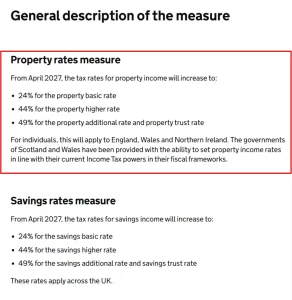
HMRC confirms that the property-income tax rates will rise to 24%, 44% and 49% from April 2027.
Why Has John Healey Increased Taxes on Rental Income?
The government’s central argument is that income generated from property and other assets should make a greater contribution to public finances.
Unlike ordinary employment income, rental income generally does not attract National Insurance contributions simply because it is rental income.
The Treasury argues that increasing tax on income from assets helps protect the main Income Tax rates applicable to employment earnings while generating additional revenue.
The financial forecasts provide more context.
HMRC estimates that the latest two-percentage-point increase will raise:
| Tax year | Estimated additional revenue |
| 2027/28 | £35 million |
| 2028/29 | £575 million |
| 2029/30 | £435 million |
| 2030/31 | £445 million |
| 2031/32 | £455 million |
These figures relate to the additional October 2026 measure, rather than the total revenue from both Budget announcements.
The government estimates that approximately 5% of taxpayers will experience an average additional annual tax charge of £225 in 2027/28 because of the latest property-income tax increase.
By 2031/32, HMRC estimates that around 2.4 million landlords will be affected.
This is an important distinction when interpreting headlines. The policy is significant for affected landlords, but it does not mean that every UK taxpayer or homeowner will face higher property-income tax.
Our assessment is that the government’s challenge is balancing its revenue objectives against the potential impact on private rental supply.
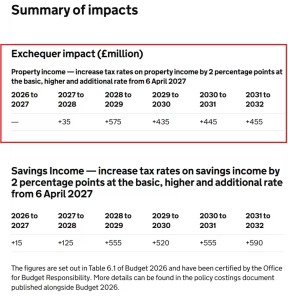
HMRC’s forecast showing expected tax revenue from the additional landlord income tax increase.
How Much More Tax Could an Individual Landlord Pay?
To understand the financial impact, we calculated several straightforward examples.
These illustrations assume that all the stated taxable property profits fall into the specified tax band, with no special adjustments, additional reliefs or restrictions.
| Annual taxable property profit | Tax band | Tax at 2026/27 rate | Tax at 2027/28 rate | Annual increase |
| £10,000 | Basic | £2,000 | £2,400 | £400 |
| £15,000 | Basic | £3,000 | £3,600 | £600 |
| £20,000 | Higher | £8,000 | £8,800 | £800 |
| £30,000 | Higher | £12,000 | £13,200 | £1,200 |
| £40,000 | Additional | £18,000 | £19,600 | £1,600 |
These examples illustrate the combined four-percentage-point change from 2026/27 to 2027/28, not just the extra two points announced in October 2026.
They also exclude the effect of residential mortgage finance-cost tax reductions.
Real landlords may have rental profits spread across different tax bands, meaning their actual tax bills could differ substantially.
What Happens to a Landlord With Mortgage Interest Costs?
Consider a higher-rate taxpayer earning £60,000 from employment while also letting a residential property.
Their rental finances might look like this:
| Financial item | Annual amount |
| Gross rental income | £24,000 |
| Allowable operating expenses | £4,000 |
| Mortgage interest | £9,000 |
| Property profit before finance-cost relief | £20,000 |
| Actual cash profit before tax | £11,000 |
Because residential mortgage interest is generally not deducted directly from the rental profit calculation for individual landlords, the tax treatment requires a separate calculation.
Assuming the landlord qualifies for the full residential finance-cost tax reduction, our comparison is:
| Calculation | 2026/27 | 2027/28 |
| Tax on £20,000 property profit | £8,000 | £8,800 |
| Finance-cost tax reduction | £1,800 | £2,160 |
| Net property tax liability | £6,200 | £6,640 |
| Cash remaining after tax | £4,800 | £4,360 |
The landlord retains approximately 39.6% of their £11,000 cash profit after the illustrated property tax calculation in 2027/28.
The effective tax burden is approximately 60.4% of that cash profit, despite the statutory higher property-income rate being 44%.
This happens because mortgage interest is not directly deducted when calculating taxable residential rental profits.
The finance-cost reduction is expected to follow the new 24% property basic rate, subject to the normal restrictions.
For landlords reviewing their arrangements, understanding whether mortgage interest is tax deductible in the UK is essential before estimating the impact of the Budget.
Our calculation illustrates why headline rates alone can underestimate the pressure on highly leveraged landlords.
Will John Healey’s Landlord Tax Increase Lead to Higher Rents?
One of the biggest concerns surrounding the tax increase is whether landlords will pass additional costs to tenants.
The Office for Budget Responsibility has warned that policies reducing private landlord returns could contribute to higher rents over time by discouraging new investment and reducing rental supply.
Ben Beadle, chief executive of the National Residential Landlords Association, responded to the October Budget by saying:
“The Chancellor has today made life harder for renters right across the country.”
His response reflects concerns among landlord representatives that higher taxation will discourage investment in rental properties.
However, this does not establish that every landlord will increase rents or that tenants will experience a uniform increase.
Rent levels are influenced by local supply and demand, household incomes, competing properties, mortgage costs and applicable tenancy regulations.
Some landlords may absorb the tax increase through lower profits. Others may reassess investment plans or increase rents where legally permitted and commercially achievable.
A landlord cannot automatically recover a £500 annual tax increase simply by adding £500 to the rent.
The property’s market rent and the tenancy’s legal terms remain important.
Could Reduced Rental Supply Affect Tenants?
The longer-term concern is that landlords facing persistently lower returns might sell existing investments or avoid purchasing additional rental properties.
If rental supply falls while demand remains high, tenants could face greater competition for available homes.
However, the outcome is not guaranteed.
A property sold by a landlord might be purchased by another landlord and remain in the rental market. Alternatively, it might be bought by a first-time buyer, reducing both the rental supply and the number of households seeking to rent.
Our analysis suggests that the net housing-market impact will depend on how ownership and occupancy change rather than simply how many landlords decide to sell.
Could the Tax Crackdown Force Small Landlords to Sell Properties?
Smaller landlords may be particularly sensitive to the combination of higher taxation, financing costs and maintenance spending.
A landlord owning one or two mortgaged properties may have less flexibility than a larger investor with diversified rental income.
Unexpected repairs, prolonged vacancies or mortgage refinancing at higher interest rates can quickly reduce annual cash returns.
The latest tax increase adds another factor to these decisions.
Before selling, landlords need to consider:
- Expected annual rental income after the new tax rates.
- Mortgage interest and refinancing costs.
- Maintenance and property-management spending.
- Potential Capital Gains Tax liabilities when selling.
- Whether the property is expected to appreciate over the long term.
- The cost and availability of alternative investments.
Our review indicates that an immediate sale is not necessarily the most financially efficient response.
Selling a profitable property can create a substantial one-off tax charge and transaction expenses, potentially outweighing the additional annual Income Tax.
Investors should therefore compare the projected cash flow from keeping a property with the estimated net proceeds and alternative investment returns from selling.
Will More Landlords Move Their Properties Into Limited Companies?
The increased personal property-income tax rates could make limited company ownership more attractive to some investors.
Unlike individual landlords, property-owning companies generally pay Corporation Tax on taxable profits rather than the personal property-income tax rates.
Qualifying mortgage interest is also generally treated differently under Corporation Tax rules.
This can be advantageous for certain highly leveraged portfolios, although company ownership introduces additional costs and complications.
Steve Cox, chief commercial officer at Fleet Mortgages, said the increase could encourage more landlords to reconsider their ownership structures.
His company’s third-quarter 2026 Rental Barometer showed that 71% of its buy-to-let mortgage applications came through limited companies, compared with 78% in the preceding quarter.
These percentages represent Fleet Mortgages’ applications, not the proportion of all UK rental properties owned by companies.
| Consideration | Individual ownership | Limited company ownership |
| Tax on rental profits | Personal property-income rates | Corporation Tax |
| Residential mortgage interest | Restricted finance-cost reduction | Generally deductible subject to company tax rules |
| Administration | Personal tax reporting | Company accounts and tax filings |
| Withdrawing profits | Income belongs to individual | Salary or dividend taxation may apply |
| Property transfer costs | No transfer required if already personally owned | CGT, SDLT and refinancing costs may arise on transfer |
Understanding how Corporation Tax works for UK limited companies is important when comparing ownership structures.
The standard Corporation Tax rates generally range from 19% to 25%, depending on taxable profits and relevant rules.
However, comparing a 19% Corporation Tax rate with a 44% personal property-income tax rate without considering dividend taxation, financing and transfer costs would be misleading.
A company structure is not automatically more tax-efficient, particularly where landlords intend to withdraw most rental profits personally.
Does the New Tax Apply to All UK Landlords?
The announced property-income rates apply to individuals in England, Wales and Northern Ireland.
The position in Scotland requires separate attention because of devolved Income Tax arrangements.
The government has provided mechanisms for Scotland and Wales to set property-income rates under their devolved powers, although the announced UK-government rates are intended to apply in Wales.
Landlords should also distinguish between personally owned rental properties and those held by companies.
| Landlord or property category | Expected treatment |
| Individual landlord in England | New property-income rates |
| Individual landlord in Wales | New rates, subject to devolved arrangements |
| Individual landlord in Northern Ireland | New property-income rates |
| Scottish taxpayer receiving property income | Devolved tax arrangements need checking |
| Property held by a limited company | Corporation Tax framework |
| Residential property occupied solely as an owner’s home | No rental income merely from ownership |
The separate property-income rates are planned for the 2027/28 tax year and require the relevant Finance Bill provisions.
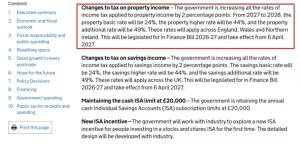
Autumn Budget 2026 confirms when the new property-income tax rates will apply and which UK nations are covered.
Is This a National Insurance Tax on Rental Income?
No. The October 2026 measure increases Income Tax rates on property income. It does not introduce a general new National Insurance charge on residential rental income.
This distinction matters because earlier discussions about a proposed National Insurance levy on landlords involved a different policy possibility.
The confirmed Budget measures instead establish higher separate rates for income from property.
Landlords should not combine speculative National Insurance proposals with the confirmed property-income increases when estimating their future tax liabilities.
Other existing tax obligations continue to apply, including Capital Gains Tax where relevant, Stamp Duty Land Tax on applicable transactions and Corporation Tax for company-held property.
The government has also abolished the former Furnished Holiday Lettings tax regime from April 2025, so owners of holiday accommodation should assess the relevant tax treatment rather than assume the previous special reliefs continue.
How Does Making Tax Digital Affect Landlords in 2027?
Another significant change for landlords is the expansion of Making Tax Digital for Income Tax.
This is separate from John Healey’s latest increase in property-income tax rates, although both changes are relevant to planning for April 2027.
Making Tax Digital requires eligible landlords and sole traders to maintain digital financial records and submit quarterly updates through compatible software.
| Start date | Qualifying annual income threshold |
| 6 April 2026 | More than £50,000 |
| 6 April 2027 | More than £30,000 |
| 6 April 2028 | More than £20,000 |
Qualifying income generally refers to combined gross income from property and self-employment before expenses, rather than taxable profit.
A landlord collecting £35,000 annually in gross rent may therefore fall within Making Tax Digital even if allowable expenses leave substantially lower taxable profits.
Existing annual tax-return and payment obligations also continue.
Although the new property-income tax rates do not independently create a new reporting requirement, landlords entering Making Tax Digital will need to comply with its separate digital record-keeping and quarterly update rules.
For investors managing multiple properties, maintaining accurate rental and expenditure records is becoming increasingly important.
What Should Landlords Do Before April 2027?
We recommend approaching the tax changes through a structured financial review rather than reacting solely to headline percentages.
A landlord should begin by estimating expected property income and allowable expenses for 2027/28.
They should then assess whether part of their rental profit will fall into a higher tax band once employment, pension or other income is considered.
Mortgage interest must be considered separately under the residential finance-cost rules.
Practical preparation includes:
- Recalculate rental profitability: Estimate post-tax returns using the 24%, 44% and 49% property-income rates where applicable.
- Review mortgage arrangements: Identify upcoming fixed-rate expiries and potential refinancing costs.
- Check allowable expenses: Ensure legitimate repairs, insurance, agent fees and other qualifying expenses are properly recorded.
- Compare ownership structures: Seek professional advice before transferring personally owned property into a limited company.
- Prepare for digital reporting: Check whether gross property and self-employment income brings you within Making Tax Digital.
- Review future investment plans: Compare expected rental yield, taxation, capital growth and disposal costs.
- Maintain sufficient cash reserves: Allow for maintenance, vacant periods, additional tax liabilities and unexpected property expenditure.
Investors should also distinguish the £1,000 annual property allowance from the new tax rates. The allowance remains available under its existing rules, but it generally cannot be combined with deductions for actual expenses against the same income.
We consider accurate cash-flow forecasting more useful than relying on a single headline tax percentage.
What Does the Crackdown Mean for First-Time Buyers?
The landlord tax increase could also influence the housing market beyond existing property investors.
If some landlords sell rental properties, additional homes may become available for owner-occupiers, including first-time buyers.
However, increased property availability does not automatically translate into greater affordability.
Buyers still face deposit requirements, mortgage affordability checks, transaction costs and differences in local house prices.
The Budget 2026 package also includes measures aimed at supporting housing development and access to homeownership.
The wider policy challenge is ensuring that the housing market can accommodate both prospective buyers and households who need to rent.
A reduction in landlord demand could benefit some purchasers while increasing competition among renters, depending on local market conditions.
From an investment perspective, we expect regional differences to matter considerably. Highly mortgaged landlords in expensive markets may respond differently from investors owning debt-free properties in areas with lower purchase prices.
Is Property Investment Still Worth It After the John Healey Tax Crackdown?
Property investment remains potentially profitable, but the higher Income Tax rates reduce the attractiveness of some personally owned buy-to-let arrangements.
A debt-free landlord with relatively low operating expenses may continue to generate satisfactory after-tax returns.
Conversely, an investor with high mortgage costs, extensive maintenance liabilities and income already falling into the higher tax band may experience a much greater reduction in available cash.
The key comparison should be between net investment returns after all relevant expenses and taxes, rather than gross rental yield.
For example, a property advertised as producing an 8% gross rental yield may generate a substantially lower net yield once financing, insurance, maintenance, management costs, vacancies and taxation are considered.
Investors must also account for potential capital appreciation, disposal costs and the risks associated with property prices.
Our overall assessment is that the tax crackdown makes financial planning and ownership structure increasingly important, particularly for landlords managing multiple properties.
It does not automatically make every rental investment unprofitable, but it reduces the margin for error where returns are already weak.
Conclusion: What Happens Next for UK Landlords?
The John Healey landlord tax crackdown marks a significant change in how personal rental income is set to be taxed in Britain.
From 6 April 2027, the planned property-income tax rates will rise to 24%, 44% and 49%, four percentage points above the equivalent main rates currently applicable to rental income.
The additional tax revenue is intended to support government finances, but the policy has also raised concerns about landlord profitability, future investment and rental affordability.
Our analysis indicates that the consequences will be most noticeable for landlords with substantial taxable rental profits, high mortgage costs or limited financial flexibility.
The actual effect on rental supply and tenant prices remains uncertain and will become clearer after implementation.
For now, landlords should review their expected tax liabilities, ensure they understand the mortgage-interest rules and make decisions based on their complete financial position.
The new rates have been announced, but their final implementation depends on the relevant legislation being enacted.
Frequently Asked Questions
When will John Healey’s landlord tax increase start?
The new property-income tax rates are scheduled to take effect from 6 April 2027, applying to the 2027/28 tax year.
What are the new landlord tax rates for 2027?
The planned rates are 24% for basic-rate taxpayers, 44% for higher-rate taxpayers and 49% for additional-rate taxpayers.
Will landlords pay 49% tax on all rental income?
No. The 49% rate applies to taxable property income falling within the additional-rate band, not automatically to all gross rent collected.
Will tenants pay more rent because of the tax crackdown?
Some landlords may seek higher rents, but the outcome depends on demand, local market conditions, tenancy rules and landlord decisions.
Can landlords avoid the higher personal rates by using a limited company?
Company-held rental profits generally fall under Corporation Tax rather than personal property-income tax. However, transfer expenses and further taxation can make incorporation unsuitable for some landlords.
Is the landlord tax increase already law?
The additional two-percentage-point increase was announced in October 2026 and is intended to be legislated through Finance Bill 2026–27.