
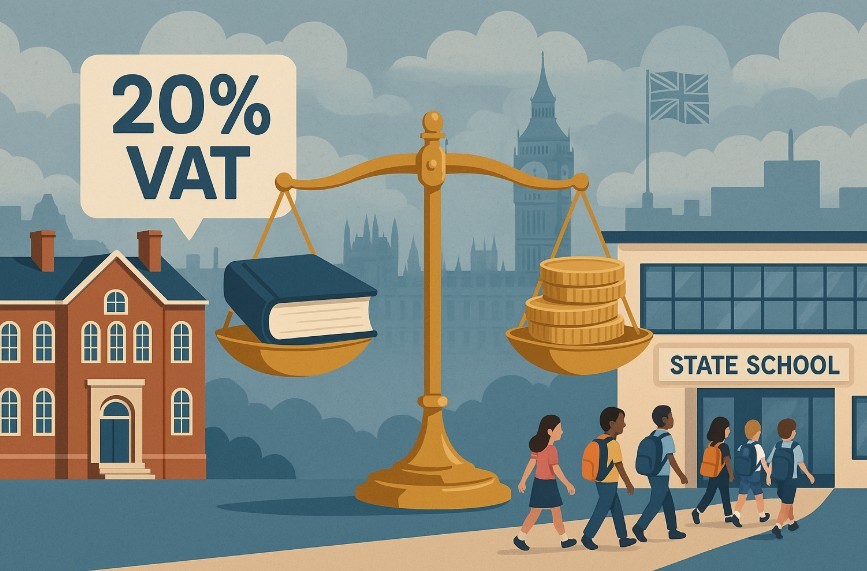
VAT on private school fees has now been in force across the UK since 1 January 2025, meaning most fee-charging private education and boarding services are subject to the standard 20% VAT rate.
The measure followed Labour’s 2024 general election manifesto commitment, was formally announced by the government on 29 July 2024, confirmed at the Autumn Budget on 30 October 2024 and subsequently enacted through sections 47 to 49 of the Finance Act 2025.
It was not introduced in the 2024 Spring Budget, as previously stated. More than a year after implementation, the debate has moved beyond predictions.
Department for Education figures published in June 2026 show that the number of pupils in independent schools in England fell by 3.8% to around 560,300 in 2025/26, although demographic changes are also affecting pupil numbers across the wider school system.
The policy has also survived challenges in both the High Court and Court of Appeal. However, the legal dispute is not over. The Supreme Court has granted permission for a further appeal, with a hearing scheduled for 1 and 2 December 2026.
Here is what parents, schools and policymakers need to know about how private school VAT operates in 2026, its financial impact and what could happen next.
What Is VAT on Private School Fees?
When Did the UK Government Introduce VAT on Private Education?
As of 1 January 2025, the UK government has implemented a 20% Value Added Tax (VAT) on private school fees across England, Wales, Scotland, and Northern Ireland.
This VAT applies to both tuition and boarding charges, creating a substantial financial adjustment for families relying on independent education.
The policy was not introduced in the 2024 Spring Budget. Labour pledged to remove the VAT exemption for private school fees in its 2024 general election manifesto.
After winning the election, the government announced the policy on 29 July 2024, before Chancellor Rachel Reeves confirmed it in the Autumn Budget on 30 October 2024.
The change was subsequently enacted through sections 47 to 49 of the Finance Act 2025. From 1 January 2025, education, vocational training and boarding provided for a charge by private schools became subject to VAT at the standard 20% rate.
What is the Cut-off Date for VAT-free School Fee Payments?
Payments made on or after 29 July 2024 for school terms beginning on or after 1 January 2025 were brought within special anti-forestalling VAT rules.
Payments received before 29 July 2024 are treated according to the terms of the individual agreement and normal VAT tax-point rules, so they should not simply be described as automatically VAT-free.
This condition was introduced to prevent institutions from encouraging large-scale fee prepayments, which could result in revenue shortfalls for HMRC.
Why Has the UK Government Introduced VAT on Private School Fees?

What Are the Financial Goals Behind This Policy?
The primary aim is to generate revenue for the public sector, particularly state schools, which educate around 90% of UK children.
The original government costing did not forecast £1.725 billion every year from implementation. It estimated receipts of around £1.505 billion in 2025/26, £1.56 billion in 2026/27 and £1.725 billion by 2029/30.
The Office for Budget Responsibility subsequently revised the expected yield upwards by an average of around £40 million per year in its November 2025 forecast because of updated assumptions about fee growth. The OBR continues to regard changes in private-school pupil numbers as one of the biggest uncertainties surrounding the forecast.
In the words of the Chancellor, this is about “redirecting public benefit to where it’s most needed” a clear statement that independent schools no longer qualify for state-sponsored tax reliefs in today’s education model.
What Other Financial Advantages Are Being Removed From Private Schools?
Alongside VAT, private schools with charitable status in England lost eligibility for charitable business-rates relief from April 2025. This is separate from the UK-wide VAT change and should not be described as an identical business-rates measure applying across all four UK nations.
How Will VAT on Private School Fees Financially Impact Families and Schools?
Will the Cost of Private Education Rise by 20%?
A 20% VAT rate does not necessarily mean parents’ bills rise by exactly 20%. Schools can reclaim VAT on eligible business costs, which reduces the effective tax burden.
The government’s original modelling estimated that VAT liability after input-tax recovery would average around 15% of fee income, although the figure varies between schools.
The OBR initially estimated an effective VAT rate of about 15.4% and expected schools to respond through a combination of higher fees, reduced expenditure and efficiency savings rather than simply adding the full 20% to every parent’s bill.
For example, a £15,000 yearly tuition fee could rise to approximately £16,500–£18,000, depending on the school’s financial strategy and location. For a quick estimate of how VAT might affect your child’s school fees, try our VAT Calculator.
How Will Middle-income Families Be Affected?
This policy disproportionately impacts middle-income families, many of whom already stretch their budgets to afford private schooling due to specific academic, social, or pastoral needs.
According to legal testimony in the High Court, about 25% of affected families fall below the national average wealth line, challenging the notion that private education is exclusively for the affluent elite.
These families are often those living in areas with underperforming state schools or those who have children with special educational needs that state schools struggle to accommodate.
Will Private Schools Reduce Bursaries or Scholarships?
Bursaries and scholarships, key tools for widening access to private education are under pressure. Many schools are reassessing their aid programmes, with some institutions reportedly scaling back awards to cover their new tax liabilities.
This could reduce the socio-economic diversity of school communities and create an even more exclusive private sector.
How Does the New VAT Policy Affect Pupils with SEND and Those in Faith Schools?

Having an EHCP does not by itself make private school fees VAT-free.
Where a private school is named in a pupil’s EHCP and the local authority funds the placement, VAT is charged on the fees, but the local authority can generally reclaim that VAT. The practical effect is therefore different from a privately funded placement.
Where parents independently choose and fund a private school, including cases where a child has SEND or an EHCP but the local authority is not responsible for funding that placement, the school fees remain subject to the normal VAT rules. Parents themselves do not gain a right to reclaim VAT simply because their child has SEND.
How Are Religious Families Affected by the Policy?
Religious communities, especially those for whom faith schooling is integral are also affected. In areas where faith-based state schools are unavailable, families rely on independent faith schools, which are now subject to VAT. Critics argue this infringes on religious freedom, especially where alternatives are lacking.
What Is the Latest Legal Position on VAT on Private School Fees?
Legal challenges were brought against the legislation by families, pupils and private faith schools, arguing that imposing VAT without exemptions for certain low-cost religious schools was incompatible with rights protected by the European Convention on Human Rights.
The Divisional Court considered the challenges in 2025 and dismissed the substantive claims on 13 June 2025. The claimants then appealed.
On 27 February 2026, the Court of Appeal also dismissed the appeals in BYL and another v Chancellor of the Exchequer and others.
The court concluded that the government’s decision not to create an exemption for low-cost schools was justified and that the VAT provisions were compatible with the Convention rights relied upon in the case.
However, that is not the final stage of the litigation. On 22 May 2026, the Supreme Court granted permission to appeal. The linked cases involving BYL and Emmanuel School are currently scheduled to be heard on 1 and 2 December 2026.
Until the Supreme Court decides otherwise, the VAT rules remain in force.
Could VAT on Private School Fees Lead to a Shift Towards State Education?

Will Parents Move Their Children Into the State Sector?
The government’s long-term modelling expects around 35,000 fewer pupils in private education, with most of the adjustment taking place gradually and often at natural transition points rather than through pupils leaving schools immediately.
The OBR continues to use a long-term reduction of roughly 6% in private-school pupil numbers. There is now some real-world evidence of contraction.
Department for Education figures show that independent-school enrolment in England fell 3.8% to around 560,300 pupils in 2025/26, the second consecutive annual decline.
However, the DfE also notes that falling birth rates and wider demographic changes are reducing pupil numbers across other school types, so the entire decline cannot automatically be attributed to VAT.
Do State Schools Have the Capacity to Take in More Students?
Government statistics from 2024 show:
- 83% of primary schools had one or more unfilled places
- 77% of secondary schools reported similar figures
While this suggests that national capacity exists, local conditions vary. Urban schools and specialist academies may not be able to handle sudden increases without hiring more staff, expanding buildings, or investing in additional support.
How Can Parents and Schools Prepare for the VAT Changes?
What Should Parents Know About Prepayments and VAT?
Families should seek clarification from their school’s finance office about prepayment options. While some may still offer payment plans or locked rates, the 29 July 2024 cut-off limits tax avoidance. Understanding VAT-inclusive pricing is essential for budget forecasting.
What Are Schools Doing to Manage the Transition?
Schools have taken various measures, including:
- VAT registration with HMRC
- Updating billing systems and contracts
- Conducting financial audits
- Increasing transparency with parents through newsletters and webinars
Some schools are also considering outsourcing services, cutting extracurriculars, or restructuring class sizes to optimise their finances.
How Do Private School Fees Compare Before and After VAT?
| Situation | VAT Treatment in 2026 |
|---|---|
| Private Day School | Education fees generally subject to 20% VAT |
| Private Boarding School | Education and qualifying boarding charges generally subject to 20% VAT |
| LA-funded Private SEND Placement | VAT charged, but local authority can generally reclaim it |
| Parent-funded SEND Placement | Normal private-school VAT rules apply |
| Qualifying Nursery Class | Can remain VAT-exempt where wholly or almost wholly made up of children below compulsory school age |
HMRC confirms that nursery classes which are wholly or almost wholly made up of children below compulsory school age remain VAT-exempt. This means your existing FAQ suggesting exemption depends on participation in the free early-education funding scheme should also be removed.
Conclusion
VAT on private school fees is no longer a newly announced policy. As of 2026, it has been operating for more than a year, with private education and boarding generally subject to the standard 20% VAT rate from 1 January 2025.
The financial effect varies between schools because institutions can recover VAT on eligible costs and decide how much of the remaining burden to absorb or pass on through fees.
Meanwhile, official figures show that independent-school pupil numbers in England declined by 3.8% in 2025/26, although demographic changes mean VAT cannot automatically be treated as the sole cause.
Parents of children with SEND should also be careful about claims of blanket exemptions. An EHCP does not automatically remove VAT. The important distinction is whether the local authority is funding the private placement, in which case the authority can generally reclaim the VAT it pays.
The biggest issue still unresolved in 2026 is legal rather than administrative. Both the High Court and Court of Appeal have upheld the policy, but the Supreme Court has granted a further appeal scheduled for December 2026. Until that case is determined, the current VAT regime remains fully in effect.