

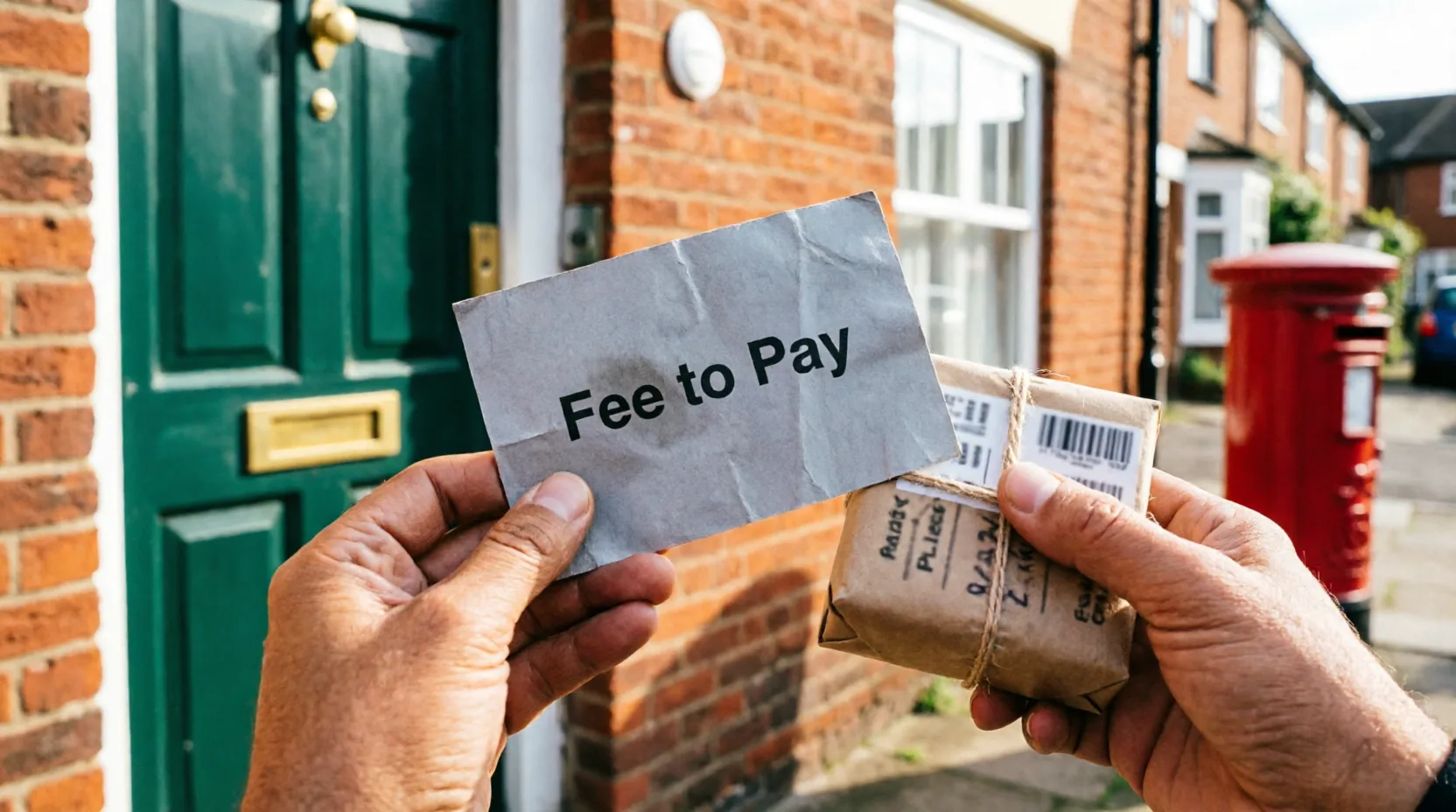
Receiving a grey Royal Mail Fee to Pay card when you are not expecting anything can be confusing. The card tells you that money is due before an item can be released, but it does not normally tell you clearly who sent the parcel or letter.
So, can you find out who the sender is before paying?
Usually, the sender’s full name cannot be identified from the Fee to Pay card alone. However, you can often narrow it down by checking recent orders and tracking references, asking Royal Mail at the delivery office, and examining the outside of the item if staff are able to show it to you.
More importantly, you are not required to pay simply because a Fee to Pay card has arrived. If you do not recognise the item or the charge does not make economic sense, you can choose not to pay and allow Royal Mail to deal with the undelivered item according to its retention and return procedures.
This guide explains exactly what a Royal Mail Fee to Pay card means, how to identify the likely sender, what the charges are in 2026, how to check whether the notice is genuine and what online sellers should do to avoid creating these charges for their customers.
What Does a Royal Mail Fee to Pay Card Mean?
A Fee to Pay card means Royal Mail is holding or processing an item addressed to you but some form of payment is required before it can be released.
The most common reasons are:
- The sender paid insufficient postage
- No valid postage was paid
- A counterfeit stamp was detected
- A non-barcoded stamp was used
- The parcel exceeded the permitted size or weight
- Import VAT or Customs Duty is due
- A Royal Mail or Parcelforce customs handling fee applies
Royal Mail confirms that where insufficient postage has been paid, the recipient may be asked to pay the shortfall together with the applicable surcharge before receiving the item.
That does not necessarily mean you personally caused the problem.
For domestic mail, it will often be the sender who selected the wrong postage, underestimated the parcel’s size or weight, or used an invalid stamp.
For an international purchase, the amount may instead relate to legitimate customs charges arising when goods enter the UK.
Royal Mail Fee to Pay: Who Is the Sender?
The frustrating answer is that Royal Mail’s Fee to Pay card does not normally identify the sender in full.
The card exists primarily to tell you:
- Why an item could not be released
- How much is due
- The relevant payment/reference details
- What you need to do next
The sender’s identity may only become obvious once you see or receive the actual item.
However, there are several ways to investigate before deciding whether to pay.
1. Check Your Recent Orders
Start with purchases made during the previous few weeks.
Look through:
- Amazon and eBay orders
- Etsy purchases
- Vinted transactions
- Retailer accounts
- PayPal transactions
- Bank and credit-card statements
- Email order confirmations
- Subscription deliveries
- Replacement or warranty orders
Do not assume the parcel will display the same company name you recognise from your order.
Retailers frequently use:
- Fulfilment centres
- Marketplace sellers
- Third-party warehouses
- Parent companies
- Logistics companies
- Overseas export companies
A name or origin that initially appears unfamiliar may therefore still relate to a genuine purchase.
Marketplace sellers should be particularly careful to follow the shipping method provided for individual orders. Problems caused by selecting the wrong parcel service or label can affect both tracking and the customer’s transaction. This is also relevant to people selling on Vinted in the UK.
2. Check Any Tracking Information
If the notice contains a trackable reference, enter it by independently visiting Royal Mail’s official tracking service.
Tracking may reveal clues such as:
- When Royal Mail received the parcel
- Whether it originated internationally
- Which stage of the network it has reached
- Whether its movements correspond with an order you are expecting
Tracking will not necessarily display the sender’s name.
A Royal Mail processing centre or parcel hub appearing in tracking information is also not necessarily the sender. It may simply be one of the facilities through which the parcel travelled.
3. Visit the Delivery Office
If the sender still cannot be identified, the local Royal Mail delivery office may be your most useful option.
Royal Mail confirms that customers collecting retained mail should normally bring the Fee to Pay card together with acceptable identification.
You can ask staff whether any additional information is available about the item.
There are also longstanding customer reports of delivery offices allowing recipients to look at the outside of an item before deciding whether to pay.
A recent UK Business Forums discussion from April 2026 similarly reported that a recipient could visit the delivery office to view a letter but could not open it before payment.
However, this should not be presented as an automatic right.
Royal Mail does not currently publish a universal guarantee that every delivery office must show an item before payment. Whether staff can do so may depend on the item, local arrangements and security requirements.
You should not expect to be allowed to open the parcel or letter before paying.
What Information Is on a Fee to Pay Card?
Exact layouts can change, but a genuine Royal Mail Fee to Pay notification will normally provide enough information to identify the payment request.
Typical information includes:
| Card field | What it tells you |
| Reason for charge | Why Royal Mail requires payment |
| Amount due | The amount required before release |
| Reference details | Used to identify the retained item/payment |
| Barcode | May be used by the payment system |
| Recipient/address information | Connects the card with the delivery |
| Payment instructions | Explains what to do next |
An older official Royal Mail Fee to Pay card also showed tick boxes distinguishing a customs charge from a situation where the sender did not pay the full postage.
One thing you should not rely upon is a claim that every legitimate Royal Mail Fee to Pay reference must contain a particular number of digits or characters.
Card designs, Royal Mail products and Parcelforce notifications can vary.
Therefore:
Reference-number format alone is not a reliable authenticity check.
Verify the notice independently through Royal Mail instead.
How Much Is a Royal Mail Fee to Pay in 2026?
Royal Mail’s current Fee to Pay page publishes different charges depending on the size of the item and why the postage was considered invalid or insufficient.
The following charges were displayed when checked on 9 September 2026:
| Item/reason | Current Royal Mail charge |
| Letter/Large Letter – no postage or counterfeit stamp | £5.00 |
| Letter/Large Letter – insufficient postage | £1.50 |
| Letter/Large Letter – non-barcoded stamp | £2.50 |
| Small Parcel – no postage or counterfeit stamp | £7.00 |
| Small Parcel – insufficient postage | £3.50 |
| Small Parcel – non-barcoded stamp | £3.50 |
| Medium Parcel | £1.50 plus incremental postage, rounded to the nearest 10p |
| Medium Parcel over 61cm × 46cm × 46cm and/or 20kg | £10.00 fee |
| Royal Mail customs handling | £8.00 |
| Parcelforce customs handling | £12.00 |
| Goods over £900 requiring full customs declaration | £25.00 handling fee |
These are Royal Mail’s published current charges and should be checked again before publication if the article is updated later.
The final amount for an international parcel can be considerably higher because import VAT or Customs Duty may be added separately.
Royal Mail explains that customs charges are assessed by Border Force on behalf of HMRC. Royal Mail can pay the applicable import VAT and Customs Duty before recovering the amount from the recipient, together with the relevant handling charge.
Should You Actually Pay the Royal Mail Fee?
Not necessarily.
Use the following decision process.
Are you expecting a parcel?
Yes → Compare the Fee to Pay notice with recent orders and tracking numbers.
No → Investigate the sender before paying.
↓
Does the tracking or timing match an order?
Yes → The charge may be legitimate. Check why the fee was applied.
No → Ask other members of the household and consider visiting the delivery office.
↓
Is it an international purchase?
Yes → Customs VAT, duty or handling charges may legitimately be due.
No → The sender may have underpaid the postage.
↓
Is the item worth more to you than the charge?
For example, paying £1.50 to release an important £100 purchase is very different from paying £7 for an unsolicited letter or low-value item you do not recognise.
↓
Does anything about the notice look suspicious?
If yes, do not use the payment link you received. Navigate independently to Royal Mail’s website and verify the information.
Still have no idea what the item is?
You can choose not to pay.
Paying the charge is essentially the practical requirement for having the retained item released. It does not mean an unknown recipient must automatically pay every charge presented to them.
Is a Royal Mail Fee to Pay Card a Scam?
A genuine grey Fee to Pay card is part of Royal Mail’s normal process.
However, Royal Mail is frequently impersonated by phishing campaigns that claim a small delivery charge must be paid.
Royal Mail’s security guidance makes an important distinction.
For ordinary underpaid postage, Royal Mail says it would notify customers by leaving a grey Fee to Pay card and would not request the payment by email or text.
Customs charges are different.
Royal Mail says it may send an email or SMS where a customs fee is due, but it will also leave a grey Fee to Pay card. Any payment link in that customs message should direct the customer to Royal Mail’s Fee to Pay service.
Genuine Fee to Pay Checklist
Before paying:
- Check whether a physical grey Fee to Pay card was delivered.
- Confirm the amount and reason shown on it.
- Do not search for a random payment website.
- Navigate independently to Royal Mail’s official Fee to Pay service.
- Check tracking independently where a tracking reference exists.
- Never send passwords or bank security information by email or SMS.
- Check that any page collecting payment is genuinely operated by Royal Mail.
Royal Mail explicitly states that it will never ask customers to send account details or passwords by email and will not ask customers to enter information on a page that is not part of Royal Mail.
Red Flags That Suggest a Scam
Be especially cautious if a message:
- Arrives only by text for an alleged domestic postage shortfall
- Uses an unfamiliar website
- Claims immediate payment is required within minutes
- Requests your banking password
- Asks for an unusually small “redelivery fee” through a shortened URL
- Requests cryptocurrency or money transfer
- Contains an attachment asking you to log in
- Asks for unnecessary identity or financial information
Royal Mail publishes examples of phishing messages falsely claiming that fees such as £1, £2.99 or £3.95 are required to release parcels.
How Do You Report a Fake Royal Mail Fee Message?

Royal Mail asks customers to report suspicious emails, texts, calls and fraudulent Royal Mail-branded websites to its scam-reporting team.
Its current security advice also states that spam texts can be forwarded to 7726 free of charge.
If personal or banking information has already been entered into a fraudulent website, Royal Mail recommends reporting the incident to Action Fraud. In Scotland, Police Scotland should be contacted where applicable.
The most important immediate action is to contact your bank if card or banking credentials may have been compromised.
How Do You Pay a Genuine Royal Mail Fee to Pay Charge?
Royal Mail currently says customers should have:
- The details from the Fee to Pay card, letter, SMS or email notification
- A UK credit or debit card, or
- PayPal
The official page then allows customers to pay the charge and arrange delivery where applicable.
Customers who need to collect an item should follow the instructions on their specific card because collection and identification requirements can vary.
For businesses that depend on postal services, knowing the wider pattern of Royal Mail delivery times in the UK can also help when dealing with retained items, delayed parcels and customer enquiries.
What If the Royal Mail Fee to Pay Barcode Does Not Work?
This is particularly important in 2026.
As of 9 September 2026, Royal Mail’s own Fee to Pay page carries an active notice explaining that a small number of Parcelforce customers with customs charges may find that the barcode on their Fee to Pay card or letter is not recognised.
Royal Mail’s current workaround is:
- Choose Customs Charge.
- Select Enter Card Details in red under the section headed Don’t have a barcode number.
- Manually enter the requested information and continue with payment.
This notice is currently displayed directly on Royal Mail’s Fee to Pay page.
That means a barcode error does not automatically prove a Fee to Pay card is fake.
At the same time, do not use an alternative payment website simply because the barcode fails. Use Royal Mail’s published workaround on its official site.
What Happens If You Don’t Pay the Royal Mail Fee?
If the charge relates to underpaid postage and you decide you do not want the item, you can simply decline to pay.
Royal Mail states that when incorrect postage is used and the recipient does not pay, the item can be returned to the sender if a return address is available, or retained for a limited period.
Royal Mail’s current general redelivery information says items are normally held for 18 calendar days before being returned to the sender.
Older Royal Mail Fee to Pay cards gave a more specific distinction:
- Underpaid items – 18 calendar days
- Customs items – 21 calendar days
However, Royal Mail’s current public Fee to Pay webpage does not presently repeat that separate 21-day customs period. Therefore, the deadline printed on your current card or notification should take priority, particularly for customs parcels.
If Royal Mail cannot identify or locate the sender, different return-handling procedures may apply.
Can You Refuse a Royal Mail Fee to Pay Item?
Yes, in practical terms you can choose not to pay for the item.
You do not need to hand Royal Mail money merely because someone sent something to your address with insufficient postage.
If you do nothing, the retained item will eventually proceed through Royal Mail’s return or undeliverable-mail process.
This may be the sensible option where:
- You did not order anything
- Nobody you know sent anything
- The item appears to have been sent to you accidentally
- The fee exceeds the likely value of the contents
- You do not want the item
If it relates to a purchase you have already paid for, however, contact the seller before simply abandoning it.
Who Is Legally Responsible for an Underpaid Ecommerce Parcel?
There are two different questions here.
Who must pay Royal Mail to release the parcel?
Operationally, Royal Mail may require the recipient to pay the Fee to Pay charge before the item is released.
Who is responsible for delivering an online purchase properly?
Where a consumer buys goods from a UK business, the retailer is generally responsible for getting those goods to the customer.
Citizens Advice states that where a business uses a courier, the seller remains responsible for ensuring the order is delivered, rather than passing the delivery problem to the customer.
Therefore, if a retailer sends a £50 product but accidentally underpays the postage and the customer receives a £3.50 Fee to Pay card, the business should not simply tell the customer that the surcharge is their problem.
The customer should contact the retailer.
Depending on the circumstances, the practical options may include:
- The retailer reimbursing the charge
- The retailer arranging another delivery
- The parcel being returned before a replacement is sent
- A refund where the order ultimately cannot be delivered
Different considerations apply to import VAT and Customs Duty where the customer agreed to buy goods on terms making those import charges their responsibility.
They should not be confused with a retailer simply failing to buy sufficient UK postage.
What About Underpaid Returns?
Returns can become more complicated.
Suppose a customer returns an ecommerce purchase but uses insufficient postage.
Royal Mail may require the business receiving the return to pay before the parcel is released.
Who ultimately bears that cost depends on the return arrangement.
Seller Provided the Return Label
If the retailer supplied a valid prepaid return label and the customer correctly followed the instructions, an underpayment problem may need to be resolved by the retailer or its delivery provider.
Customer Bought Their Own Postage
Where a customer was responsible for arranging the return and selected insufficient postage, the seller may have a stronger basis for expecting the customer to resolve any additional cost, subject to the retailer’s terms and applicable consumer law.
Marketplace Transaction
Marketplace rules may determine:
- Which shipping method must be used
- Who pays for returns
- Whether a prepaid label is provided
- What happens if tracking fails
- How disputes are resolved
Keep the original label, postage receipt, tracking information and photographs until any return dispute is fully resolved.
How Can Small Businesses Avoid Causing Fee to Pay Charges?
For startups and ecommerce businesses, a Fee to Pay card is not just a minor postage problem.
It can become a customer-experience problem.
Imagine a customer orders a £12 product and then receives a Royal Mail notice demanding an additional £3.50 before it will be delivered.
Even if the mistake was accidental, the customer may conclude that:
- The business has charged hidden delivery fees
- The company is unprofessional
- The parcel is a scam
- Their order has been delayed
- They should request a refund
Businesses therefore need reliable shipping controls.
Weigh the Fully Packaged Parcel
Do not weigh only the product.
The final weight includes:
- Product
- Box or mailing bag
- Protective material
- Inserts
- Tape
- Labels
- Promotional material
A parcel that appears comfortably below a weight threshold before packing may move into another category once fully prepared.
Measure the Package Properly
Size limits matter as well as weight.
Royal Mail currently specifies a £10 fee where a Medium Parcel exceeds 61cm × 46cm × 46cm and/or 20kg, with packaging included in the measurements.
Use Current Barcoded Stamps
Royal Mail says ordinary non-barcoded stamps stopped being valid for postage in July 2023, although eligible stamps can be exchanged through the Stamp Swap Out scheme.
Businesses should remove old non-barcoded stamp stock from normal dispatch workflows.
Consider Online Postage or Click & Drop
Royal Mail provides online postage options including Click & Drop, with online prices available separately from Post Office counter pricing.
For a growing ecommerce business, systematic label generation can reduce errors compared with manually estimating postage for every parcel.
More broadly, founders planning their logistics operations should treat fulfilment as part of the business model rather than an afterthought. That includes carrier selection, packaging, shipping costs and customer communication when starting an ecommerce business in the UK.
Add a Return Address
A return address makes it easier for an undeliverable or unpaid item to find its way back to the business rather than entering a more complicated undeliverable-mail process.
Keep Proof of Postage
Maintain records showing:
- Service purchased
- Parcel weight
- Date sent
- Tracking number
- Postage price
- Customer address
For higher-volume sellers, retaining dispatch information digitally makes investigating customer complaints considerably easier.
What Should a Business Do If a Customer Receives a Fee to Pay Card?
Do not immediately assume the customer is mistaken.
Ask them to provide a photograph of the Fee to Pay card with sensitive payment details obscured where appropriate.
Then check:
- The customer’s order number
- The tracking reference
- The postal service purchased
- The recorded parcel weight
- The dimensions
- The label used
- Whether the item was a return
- Whether customs charges are legitimately involved
If your business genuinely underpaid the postage, resolve the issue quickly rather than expecting the customer to absorb the cost.
A £1.50 or £3.50 postage mistake can become far more expensive if it leads to:
- A refund
- A replacement shipment
- A payment dispute
- A marketplace claim
- A negative review
- Lost repeat business
- Customer-support time
For startups, accurate postage is therefore part of customer retention, not simply warehouse administration.
Frequently Asked Questions
How do I find out who sent a Royal Mail parcel with a Fee to Pay?
The Fee to Pay card normally does not identify the sender in full. Check recent orders and tracking details, ask other members of the household and contact or visit the Royal Mail delivery office if the sender remains unclear.
Can Royal Mail tell me who the sender is?
Royal Mail may have additional information about the item, but it cannot be assumed that staff can always disclose or identify the sender. Visiting the delivery office may provide more clues than the Fee to Pay card itself.
Can I see the parcel before paying?
Some customers report being allowed to view the outside of an item at a delivery office before deciding whether to pay. However, Royal Mail does not publish this as a universal right, and you should not expect to be permitted to open the item before payment.
Can I refuse to pay Royal Mail’s Fee to Pay charge?
Yes. If you do not want the item, you can choose not to pay. Royal Mail states that unpaid items can eventually be returned to the sender where possible.
How long does Royal Mail keep a Fee to Pay parcel?
Royal Mail’s current general retention information states that items are normally held for 18 calendar days before being returned. Older Fee to Pay cards specified 21 days for customs items, so always follow the deadline shown on your current notification.
Why did I get a Fee to Pay card when I already paid delivery?
The retailer or sender may have bought insufficient postage, selected the wrong size or weight category, used invalid postage or made an error when preparing the parcel. Alternatively, the charge may relate to customs rather than the original delivery price.
Is Royal Mail Fee to Pay genuine?
Yes, Royal Mail genuinely uses grey Fee to Pay cards. However, scammers impersonate Royal Mail, so verify payment independently through Royal Mail’s official website rather than relying on unsolicited links.
Does Royal Mail text about Fee to Pay?
Royal Mail says it does not request payment by email or text for an ordinary underpaid-postage surcharge. Customs charges are an exception: Royal Mail may send an SMS or email where customs fees are due, but says it will also leave a grey Fee to Pay card.