

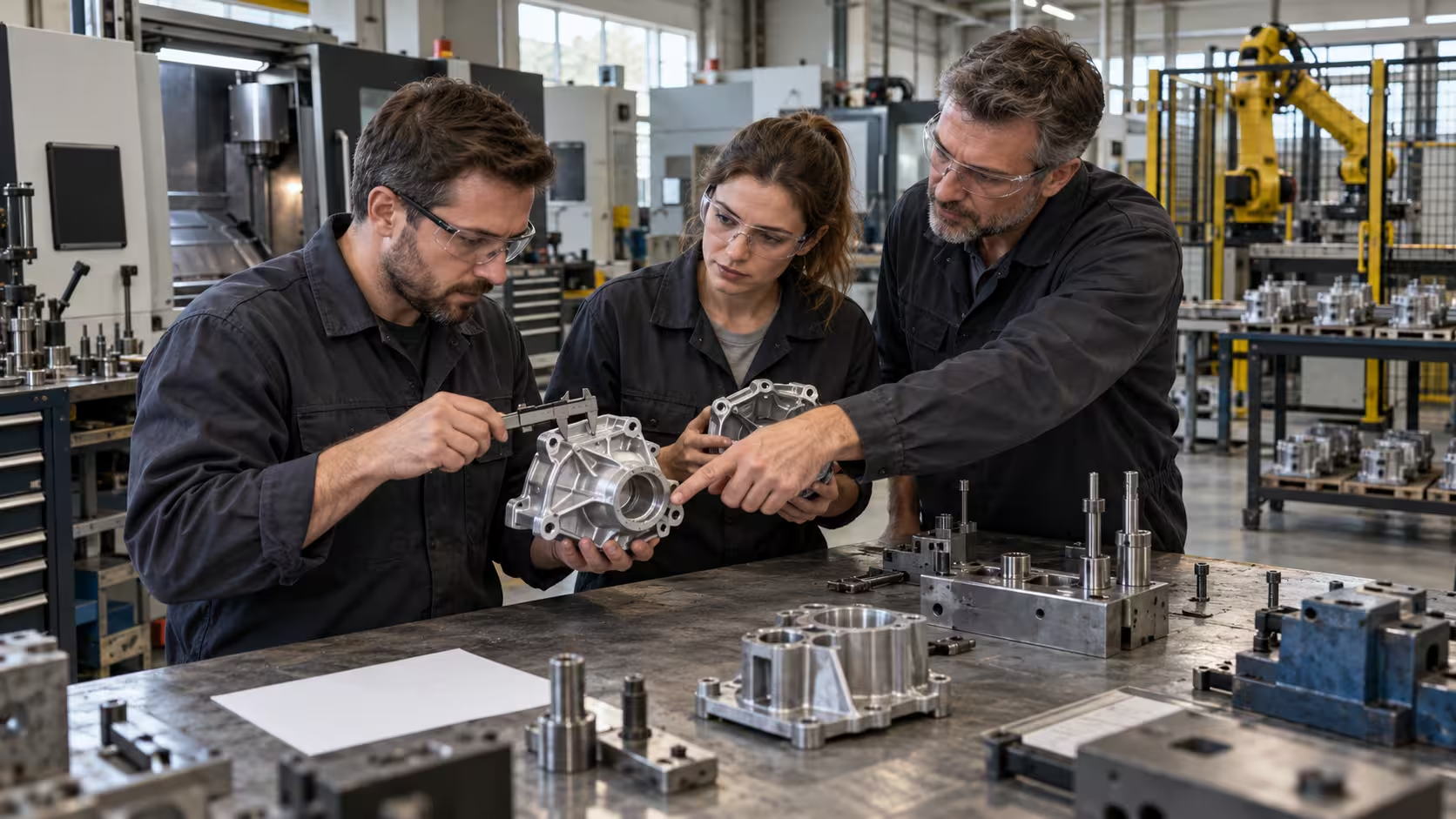
Early-stage hardware companies often face a difficult manufacturing decision long before demand becomes predictable. Building internally can provide tighter control over process knowledge, schedules, and product changes.
Outsourcing can reduce capital requirements and give a startup access to equipment, specialists, and supplier networks that would take years to build.
A company developing metal components, for example, may use a CNC machining service for prototypes and early production instead of purchasing machines, hiring operators, and creating its own inspection program.
The right model depends on the product, expected volume, tolerance requirements, available cash, technical talent, and how often the design is still changing.
Startups rarely need to treat the decision as permanent. Many companies outsource early production, keep sensitive engineering work inside, and bring selected processes in-house only after volumes and process requirements become more predictable.
Start With the Process, Not the Company Structure
Founders sometimes frame manufacturing as a simple choice between owning production and hiring someone else to do it. The more useful question is which processes the company can realistically perform well at its current stage.
A product may require machining, molding, sheet metal work, electronics assembly, surface finishing, testing, packaging, and final assembly.
Owning every step would require very different equipment, skills, safety procedures, maintenance programs, and quality controls. Even well-funded startups can struggle to support that range efficiently.
Map each manufacturing step before deciding where it should happen. Identify expensive equipment, specialized skills, inspection requirements, expected cycle times, and likely production volumes.
Processes that require costly machinery or deep specialist knowledge are often stronger candidates for outside production during the early stages.
Keep activities in-house when they depend heavily on proprietary know-how, rapid experimentation, or unusually close engineering involvement.
Prototype assembly, test development, firmware loading, or final validation may stay internal even when suppliers produce most physical components.
In-House Manufacturing Gives Control, but Control Has a Cost
Internal production gives engineers direct access to machines, operators, tooling, and work-in-progress. That can shorten communication loops when a product changes frequently.
An engineer can inspect a part, discuss the problem with the operator, revise a drawing, and test a new version without sending files through several organizations.
That speed can be valuable for products with difficult tolerances, unusual materials, sensitive assembly steps, or processes that depend heavily on accumulated shop knowledge. Companies may also want to protect certain production methods from external suppliers.
The financial burden, however, extends far beyond buying equipment.
Machines require floor space, installation, tooling, maintenance, calibration, consumables, operators, supervisors, inspection equipment, safety procedures, and production planning. A startup also carries those costs when machines sit idle.
Utilization often becomes the deciding issue. A machine that runs only a few hours each week ties up capital without generating enough output to justify ownership.
In-house production becomes more attractive when demand is consistent enough to keep equipment productive, and the company has enough technical work to support dedicated manufacturing staff.
Outsourcing Preserves Cash and Expands Technical Reach
Contract manufacturers already own equipment, employ skilled operators, and maintain production systems for multiple customers. A startup can gain access to those resources without funding the full infrastructure itself.
This can be especially helpful during product development. Early designs change. Volumes may start at ten units, rise to several hundred, then change again after testing or customer feedback.
An external supplier can often accommodate that uncertainty more easily than a startup trying to justify permanent equipment around an unstable forecast.
Outsourcing also gives founders access to processes that would make little sense to build internally.
A single product may need laser cutting, CNC machining, anodizing, injection molding, printed circuit board assembly, and specialized testing. Using qualified suppliers allows the startup to buy each capability as needed.
The tradeoff is dependence. Supplier lead times, production queues, minimum order quantities, communication speed, and quality consistency can affect the startup’s schedule.
External production therefore requires strong drawings, clear specifications, revision control, inspection criteria, and disciplined supplier communication.
Design Changes Become the Real Test of the Manufacturing Model
Early-stage products rarely stay frozen for long. Customer feedback, testing failures, component shortages, compliance requirements, and cost targets can all trigger engineering changes.
Outsourced manufacturing works best when the startup controls its technical documentation.
Drawings, bills of materials, CAD files, tolerances, approved materials, assembly instructions, and revision records should remain organized internally.
A supplier can manufacture the product, but the startup should retain authority over what constitutes the current approved design.
Change control matters even at low volume. Sending an updated CAD file by email without revising the drawing or part number creates opportunities for confusion.
The supplier may produce from an older file, purchasing may order outdated components, or inspection may use obsolete limits.
An in-house shop can make informal changes faster, but informality creates its own risk. Teams can become dependent on undocumented knowledge held by one engineer or machinist.
If the company later transfers production to a supplier, missing process information can make that transition much harder.
Unit Cost Alone Can Produce the Wrong Decision
Founders often compare the supplier’s quoted price with the apparent cost of producing the part internally. That comparison can be misleading if it ignores equipment depreciation, labor burden, scrap, rework, setup time, inspection, floor space, maintenance, and management time.
Suppose an outsourced component costs $65 per unit while internal calculations suggest a machining cost of $40. The $25 difference may look significant.
If the internal figure excludes tooling, programming, inspection, operator downtime, rejected parts, and machine ownership, the actual cost may be much closer to the supplier quote.
Cash timing matters too. Outsourcing can require deposits, tooling charges, minimum order quantities, or purchases of material before production starts.
In-house production may require much larger initial spending on equipment and facilities. Both models affect working capital differently.
Startups should model cost at several production levels rather than relying on one forecast. Calculate what happens at 100, 1,000, and 10,000 units.
A process that makes sense externally at 100 units may become economical internally at 10,000. Another process may remain cheaper to outsource even at high volume because the supplier runs specialized equipment at much higher utilization.
Supplier Selection Matters More Than the Outsourcing Label
A weak supplier can make outsourcing look like a bad strategy when the real problem is vendor selection. Price should form only one part of the evaluation.
Start by reviewing process capability.
Can the supplier consistently hold the required tolerances? Do they work with the specified materials? What inspection equipment do they use? How do they manage nonconforming parts? How do they control revisions? Ask for sample inspection reports and, where appropriate, request a first-article inspection before releasing a larger batch.
Communication quality deserves equal attention. Early-stage companies change quickly, so a supplier that responds clearly and flags manufacturing concerns early can save substantial time. A vendor that accepts every drawing without raising questions may create bigger problems later.
Capacity also matters. A supplier may perform well on ten prototypes but struggle when demand rises to several thousand units. Discuss expected growth before the relationship begins.
Ask about normal lead times, rush capacity, second-source options, subcontracted operations, and material availability.
Intellectual property protection should match the sensitivity of the work. Use appropriate contracts and limit the information shared with each supplier where practical.
Critical assemblies may require tighter controls than standard components produced from common processes.
A Hybrid Model Often Fits Early-Stage Companies Best
Many startups get better results by dividing manufacturing responsibilities rather than choosing one model for the entire product.
External suppliers produce parts that require expensive or specialized equipment, while the startup keeps prototype assembly, testing, final calibration, or sensitive process steps internally.
This structure can preserve engineering speed without forcing the company to build a full factory too early.
Internal teams stay close to the product and can inspect supplier output, test design changes, and improve assembly methods. Suppliers handle processes where scale and specialized equipment create a clear advantage.
The balance can change as production grows. A company may bring final assembly inside once demand becomes predictable, then later add dedicated equipment for a high-volume component.
Another startup may move in the opposite direction and outsource more production after discovering that managing a factory distracts from product development and sales.
The decision should follow evidence from actual production. Track supplier lead times, defect rates, rework, engineering hours, equipment utilization, labor requirements, and cash tied up in inventory. Those numbers provide a much stronger basis for changing the manufacturing model than preference alone.
For most early-stage startups, the objective is to build a manufacturing system that can support learning without consuming resources faster than the business can support.
Outsourcing gives access to established production capability and protects capital. In-house manufacturing gives direct control and can support rapid technical work when the process demands it.
The strongest approach often combines both. Keep control of the product definition, technical documentation, supplier requirements, and quality standards inside the company.
Place each manufacturing process where it can run most reliably and economically. As volumes grow and the product stabilizes, revisit the decision with real production data rather than assumptions made during the prototype stage.