


A self-employed carer in the UK typically charges around £18 to £25 per hour for personal care, based on published 2026 private-care rates. For 2027, a working range of approximately £19 to £26 per hour is a reasonable pricing scenario for standard personal care, although actual charges will depend on location, experience, care requirements and demand.
Unlike employed care workers, independent carers negotiate their own fees and cover their operating expenses. Consequently, charging £24 per hour does not mean taking home £24.
The financial landscape is also changing. The National Living Wage increased to £12.71 in April 2026 and is set to reach £13.21 in April 2027. Although genuinely self-employed carers are not directly covered by the statutory minimum wage, these increases influence the wider care market.
Our analysis examines real booking data, operating costs, employment obligations and tax changes to establish what independent carers should consider before setting their rates for 2027.
How Much Do Self-Employed Carers Charge Per Hour in 2027?
There is no government-prescribed hourly rate for genuinely self-employed carers. Prices depend on the services provided and the agreement between the carer and client.
Private-care platform PrimeCarers reported that 70% of its hourly carers advertised rates between £18 and £20 in August 2026. Its transaction data also showed families paying an average of £21.08 per hour across 48,169 paid care hours in the 12 months to September 2026.
Carers retained an average of £17.14 per hour after the platform fee, before their own business expenses and taxes.
These figures demonstrate the distinction between the amount a family pays and the income a carer actually receives.
Self-Employed Carer Hourly Rate: 2026 vs 2027
| Type of care | Published 2026 pricing benchmarks | Illustrative 2027 rates |
| Companionship care | £15–£20/hour | £16–£21/hour |
| Standard personal care | £18–£25/hour | £19–£26/hour |
| Sleeping night care | £160–£190/night | £166–£197/night |
| Waking night care | £165–£250/night | £171–£260/night |
| Standard live-in care | £140–£160/day | £145–£166/day |
The 2026 benchmarks are based on published platform pricing. The 2027 figures illustrate an approximately 3.9% increase, broadly matching the announced National Living Wage uplift. They are not official rates or independently measured 2027 market averages.
Our assessment suggests that carers should evaluate their prices annually rather than automatically apply the same increase to every client.
For example, a carer charging £20 per hour in 2026 might consider approximately £20.80 in 2027. However, someone travelling significant distances between appointments could require a higher adjustment.
The same principle applies across other independent services, including cleaners and handymen, where customer charges must cover substantially more than labour alone.
What Changes Will Affect Carer Hourly Rates in 2027?
The most significant confirmed change is the increase in the statutory minimum wage for employees and workers aged 21 or over.
| Pay period | National Living Wage | Annual increase |
| April 2025 | £12.21 | — |
| April 2026 | £12.71 | 4.1% |
| April 2027 | £13.21 | 3.9% |
The April 2027 increase represents an additional 50p per hour for eligible workers.
For someone working 37.5 paid hours per week, that is £18.75 in additional gross weekly pay compared with the April 2026 rate.
However, it would be incorrect to describe £13.21 as the compulsory minimum hourly charge for a genuinely self-employed carer.
Independent professionals generally negotiate commercial fees, while employed carers have statutory pay rights.
Why Does This Matter for Private Care?
When agency employment costs rise, independent carers may face pressure to increase their own charges to remain financially sustainable.
Nevertheless, a higher wage benchmark does not guarantee a corresponding rise in what families can afford.
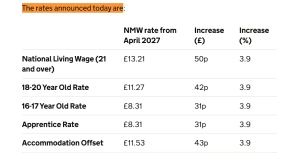
The Low Pay Commission’s official announcement confirms that the National Living Wage will rise to £13.21 per hour from April 2027, representing a 3.9% increase.
How Much Can a Self-Employed Carer Actually Earn After Expenses?
One of the biggest mistakes when calculating independent carer income is treating invoiced revenue as personal earnings.
A carer might advertise £24 per hour but receive payment for only 25 hours during a working week.
The remaining time may involve travelling, preparing care notes, contacting families, arranging appointments and completing administration.
We modelled the following scenario using 2026/27 tax rules.
| Financial calculation | Illustrative amount |
| Hourly client charge | £24 |
| Billable hours per week | 25 |
| Paid working weeks | 46 |
| Annual gross revenue | £27,600 |
| Annual allowable business expenses | £3,300 |
| Profit before personal tax | £24,300 |
| Illustrative Income Tax | £2,346 |
| Illustrative Class 4 National Insurance | £703.80 |
| Annual income after these taxes | £21,250.20 |
| Average monthly equivalent | £1,770.85 |
This example assumes a sole trader in England, Wales or Northern Ireland receiving the standard £12,570 Personal Allowance, with no other taxable income. It excludes pension contributions, student loan repayments and other adjustments. Scottish Income Tax calculations may differ.
The £3,300 expense figure is illustrative, not an industry average.
The model demonstrates that a £24 hourly charge can translate into considerably less disposable income than the advertised rate suggests.
It also highlights the importance of understanding tax-free income before setting a price.
How Can Carers Calculate a Profitable Hourly Rate?
A practical starting formula is:
Minimum hourly charge = (Desired annual pre-tax income + annual business expenses) ÷ expected annual billable hours
Suppose a carer wants £26,000 before personal taxes, expects £3,300 of business expenses and anticipates 1,150 billable hours.
The calculation becomes:
(£26,000 + £3,300) ÷ 1,150 = £25.48 per hour
This suggests that charging approximately £25.50 per hour would be necessary to achieve that particular financial target.
A smaller number of regular clients can sometimes be more profitable than numerous short appointments spread across a large geographical area.
How Much Does an Independent Carer Cost Compared With a Care Agency?
Families often compare private carers with domiciliary care agencies, but the two services do not necessarily provide equivalent administrative support, regulation or backup arrangements.
The Homecare Association calculated a minimum sustainable price of £34.42 per hour for regulated homecare providers in England for 2026/27.
Its research also found that English local authorities paid an average of £25.37 per hour for homecare contracts.
The association reported that 61% of the contracts examined had fees below the £26.17 hourly amount it calculated was necessary to cover statutory employment costs at minimum-wage pay levels.
These figures are agency operating benchmarks, not wages paid to individual carers or universal consumer prices.
| Comparison | Independent carer | Regulated care agency |
| Pricing | Negotiated with the client | Set by the provider |
| Administration | Usually managed personally | Usually managed by agency |
| Replacement cover | Must be arranged separately | May be provided under contract |
| Insurance | Carer checks appropriate cover | Provider arranges organisational cover |
| Employment costs | Depends on actual status | Agency bears employer obligations for its employees |
| Care regulation | Depends on service arrangement | Relevant regulated services require registration |
A family might choose an independent carer for continuity and a direct relationship. An agency may offer greater organisational capacity and replacement arrangements.
However, direct hiring is not automatically cheaper once insurance, administration, substitute cover and possible employer obligations are included.
Anyone planning to expand beyond individual care work should understand the cost of starting a care agency, because the regulatory and financial requirements can be substantially different.
Which Expenses Should Self-Employed Carers Include in Their Prices?
The hourly rate needs to recover the costs of delivering care safely and consistently.
Our financial analysis identifies five areas that should receive particular attention.
1. Travel and Mileage
Travelling between clients can reduce the number of billable hours available.
For the 2026/27 tax year, HMRC increased the simplified business mileage rate for eligible cars and vans from 45p to 55p for the first 10,000 business miles. The rate remains 25p for subsequent miles.
These figures represent potential tax deductions, not reimbursements from HMRC. Eligible business journeys must be distinguished from private travel and non-qualifying commuting.
Carers using vehicles should examine the wider rules around claiming vehicle expenses.
2. Insurance
Appropriate public liability, professional indemnity and specialist care-related insurance may be necessary depending on the services provided and contractual obligations.
3. Training and Safeguarding
Relevant training may include moving and handling, medication support, infection prevention, first aid and dementia awareness.
Training should match the responsibilities undertaken. A carer should not offer clinical procedures outside their competence or legal authority.
4. Unpaid Time
Holidays, illness, cancellations, quotations, record-keeping and unpaid gaps between clients all affect profitability.
5. Platform Fees
Some introductory or booking platforms deduct a percentage before paying the carer.
For example, if a platform deducted 20% from a £25 booking, the carer would receive £20 before business expenses and taxes.
The practical solution is to calculate profitability from the amount actually received rather than the customer-facing booking price.
Do Self-Employed Carers Need CQC Registration?
The answer depends on the nature of the service and how the care arrangement operates.
In England, the Care Quality Commission regulates specified activities, including certain personal care services.
However, an individual personal assistant who works directly for someone under that person’s direction and control may fall within an exemption from registration, even where the personal assistant is described as self-employed.
The position changes where someone operates a business that organises, directs or provides regulated personal care independently.
Such arrangements may require CQC registration.
Importantly, HMRC employment status and CQC registration status are separate questions. A person described as self-employed for one purpose is not necessarily self-employed for tax or employment-law purposes.
The actual contractual relationship, working practices and level of control must be examined.
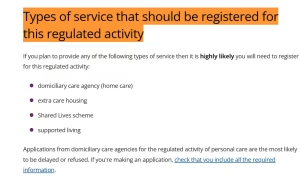
The Care Quality Commission explains when personal care services require registration and when directly engaged personal assistants can fall within an exemption.
What About DBS Checks in 2027?
A significant change took effect on 21 January 2026.
Eligible self-employed workers and personal employees can now apply for Enhanced or Enhanced with Barred List DBS checks through an authorised Umbrella Body.
This can be particularly relevant to independent carers supporting adults who need personal care.
Eligibility depends on the actual duties performed. Not every role qualifies for the same level of check.
Families should also consider references, safeguarding experience, appropriate training and a clear written care agreement.
How Will Tax and Making Tax Digital Affect Self-Employed Carers in 2027?
A genuinely self-employed carer generally reports business profits through Self Assessment when registration and filing requirements apply.
The standard £1,000 trading allowance remains relevant. Qualifying gross trading income above £1,000 generally creates a requirement to register for Self Assessment, subject to individual circumstances.
For 2026/27, Class 4 National Insurance is generally charged at 6% on profits above £12,570 up to £50,270, and 2% above that level.
Where profits reach £7,105, Class 2 contributions are generally treated as paid without a separate compulsory payment.
These are 2026/27 figures and should be checked against the applicable tax year when planning 2027/28 finances.
A further change is the expansion of Making Tax Digital for Income Tax.
From 6 April 2027, qualifying sole traders with total gross qualifying self-employment and property income above £30,000 in 2025/26 generally enter the system.
They will need compatible software for digital record-keeping and periodic reporting, subject to relevant exemptions.
Carers can explore Making Tax Digital and suitable accounting software before the change takes effect.
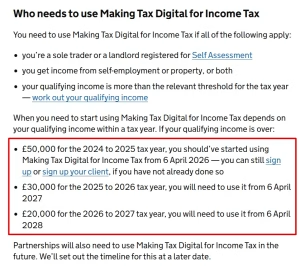
HMRC’s Making Tax Digital timetable shows the qualifying income thresholds and corresponding implementation dates, including the £30,000 threshold from April 2027.
Carers should also retain sufficient funds for tax payments. The HMRC July tax deadline illustrates how payments on account can affect a sole trader’s cash flow.
VAT requires separate consideration because certain welfare services can qualify for exemption under specific conditions. A carer should not assume that every independently supplied care service is automatically VAT-exempt.
What Should Be Included in a Private Carer’s Hourly Agreement?
A clear written agreement helps both parties understand the service and reduces the likelihood of disputes.
The agreement should specify the hourly charge, minimum visit duration, duties, travel charges, payment frequency, cancellation terms and arrangements for holidays or emergencies.
For example, a carer charging £23 per hour might require a minimum two-hour booking.
That would create a £46 minimum visit charge before any separately agreed expenses.
A two-hour appointment may be commercially sustainable where a 30-minute visit is not, particularly when travel and administrative time are considered.
It is also useful to specify which duties are excluded, how care notes are handled and what happens when a client needs more support than originally agreed.
For professionals starting a business, clear contracts and accurate records are often more valuable than competing solely on the lowest price.
How Can Independent Carers Increase Their Earnings Without Overcharging?
Higher earnings do not always require a substantial price increase.
Our assessment identifies several ways to strengthen the financial performance of an independent care service:
- Reduce travel gaps: Accept appointments within a manageable geographical area to improve billable-hour efficiency.
- Offer consistent schedules: Regular weekly arrangements can provide more predictable income.
- Review prices annually: Account for rising costs, professional development and changes in care requirements.
- Develop suitable specialisms: Relevant training can support higher-value services, provided the carer is competent and appropriately authorised.
- Establish cancellation terms: Reasonable contractual notice can reduce unexpected losses.
A carer who increases billable time from 20 to 25 hours weekly improves the potential volume of paid work by 25%, even before changing their hourly rate.
This is why efficient scheduling can have as much financial importance as increasing prices.
The same principle applies to many service businesses, including those outlined in the practical considerations for starting a cleaning business.
Final Thoughts
The appropriate self-employed carer hourly rate in 2027 depends on more than the amount competitors advertise.
Published 2026 booking data provides a starting point, while the confirmed 3.9% National Living Wage increase offers an additional commercial benchmark.
For many independent carers, the most important financial decision will be identifying a rate that covers unpaid time, travel, insurance, training and tax while remaining affordable for clients.
Rather than setting charges solely against agency prices, carers should calculate their annual income requirements, estimate realistic billable hours and establish transparent agreements.
A sustainable care business needs to protect both the quality of care and the financial security of the person providing it.
Frequently Asked Questions
What is a reasonable self-employed carer hourly rate in 2027?
Approximately £19–£26 per hour is a useful planning range for standard personal care, based on 2026 platform benchmarks and an illustrative uplift. Actual 2027 market rates will depend on location and care requirements.
Can a self-employed carer charge £30 per hour?
Yes. A genuinely self-employed carer can negotiate a £30 hourly fee. Whether clients will pay it depends on experience, care complexity, local competition and the services included.
Do self-employed carers receive holiday pay?
Genuinely self-employed carers are not ordinarily entitled to statutory paid annual leave through their clients. However, someone classified as self-employed may have employment rights if their actual working relationship gives them worker or employee status.
How much should a private carer charge for overnight care?
Published 2026 platform benchmarks include approximately £160–£190 for a sleeping night and £165–£250 for a waking night. The agreed duration, duties and overnight working arrangements are important.
Are self-employed carers cheaper than agencies?
They may be, particularly when families engage them directly. However, the comparison should include platform charges, replacement cover, insurance and any employment responsibilities.
Do self-employed carers pay National Insurance?
Yes, depending on taxable profits and the relevant tax year. For 2026/27, Class 4 contributions generally apply when annual self-employment profits exceed £12,570.