


The family business inheritance tax impact changed materially from 6 April 2026. Qualifying family businesses can still receive Business Relief, but 100% relief is no longer unlimited.
An individual now has a £2.5 million combined allowance for qualifying Business Relief and Agricultural Relief property.
Once that allowance is exhausted, qualifying value above it generally receives 50% relief, producing an effective Inheritance Tax rate of up to 20% on that excess before considering other allowances.
Unused allowance can transfer between spouses and civil partners, potentially increasing the 100% relief allowance to £5 million.
This means many smaller and medium-sized family businesses remain substantially protected, but owners of larger trading companies now need to think much more carefully about valuation, liquidity, ownership structure and succession.
The wider debate around inheritance tax changes affecting family businesses has therefore shifted from whether reform will happen to how established businesses should operate under rules that are already in force.
What Changed for Family Business Inheritance Tax From 6 April 2026?
The reform fundamentally changed the way Agricultural Relief and Business Relief interact with Inheritance Tax.
The standard IHT rate remains 40%, but qualifying business and agricultural assets receive more favourable treatment.
| Rule | Current Treatment |
| Standard Inheritance Tax rate | 40% |
| Combined 100% BPR/APR allowance | £2.5 million per individual |
| Relief above £2.5 million | 50% |
| Effective IHT rate on qualifying excess | Up to 20% |
| Transfer to spouse/civil partner | Unused allowance can transfer |
| Maximum transferred 100% allowance | Up to £5 million |
| Standard nil-rate band | £325,000 per person |
| Basic combined headline protection for a couple | £5.65 million using £5m relief allowance plus two £325,000 nil-rate bands |
| Business ownership requirement | Generally at least two years |
| IHT instalments on qualifying assets | Up to 10 annual interest-free instalments |
| Rules effective from | 6 April 2026 |
The current official Agricultural and Business Property Relief reform rules confirm both the £2.5 million allowance and 50% relief on qualifying value above it. The same framework remains in the government’s current tax tables following Budget 2026.
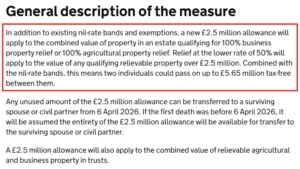
Official inheritance tax rules confirming the £2.5 million combined Business and Agricultural Relief allowance.
How Does the £2.5 Million Business Relief Allowance Affect a Family Company?
For a qualifying privately owned trading business, the first £2.5 million of value allocated to the owner’s available 100% allowance can effectively be removed from the IHT calculation through Business Relief.
Qualifying value above that allowance does not suddenly become fully taxable. Instead, it generally receives 50% Business Relief.
The Effective 20% Rate Above the Allowance
Suppose an owner dies holding £3.5 million of qualifying family-company shares and has the full £2.5 million allowance available.
The calculation before ordinary nil-rate bands and other exemptions would broadly be:
- First £2.5 million: 100% relief.
- Remaining £1 million: 50% relief.
- Amount remaining chargeable after Business Relief: £500,000.
- IHT at 40% on that £500,000: £200,000.
The economic result is therefore an effective maximum IHT rate of 20% on the £1 million qualifying value above the allowance.
The following examples deliberately exclude the £325,000 nil-rate band, spouse exemption and other deductions so that the effect of Business Relief can be seen clearly.
| Qualifying Business Value | 100% Relief | Value Receiving 50% Relief | Value Left After BPR | IHT at 40% Before Other Allowances |
| £2 million | £2 million | £0 | £0 | £0 |
| £2.5 million | £2.5 million | £0 | £0 | £0 |
| £3.5 million | £2.5 million | £1 million | £500,000 | £200,000 |
| £5 million | £2.5 million | £2.5 million | £1.25 million | £500,000 |
| £7.5 million | £2.5 million | £5 million | £2.5 million | £1 million |
Actual estate calculations may be lower because the ordinary nil-rate band, spouse exemption, debts, charitable exemptions and other reliefs can still be relevant.
Which Family Businesses Can Qualify for Business Relief?
Business Relief is not automatically available simply because a company is family owned.
The underlying activity and ownership conditions matter. The official Business Relief qualification rules state that a business or an interest in a business and shares in an unlisted company can qualify, subject to the statutory conditions.
| More Likely to Qualify | Normally Excluded or Restricted |
| Private trading company shares | Businesses mainly holding investments |
| Sole-trader businesses | Businesses mainly dealing in stocks or securities |
| Partnership interests | Businesses mainly dealing in land or buildings |
| Qualifying trading-company interests | Not-for-profit organisations |
| Certain business-use land, buildings or machinery | Assets not mainly used for the business |
| Certain controlling interests | Assets not required for future business use |
A particularly important distinction is between a trading company and an investment company. A family manufacturing business, retailer, engineering company or trading services company may potentially qualify, while a company whose activity mainly consists of holding investments or investment property may not.
The Two-Year Ownership Test
In most cases, the deceased must have owned the business or relevant asset for at least two years before death.
Replacement-property rules can sometimes preserve qualification where qualifying business property has changed during the ownership period, but family owners should not assume that a recently acquired company or asset will immediately receive relief.
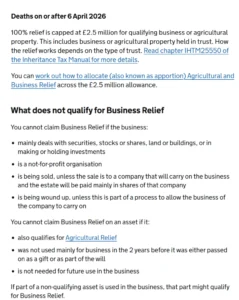
Current Business Relief eligibility rules and exclusions applying to family-business assets.
How Does the Transferable Allowance Help Married Family-Business Owners?
One of the most significant protections introduced alongside the reform is the ability to transfer unused £2.5 million relief allowance between spouses and civil partners.
If the first spouse does not use their allowance, the surviving spouse may potentially have up to £5 million of 100% BPR/APR allowance available.
Importantly, where the first spouse or civil partner died before 6 April 2026, the rules can treat the full £2.5 million allowance as available for transfer, subject to the relevant claim requirements.
Families dealing with the estate of the surviving parent should therefore consider the interaction between the business allowance and the ordinary rules for inheritance tax when the second parent dies.
The government describes two individuals as potentially being able to pass £5.65 million tax-free, combining £5 million of qualifying BPR/APR allowance and two £325,000 standard nil-rate bands.
That £5.65 million figure should not be interpreted as a universal ceiling.
Qualifying business value above the £5 million combined 100% allowance can still receive 50% relief, while the way ordinary nil-rate bands are allocated can change the eventual result.
There is another complication: the residence nil-rate band may not provide an additional £350,000 simply because the family owns a home.
The residence allowance begins tapering once the estate exceeds £2 million, and the value used for that taper is calculated before deducting Business Relief or Agricultural Relief.
For high-value family-business estates, this distinction can materially change succession calculations.
Why Can the New Rules Create a Cash-Flow Problem for Family Businesses?
The principal commercial problem is that business value and available cash are not the same thing.
A family company may have a £6 million valuation because it owns machinery, premises, stock, intellectual property and a profitable trading operation, yet the beneficiaries may have relatively little personal cash available.
Inheritance Tax can therefore create a liquidity problem even where the underlying business remains commercially healthy.
Liquidity and Succession Risk
Potential responses may include:
- holding more cash within the wider family structure;
- arranging life assurance where appropriate;
- reviewing dividend policy;
- planning lifetime transfers;
- creating funding arrangements between shareholders;
- restructuring ownership before succession;
- selling non-core assets;
- or, in more difficult cases, selling part of the company.
Tax barrister Emma Chamberlain, when discussing the valuation problems created by the reforms, made an especially relevant observation:
“Valuation, as we all know, is an art, not a science.”
Her evidence highlighted the particular difficulty of valuing minority interests in private companies, where the figure used for IHT may itself become an area of disagreement.
Family Business UK CEO Neil Davy has focused on the wider commercial issue, saying:
“Passing a business successfully from one generation to the next protects jobs, investment and local prosperity for the long term.”
His comments followed Budget 2026, when the core BPR reform was left in place.
For businesses considering changes to ownership, governance or capital structure, broader business restructuring and succession planning can therefore become part of the inheritance-tax discussion rather than a completely separate exercise.
What Is the Wider Economic Impact on Family Businesses?
There is an important difference between the number of estates expected to pay more tax and the number of businesses that may change their behaviour because of the rules.
Official estimates suggest relatively few estates will actually pay additional IHT. Business groups, however, argue that owners may alter investment, hiring, succession or cash-retention decisions years before a taxable death occurs.
A 2026 Family Business UK survey reported that 51% of family businesses surveyed still expected to be affected despite spending time and money on legal and tax advice, while more than 60% of medium and large family businesses employing over 50 people said they expected an impact.
These figures represent industry survey evidence rather than an HMRC forecast.
This helps explain why the impact cannot be measured only by counting estates.
The owner of a business who expects a future six-figure IHT liability may start reserving capital several years before succession. That can affect:
- expansion;
- acquisitions;
- recruitment;
- capital expenditure;
- debt reduction;
- dividends;
- and the family’s willingness to retain ownership.
A real family-business succession can also fail for reasons extending far beyond tax.
The lessons from one long-running family business succession case study show why leadership continuity, retirement planning and identifying the next generation early remain important even where IHT is manageable.
How Do Lifetime Gifts Interact With the Seven-Year Inheritance Tax Rule?
Gifting business shares during an owner’s lifetime may remain part of succession planning, but the timing now requires particular care.
For deaths on or after 6 April 2026, the £2.5 million 100% relief allowance can take account of qualifying transfers made during the preceding seven-year period.
Transitional rules are particularly important for qualifying gifts made on or after 30 October 2024 where the donor dies on or after 6 April 2026 and within seven years of the transfer.
This prevents owners from assuming that simply giving away a business shortly before the new regime started necessarily preserves unlimited 100% relief.
Lifetime transfers also require consideration of matters outside IHT, including:
- Capital Gains Tax;
- control of the company;
- voting rights;
- dividend entitlement;
- shareholder agreements;
- the financial security of the outgoing generation;
- and whether the recipient is ready to own or operate the business.
Giving shares away solely for tax reasons can therefore create larger commercial problems if succession has not been properly designed.
How Are Family-Business Trusts Affected?
Trusts do not provide a simple way around the £2.5 million restriction.
The legislation introduced a £2.5 million 100% trust relief allowance for qualifying agricultural and business property, but detailed rules determine how that allowance operates.
Multiple trusts created by the same settlor can be affected by rules designed to prevent the allowance simply being multiplied through numerous settlements.
Trustees may also have to consider:
- ten-year anniversary charges;
- exit charges;
- transfers into trust;
- previous use of available allowances;
- business valuations;
- and whether the underlying assets continue to qualify for relief.
Budget 2026 introduced a further, separate IHT measure concerning the deduction of liabilities involving trust property, applying to relevant deaths and chargeable events from 28 October 2026. It did not replace or reverse the £2.5 million APR/BPR framework.
Trust planning should therefore be reviewed on its own facts rather than treated as an automatic solution to the family-business inheritance tax problem.
Can Family Businesses Pay the Inheritance Tax Bill Over Ten Years?
Yes. One of the most valuable liquidity protections introduced from 6 April 2026 is the extension of interest-free instalment treatment to property qualifying for Agricultural Relief or Business Relief.
Eligible IHT can generally be paid in 10 equal annual instalments, and for qualifying assets inherited from 6 April 2026 the outstanding qualifying balance does not normally attract interest provided payments are made on time.
The official Inheritance Tax instalment rules explain that late instalments can still attract interest.
For a family company facing a £600,000 qualifying liability, a 10-year arrangement could potentially convert the immediate funding issue into payments of approximately £60,000 a year, assuming the entire liability qualifies and ignoring any other adjustments.
That does not eliminate the tax, but it can substantially reduce the pressure for a rushed disposal of business assets.
How Do Business Owners Claim Business Relief?
The executor or administrator generally claims Business Relief when completing the estate’s Inheritance Tax reporting.
For a deceased person who owned shares, a business, a business partnership interest or relevant business assets, HMRC states that the personal representatives should normally complete:
- IHT400 — Inheritance Tax account
- Schedule IHT413 — Business or partnership interests and assets
The business must be reported at its market value, which is why an independent and defensible valuation can become particularly important for privately held family companies.
Records should support not only the headline valuation but also ownership history, business activity, shareholder rights and the use of significant assets.
What Do the Latest Official Forecasts Say About the Impact?
The official forecast is narrower than some of the earlier public discussion surrounding the reform.
HMRC currently estimates that up to 1,100 UK estates will pay more Inheritance Tax in 2026–27 as a result of the APR and BPR reforms.
| Official Measure | Latest Estimate |
| Estates paying more IHT in 2026–27 | Up to 1,100 |
| Estates claiming APR, including some also claiming BPR, paying more | Up to 185 |
| Estates only claiming BPR paying more | Up to 915 |
| Of BPR-only estates, those holding only “not listed” market shares | Around 700 |
| Revenue impact in 2026–27 | £140 million |
| Revenue impact in 2027–28 | £290 million |
| Revenue impact in 2028–29 | £305 million |
| Revenue impact in 2029–30 | £295 million |
| Revenue impact in 2030–31 | £295 million |
The latest figure for 2029–30 is therefore £295 million, rather than the earlier rounded £300 million figure sometimes used when discussing the reform.
HMRC also estimates that around 85% of estates claiming Agricultural Relief, including those also claiming Business Relief, will not pay more IHT in 2026–27.
For BPR-only estates excluding those holding only shares designated as “not listed”, more than 80% are forecast not to pay additional tax.
These projections are not guarantees.
HMRC explicitly notes that its estate-count estimates are static and do not fully reflect changes families may make to their affairs, while the OBR has described behavioural responses to the broader inheritance-tax reforms as particularly uncertain.
What Should Family-Business Owners Review Under the New Rules?
The most useful response is not necessarily to transfer the business immediately. It is to establish the family’s exposure before making irreversible decisions.
Owners should consider:
- obtaining a realistic current business valuation;
- forecasting what the business could be worth in five or ten years;
- confirming whether the company is genuinely a qualifying trading business;
- reviewing each shareholder’s available £2.5 million allowance;
- checking transferable allowances between spouses or civil partners;
- modelling the tax position following both the first and second death;
- checking whether the family has sufficient liquidity to fund IHT;
- reviewing shareholder agreements, wills and insurance arrangements;
- documenting previous business gifts and ownership changes;
- considering whether lifetime succession is commercially appropriate;
- reviewing trusts containing business or agricultural assets;
- and ensuring executors know where all relevant company records are kept.
Owners whose wealth also includes significant pension savings should consider the separate pension inheritance tax changes for founders and business owners due to apply from 6 April 2027.
That is increasingly important because business shares, pensions, investments and personal property should be modelled as one estate rather than treated as unrelated pools of wealth.
Conclusion
The family business inheritance tax reforms do not remove Business Relief, but they fundamentally change succession planning for higher-value companies.
The first £2.5 million of qualifying business and agricultural property can still receive 100% relief, while qualifying excess normally receives 50% relief.
Transferable allowances give married couples and civil partners significantly greater protection, and interest-free instalments can reduce immediate liquidity pressure. However, valuation, lifetime gifts, trusts and business structure now matter more than before.
For established family firms, the practical priority is to calculate the exposure early and align tax planning with ownership, leadership succession and long-term commercial needs.
FAQs
Does a family business automatically qualify for 100% Business Relief?
No. The business must satisfy the qualifying conditions. Businesses mainly involved in holding investments, dealing in securities or dealing in land and buildings can be excluded.
Is everything above £2.5 million taxed at 40%?
No. Qualifying business or agricultural property above the available £2.5 million allowance generally receives 50% relief, producing an effective IHT rate of up to 20% on that excess before other allowances.
Can a married couple receive £5 million of full Business Relief?
Potentially, yes. An unused £2.5 million allowance can transfer between spouses or civil partners, allowing the surviving estate to have as much as £5 million of 100% BPR/APR allowance.
Can giving the business to children avoid the new rules?
Not automatically. Lifetime gifts interact with the seven-year rules, transitional provisions, Capital Gains Tax and ownership considerations. A transfer should be assessed commercially as well as for IHT.
Can a family business pay its IHT liability over time?
Qualifying IHT relating to assets eligible for Business Relief or Agricultural Relief can generally be paid in 10 annual interest-free instalments under the rules applying from 6 April 2026.
Does the £175,000 residence nil-rate band always sit on top of Business Relief?
No. The residence nil-rate band begins tapering for estates above £2 million, and Business Relief is not deducted when determining the estate value for that taper calculation.
Which forms are used to claim Business Relief after a business owner dies?
Personal representatives will normally use form IHT400 together with Schedule IHT413 when reporting relevant business or partnership interests and claiming Business Relief.