
Opening a Subway franchise in the UK can be an attractive opportunity for entrepreneurs who want to enter the food and hospitality industry without developing an entirely new restaurant brand.
However, understanding the Subway franchise cost UK involves considerably more than paying an initial franchise fee.
In 2026, Subway’s UK franchising information indicates that a new restaurant requires an investment starting at approximately £180,000, while the initial franchise fee is £15,000.
Franchise owners must also account for ongoing royalty fees, advertising contributions, staffing, property costs, equipment, insurance and working capital.
From our analysis of franchise investment information, financial planning requirements and published experiences of franchise operators, one issue stands out: the cost of acquiring a franchise is not necessarily the amount required to operate it successfully.
A business may have enough funding to open a restaurant but still encounter cash-flow difficulties if sales develop more slowly than expected.
We have examined the investment requirements, operational expenses, financing options and potential returns to explain what prospective Subway franchise owners should understand before making a financial commitment.
What Is a Subway Franchise and How Does It Work in the UK?
A Subway franchise is a business arrangement that allows an approved entrepreneur or company to operate a Subway restaurant using the brand’s established operating systems, menu, technology and commercial identity.
Instead of building a new restaurant concept, a franchisee operates under Subway’s business framework and pays fees for access to its brand, systems and ongoing support.
The franchise owner is responsible for running the restaurant, managing employees, controlling expenditure and maintaining the required operational standards.
Subway provides support in several areas, including restaurant design, training, marketing, technology, purchasing arrangements and site development.
However, these benefits do not remove the financial risks associated with running a hospitality business.
A franchise owner must still manage the relationship between customer demand, sales revenue, labour costs and operating margins.
Entrepreneurs considering this business structure should also understand how other franchise business opportunities in the UK differ in their investment requirements, operating flexibility and commercial commitments.
How Much Does a Subway Franchise Cost in the UK in 2026?
The current headline investment for a new Subway restaurant in the UK starts at approximately £180,000, although the final amount depends on the location, restaurant format, building condition and construction requirements.
Subway’s franchising material published in May 2026 also referred to investments starting at around £150,000 for certain locations and formats. Its current UK FAQ, however, specifies approximately £180,000 as the starting investment.
For financial planning, we would use the current £180,000 figure as the initial reference point and request an individual quotation before committing to a site.
These figures are not a maximum investment limit. Larger premises, extensive renovations and expensive commercial leases can increase the amount considerably.
Subway Franchise Costs at a Glance
| Investment requirement | UK franchise information |
| Initial franchise fee | £15,000 |
| Total investment | From approximately £180,000 |
| Royalty fee | 8% of net turnover |
| Advertising and marketing fee | 4.5% of turnover |
| Combined ongoing percentage fees | 12.5% of the relevant turnover base |
| Published minimum net worth requirement | £150,000 |
| Published minimum liquid assets requirement | £100,000 |
| Franchise agreement | 20 years |
| Typical development period | Approximately 6–12 months |
| Initial training | Three weeks |
The published financial qualification figures should be reconfirmed directly with Subway because requirements may vary according to the applicant, proposed territory, investment structure and number of restaurants.
Importantly, the £15,000 franchise fee is only one part of the opening investment. It should not be confused with the total amount needed to establish a functioning restaurant.
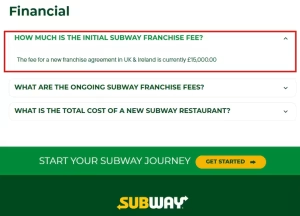
Official Subway UK franchise investment information showing the £15,000 initial fee, 8% royalty, 4.5% advertising contribution and approximately £180,000 starting investment.
What Is Included in the Initial Subway Franchise Investment?
The initial investment covers several separate financial commitments. Some relate directly to the franchise agreement, while others are necessary to secure, construct, equip and launch the restaurant.
Our financial assessment separates these costs because each category has different payment dates, risks and financing requirements.
Initial Franchise Fee
The current UK and Ireland fee for a new Subway franchise agreement is £15,000.
This provides the contractual right to operate under the franchise arrangement, subject to the agreement’s terms.
It does not pay for the property, restaurant equipment, inventory or working capital.
At a total investment of £180,000, the initial franchise fee would represent approximately 8.3% of the opening budget.
This means most of the initial capital is committed to creating and operating the physical restaurant rather than purchasing franchise rights alone.
Property Acquisition and Lease Expenses
Property is one of the most variable costs involved in opening a Subway.
A restaurant in a busy city centre may have substantially different financial requirements from one operating inside a university, petrol station or smaller shopping development.
Property-related expenses can include:
- Commercial lease deposits and rent paid in advance.
- Solicitor and lease negotiation fees.
- Building surveys and professional assessments.
- Planning and building control requirements where applicable.
- Service charges and business rates.
- Accessibility improvements and necessary modifications.
Prospective owners should also examine rent-review clauses, lease break provisions and repairing obligations.
A property with reasonable opening rent may become less attractive if future increases are difficult to absorb.
Restaurant Construction and Fit-Out
Restaurant conversion can involve flooring, counters, lighting, food preparation areas, plumbing, ventilation, electrical work and branded interiors.
The amount required depends heavily on whether the proposed premises are already suitable for food service.
An existing restaurant unit may require less structural work than a commercial property being converted for the first time.
However, acquiring a previously fitted restaurant does not guarantee that its equipment, layout or interior will satisfy Subway’s current requirements.
Equipment and Technology
Restaurant equipment is another substantial expense.
Typical requirements may include food preparation counters, refrigeration, ovens, storage systems, point-of-sale technology, security equipment and customer ordering facilities.
Digital ordering and delivery integration can also influence technology requirements.
Prospective franchisees should clarify which items must be purchased, which can be financed and which may require replacement during the agreement.
Opening Stock, Recruitment and Working Capital
The initial investment also needs to account for food ingredients, packaging, staff uniforms, insurance, recruitment, training expenses and pre-opening activities.
Working capital is particularly important because costs begin before the restaurant reaches its expected sales volume.
Rent may become payable before opening, employees require training, and suppliers must be paid even when revenue is still developing.
Our preference is to assess working capital separately from construction costs rather than assume that unused building funds will be available after opening.
What Would a Realistic Subway Franchise Startup Budget Look Like?
The following example illustrates how an entrepreneur might allocate £200,000 to a proposed restaurant.
This is our hypothetical planning model, not an official Subway quotation or an average of actual franchise openings.
| Investment category | Illustrative budget | Share of total |
| Initial franchise fee | £15,000 | 7.5% |
| Property deposits, legal and acquisition costs | £18,000 | 9% |
| Restaurant fit-out and conversion | £75,000 | 37.5% |
| Equipment, technology and security | £51,000 | 25.5% |
| Training, travel and recruitment | £6,000 | 3% |
| Opening inventory and supplies | £7,000 | 3.5% |
| Insurance, pre-opening marketing and administration | £4,000 | 2% |
| Working capital and contingency | £24,000 | 12% |
| Total illustrative investment | £200,000 | 100% |
In this model, fit-out and equipment account for 63% of the total investment.
This shows why the condition and suitability of the selected property can have a major influence on the amount of capital required.
The working-capital allocation also deserves careful consideration. A £24,000 reserve may provide only a limited operating buffer for a restaurant with significant monthly payroll, rent and supplier commitments.
The appropriate reserve should be calculated from projected cash outflows, seasonal trading patterns and the anticipated time required to establish regular customer demand.
Investors should also confirm whether each quotation includes VAT, whether any VAT can be recovered, and when those payments and recoveries are expected.
For a broader understanding of how establishment and operating expenses affect early-stage businesses, the real cost of running a UK startup highlights why wages, property expenses and other overheads must be included from the beginning.
What Are the Ongoing Subway Franchise Fees in the UK?
Opening expenses are only the first stage of franchise ownership.
After trading begins, Subway franchisees pay recurring fees alongside normal restaurant operating costs.
The two principal percentage-based charges are the royalty fee and the advertising and marketing contribution.
Royalty Fee – 8%
Subway’s current UK information specifies a royalty fee equivalent to 8% of net turnover.
This charge supports the commercial franchise arrangement and access to the franchisor’s systems.
It is based on sales rather than the restaurant’s remaining profit.
Consequently, the royalty can remain payable even when the restaurant is experiencing weak profitability.
Advertising and Marketing Fee – 4.5%
Franchisees also contribute 4.5% towards advertising and marketing activities.
These contributions help finance regional and national promotional activity.
Although national marketing can support brand recognition and customer acquisition, the contribution remains a cost that must be included in the restaurant’s financial forecast.
Combined Franchise Fees – 12.5%
Taken together, the royalty and advertising contributions represent 12.5% of the relevant net sales base.
For illustration:
| Monthly turnover excluding VAT | Royalty at 8% | Marketing at 4.5% | Combined fees |
| £20,000 | £1,600 | £900 | £2,500 |
| £30,000 | £2,400 | £1,350 | £3,750 |
| £40,000 | £3,200 | £1,800 | £5,000 |
| £50,000 | £4,000 | £2,250 | £6,250 |
| £60,000 | £4,800 | £2,700 | £7,500 |
These calculations use turnover excluding VAT for consistency. The precise contractual definitions and treatment of different sales channels should be checked in the franchise agreement.
For a restaurant generating £40,000 in monthly net sales, the combined franchise charges would be £5,000 before food, wages, rent, utilities and other expenses.
That is why evaluating gross revenue alone can provide an incomplete picture of franchise profitability.
How Much Does It Cost to Run a Subway Restaurant Every Month?
The monthly operating budget will depend on sales, opening hours, staffing arrangements, delivery activity and property costs.
The main expenses normally include food supplies, labour, premises, utilities, insurance, maintenance and franchise charges.
Food and Packaging Costs
Food costs depend on product mix, supplier prices, portion control, spoilage and promotional activity.
Although Subway operates within an established purchasing framework, franchise owners still need to monitor how food and packaging expenses affect restaurant margins.
In financial modelling, food costs should be measured against net sales rather than assessed only as a monthly cash amount.
Staffing and Employment Costs
Payroll is a major consideration for a food-service business.
From 1 April 2026, the UK National Living Wage for employees aged 21 and over is £12.71 per hour.
Franchise owners must also budget for relevant employer National Insurance contributions, pension contributions, paid leave, recruitment, training and management cover.
A staffing model that appears affordable at opening may become expensive if the restaurant needs additional employees during busy periods or experiences high employee turnover.
Rent, Business Rates and Utilities
Property costs remain payable even when customer traffic falls.
Electricity, heating, refrigeration and other essential services can make energy expenditure a meaningful part of restaurant overheads.
Business rates, property service charges, waste collection and maintenance must also be included.
A financially attractive restaurant is therefore not always the location with the highest footfall. It is the location where expected customer spending justifies the total cost of occupancy.
Delivery and Technology Expenses
Online ordering can help restaurants reach additional customers, but third-party delivery commissions and packaging costs can reduce the contribution from individual orders.
Franchise owners should analyse direct in-store purchases separately from delivery-platform orders where possible.
A promotion that increases transaction numbers without preserving an adequate contribution margin may not improve operating profit.
How Much Profit Can a Subway Franchise Make in the UK?
There is no single reliable profit figure that applies to every UK Subway restaurant.
Subway’s public UK franchise FAQs explain investment and fee requirements but do not establish a verified average net profit for individual franchisees.
Some online earnings estimates also confuse a business owner’s personal salary with the profit generated by the restaurant.
These are different measures.
A franchise owner may receive a salary for managing the operation while the company generates additional profit, or the owner may take limited drawings because cash is required for loan repayments and future investment.
To make the financial implications clearer, we developed three illustrative monthly trading scenarios.
Subway Restaurant Profitability Scenarios
The following model assumes an established restaurant operating for a full month. All sales figures exclude VAT.
| Monthly financial item | Lower-sales scenario | Base scenario | Higher-sales scenario |
| Net sales | £24,000 | £32,000 | £42,000 |
| Food and packaging | £7,200 | £9,600 | £12,600 |
| Labour, including management | £8,640 | £8,640 | £10,800 |
| Rent, rates and premises | £3,200 | £3,200 | £3,200 |
| Royalty – 8% | £1,920 | £2,560 | £3,360 |
| Advertising – 4.5% | £1,080 | £1,440 | £1,890 |
| Utilities, insurance and maintenance | £1,920 | £1,920 | £2,100 |
| Delivery and transaction costs | £960 | £1,280 | £1,680 |
| Administration and other overheads | £640 | £640 | £700 |
| Monthly operating result | -£1,560 | £2,720 | £5,670 |
| Operating margin | -6.5% | 8.5% | 13.5% |
Important: These figures are illustrative financial assumptions, not reported Subway franchisee earnings. The operating result is before finance costs, depreciation, tax and owner distributions. The labour budget assumes paid management is included.
The model demonstrates how operating results can change significantly with sales.
At £24,000 in monthly net revenue, the restaurant records an operating loss of £1,560.
At £32,000, it generates a monthly operating surplus of £2,720.
At £42,000, the operating surplus reaches £5,670.
If those monthly results continued throughout a full year, the equivalent annual operating figures would be:
- Lower-sales scenario: £18,720 operating loss.
- Base scenario: £32,640 operating surplus.
- Higher-sales scenario: £68,040 operating surplus.
Actual profits could differ substantially because labour scheduling, food costs, occupancy expenses and the proportion of delivery sales vary by location.
The central financial lesson is that sales growth creates value only when the restaurant retains sufficient margin after its operating costs.
What Is the Break-Even Point for a Subway Franchise?
Break-even analysis measures the sales required to cover operating expenditure before the restaurant begins generating an operating surplus.
This is an important calculation for lenders and prospective franchise owners because it shows how much trading activity the business needs to sustain itself.
Using the base model above, the main variable costs are:
| Variable expense | Percentage of net sales |
| Food and packaging | 30% |
| Franchise royalty | 8% |
| Marketing contribution | 4.5% |
| Delivery and transaction expenses | 4% |
| Total variable costs | 46.5% |
| Contribution margin | 53.5% |
Assuming monthly fixed operating expenses of £14,400, the calculation becomes:
Break-even monthly sales = £14,400 ÷ 53.5% = approximately £26,916
Under these assumptions, the restaurant would need approximately £26,916 in monthly net sales to cover its modelled operating costs.
That is equivalent to roughly £897 per day over a 30-day trading month.
For example, if the average customer transaction generated £8 in net revenue, the restaurant would require approximately 112 transactions per day to reach that operating break-even point.
This does not include loan repayments or recovery of the original investment.
A prospective owner should calculate a second cash-flow break-even target that includes debt repayments, necessary capital expenditure and other cash commitments.
A business that breaks even at the operating level may still experience negative cash flow after financing obligations.
How Much Personal Capital Do You Need to Open a Subway Franchise?
Published UK franchising information refers to minimum financial qualifications of £150,000 in net worth and £100,000 in liquid assets.
Net worth generally means the value of an individual’s assets after deducting liabilities.
Liquid assets are financial resources that can be accessed relatively quickly, such as available cash and qualifying readily realisable investments.
These qualifications are different from the initial franchise fee and the overall restaurant construction budget.
An investor may meet the minimum net worth requirement but still be unable to fund a proposed restaurant without external finance.
Equally, satisfying the stated minimum does not guarantee approval, because Subway will assess the proposed investment, applicant and commercial opportunity.
For instance, an investor considering a £200,000 project might explore a combination of personal capital and bank borrowing.
However, the lender and franchisor must both be satisfied that the owner retains enough available funds to cover the project and its early operating requirements.
The important distinction is between qualifying financially to apply and having sufficient capital to operate the business sustainably.
Can You Get a Loan to Open a Subway Franchise in the UK?
Funding may be available through banks, specialist franchise lenders, equipment finance providers and personal investment arrangements.
However, financing is not automatic simply because Subway is an established international brand.
Lenders assess the individual’s financial position, creditworthiness, business plan, proposed location and ability to repay borrowing.
Commercial Bank Finance
A commercial business loan may help finance part of the initial investment.
A lender will generally want a credible business plan and evidence supporting the projected restaurant turnover.
That evidence could include demographic research, local competition, proposed trading hours, site costs and realistic profitability assumptions.
Equipment Finance
Equipment leasing or asset finance may allow an investor to spread qualifying equipment costs over an agreed period.
Although this can reduce the amount needed upfront, monthly repayments create an additional cash-flow obligation.
Owners must also consider the total interest cost, lease restrictions and responsibility for equipment maintenance.
Personal Capital and Business Partnerships
Entrepreneurs may invest their own capital or establish a business partnership.
A partnership can provide additional funding and operational expertise, but commercial arrangements should clearly define ownership, management responsibilities, profit distributions and exit procedures.
Our assessment is that investors should understand the difference between taking on debt and giving away an equity stake before deciding how to structure franchise funding.
The financial considerations explored in business debt for startups are especially relevant when evaluating repayment affordability.
Example of Franchise Loan Repayments
Consider a hypothetical £90,000 business loan with:
| Loan detail | Illustrative terms |
| Amount borrowed | £90,000 |
| Annual interest rate | 9% |
| Repayment period | 7 years |
| Approximate monthly repayment | £1,448 |
| Approximate annual repayments | £17,376 |
This is an illustrative repayment calculation, not a current lender offer.
Under our earlier base trading scenario, the restaurant produces £2,720 per month before financing.
After a £1,448 loan repayment, approximately £1,272 remains before tax, additional capital expenditure and other excluded cash commitments.
This example shows why borrowing can materially affect the cash available to a franchise owner.
The lender’s interest rate, repayment term, security requirements and personal guarantees should all be examined before borrowing.
Entrepreneurs with limited personal savings can also investigate startup business loan options, although smaller government-supported programmes are unlikely to finance an entire Subway restaurant on their own.
Is Buying an Existing Subway Franchise Cheaper Than Opening a New One?
Purchasing an established Subway restaurant is an alternative to constructing a new outlet.
The purchase price is negotiated between the buyer and seller, with Subway retaining approval over the franchise transfer.
Buying an existing restaurant may reduce construction work and provide access to an established operating history.
However, it is not automatically cheaper or more profitable.
An established restaurant with strong sales, a desirable location and modern equipment may command a significant purchase premium.
Conversely, a cheaper restaurant may require renovation or have underlying operational problems.
New Subway Restaurant vs Existing Franchise
| Consideration | New restaurant | Existing restaurant |
| Initial investment | Construction and opening expenses | Negotiated purchase price and transfer-related costs |
| Sales history | Not available for the new site | Historical trading information may be available |
| Equipment | Typically new or newly fitted | Condition and replacement needs vary |
| Employees | New team recruitment | Existing employees may transfer |
| Customer base | Must be established | May already exist |
| Property risk | Depends on new lease and site | Existing lease must be examined |
| Renovation costs | Included in development budget | Refurbishment may still be required |
| Franchisor approval | Required | Required for ownership transfer |
What Should Buyers Check Before Purchasing an Existing Subway?
A potential buyer should review at least two years of available weekly sales information and investigate whether revenue has been stable, increasing or declining.
Historical sales should also be compared with:
- Payroll and staffing records.
- Food and supplier costs.
- Rent, rates and service charges.
- Equipment condition and maintenance requirements.
- Existing franchise obligations.
- Lease duration and future rent reviews.
- Local competition and changes in customer footfall.
- Outstanding liabilities and possible employee transfer obligations.
The seller’s asking price is not sufficient evidence of business value.
A franchise with strong historical revenue but weak margins may be less attractive than a smaller business operating with better cost control.
We would also assess whether the proposed purchase price can be recovered through realistic future cash generation rather than relying on optimistic resale assumptions.
How Do You Apply for a Subway Franchise in the UK?
Subway uses a structured application and approval process to assess prospective franchise partners.
The process includes financial and commercial evaluation before the restaurant can be developed or acquired.
Step 1: Assess Your Financial Position
The first step is establishing how much capital you can commit without compromising personal financial security.
This includes examining savings, existing debt, available business funding and the amount required for living expenses during the startup period.
Step 2: Submit an Initial Application
Prospective franchise partners can complete the application questionnaire through Subway’s UK franchise website.
Applicants may be asked about their business background, investment capacity and development objectives.
Step 3: Complete Franchise Discussions and Due Diligence
Suitable candidates progress to discussions with Subway’s development team.
This provides an opportunity to understand operational expectations, financial requirements, training and the proposed restaurant format.
Step 4: Prepare a Business Plan and Funding Proposal
A credible proposal should explain the location, expected customer demand, sales projections, investment requirements and funding structure.
Financial forecasts should include optimistic, realistic and adverse trading scenarios.
Step 5: Identify and Assess a Suitable Location
Subway works with applicants to identify possible restaurant locations.
Site assessment should consider visibility, footfall, local competition, customer demographics and the commercial suitability of the property.
Step 6: Review and Sign the Franchise Agreement
Once approval and commercial arrangements are complete, the applicant reviews the legal documentation.
An independent solicitor experienced in franchising should examine the agreement before signing.
Step 7: Complete Restaurant Development and Training
The restaurant must be developed or transferred in accordance with the agreed requirements.
The franchisee also completes the required training programme before trading begins.
Step 8: Open and Operate the Restaurant
Following the necessary approvals, recruitment, training and operational preparation, the restaurant can begin trading.
Subway’s UK information indicates that restaurant development typically takes approximately six to twelve months, although individual projects can take longer.
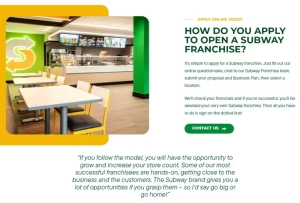
Subway’s official franchise application process, showing how prospective owners move from the initial questionnaire to business planning, site selection and opening.
What Training and Business Support Does Subway Provide?
Subway’s franchise training is designed to help new owners understand its operating requirements, restaurant management processes and brand standards.
The published UK programme includes three weeks of initial franchise partner training, with two weeks completed through intensive practical training at a certified training restaurant.
Support may also include guidance covering restaurant design, construction, lease negotiations, store development and employee onboarding.
Subway’s online training resources allow franchisees and their employees to access ongoing learning materials.
However, formal training should not be confused with complete operational responsibility being transferred to the franchisor.
Owners must still understand financial reporting, payroll, employee supervision, customer service and stock management.
In a published franchise-owner testimonial, multi-unit operator Anthony Deegan-Williams described the ownership structure with the words:
“We are in business for ourselves just not by ourselves.”
That distinction is important from a business perspective. Franchisees receive support from an established system while remaining responsible for the commercial performance of their own operations.
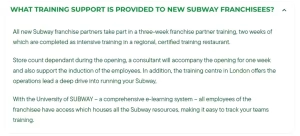
Subway’s official franchise training information explaining the three-week training programme and ongoing operational support.
What Makes a Good Location for a Subway Franchise?
Location selection is one of the most influential commercial decisions in restaurant franchising.
A busy shopping street may generate strong customer demand, but high rent and intense competition can reduce profitability.
A smaller commercial site may have lower fixed costs but struggle to attract sufficient customers.
Our approach to evaluating potential Subway locations focuses on the relationship between demand and operating expenditure.
High-Street Locations
High-street restaurants may attract local residents, workers, students and passing customers.
The main considerations include pedestrian traffic, local spending patterns, nearby competitors, property costs and the availability of delivery customers.
Transport Hubs
Railway stations and airports can create demand from customers looking for convenient food.
However, the commercial terms for these locations can differ significantly from conventional high-street leases.
Operating restrictions, service charges and landlord requirements must be assessed carefully.
Universities and Hospitals
Universities and hospitals may provide access to relatively concentrated customer populations.
Nevertheless, sales can be affected by academic calendars, building access, contractual restrictions and operating hours.
Petrol Stations and Other Non-Traditional Sites
Subway has also highlighted opportunities within smaller and non-traditional restaurant formats.
Mike Kehoe, Subway’s Global Chief Development Officer, has stated that non-traditional locations account for approximately 25% of the brand’s global restaurant footprint.
This demonstrates the scale of the format internationally, but it does not establish the profitability of any particular UK location.
Franchise investors should therefore analyse each site individually rather than assume that a format associated with a major brand will automatically generate adequate returns.
What Are the Legal and Regulatory Requirements for Opening a Subway?
Operating a Subway restaurant involves meeting ordinary UK business and food-service legal requirements as well as the franchise agreement.
Requirements depend on the location, business structure and proposed trading activities.
Food Business Registration
A new food business must register with its local authority at least 28 days before trading begins.
Registration is free and is also relevant when taking over an existing food business.
Food Safety and Allergen Management
Restaurants must maintain appropriate food safety procedures and provide legally required allergen information.
Food handling, storage, cleaning, temperature management and staff practices must meet applicable standards.
Employment Obligations
The restaurant operator is responsible for complying with employment law, including minimum wage obligations, statutory entitlements and relevant employer contributions.
Employers’ liability insurance will normally be required where the legal conditions apply.
VAT and Tax Administration
The UK VAT registration threshold is £90,000 in taxable turnover over a rolling twelve-month period, with additional rules where turnover is expected to exceed the threshold in the next thirty days.
Franchise owners should obtain professional advice on VAT treatment, as food products and transactions can be subject to different rules.
Corporation tax or personal tax obligations depend on the business’s legal structure.
Premises and Trading Permissions
Owners should also review planning permissions, building regulations, signage consent, waste arrangements, business rates and any applicable local licensing requirements.
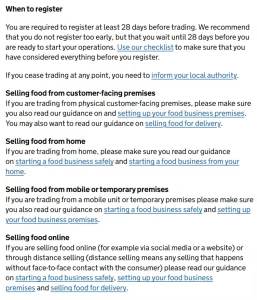
Official UK food business registration guidance confirming that food businesses must register with the local authority at least 28 days before trading.
What Are the Benefits and Risks of Owning a Subway Franchise?
A Subway franchise offers access to an established business system, but the investment should be assessed against its limitations and financial commitments.
| Potential advantage | Commercial consideration |
| Established international branding | Customer awareness does not guarantee local sales |
| Structured training | Owners remain responsible for staff and operations |
| Established supply arrangements | Food costs and wastage still require monitoring |
| Marketing support | Franchisees contribute 4.5% of turnover |
| Different restaurant formats | Not every format is available or suitable for every applicant |
| Opportunities for additional restaurants | Expansion requires further capital and operational capacity |
| Established operating procedures | Franchise agreements limit independent decision-making |
From a financial standpoint, the principal benefit is being able to operate within an established commercial framework.
The main limitation is that ongoing percentage-based fees reduce the proportion of revenue retained by the restaurant.
A further risk is the possibility of future investment requirements, including equipment replacement, technology upgrades and restaurant refurbishment.
These obligations should be considered when analysing total ownership costs over the life of the agreement.
How Does Subway Compare With Other Food Franchise Opportunities?
Subway is one of several established food-service brands that prospective UK entrepreneurs may consider.
However, different brands use different ownership structures, financial qualification requirements and development strategies.
A simple comparison of headline franchise fees is therefore insufficient.
For example, entrepreneurs examining the McDonald’s franchise investment need to consider its own property, operating and application arrangements.
Similarly, the Costa Coffee franchise cost is affected by the difference between full restaurant partnerships, concessions and other commercial formats.
The Wingstop franchise investment may also involve different development expectations and capital requirements.
Other opportunities, such as a Cake Box franchise, operate within a different food-service segment and should be evaluated according to their individual business models.
Our assessment is that franchise comparisons should focus on five commercial factors:
- Total capital required, including working capital.
- Percentage-based ongoing payments.
- Expected restaurant-level operating margins.
- Availability and quality of suitable locations.
- Contractual obligations and the cost of future investment.
A business with a lower entry fee may not necessarily offer better profitability if recurring costs or lease commitments are higher.
How Long Does a Subway Franchise Agreement Last?
Subway’s UK franchising information specifies a standard franchise agreement term of 20 years.
This provides a long-term contractual framework for operating the business, subject to compliance with the franchise agreement.
However, a 20-year franchise term does not automatically guarantee a 20-year property lease, renewal rights or uninterrupted trading.
Prospective owners should examine the relationship between the franchise agreement and the commercial property lease.
They should also understand provisions relating to:
- Renewal and expiry.
- Restaurant refurbishment.
- Brand and operational standards.
- Franchise transfer and sale.
- Territory and development arrangements.
- Contract termination.
- Fees and additional investment requirements.
A long agreement can provide operating continuity, but it also creates obligations extending well beyond the initial opening period.
Is a Subway Franchise Worth the Investment in 2026?
A Subway franchise may be commercially viable for an investor who has adequate capital, access to a suitable location and the ability to manage restaurant operations effectively.
However, we would not treat brand recognition alone as sufficient justification for investing.
The financial decision should be based on the projected return after all operating costs and necessary financing commitments.
For instance, an illustrative investment of £200,000 generating a sustainable annual operating surplus of £32,640 would produce a pre-financing operating return equivalent to 16.3% of the initial investment.
That calculation is useful for comparing scenarios, but it is not the same as a 16.3% net investment return.
Interest, taxes, future refurbishment, financing principal repayments, depreciation and the timing of cash flows can all affect the actual amount earned by the owner.
The result would also depend on whether the business consistently maintained the assumptions used in the forecast.
Before investing, our financial assessment would prioritise evidence of sustainable sales, controllable labour expenditure, reasonable occupancy costs and sufficient working capital.
An attractive franchise opportunity should be capable of supporting its operating expenses and financing obligations without depending entirely on optimistic sales growth.
What Should You Check Before Investing in a Subway Franchise?
We recommend completing a detailed commercial assessment before signing a franchise agreement or committing to a property.
At minimum, prospective investors should establish the following:
- Investment affordability: Can the owner fund the project and retain adequate liquidity?
- Sales assumptions: Are projected customer numbers and average transaction values supported by local evidence?
- Cost exposure: Can the business absorb higher wages, rent, food prices or utility bills?
- Debt commitments: Will the restaurant generate enough cash to meet loan repayments?
- Property suitability: Does the proposed location justify its occupancy costs?
- Contractual obligations: Are renewal, transfer, refurbishment and termination provisions understood?
- Exit strategy: Could the business be sold, and what factors might affect its resale value?
A franchise investment should also be stress-tested against adverse trading conditions.
For example, reducing projected revenue by 15% while maintaining substantial fixed expenses can materially change the operating result.
Testing these scenarios before investing helps identify whether the business has sufficient financial resilience.
Conclusion
Understanding the Subway franchise cost in the UK requires examining the full financial commitment rather than focusing on the initial franchise fee.
In 2026, the published starting investment for a new Subway restaurant is approximately £180,000, with a £15,000 initial franchise fee and ongoing royalty and marketing charges totalling 12.5% of the relevant turnover base.
The actual amount required may be higher depending on the location, restaurant construction, equipment and working-capital needs.
Our analysis suggests that location quality, cash-flow management, labour efficiency and financing arrangements are central to evaluating the opportunity.
For entrepreneurs with appropriate financial resources and operational experience, Subway provides an established structure for entering the food-service industry.
Nevertheless, investors should calculate realistic operating margins, verify the terms of the franchise agreement and assess whether the projected returns adequately compensate for the capital and business risks involved.
A successful franchise investment begins with accurate financial planning, not simply the ability to afford the opening fee.
Frequently Asked Questions About Subway Franchise Cost UK
How much money do you need to open a Subway franchise in the UK?
Subway’s current UK information indicates an initial investment starting at approximately £180,000. The final amount depends on the property, restaurant format, equipment, construction and working-capital requirements.
What is the Subway franchise fee in the UK?
The current fee for a new Subway franchise agreement in the UK and Ireland is £15,000. This is separate from the overall investment required to open the restaurant.
How much does Subway charge in royalties?
Subway charges an 8% royalty on net turnover, together with a 4.5% advertising and marketing contribution. The combined percentage is 12.5%.
Can you open a Subway franchise with £100,000?
An applicant with £100,000 in liquid assets may meet one of the published financial qualification requirements, but that does not mean £100,000 is sufficient to open a restaurant. Additional capital or finance may be required, and Subway must approve the application.
How much can a Subway franchise owner earn per year?
There is no publicly verified UK-wide average profit figure in Subway’s current franchise FAQs. Earnings depend on restaurant sales, labour costs, property expenses, franchise charges and financing commitments.
How long does it take to open a Subway franchise?
Subway indicates that restaurant development typically takes approximately six to twelve months. The actual timeline depends on application approval, property selection, construction and training.
Can you buy an existing Subway restaurant?
Yes. Existing Subway restaurants may be available for resale. The price is negotiated between the buyer and seller, and the transfer requires Subway’s approval.
Can one person own multiple Subway franchises?
Multi-unit ownership is possible, subject to the franchisor’s approval, the applicant’s financial resources and their capacity to manage additional restaurants.
Does Subway provide training for new owners?
Yes. The published initial franchise partner training programme lasts three weeks, including two weeks of practical training in a certified training restaurant.
Is owning a Subway franchise profitable?
A Subway franchise can generate an operating profit, but profitability is not guaranteed. Investors should assess verified trading information where available and prepare financial forecasts that account for all operating costs and financing obligations.