
How much does a Wingstop franchise cost in the UK in 2026? The answer is more complicated than the investment figures published on many franchise websites.
Although Wingstop has become one of the fastest-growing chicken restaurant brands in Britain, its UK operations follow a different franchise structure from the United States.
The brand’s 2026 US franchise disclosures indicate an initial investment of approximately $310,400 to $1,048,500, excluding real estate purchase and lease costs.
However, these figures are not an official UK franchise quotation, and individual UK franchise opportunities are not publicly advertised under a standard pricing package.
We analysed Wingstop’s financial disclosures, UK expansion, ownership arrangements and restaurant economics to explain the real financial considerations for entrepreneurs interested in the business.
Our analysis also examines how much restaurant revenue is needed to cover operating costs, what the UK operator’s financial performance reveals and whether owning a Wingstop restaurant is currently a realistic opportunity for independent investors.
What Is Wingstop and How Does Its Franchise Business Work?
Wingstop is an American fast-casual restaurant chain founded in Garland, Texas, in 1994. It specialises in cooked-to-order chicken wings, boneless chicken, tenders, seasoned fries and a selection of signature flavours.
The business began franchising in 1997 and has subsequently expanded into international markets, including the United Kingdom.
Unlike a conventional independent restaurant, a Wingstop outlet operates within a branded system covering food preparation, restaurant design, marketing, approved suppliers, technology and customer experience.
For an investor, the commercial attraction is access to an established concept rather than having to develop every aspect of a new restaurant business independently.
However, the franchise structure also means accepting contractual restrictions and ongoing financial obligations.
How Large Is Wingstop’s Business in 2026?
| Business indicator | Latest available information |
| Founded | 1994 |
| Franchising began | 1997 |
| First UK restaurant | London, 2018 |
| Global restaurant network | 3,331 restaurants at 26 September 2026 |
| UK expansion | 100th UK restaurant milestone reached in August 2026 |
| UK and Ireland master franchise operator | Lemon Pepper Holdings |
| Majority investor in UK operator | Sixth Street |
| UK operator’s 2025 revenue | Approximately £216.4 million |
| UK operator’s 2025 operating profit | Approximately £24.3 million |
| US domestic average unit volume, Q3 2026 | Approximately $1.85 million annualised |
The international expansion demonstrates the scale of the Wingstop business, but franchise system growth should never be confused with guaranteed profitability for individual restaurant owners.
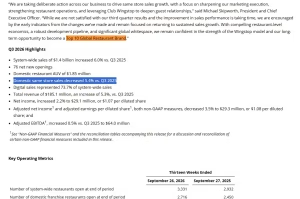
Wingstop’s official third-quarter 2026 financial results showing its global restaurant network, digital sales and domestic average unit volume.
Can You Buy a Wingstop Franchise in the UK in 2026?
This is the first question prospective investors need to resolve before considering franchise costs.
Wingstop’s British operations are managed by Lemon Pepper Holdings, which holds the master franchise rights covering the UK and Ireland.
In January 2025, Sixth Street became the majority shareholder in the business, supporting its continued restaurant expansion.
A master franchise arrangement gives a business operator development rights within an agreed market. It does not automatically mean those rights are available for resale to individual investors.
Wingstop UK has concentrated on growing its restaurant network through its established operating structure, and there is no publicly verified standard UK individual-franchise application package.
Consequently, investors should not assume that submitting a franchise enquiry guarantees an opportunity to acquire a restaurant.
What Is the Difference Between a Master Franchise and a Single-Unit Franchise?
| Franchise structure | What it means | Investor considerations |
| Single-unit franchise | Operating one restaurant under a brand agreement | Individual location profitability |
| Multi-unit franchise | Operating several restaurants | Higher capital and management commitments |
| Area development | Contractual rights and obligations to develop multiple sites | Expansion targets and development deadlines |
| Master franchise | Rights to develop a brand across a country or territory | Larger-scale funding, management and contractual commitments |
| Franchise resale | Purchasing an existing franchised business, where permitted | Valuation, liabilities and transfer approval |
Wingstop’s UK structure is particularly relevant because it means the published US franchise agreement cannot simply be applied to an entrepreneur seeking one British restaurant.
Investors comparing different ownership structures can examine broader franchise business opportunities in the UK to understand how single-unit, multi-unit and master franchise agreements differ.
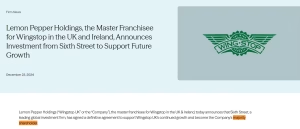
Official announcement confirming Lemon Pepper Holdings’ position as Wingstop’s UK and Ireland master franchisee and Sixth Street’s investment in the business.
How Much Does a Wingstop Franchise Cost in 2026?
Wingstop’s April 2026 US Franchise Disclosure Document provides an investment range of $310,400 to $1,048,500 for a new restaurant.
The estimate includes restaurant preparation, equipment, franchise-related fees and selected opening expenses. It excludes the purchase of real estate and lease costs.
For British entrepreneurs, these figures provide an indication of the capital-intensive nature of the business, but they should not be treated as a UK quotation.
| Cost or requirement | US 2026 disclosure | Confirmed UK position |
| Total initial investment | $310,400–$1,048,500 | No standard public UK figure verified |
| Initial franchise fee | $25,000 | Not publicly confirmed |
| Initial development fee for one restaurant | $25,000 | Not publicly confirmed |
| Combined initial franchise and development fees | $50,000 | Not publicly confirmed |
| Continuing royalty | 6% of gross sales | Depends on UK contractual terms |
| Advertising fund contribution | 5.5% of gross sales | Depends on UK contractual terms |
| Combined royalty and advertising charge | 11.5% | Not a confirmed UK rate |
| Real estate purchase | Excluded | Site-specific |
| Lease costs | Excluded from quoted US investment range | Site-specific |
| UK individual franchise availability | Not applicable | No standard public offer verified |
These amounts describe the US offering, not an authorised UK investment package.
One important change from older information is the reported 2026 US franchise fee of $25,000. Wingstop’s 2025 annual report described an earlier $20,000 franchise fee, illustrating why older franchise articles can quickly become inaccurate.
For an actual investment decision, the latest applicable agreement matters more than any historical published estimate.
What Would a UK Restaurant Development Budget Look Like?
Although an official Wingstop UK franchise quotation is unavailable, an illustrative restaurant budget can show how initial capital may be allocated.
The following is our hypothetical financial planning exercise for a branded fast-casual restaurant. It is not an estimate supplied by Wingstop.
| Development expense | Illustrative budget |
| Property deposit and preliminary occupancy costs | £55,000 |
| Restaurant refurbishment and fit-out | £250,000 |
| Commercial kitchen and catering equipment | £145,000 |
| Ordering technology and payment systems | £35,000 |
| Recruitment and initial staff training | £30,000 |
| Opening food stock and packaging | £20,000 |
| Professional fees, surveys and permits | £25,000 |
| Opening marketing and promotions | £15,000 |
| Initial working capital | £75,000 |
| Illustrative development budget | £650,000 |
| Wingstop UK franchise or licence fees | Not included; terms unconfirmed |
The £650,000 figure is a scenario assumption, not Wingstop’s advertised UK franchise cost. It excludes any unconfirmed franchise or licence payment and could differ substantially from an actual project.
In some locations, construction costs may be higher because of extraction systems, ventilation, electrical capacity, accessibility requirements and lease conditions.
The operator must also consider whether the quoted property and construction costs include VAT and whether VAT can be recovered.
From a financial planning perspective, adequate working capital is particularly important. A restaurant can generate sales without producing enough cash to meet wages, rent, supplier payments and loan obligations during its early trading period.
What Are Wingstop’s Initial Franchise Fees and Ongoing Charges?
A franchise fee is only one part of the financial commitment.
The more important long-term issue may be the percentage of sales paid through royalties, advertising contributions and other contractual charges.
Initial Franchise and Development Fees
Under Wingstop’s 2026 US franchise disclosures, the standard franchise fee and initial development fee are both $25,000 for a new single-restaurant arrangement.
A development agreement is required even where the investor plans to develop only one restaurant.
Additional restaurants may involve further development obligations.
These requirements should not be confused with the commercial terms applying to Lemon Pepper Holdings or any hypothetical UK sub-franchise.
Royalty and Marketing Fees
In the US, Wingstop’s disclosed standard continuing charges are a 6% royalty and a 5.5% advertising contribution.
The combined 11.5% represents a significant portion of sales before accounting for food costs, staffing, rent or other restaurant expenditure.
Consider an illustrative restaurant generating £1.2 million in annual sales.
| Fee calculation | Annual amount |
| Annual sales | £1,200,000 |
| 6% royalty | £72,000 |
| 5.5% advertising contribution | £66,000 |
| Combined 11.5% charge | £138,000 |
This example applies US fee percentages for illustration only. It does not represent an actual UK Wingstop franchise agreement.
The financial implication is clear: franchise fees charged on turnover reduce cash available to the operator even when profits are low.
An investor therefore needs to assess the entire fee structure, including possible technology charges, required refurbishment, renewal obligations, supplier arrangements and any additional marketing expenditure.
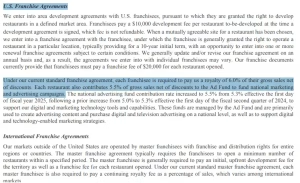
Wingstop’s official annual-report explanation of US franchise royalties, advertising contributions and international master franchise arrangements.
How Profitable Is Wingstop in the UK?
Wingstop’s British operations have reported substantial revenue and operating profit, providing useful evidence about the wider business.
For the financial year ended 28 December 2025, Lemon Pepper Holdings reported approximately £216.4 million in revenue and £24.3 million in operating profit.
This represents an operating profit margin of approximately 11.2%.
| Financial metric | UK operator, 2025 |
| Revenue | £216.4 million |
| Operating profit | £24.3 million |
| Profit before tax | £23.5 million |
| Operating profit margin | Approximately 11.2% |
| Profit before tax margin | Approximately 10.9% |
The figures demonstrate profitability at the corporate operating level, but they do not establish the average earnings of an individual Wingstop restaurant.
Corporate accounts include the results of the wider operating business and may reflect central costs, management activities and other group arrangements.
They are not interchangeable with single-outlet franchise profit.
It is also important to understand that the reported 73% revenue increase compares a 12-month 2025 reporting period with a shortened preceding accounting period. Investors should not interpret that headline percentage as a like-for-like annual sales growth rate.
Chris Sherriff, Chief Executive of Wingstop UK and Ireland, highlighted the company’s focus on opening restaurants in suitable locations and maintaining operational standards as the business expanded.
His comments reflect an important commercial reality: successful restaurant expansion depends on site selection, execution and management discipline, rather than brand recognition alone.
What Do Wingstop’s US Restaurant Sales Reveal?
Wingstop’s US disclosures also provide a useful perspective on restaurant demand.
For the 52 weeks ended 27 December 2025, the 2026 US franchise disclosures reported average annual net sales of approximately $2.01 million across the qualifying established franchised restaurants included in the calculation.
The median was approximately $1.89 million.
These measures represent restaurant revenue, not franchisee profit, and exclude newly opened restaurants that did not operate throughout the full reporting period.
Wingstop’s third-quarter 2026 results subsequently reported domestic average unit volume of approximately $1.85 million, while domestic same-store sales declined 5.4% from the corresponding quarter in 2025.
The changing performance demonstrates why investors should avoid assuming that historic restaurant sales will continue increasing indefinitely.
How Much Profit Could a Wingstop-Style Restaurant Generate?
A realistic financial assessment must examine how food costs, labour, franchise charges, property expenses and delivery commissions affect a restaurant’s earnings.
To illustrate the process, we developed a hypothetical financial model for a UK fast-casual chicken restaurant.
These assumptions are not actual Wingstop UK operating costs or franchisee results.
Illustrative Annual Restaurant Cost Structure
| Cost category | Model assumption |
| Food and packaging | 32% of net sales |
| Labour | 26% |
| Third-party delivery costs | 6% |
| Franchise and marketing fees | 11.5% |
| Fixed property and other operating costs | £250,000 annually |
The 11.5% is based on the US disclosed fee structure purely as a modelling scenario. The actual UK fee burden is unconfirmed.
The percentage-based costs total 75.5% of sales, leaving a 24.5% contribution before the fixed operating expenses.
How Would Profit Change at Different Sales Levels?
| Financial metric | Lower sales | Base scenario | Higher sales |
| Annual net sales | £900,000 | £1,200,000 | £1,500,000 |
| Percentage-based costs, 75.5% | £679,500 | £906,000 | £1,132,500 |
| Fixed operating costs | £250,000 | £250,000 | £250,000 |
| Illustrative operating contribution after modelled costs | -£29,500 | £44,000 | £117,500 |
| Operating margin | -3.3% | 3.7% | 7.8% |
These results are before financing costs, depreciation, tax and any unmodelled expenditure. They are not forecasts or claims about actual Wingstop franchise earnings.
An important finding is that the restaurant could be loss-making at £900,000 in annual sales under these assumptions, despite generating substantial revenue.
At £1.2 million, the model produces just £44,000 before financing and other exclusions.
This shows why investors should not estimate earnings by applying an assumed profit percentage to restaurant turnover.
Using a unit economics calculator can help examine how selling prices, food margins and fixed costs affect operating results.
What Is the Break-Even Point?
Using the above hypothetical assumptions:
Break-even annual sales = £250,000 ÷ 24.5% = approximately £1.02 million.
That equates to approximately £85,000 per month or £19,600 per week in net sales.
This is operating break-even under the model, not full cash break-even after debt repayments.
If operating expenses rise, customer demand weakens or the fee structure changes, the required sales level could increase.
How Much Working Capital Would a Wingstop Restaurant Need?
Working capital is the cash available to fund daily operations before incoming revenue becomes sufficient to cover expenditure.
For restaurant businesses, the requirement can be significant because wages, rent, utilities and supplier bills continue even during slower trading periods.
An investor should plan for:
- Payroll, pension contributions and employer National Insurance.
- Opening inventory and supplier payment cycles.
- Rent, business rates, service charges and utilities.
- Repairs, cleaning, food safety and equipment servicing.
- Payment processing and delivery platform deductions.
- Marketing expenditure and unexpected trading shortfalls.
Rather than relying solely on an initial development budget, we would test whether the business could withstand at least several months of disappointing sales.
For example, a restaurant with £70,000 in average monthly cash operating expenditure may need substantial liquidity to manage a prolonged opening delay or weaker-than-expected launch.
The appropriate reserve depends on the actual expenditure profile, landlord payment schedule, supplier credit terms and funding arrangements.
What Are the Financial Requirements to Own a Wingstop Franchise?
US franchise requirements and UK master franchise arrangements should be considered separately.
Some older UK-facing franchise pages quote minimum net worth figures between roughly £950,000 and £1.2 million, alongside liquid capital requirements of £475,000 to £600,000.
However, these figures should not be presented as verified current requirements for a UK Wingstop franchise.
The 2026 US disclosure information reviewed does not establish those figures as a standard British eligibility threshold.
For an investor, the more useful distinction is between net worth and liquid capital.
Net worth refers to the value of assets after deducting liabilities.
Liquid capital refers to funds that can readily be accessed for investment or operating expenditure.
An entrepreneur with substantial property equity may have high net worth but limited cash available to finance restaurant construction.
Lenders and commercial partners will also assess industry experience, existing financial commitments, creditworthiness and management capability.
How Can You Finance a Wingstop-Style Restaurant in the UK?
Financing a branded restaurant may involve a combination of personal capital, business borrowing, asset finance and equity investment.
However, financing should only be arranged against a genuine, confirmed commercial opportunity.
Bank Finance
A bank may consider a restaurant funding application where the applicant can demonstrate credible projected cash flow, relevant management experience and an adequate equity contribution.
The lender may request a business plan, operating projections, asset valuations, lease information and evidence of the franchisor’s approval.
Approval is not automatic, even where the proposed restaurant operates under an established brand.
Asset Finance
Asset finance can potentially spread the purchase cost of eligible catering equipment, kitchen machinery or other operational assets.
It may reduce the initial cash required for equipment, but it creates ongoing payment obligations that must be included in the cash-flow forecast.
Investor or Partnership Capital
Experienced hospitality operators sometimes use shareholder investment or joint-venture arrangements to fund expansion.
This may reduce dependence on bank borrowing, although investors will normally expect appropriate ownership rights, governance arrangements and financial returns.
Government-Backed Start Up Loans
The UK Start Up Loans programme provides eligible applicants with loans of up to £25,000, subject to its conditions and credit assessment.
For a large-format restaurant investment, this would generally represent only a small component of the required funding.
It should not be presented as a solution capable of financing an entire Wingstop restaurant.
Before accepting commercial finance, calculate the impact of interest and repayment commitments using a business loan calculator.
An operation producing accounting profit may still struggle to meet monthly debt repayments.
What Are the Main Risks of Investing in a Wingstop Franchise?
An established restaurant brand can offer operational advantages, but it does not eliminate commercial risk.
Food Price Volatility
Chicken is one of Wingstop’s principal ingredients, creating exposure to raw material prices and supply-chain conditions.
Higher food costs can reduce contribution margins, especially where menu prices cannot be increased without affecting demand.
Labour and Employment Costs
Restaurants rely on sufficient staffing during preparation, peak service, delivery demand and cleaning.
Changes in wages, employer contributions, staff turnover and productivity can materially affect restaurant economics.
Labour costs also depend on operating hours, restaurant format and management structure.
Property and Location Risk
Restaurants with high fixed rent obligations are vulnerable to lower-than-expected sales.
A location with strong footfall is not automatically profitable if its occupancy costs are excessive relative to revenue.
Investors should consider access, delivery catchment, customer demographics, competing restaurants, parking, business rates and lease conditions.
Delivery Platform Economics
Digital ordering and delivery are important components of Wingstop’s operating model.
Wingstop reported that digital transactions represented 73.7% of its worldwide system sales in the third quarter of 2026.
However, digital sales do not necessarily mean third-party delivery sales. They can include orders placed through different digital channels.
Third-party delivery commission, packaging, discounts and refunds must be assessed separately when calculating contribution per order.
Contractual and Expansion Risk
Franchise agreements can impose restrictions concerning approved suppliers, trading standards, development deadlines, renewal rights and transfers.
For UK investors, the most significant uncertainty is whether an individual franchise opportunity is actually available.
That issue should be resolved before spending heavily on property negotiations or detailed franchise applications.
Why Has Wingstop Expanded So Quickly in the UK?
Wingstop’s British expansion reflects a combination of distinctive food positioning, digital ordering, brand marketing and investment in new locations.
Since opening its first UK restaurant in 2018, the business has developed a stronger presence across major cities and regional markets.
The 100th UK restaurant milestone in August 2026 represented a significant development for the brand.
Its wider UK and Ireland business has also received institutional investment, supporting a strategy focused on additional restaurant openings.
From a business perspective, there are several reasons the model can attract attention.
First, chicken-based fast-casual restaurants can appeal to consumers seeking customisable meals, convenient ordering and takeaway options.
Second, restaurant operations can potentially be standardised across multiple locations through established preparation procedures and shared purchasing arrangements.
Third, brand marketing and digital ordering can support customer acquisition across the wider network.
However, operating scale should not be confused with low risk. New restaurant openings require capital, management resources and consistent operational performance.
The company’s investment and expansion strategy demonstrates confidence in the market, but individual investors still need evidence of sustainable restaurant-level returns.
How Does Wingstop Compare With Other UK Food Franchises?
An investor researching Wingstop may also want to assess alternative restaurant brands that offer more clearly defined UK ownership routes.
Comparisons should focus on the underlying business model, total investment, contractual commitments and availability rather than headline franchise fees alone.
| Restaurant brand | Core operating model | Important investment consideration |
| Wingstop | Chicken-focused fast-casual restaurants | UK master franchise structure and limited public individual-investor information |
| KFC | Fried chicken quick-service restaurants | Significant capital and operational requirements |
| McDonald’s | Large-scale quick-service restaurant model | Formal franchise selection and substantial investment |
| Pepe’s Piri Piri | Chicken-focused takeaway and restaurant operations | Review current territory availability and franchise terms |
| Cake Box | Specialist bakery retail franchise | Different operational model and capital requirements |
Entrepreneurs researching chicken-led restaurant formats may compare KFC franchise investment costs with the operating and funding structure associated with Pepe’s Piri Piri franchises.
Likewise, McDonald’s franchise investment requirements provide a useful reference for understanding the capital and operator experience expected by large restaurant chains.
These comparisons are not intended to suggest that every brand is currently accepting franchise applications. Investors should confirm availability and current fees directly.
What Should Investors Check Before Pursuing a Wingstop Franchise?
The financial assessment should begin with ownership availability and contractual rights, followed by a detailed review of the proposed restaurant economics.
Important checks include:
- Confirm UK franchise availability: Establish whether the current master franchise operator is willing and authorised to offer any individual restaurant opportunities.
- Request current contractual terms: Obtain written details of franchise fees, royalties, marketing charges and development obligations.
- Examine actual restaurant performance: Request representative UK outlet sales, operating costs, margins and trading history where available.
- Check site economics: Evaluate rent, service charges, fit-out costs, local competition and achievable sales.
- Prepare downside scenarios: Test how the business performs with lower sales, higher labour costs and additional borrowing.
- Assess contractual restrictions: Review supplier obligations, renewal rights, territory provisions and exit arrangements.
- Seek independent advice: Have the financial assumptions examined by an experienced accountant and the franchise contract reviewed by a specialist solicitor.
Unlike the US, the UK does not generally impose the same mandatory federal-style Franchise Disclosure Document system.
A prospective British investor should therefore not assume that receiving a US-format FDD is a compulsory stage in a UK franchise transaction.
The necessary financial and legal information should be obtained through appropriate contractual disclosures, due diligence and professional review.
Is Wingstop a Suitable Business Investment in 2026?
Wingstop has demonstrated considerable brand growth and financial scale in Britain.
The UK operator’s reported profitability and the continued expansion of its restaurant network indicate that the business has established a meaningful presence in the fast-casual dining market.
Nevertheless, the attractiveness of the brand must be separated from the practical possibility of acquiring a franchise.
For individual entrepreneurs, the absence of a standard publicly verified UK franchise offer creates a material barrier to evaluating the investment.
Even if an opportunity becomes available, the financial outcome will depend on the acquisition price, location, operating margins, fees, financing arrangements and contractual obligations.
The business may appeal most to experienced hospitality investors with sufficient capital and management capabilities rather than entrepreneurs seeking a low-cost or hands-off startup.
The strongest financial approach is to evaluate the restaurant as an operating business first and the brand as an additional commercial advantage.
Conclusion
The Wingstop franchise cost in the UK cannot currently be established from a single official public price list.
Wingstop’s 2026 US disclosures place the estimated investment for a new restaurant at $310,400 to $1,048,500, excluding property purchase and lease costs, with a $25,000 initial franchise fee and a further $25,000 initial development fee.
Those figures are useful for understanding the scale of investment but do not establish the cost of owning a Wingstop restaurant in Britain.
Meanwhile, the UK operator has reported £216.4 million in 2025 revenue and approximately £24.3 million in operating profit, confirming meaningful financial activity at the group level rather than guaranteeing individual restaurant returns.
Our financial analysis shows why franchise availability, capital requirements, restaurant operating costs and borrowing commitments must all be examined before considering investment.
For prospective entrepreneurs, the correct first step is to verify whether the UK master franchise operator offers an appropriate investment route. Only then can a reliable business plan and investment assessment be prepared.
Frequently Asked Questions
How much does it cost to open a Wingstop franchise in the UK?
There is no publicly verified standard UK franchise investment figure. Wingstop’s 2026 US disclosure estimates $310,400 to $1,048,500 for a new restaurant, but these are not UK franchise prices.
Is Wingstop currently offering franchises in the UK?
A standard publicly available individual UK franchise offer could not be verified. The British business operates through Lemon Pepper Holdings under a master franchise arrangement.
What is Wingstop’s franchise fee?
The 2026 US franchise disclosures report a $25,000 franchise fee and a separate $25,000 initial development fee. The corresponding UK commercial terms have not been publicly confirmed.
How much profit does a Wingstop franchise make?
Individual UK Wingstop restaurant profits are not publicly established by the group figures. Lemon Pepper Holdings reported approximately £24.3 million in operating profit for 2025, which reflects the wider business rather than one restaurant.
What percentage of sales does Wingstop charge in royalties?
The 2026 US disclosures describe a 6% royalty and a 5.5% advertising fund contribution. The UK master franchise arrangements may differ.
Can I open a Wingstop franchise with £100,000?
There is no verified individual UK offering against which to assess a £100,000 investment. However, restaurant development can require substantially greater capital, and £100,000 should not be assumed sufficient.
How long does a Wingstop franchise agreement last?
Wingstop’s standard US restaurant franchise arrangements generally involve an initial 10-year term, subject to applicable contractual provisions. UK contractual terms need to be verified separately.
Is Wingstop a profitable franchise business?
Wingstop’s wider business has reported significant revenue and operating profit. However, profitability at the company level does not establish the earnings or investment returns available to an individual franchise owner.
Does Wingstop offer multi-unit franchise opportunities?
Wingstop operates multi-unit development arrangements in some markets. That does not establish that individual multi-unit opportunities are available to UK investors under the existing master franchise structure.