


To get a personal loan with low interest rates, check your credit reports, work out what you can afford and compare personalised quotes before making a formal application.
Your income, existing debts, credit history, borrowing amount and repayment term can all affect the rate offered. Compare the total amount repayable alongside the APR, because a smaller monthly payment can mean paying more interest over a longer period.
- Check eligibility using a soft search before applying
- Compare personal rates for the same loan amount and term
- Correct credit-report errors and keep existing payments up to date
- Choose repayments that leave room for essential spending and unexpected costs
- Check fees and early-settlement conditions before accepting
Last Updated: 02.09.2026
What Is A Good Personal Loan Interest Rate In 2026?
A good personal loan rate depends on the amount you need, the repayment period and the offers you qualify for. A rate available on a £10,000 loan might not be available on £2,000, even with the same lender.
Mainstream lenders continue to advertise examples around the 6% range for some larger personal loans. However, there is no single rate that every applicant with a strong credit record will receive.
Current Rates And Borrowing Bands
The following snapshot shows published representative pricing from two UK lenders. These examples help establish a comparison point rather than identify a universal cheapest loan.
| Lender | Amount Covered By The Published Rate | Repayment Term | Representative APR | Eligibility Or Pricing Points | Date Checked |
| Tesco Bank | £7,500–£25,000 | 1–5 years | 6.4% | UK residents aged 18 or over, subject to status. Clubcard customers can receive different pricing | 2 September 2026 |
| Santander | £7,500–£25,000 | 1–5 years | From 6.4% | Applicants aged 21 or over. Minimum regular annual income is £10,500 for loans below £20,000 and £20,000 for larger loans | 2 September 2026 |
The figures come from the lenders’ published product information. Santander dates its displayed information and rates to 7 July 2026. Rates can change, and meeting basic eligibility criteria does not guarantee approval or the advertised APR.
Borrowing bands matter because a lender may price smaller loans differently from larger loans. Check the rate for your actual amount and term instead of assuming the headline example applies throughout its range.
Representative APR Vs Your Personal Rate
APR stands for annual percentage rate. It expresses the annual cost of borrowing, taking account of interest and relevant compulsory charges.
It is useful for comparing loans, although charges triggered by events such as late payment or early settlement require separate attention.
Representative APR describes advertised pricing.
Under the FCA’s current definition, the lender must reasonably expect at least 51% of agreements resulting from the promotion to receive that APR or a lower one. It is not a statement that you have a 51% chance of approval.
Your personal APR is the rate offered after the lender assesses your circumstances. You could be accepted but offered a higher rate.
In April 2026, the FCA published a consultation and discussion paper reviewing consumer-credit financial promotions, including cost disclosures.
That review did not itself replace the representative APR definition. The current Handbook still contains the 51% test.
How Can You Improve Your Chances Of Getting A Lower Rate?
Preparation helps you identify suitable lenders and avoid preventable application problems. It cannot guarantee a particular rate, but it gives you a clearer view of your options before committing.
Check Your Credit Reports And Review Affordability
Check the information held by Experian, Equifax and TransUnion. Look for unfamiliar accounts, incorrect addresses, inaccurate missed payments and balances that appear wrong. Report errors to the relevant credit reference agency and lender.
Register on the electoral roll at your current address if eligible. Keep existing credit payments up to date and reduce outstanding balances where affordable.
There is no universal credit score that guarantees a cheap loan. Lenders use their own assessments, and the score shown by a consumer credit service is only one indication of your credit position.
For your budget, start with reliable take-home income and subtract essential bills, housing costs, existing repayments and regular commitments.
Include occasional expenses such as annual insurance or vehicle repairs. The remaining amount is a starting point for judging affordability, rather than a target to spend entirely on a new repayment.
Use Soft-Search Eligibility Checks And Personalised Quotes
An eligibility check usually estimates your likelihood of acceptance. A personalised quote may also show the rate and repayment terms available to you. These are different results, so read what the tool actually promises.
For example, M&S Bank says its personalised quotation search does not affect your credit rating. That does not mean every comparison tool provides a confirmed personal rate or that all subsequent checks are soft searches.
Before continuing, establish whether the result shows:
- An estimated chance of approval
- An indicative or personalised APR
- The monthly repayment and total amount repayable
- Conditions that must still be satisfied
- The stage at which a hard credit search will happen
Comparison services may cover different lender panels. Include suitable direct-lender options when researching, while checking the search type before submitting details.
Avoid Unnecessary Applications And New Borrowing
Several formal applications close together can affect how lenders assess you. A succession of applications also makes it harder to compare options calmly if each offer creates pressure to act.
Use this checklist before applying:
- Confirm the amount you need and the permitted loan purpose
- Check the lender’s age, residency and income requirements
- Review your credit records and household budget
- Compare available quotes using the same amount and term
- Read the search disclosure and final terms
Improving your finances can take time to appear in credit records. Avoid assuming that paying down a balance today will immediately change tomorrow’s quote.
How Do Loan Amounts And Repayment Terms Affect The Total Cost?
The interest rate is only one part of the calculation. The amount borrowed and the time taken to repay it determine how much interest can accumulate.
Compare Monthly Repayments And Total Interest
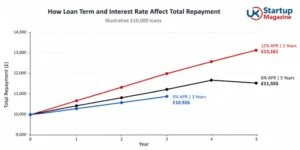
Consider these illustrative £10,000 loans:
| Amount Borrowed | Illustrative APR | Term | Approximate Monthly Payment | Approximate Total Interest | Approximate Total Repayment |
| £10,000 | 6% | 3 years | £303.50 | £925.99 | £10,925.99 |
| £10,000 | 6% | 5 years | £192.59 | £1,555.39 | £11,555.39 |
| £10,000 | 12% | 5 years | £219.36 | £3,161.42 | £13,161.42 |
Calculations assume equal monthly repayments, no fees and a monthly interest rate equivalent to the stated APR. Totals use unrounded repayments. Actual lender calculations, payment dates and final-payment rounding may differ.
Extending the 6% loan from three to five years reduces the monthly payment by about £111 but adds approximately £629 to the interest cost.
That does not automatically make the shorter term suitable. A repayment of £303.50 is only useful if your budget can sustain it. If neither term leaves enough room for essential spending, consider reducing or delaying the borrowing.
When Could Borrowing Slightly More Cost Less?
Some lenders reduce their rate at particular borrowing thresholds. A small increase in the amount can occasionally lower both the repayment and the total paid back.
For example, suppose a hypothetical lender offers £7,300 at 8% APR over five years, but £7,500 at 6% APR over the same period.
Using the calculation assumptions above:
- The £7,300 loan costs approximately £147.04 a month and £8,822.66 in total
- The £7,500 loan costs approximately £144.44 a month and £8,666.54 in total
In this example, the larger loan provides £200 more while reducing total repayment by approximately £156. These are hypothetical rates, not a live offer.
The result depends on qualifying for the lower rate and keeping the comparison consistent. Do not assume borrowing more always creates a saving, and do not use the extra amount as a reason to increase spending.
What Should You Check When Comparing And Accepting Loan Offers?
Once you have suitable quotes, compare the complete agreements. A headline percentage does not describe every cost or condition that could matter during repayment.
Compare Personal APRs, Fees And Total Repayment
Use the same borrowing amount and term wherever possible. Comparing a three-year quote with a seven-year quote mainly shows the effect of the different repayment periods.
| Comparison Point | What To Check |
| Personal APR | Whether the figure is your offered rate or an advertised example |
| Monthly payment | Whether it fits your budget throughout the term |
| Total amount repayable | The full scheduled repayment, including relevant fees |
| Fees | What is already included in the APR and total, plus any charges that depend on later events |
| Overpayments | Whether extra payments reduce the term, monthly payment or both |
| Payment breaks | Whether interest continues and increases the total cost |
Do not add an arrangement fee twice if it is already included in the total repayment figure. Also check that the cash you receive matches the amount you need, particularly where a fee is deducted from the advance.
Understand Overpayments, Early Settlement And Withdrawal Rights
Partial overpayments reduce part of the debt. Full early settlement closes the loan. The costs and procedures can differ.
Tesco Bank, for example, allows extra repayments without fees but states that a two-month interest charge applies when its loan is settled in full early. Request a settlement figure before clearing a loan, rather than relying only on the balance displayed in an app.
For a typical regulated personal loan, you generally have 14 days to withdraw, starting from the agreement date or receipt of the agreement, whichever is later.
After giving notice, you normally have up to 30 days to repay the money, together with applicable interest for the period you had it.
Withdrawal from the credit agreement does not necessarily cancel a separate purchase funded by the loan.
Verify The Lender And Watch For Loan-Fee Scams
The FCA warns about fraudsters who promise loans and then demand advance payments, sometimes described as insurance, deposits or administration charges.
Check the firm through the FCA’s official checking service and verify the contact details independently. A familiar company name or registration number can be copied by a scammer.
Be cautious if someone pressures you to pay immediately, requests unusual payment methods or claims that approval is guaranteed without meaningful checks.
Some genuine brokers charge disclosed fees, so investigate the firm and the written terms rather than judging legitimacy from the existence of a fee alone.
Can Self-Employed Applicants Get Low-Interest Personal Loans?
Self-employed applicants can qualify for personal loans, although income evidence and eligibility requirements vary. Santander, for example, includes self-employed people among the employment categories it accepts, subject to its other lending criteria.
Income Evidence And Budgeting For Variable Earnings
Ask the lender which documents it accepts before applying. Nationwide’s published guidance for relevant applications includes recent HMRC tax calculations or SA302 forms, tax year overviews, or an accountant’s certificate as possible evidence for self-employed income.
Different lenders may request different records. There is no universal requirement that every applicant must supply exactly two or three years of accounts.
For your own budget, consider what remains after business expenses, tax provisions and personal commitments. Do not confuse business turnover with money available for household repayments.
If earnings fluctuate, check whether the repayment would remain manageable during a quieter month. A strong month should not be the only basis for deciding what you can borrow.
Personal Borrowing Vs Business Funding
Being self-employed does not automatically make a personal loan suitable for business expenditure. The lender may accept your income while restricting how its loan can be used.
Check the permitted purposes before using borrowing for stock, equipment or business cash flow. If business use is excluded, assess finance designed for that purpose instead. Always describe the intended use accurately.
What If Your Loan Offer Is Expensive Or Your Application Is Declined?
A high-rate offer or rejection is a reason to reassess the application, rather than immediately submit several more. Your next step depends on whether the issue is pricing, eligibility, affordability or inaccurate information.
Check The Offer And Any Reasons Given For Rejection
If the offered APR is higher than expected, review the monthly payment and total cost before accepting. You do not have to accept simply because the lender approved the application or completed a hard search.
After rejection, ask whether the lender can explain the main reason and which credit reference agency it used. It may not disclose its full scoring process, but any information provided can help you identify the next useful action.
Check whether you entered your income, address, employment details and borrowing purpose correctly. Genuine errors should be corrected through the lender’s process. Do not change accurate information simply to make the application appear stronger.
Consider Borrowing Less, Waiting Or Seeking Debt Support
A smaller loan or an improved financial position may produce different options, but neither guarantees approval. With poor credit, the lowest advertised rates may be unavailable even when a lender is willing to lend.
Depending on the circumstances, consider:
- Reducing the purchase cost or saving towards part of it
- Waiting for corrected credit information to appear
- Reducing existing balances where affordable
- Checking suitable credit-union options
- Getting free debt advice if current commitments are already difficult
MoneyHelper can help you find free debt advice. If you already have a loan and expect difficulty making a repayment, contact the lender before the payment is missed where possible.
Could An Alternative Be Cheaper Than A Personal Loan?
The right comparison depends on whether you need to buy something, receive cash or reduce existing debt. Products that look similar can serve different purposes.
| Borrowing Option | Potential Use | Main Cost Or Restriction |
| 0% purchase credit card | Paying a retailer for eligible purchases | Requires sufficient credit limit and repayment before the promotional period ends |
| Money transfer credit card | Moving money into your bank account | Usually involves a transfer fee and a limited promotional period |
| Balance transfer credit card | Moving eligible existing credit-card debt | Transfer fees, provider restrictions and a promotional deadline may apply |
| Credit-union loan | Borrowing through an eligible membership organisation | Membership rules, affordability checks and rates vary |
| Employer loan | An approved expense such as a travel season ticket | Availability, permitted use and repayment arrangements depend on the employer |
When Can A 0% Credit Card Reduce Borrowing Costs?
A purchase card can provide interest-free borrowing on eligible spending during its promotional period. You need enough available credit and a repayment plan that clears the balance before the offer ends.
For example, a £2,400 purchase spread across a hypothetical 24-month interest-free period requires £100 a month to clear, assuming no fees or additional spending. Aiming to finish earlier gives you some room for disruption.
Minimum payments are still required. Paying only the minimum may leave a balance when the promotion expires, and missing required payments can put the offer at risk.
A 0% money transfer can still have an upfront cost. A hypothetical 3% fee on £2,000 adds £60. Include that fee when comparing it with a personal loan, and check whether it is added to the card balance or handled differently.

Will Debt Consolidation Actually Save You Money?
Compare what you would pay from today by keeping your existing debts with what you would pay under the replacement loan. Include any settlement costs and avoid treating interest already paid as a future saving.
Consider this hypothetical example:
|
Option |
Balance Financed | APR | Remaining Term | Approximate Monthly Payment |
Approximate Future Total Repayment |
| Keep the existing loan | £6,000 | 20% | 12 months | £551.14 | £6,613.69 |
| Replace it with a consolidation loan | £6,000 | 10% | 36 months | £192.39 | £6,926.08 |
These calculations use the earlier assumptions and exclude settlement charges, new fees and further borrowing.
The replacement cuts the rate and monthly payment, but increases future repayment by about £312 because the debt lasts longer. Charges could increase the difference further.
Consolidation can simplify payments, but it does not remove the debt. Avoid running up fresh balances on credit accounts that the new loan has cleared.
Frequently Asked Questions
What Credit Score Do You Need For A Low-Interest Personal Loan?
There is no universal minimum score. Lenders assess your credit history, income, existing debts and affordability using their own criteria.
Does Checking Loan Eligibility Affect Your Credit Score?
A soft-search eligibility check does not affect your credit score. A formal application usually involves a hard search, so check before proceeding.
Does Your Existing Bank Always Offer The Lowest Interest Rate?
No. Your bank may offer competitive customer pricing, but comparing personalised quotes from other lenders could reveal a cheaper option.
Can Self-Employed People Get Low-Interest Personal Loans?
Yes, subject to the lender’s eligibility and affordability checks. You may need tax calculations, accounts or other accepted evidence of income.
Can You Decline A Loan If The Offered Rate Is Too High?
Yes. You do not have to accept an offer simply because your application was approved or the lender completed a credit check.
How Long Is A Personal Loan Quote Valid?
Validity varies between lenders. Check the quote’s expiry date and conditions, as changing your borrowing amount or repayment term may change the offer.
Will A Bank Of England Rate Cut Reduce My Loan Repayments?
An existing fixed-rate personal loan normally keeps its agreed rate and scheduled repayments. A Bank Rate cut does not automatically make that loan cheaper.