
How does HMRC collect tax on savings interest? For most employed people and pensioners, HM Revenue & Customs collects any tax owed on savings interest by adjusting their PAYE tax code. Banks and building societies report interest paid to HMRC after the tax year ends, allowing it to calculate any tax liability.
People who complete Self Assessment normally declare their savings interest on their annual tax return. Others may receive a Simple Assessment bill if HMRC cannot collect the tax through PAYE.
For the 2026/27 tax year, basic-rate taxpayers generally receive a £1,000 Personal Savings Allowance, higher-rate taxpayers receive £500, and additional-rate taxpayers receive no Personal Savings Allowance.
However, the Autumn Budget announced on 28 October 2026 introduces an important change. From 6 April 2027, the government plans to increase savings income tax rates to 24%, 44% and 49%, making tax-efficient savings more important for people with substantial cash balances.
Our analysis focuses on how the collection system actually works, how much interest can be received without tax, what can go wrong with HMRC estimates, and how savers, business owners and company directors can manage their obligations.
Key takeaways:
- Banks normally pay interest without deducting Income Tax and report the interest to HMRC.
- HMRC usually collects tax on savings interest through PAYE, Self Assessment or Simple Assessment.
- The Personal Savings Allowance is £1,000 for basic-rate taxpayers, £500 for higher-rate taxpayers and £0 for additional-rate taxpayers.
- Savings interest exceeding £10,000 in a tax year normally requires a Self Assessment tax return.
- Interest inside a qualifying Cash ISA is generally free from Income Tax.
- The October 2026 Budget announced that the Cash ISA contribution limit will remain £20,000 from April 2027.
- HMRC’s estimates should be checked because incorrect figures can lead to excessive deductions.
How Does HMRC Know How Much Interest You Earn on Savings?
HMRC receives information about savings interest directly from banks and building societies through annual reporting arrangements.
Since April 2016, UK banks have generally paid savings interest gross, meaning without deducting basic-rate Income Tax beforehand.
This does not mean the interest is automatically tax-free. It means that HMRC usually deals with any tax liability after receiving information about the interest paid.
The reporting process normally follows five stages:
- You earn interest from an eligible savings account.
- Your bank or building society records the interest paid during the tax year.
- After the tax year ends on 5 April, the institution reports the relevant information to HMRC.
- HMRC combines the interest information with your other taxable income and applicable allowances.
- If tax is due, HMRC arranges collection through an appropriate method.
Where someone has several savings accounts, HMRC generally combines the reported interest when calculating the total savings income.
For example, consider someone earning:
| Savings account | Annual interest |
| Easy-access savings | £450 |
| Fixed-rate savings | £680 |
| Regular savings | £170 |
| Total savings interest | £1,300 |
If that person qualifies for the £1,000 Personal Savings Allowance, £300 would normally be taxable.
At the 2026/27 basic savings rate of 20%, the tax liability would be £60.
The important point is that HMRC looks at combined taxable interest, not whether individual accounts exceed £1,000.
Our assessment is that this is particularly relevant for savers who move money between accounts or open several products to take advantage of introductory interest rates.
How Much Savings Interest Can You Earn Tax-Free in 2026/27?
The amount of savings interest you can receive without paying tax depends on your total taxable income, your tax band and the available savings allowances.
Three provisions may apply: the Personal Allowance, the starting rate for savings and the Personal Savings Allowance.
Personal Savings Allowance
The Personal Savings Allowance allows eligible taxpayers to receive a specified amount of savings interest at a 0% tax rate.
| Income Tax position | 2026/27 Personal Savings Allowance | Normal savings tax rate |
| Basic rate | £1,000 | 20% |
| Higher rate | £500 | 40% |
| Additional rate | £0 | 45% |
Your tax band is determined using your relevant total taxable income, including savings interest. Consequently, an individual close to a higher-rate threshold may need a more detailed calculation.
Personal Allowance
The standard Personal Allowance remains £12,570 for 2026/27, although it is reduced for people with adjusted net income above £100,000.
If your wages, pension or other income have not used your full Personal Allowance, the unused amount may shelter savings interest.
Starting Rate for Savings
People with relatively low non-savings income may qualify for an additional 0% starting rate on up to £5,000 of savings interest.
The full £5,000 starting-rate band is generally available when non-savings income does not exceed the Personal Allowance.
For every £1 of non-savings income above the Personal Allowance, the available starting-rate band is normally reduced by £1.
For example, someone earning £14,000 from employment would have:
- £12,570 covered by the standard Personal Allowance.
- £1,430 of employment income above that allowance.
- A starting-rate savings band reduced from £5,000 to £3,570.
- A potential further £1,000 Personal Savings Allowance, assuming basic-rate status.
This means that person could potentially receive £4,570 of savings interest at 0%, subject to their other circumstances.
A common financial planning mistake is assuming every taxpayer can earn only £1,000 in savings interest without tax. For some lower-income individuals and pensioners, the combined allowances can provide substantially greater protection.
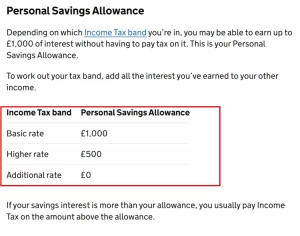
HMRC’s Personal Savings Allowance table showing the £1,000, £500 and £0 thresholds, together with the starting-rate explanation
How Does HMRC Collect Tax Through Your PAYE Tax Code?
For employees and pensioners, HMRC usually collects tax owed on savings interest by changing the tax code used by their employer or pension provider.
Instead of sending a separate demand for payment, HMRC adjusts the amount of income that can be received before PAYE deductions are calculated.
This effectively allows the outstanding tax to be collected through salary or pension payments.
Consider an employee whose taxable savings interest exceeds their allowance by £1,300.
If all that excess interest falls within the 40% savings tax band, the tax liability is:
£1,300 × 40% = £520.
HMRC may collect the £520 through an adjustment to the employee’s tax code.
If the liability were collected evenly across 12 monthly payments, the equivalent would be approximately £43.33 per month. Actual deductions depend on the tax code, payroll arrangements and when HMRC applies the adjustment.
One distinction matters: HMRC may adjust a tax code both to recover tax owed for an earlier year and to account for estimated current-year savings interest.
These are separate adjustments and should not automatically be treated as duplicate taxation.
Why Can Savings Interest Reduce Your Take-Home Pay?
When HMRC adds an untaxed interest adjustment to a PAYE code, the employee’s available tax-free allowance for payroll purposes may fall.
This can result in higher Income Tax deductions even though the employer has not increased or reduced the employee’s actual salary.
It can be confusing for someone who receives the same monthly wages but suddenly notices a smaller net payment.
Before assuming the employer has made a payroll error, it is worth checking PAYE earnings and tax code information against the details supplied by HMRC.
From a business perspective, employees and company directors should understand that an HMRC tax code adjustment is not necessarily evidence of incorrect salary processing.
The responsibility for issuing the tax code rests with HMRC, while the employer normally operates the code it receives.
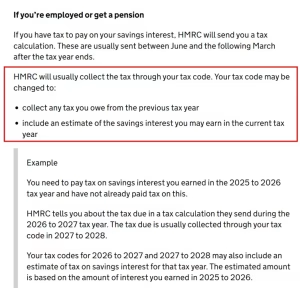
Official HMRC explanation showing how savings interest tax is collected through PAYE and why tax codes may include previous-year liabilities and current-year estimates.
When Does HMRC Collect Tax on Savings Interest?
One of the most misunderstood aspects of savings taxation is the delay between earning interest and paying tax on it.
HMRC may not calculate the final liability until after the relevant tax year has ended.
For example, the official collection process for 2025/26 interest can look like this:
| Stage | Timing | What happens |
| Interest earned | 6 April 2025–5 April 2026 | Banks record taxable savings interest |
| Bank reporting | After 5 April 2026 | Interest details are supplied to HMRC |
| Tax calculation | Usually June 2026–March 2027 | HMRC calculates any overpayment or underpayment |
| Earlier-year tax collection | Usually 2027/28 through PAYE | HMRC may adjust the tax code to recover outstanding tax |
| Current-year estimates | 2026/27 or 2027/28 | Tax codes may also account for estimated savings interest |
This means a tax code issued in 2027 may reflect interest earned in 2025/26 alongside an estimate for interest expected in the current tax year.
We consider this timing difference particularly important for people who receive a temporary lump sum, such as proceeds from selling a property or business.
If someone held £150,000 in an interest-bearing account for several months before using the money, the resulting interest might lead to a later tax code adjustment, even after the original savings balance has disappeared.
What Happens If HMRC Overestimates Your Savings Interest?
HMRC uses historical interest information to estimate how much interest a taxpayer may receive in a later tax year.
These estimates are not always accurate.
Interest rates may fall, an account may be closed, or the saver may withdraw a substantial amount of money.
Consider a higher-rate taxpayer who received £3,000 of taxable savings interest in one year but expects only £400 the following year.
The earlier figure may cause HMRC to include an unnecessarily high interest estimate in the new tax code.
If the taxpayer does not correct this, excessive Income Tax could be deducted until HMRC reconciles the figures.
Sarah Weston, a Chartered Tax Adviser and Technical Officer with the Low Incomes Tax Reform Group, highlighted this concern in January 2026:
“HMRC’s savings interest figures are a useful starting point, but they should not be treated as definitive.”
Her warning reinforces an important distinction: receiving information from banks does not guarantee that every tax calculation is correct.
How to Correct an Incorrect Interest Estimate?
If your estimated savings interest appears wrong, take the following steps:
- Sign in to your HMRC Personal Tax Account.
- Review your Income Tax estimate and tax code.
- Find any adjustment relating to untaxed savings interest.
- Compare the estimate with your bank statements and annual interest certificates.
- Contact HMRC if the interest estimate needs correcting.
- Review the new tax code and subsequent payslip or pension statement.
Useful evidence includes annual statements, account closure confirmations, fixed-term deposit certificates and records of interest paid.
The objective is to make sure HMRC taxes the interest that actually arises, rather than continuing to use an outdated estimate.
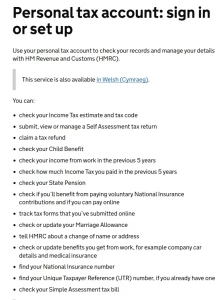
Official HMRC Personal Tax Account service showing that taxpayers can check their Income Tax estimate, tax code and tax records.
What Happens If You Are Self-Employed or Complete Self Assessment?
Self-employed individuals who already complete Self Assessment must normally include taxable savings interest in their annual tax return.
The same principle applies to company directors, landlords and investors who submit Self Assessment returns for other reasons.
Interest is reported separately from trading profits, employment income and dividends.
For example, a sole trader might receive:
| Income source | Annual amount |
| Net business profits | £42,000 |
| Personal savings interest | £1,800 |
| Total before relevant tax adjustments | £43,800 |
Assuming the individual remains within the basic-rate savings band and has no other relevant savings income, the £1,000 Personal Savings Allowance would leave £800 taxable at 20%.
The resulting savings interest tax would be £160 for 2026/27.
The actual Self Assessment calculation could differ if other income, reliefs or rate-band interactions apply.
Anyone completing a return should also understand how savings interest affects their overall tax payment position. The timing of Self Assessment payments and July tax deadlines can be important when planning business cash flow.
Does Earning More Than £10,000 in Savings Interest Trigger Self Assessment?
Yes. HMRC’s general guidance requires individuals earning more than £10,000 in savings interest in a tax year to report it through Self Assessment.
The £10,000 figure is a reporting threshold, not an additional tax-free allowance.
People who already complete Self Assessment should report their savings interest even when their interest is below £10,000.
For the 2025/26 tax year, the normal online filing and balancing-payment deadline is 31 January 2027.
What If HMRC Sends a Simple Assessment Tax Bill?
Some taxpayers cannot have their savings interest liability collected through PAYE and do not already complete Self Assessment.
In these circumstances, HMRC may issue a Simple Assessment calculation.
A Simple Assessment letter, normally identified as PA302, explains the tax due and how payment should be made.
This can happen where:
- You have taxable savings interest but no employment or pension tax code.
- The amount owed cannot reasonably be collected through PAYE.
- HMRC needs to collect other untaxed income alongside savings interest.
For a 2025/26 Simple Assessment received before 31 October 2026, the normal payment deadline is 31 January 2027. If the letter arrives on or after 31 October 2026, the deadline is generally three months from its date.
Always follow the deadline printed on the actual notice.
Myrtle Lloyd, HMRC’s Chief Customer Officer, warned taxpayers in an official announcement:
“If you receive a Simple Assessment letter and have tax to pay, please don’t ignore it.”
This is particularly relevant to savers with substantial interest income who do not receive regular PAYE earnings.
If a Simple Assessment contains incorrect information, HMRC normally requires taxpayers to contact it within 60 days.
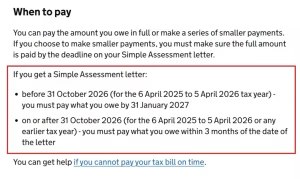
HMRC’s Simple Assessment guidance showing how taxpayers check their calculation, payment deadlines and payment requirements
How Much Tax Will You Pay on Savings Interest in 2026 and 2027?
The 2026 Autumn Budget changes the future tax position for UK savers.
Under the rules for 2026/27, savings income above the applicable allowances is normally taxed at 20%, 40% or 45%, depending on the relevant band.
The government has now announced that these rates will increase from 6 April 2027.
Savings Interest Tax Rates Compared
| Savings tax band | 2026/27 rate | Announced 2027/28 rate | Increase |
| Basic | 20% | 24% | 4 percentage points |
| Higher | 40% | 44% | 4 percentage points |
| Additional | 45% | 49% | 4 percentage points |
These announced rates apply across the UK, including Scotland, where savings income uses UK-wide savings tax rates rather than the Scottish rates applicable to most non-savings employment income.
The 2027/28 rates are Budget announcements intended to be implemented through legislation, so savers should distinguish them from the rates currently in force.
What Percentage of Taxable Interest Will You Keep?
Ignoring the effect of tax-free allowances and assuming all taxable interest falls into a single band, the percentage retained after Income Tax would be:
| Savings tax band | Retained in 2026/27 | Retained under announced 2027/28 rates |
| Basic | 80% | 76% |
| Higher | 60% | 56% |
| Additional | 55% | 51% |
These are calculations of after-tax retention, not customer ratings or survey results.
They show why comparing savings accounts using only the headline interest rate can be misleading.
Example: £50,000 Earning 4.5% Interest
Suppose an individual has £50,000 in an ordinary savings account earning 4.5% annually.
The illustrative annual interest is £2,250.
| Calculation | Basic-rate taxpayer | Higher-rate taxpayer | Additional-rate taxpayer |
| Gross interest | £2,250 | £2,250 | £2,250 |
| Personal Savings Allowance | £1,000 | £500 | £0 |
| Interest above allowance | £1,250 | £1,750 | £2,250 |
| Tax at 2026/27 rate | £250 | £700 | £1,012.50 |
| Net interest in 2026/27 | £2,000 | £1,550 | £1,237.50 |
| Tax at announced 2027/28 rate | £300 | £770 | £1,102.50 |
| Net interest in 2027/28 | £1,950 | £1,480 | £1,147.50 |
Illustrative calculations assume the taxpayer remains in the stated rate band, receives no other taxable savings interest and is not entitled to additional savings reliefs.
For the higher-rate taxpayer, the announced changes would increase the tax bill by £70 annually on the same £2,250 interest.
That might appear modest in isolation. However, people holding significantly larger deposits, such as business-sale proceeds or inheritance money, could experience a greater absolute increase.
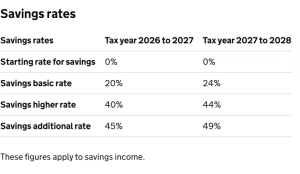
Official government comparison of savings tax rates for 2026/27 and 2027/28, showing 20% rising to 24%, 40% to 44%, and 45% to 49%.
Does HMRC Tax Interest From Fixed-Rate Savings Bonds?
Fixed-rate savings products can create a different timing issue from ordinary easy-access accounts.
The key question is generally when the saver becomes entitled to the interest and can access it under the product’s terms.
Some fixed-term products pay interest into an accessible account annually, while others retain interest until maturity.
For example, suppose someone invests £40,000 in a two-year fixed-term product at an illustrative rate of 4% annually.
Depending on the contract, interest might become taxable annually or when the account matures and the accumulated interest becomes available.
This matters because receiving two years of interest in one tax year can push a saver over their Personal Savings Allowance.
The saver should check the terms rather than assuming interest is always taxable in the year it economically accrues.
Our financial assessment is that the timing of interest entitlement can be as important as the advertised interest rate when choosing between fixed and easy-access products.
Does HMRC Tax Savings Interest From Joint Accounts?
Joint savings accounts are normally treated as producing interest shared equally between the account holders.
For example, a joint account earning £2,000 annually would usually be treated as producing £1,000 of interest for each of two equal owners.
Each person’s own income and savings allowances then determine whether they owe tax.
| Account holder | Share of interest | Personal Savings Allowance | Taxable excess |
| Partner A: basic-rate taxpayer | £1,000 | £1,000 | £0 |
| Partner B: higher-rate taxpayer | £1,000 | £500 | £500 |
Partner B would normally owe £200 at the 2026/27 higher savings rate of 40%, assuming no other relevant interest or reliefs.
The corresponding amount under the announced 2027/28 higher savings rate of 44% would be £220.
Where beneficial ownership is genuinely unequal, the tax treatment may differ. Special rules apply to certain accounts held by spouses and civil partners, and the appropriate HMRC declaration may be required.
The account title alone is not always sufficient evidence of the true ownership position.
What Types of Savings Interest Does HMRC Tax?
Taxable savings income can come from several sources beyond ordinary bank accounts.
| Savings or investment product | General UK tax position |
| Standard savings accounts | Interest potentially taxable |
| Fixed-term savings accounts | Interest potentially taxable when it arises for tax purposes |
| Building society accounts | Interest potentially taxable |
| Credit union savings | Interest may be taxable |
| National Savings & Investments interest-bearing products | Interest may be taxable, depending on the product |
| Peer-to-peer lending | Interest generally taxable under applicable rules |
| Corporate bonds and gilts | Interest generally taxable, subject to product-specific rules |
| Cash ISAs | Qualifying interest generally exempt |
| Premium Bonds | Prizes exempt from UK Income Tax |
| Junior ISAs | Qualifying interest generally exempt |
Not all payments received from banks qualify as savings interest.
For example, some cash rewards for maintaining or using an account are treated differently from interest calculated on a balance.
This distinction matters because non-interest rewards may not qualify for the Personal Savings Allowance, even though they are paid by a bank.
Can a Cash ISA Help You Avoid Tax on Savings Interest?
A Cash ISA is one of the principal ways individuals can receive qualifying savings interest without paying UK Income Tax on it.
The interest earned inside an ISA generally does not use the Personal Savings Allowance.
In addition, Cash ISA contributions do not count as taxable income.
For 2026/27, the standard adult ISA subscription limit is £20,000.
Importantly, the October 2026 Budget announced that the government will retain the £20,000 Cash ISA contribution limit for adults from April 2027, reversing the earlier proposed £12,000 restriction for people under 65.
This is a significant development for people who prefer cash savings over investment products.
Is a Cash ISA Always Better Than an Ordinary Savings Account?
Not necessarily.
Suppose an ordinary savings account offers 5% annual interest while a Cash ISA offers 4%.
If a basic-rate taxpayer has sufficient unused Personal Savings Allowance, the ordinary savings account may produce a higher net return.
However, if a higher-rate taxpayer has already exhausted their allowance, the tax treatment can change the comparison.
For example, £20,000 at 5% produces £1,000 of gross annual interest.
If all that interest were taxable at 40%, the amount retained would be £600.
A Cash ISA paying 4% on £20,000 would produce £800 of tax-free interest.
Although its headline rate is lower, the Cash ISA would produce the better after-tax return in this example.
The figures depend on the individual’s total savings income, allowance usage and tax band.
People holding more than one Cash ISA with different providers should also monitor their combined annual subscriptions to ensure they remain within the applicable limit.
Do Company Directors and Business Owners Pay Savings Interest Tax Differently?
Business owners should distinguish between interest earned personally and interest earned by a limited company.
These are not the same for tax purposes.
Personal Savings Held by a Director
When a company director earns interest from personal bank accounts, the normal personal savings taxation rules apply.
The director may be entitled to the Personal Savings Allowance, depending on their total income.
Salary, dividends and other income can affect the applicable income tax bands, meaning some directors may pay higher-rate or additional-rate tax on savings interest even if their monthly salary is relatively modest.
Money Held in a Limited Company Account
Interest earned on cash belonging to a limited company generally forms part of the company’s taxable income and is subject to Corporation Tax rules.
It does not qualify for the director’s personal £1,000 or £500 Personal Savings Allowance.
For example, if a company earns £3,000 of bank interest on retained cash reserves, that interest should be considered within the company’s Corporation Tax computation.
The applicable Corporation Tax treatment depends on the company’s circumstances and relevant rules.
A director should not transfer company money into a personal ISA merely to secure tax-free interest without considering the legal and tax consequences of extracting those funds.
Our assessment is that this distinction is particularly important for founders who retain significant business cash for future operations, tax liabilities or expansion.
Tax-efficient personal saving should be planned separately from corporate treasury management.
Does HMRC Collect Tax on Foreign Savings Interest?
UK tax residents are generally subject to UK tax on taxable foreign savings interest, subject to any applicable reliefs or special rules.
Foreign interest can arise from overseas savings accounts, fixed deposits and other interest-bearing arrangements.
Unlike many domestic accounts, foreign savings information may not appear in HMRC’s ordinary bank-reporting calculations in the same way.
Although international tax information-sharing arrangements exist, individuals should not assume that automatic reporting removes their disclosure responsibilities.
Foreign income commonly needs to be reported through Self Assessment where a return is required.
If foreign tax has already been charged on the interest, Foreign Tax Credit Relief may be available, subject to the relevant requirements.
Foreign currency interest also needs to be translated into sterling for UK tax calculations using an appropriate exchange-rate basis.
This can be especially relevant for UK-resident entrepreneurs receiving international income or maintaining personal savings outside the UK.
Do Children Have to Pay Tax on Their Savings Interest?
Children can receive savings interest, and their own tax allowances may apply.
However, special rules affect income generated by money given by parents.
If money gifted by a parent produces more than £100 of relevant income for a child during a tax year, the income can be treated as the parent’s income for tax purposes.
The £100 test generally applies separately to gifts from each parent.
For example, if a parent provides funds that generate £150 in annual interest for their child, the full £150 may be attributed to that parent, rather than only the £50 above the threshold.
The attribution does not automatically mean tax must be paid. The parent’s own available allowances and tax circumstances remain relevant.
The rule does not normally apply to qualifying Junior ISA interest, and gifts from grandparents or other relatives are subject to different treatment.
For families building long-term savings, account ownership and the source of deposits should be considered alongside the interest rate.
How Can You Check Whether HMRC Has Calculated Your Savings Interest Correctly?
Our review of the collection process identifies several areas where discrepancies can arise.
The most important are incorrect estimates, missing accounts, duplicated interest entries, wrongly attributed joint-account income and interest assigned to the wrong tax year.
A practical annual reconciliation should include:
- Downloading interest certificates from every bank and building society.
- Checking accounts opened or closed during the tax year.
- Separating taxable interest from ISA interest and tax-free prizes.
- Confirming how joint-account interest has been allocated.
- Checking when interest from fixed-term products became taxable.
- Comparing the total with HMRC’s tax calculation or Self Assessment records.
Someone estimating future interest from their savings can also use a compound interest calculator to understand potential growth, although a projection is not a substitute for actual annual interest certificates and may not account for Income Tax.
This reconciliation is especially valuable where balances fluctuate significantly throughout the year.
What If You Have Already Paid Too Much Tax on Savings Interest?
Taxpayers may be entitled to a refund if HMRC has collected more savings interest tax than was actually due.
This can occur where an estimate proves too high or an allowance was not correctly applied.
For the current tax year, HMRC may correct the position by issuing an amended tax code.
For earlier tax years, the available process depends on whether the individual completes Self Assessment.
Taxpayers using Self Assessment normally claim adjustments or repayments through the return or the relevant correction process.
Others may be able to claim using form R40, depending on their circumstances.
Refund claims are generally subject to a four-year time limit from the end of the relevant tax year.
Someone who has already submitted a repayment claim can review the HMRC repayment status process to understand the difference between a pending repayment and an issued payment.
Where HMRC has deducted too much tax through PAYE, correction of the tax code may also result in an adjustment through subsequent salary or pension payments.
How Can Pensioners Manage Savings Interest Tax?
Pensioners can be particularly affected by savings tax calculations because their taxable income may come from several different sources.
These can include the State Pension, workplace pensions, private pensions and interest-bearing savings.
A pensioner with relatively low non-savings income may qualify for the starting rate for savings in addition to the Personal Savings Allowance.
Someone receiving larger pension payments may instead be subject to higher-rate savings taxation.
It is important to distinguish between interest that is taxable and interest on which tax is ultimately payable after applying allowances.
The wider impact of pensioner income tax changes can be relevant when savings interest pushes total taxable income into a higher band.
Pensioners should also review any PAYE tax code adjustments against their pension statements, particularly where large savings balances have been withdrawn or moved into tax-free accounts.
What Should You Do If Your Savings Interest Exceeds the Tax-Free Allowance?
Exceeding your Personal Savings Allowance does not necessarily mean that you must immediately register for Self Assessment.
For many PAYE taxpayers, HMRC will receive the information from banks and arrange collection automatically.
However, taxpayers remain responsible for checking whether their tax affairs have been handled correctly.
If you know that tax is due but HMRC has not contacted you or issued a calculation by 31 March of the tax year following the year in which the interest arose, HMRC instructs you to contact it.
For example, where tax is owed on interest earned during 2025/26, the relevant date would be 31 March 2027.
A sensible approach is to maintain records throughout the year rather than relying entirely on HMRC to identify discrepancies later.
For larger balances, consider setting aside a proportion of taxable interest to meet a future tax bill.
What Is Our Financial Assessment of HMRC’s Savings Tax Collection System?
From an administrative perspective, automatic bank reporting and PAYE collection reduce the amount of paperwork required from many UK savers.
However, the system is not entirely automatic from the taxpayer’s point of view.
Our assessment identifies three practical priorities.
First, taxpayers should calculate their total savings interest rather than reviewing each account separately.
Second, they should understand that tax collection can lag behind the year in which the interest was earned, sometimes producing unexpected PAYE deductions.
Third, the changes announced for April 2027 make after-tax return comparisons increasingly important.
For business owners and entrepreneurs, the distinction between personal cash and company-owned deposits adds another layer of financial planning.
Keeping reliable records, reviewing interest estimates and using available tax-free savings arrangements can help reduce unnecessary tax costs without creating additional compliance risks.
Conclusion
Understanding how HMRC collects tax on savings interest is essential for anyone holding substantial savings, particularly employees, pensioners, company directors and self-employed individuals.
For most PAYE taxpayers, the process begins with annual information supplied by banks and building societies. HMRC then calculates any liability and usually collects it through adjustments to the taxpayer’s tax code.
Self Assessment and Simple Assessment provide alternative methods where automatic PAYE collection is not appropriate.
For 2026/27, the £1,000 and £500 Personal Savings Allowances remain important protections, while the starting rate for savings can provide additional relief for eligible lower-income taxpayers.
Looking ahead, the October 2026 Budget’s announced increase in savings income tax rates from April 2027 means that after-tax returns will matter even more.
Our overall assessment is that savers should review their total interest annually, understand the timing of HMRC tax code changes, check tax calculations against actual account records and use legitimate tax-efficient savings arrangements where appropriate.
The objective is not simply to minimise tax. It is to ensure that the correct amount is collected, at the correct time, while preserving as much of the return on savings as the law allows.
Frequently Asked Questions
Does HMRC Automatically Collect Tax on Savings Interest?
Usually, yes, for PAYE taxpayers whose savings interest is reported by UK banks. HMRC may adjust their tax code or issue a separate tax calculation if necessary.
How Much Savings Interest Is Tax-Free in 2026/27?
The Personal Savings Allowance is £1,000 for basic-rate taxpayers, £500 for higher-rate taxpayers and £0 for additional-rate taxpayers. Other allowances may also apply.
Will HMRC Take Savings Tax Directly From My Bank Account?
Normally not. UK banks generally pay savings interest gross. HMRC collects any tax owed separately through PAYE, Self Assessment or Simple Assessment.
Why Has My Tax Code Changed Because of Savings Interest?
HMRC may have included taxable interest from an earlier tax year or estimated interest for the current year. Check the calculation against your bank statements.
Do I Need to Declare Savings Interest Below £1,000?
Not usually if you are an ordinary PAYE taxpayer and HMRC can deal with your tax automatically. If you already complete Self Assessment, you should report your savings interest.
Can HMRC Tax Savings Interest From Previous Years?
Yes. HMRC can calculate unpaid tax after a tax year ends and may collect it through a later PAYE tax code or issue another form of assessment.
What Happens If My Savings Interest Is More Than £10,000?
You will normally need to report it through Self Assessment, even though the tax-free amount depends on your own allowances and circumstances.
Do Scottish Taxpayers Pay Different Savings Interest Tax Rates?
Savings income uses UK-wide savings tax rates. The announced 2027/28 rates of 24%, 44% and 49% are intended to apply throughout the UK.
Will Savings Interest Tax Increase in April 2027?
The October 2026 Budget announced savings tax rates of 24%, 44% and 49% from 6 April 2027, subject to implementation through the legislative process.
Is Cash ISA Interest Reported as Taxable Savings Income?
Qualifying Cash ISA interest is generally exempt from Income Tax and does not use the Personal Savings Allowance.