
Claims that the Department for Work and Pensions (DWP) has announced a £750 payment boost have attracted considerable attention among Universal Credit claimants, pensioners and people receiving disability benefits.
With household budgets still under pressure, the possibility of an additional £750 payment understandably raises questions about eligibility and payment dates.
However, there is no confirmed nationwide £750 DWP Cost of Living Payment for 2026. The government’s official guidance states that no new Cost of Living Payments are scheduled and no further payments are currently planned under the previous scheme.
Interestingly, the £750 figure does relate to a genuine financial support arrangement offered through the Motability Scheme.
However, this is a restricted vehicle-related payment with specific eligibility rules, not an automatic payment for everyone receiving benefits.
We analysed the published DWP guidance, historical Cost of Living Payments, Motability’s payment conditions and the confirmed benefit increases for 2026–27 to establish what households can actually expect.
Our findings reveal important differences between online payment rumours, existing disability-related support and legitimate increases in benefit entitlement.
Has the DWP Really Announced a £750 Payment Boost for 2026?
No. As of 30 October 2026, the government has not announced a new £750 Cost of Living Payment for people receiving Universal Credit, Pension Credit, Personal Independence Payment (PIP) or other benefits.
The distinction is important because several online discussions have presented the payment as though it were an established government initiative.
The official cost of living guidance confirms that there will be no Cost of Living Payment in 2026.
What Does Our Verification Review Show?
We used four checks to assess the claims: a published primary-source announcement, official eligibility rules, a confirmed payment process and identification of the organisation administering the scheme.
The percentage ratings below describe how many of these four checks were satisfied. They are editorial evidence scores, not public opinion statistics or probabilities of receiving money.
| Payment claim | Verification rating | Current position |
| New nationwide £750 DWP payment | 0% | No official scheme identified |
| £750 Motability New Vehicle Payment | 100% | Genuine, restricted eligibility |
| 2026–27 Universal Credit standard allowance increase | 100% | Confirmed benefit uprating |
| New £750 automatic payment for every PIP claimant | 0% | No such universal entitlement |
| Return of the previous Cost of Living Payment programme | 0% | No new payments planned |
Our review demonstrates why a payment amount should never be accepted as genuine without checking its eligibility conditions.
An advertised amount is not the same as an entitlement. Much like assessing online gaming rewards or promotional offers, the crucial details are who operates the scheme, who qualifies and exactly when money becomes payable.
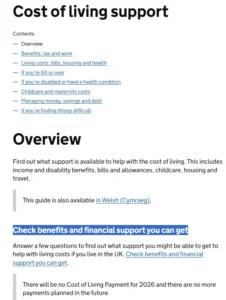
Official government guidance confirming that no new Cost of Living Payments are scheduled for 2026.
Why Did the £750 DWP Payment Rumour Start?
The discussion initially gained momentum during 2025, when online reports suggested that the government was preparing another round of financial assistance for low-income households.
Some claims described the payment as a one-off, tax-free benefit boost intended to help people meet rising energy, food and housing costs.
Others suggested that eligible claimants would automatically receive £750 without submitting an application.
However, these reports were not accompanied by an official DWP announcement.
The confusion appears to involve several overlapping factors.
Previous Cost of Living Payments
Between 2022 and 2024, eligible households received additional payments through government support programmes. Because those payments were genuine, subsequent announcements claiming a similar payment could appear credible.
The Existing Motability Payment
A legitimate £750 payment exists through the Motability Scheme. However, it relates to a vehicle arrangement and has strict eligibility requirements.
Annual Benefit Uprating
Many benefits increase annually. Some claimants may receive several hundred pounds more over a complete year, but this is different from receiving a £750 lump sum.
Unverified Online Announcements
Social media posts sometimes repeat figures without explaining the source, date or qualifying conditions.
We found that the most important omission in questionable reports was a direct connection between the advertised payment and an identifiable government policy.
Readers should also distinguish this rumour from the separate £500 Cost of Living Payment claims, which have generated similar confusion.
What Is the Genuine £750 Motability Payment?
One of the clearest explanations for the £750 figure is the Motability Scheme’s New Vehicle Payment.
Motability provides eligible disabled people with access to vehicles through qualifying mobility allowances.
The New Vehicle Payment was introduced to help customers manage the rising cost of vehicles.
Under the published scheme conditions, eligible customers can receive £750 as a one-time payment.
However, it is not a payment distributed automatically to everyone receiving disability benefits.
Who Qualifies for the £750 Motability Payment?
The qualifying order date is particularly important.
Customers who ordered their first Motability vehicle on or before 3 January 2025 may qualify for the payment.
Customers who ordered their first vehicle from 4 January 2025 onwards are not eligible for this particular New Vehicle Payment.
| Eligibility condition | Does it qualify? |
| First eligible Motability vehicle ordered by 3 January 2025 | Yes, subject to scheme conditions |
| First vehicle ordered from 4 January 2025 | No |
| Existing eligible customer who has not yet received the payment | May receive it with their next vehicle |
| Person receiving PIP but not participating in an eligible vehicle arrangement | No automatic entitlement |
| Person receiving Attendance Allowance alone | No |
| Customer who has already received the one-time payment | Cannot receive it again |
An important distinction concerns disability-benefit eligibility.
Receiving PIP does not, by itself, establish entitlement to a £750 payment. Motability generally requires a qualifying mobility allowance, such as the enhanced-rate mobility component of PIP or higher-rate mobility component of Disability Living Allowance.
Attendance Allowance alone does not qualify someone to join the Motability Scheme.
When Is the £750 Motability Payment Issued?
For eligible customers, Motability offers two main payment arrangements.
Payment Towards the Vehicle’s Advance Payment
Customers may choose to put the £750 towards the Advance Payment for their vehicle.
If the Advance Payment exceeds £750, they are responsible for the difference.
If it is lower than £750, the remaining amount may be paid to the customer after they receive the vehicle.
Payment Directly To the Customer
Alternatively, customers may choose to receive the full £750 after collecting their new vehicle.
Motability states that this is generally paid within a few weeks of receiving the vehicle.
Eligible customers do not need to submit a separate application for the New Vehicle Payment.
The official Motability payment information explains the eligibility restrictions and payment arrangements.
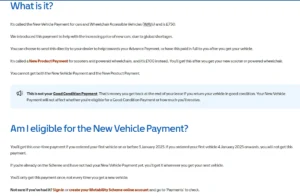
Motability’s official £750 New Vehicle Payment, including the 3 January 2025 eligibility cutoff.
Are Universal Credit Claimants Getting an Extra £750 in 2026?
Universal Credit claimants are not receiving a new nationwide £750 Cost of Living Payment.
However, the government has introduced higher standard allowance rates for the 2026–27 financial year.
These changes increase the standard element of Universal Credit for eligible households, although actual payments depend on earnings, savings, household circumstances, additional elements and deductions.
How Much Have Universal Credit Payments Increased?
We compared the published 2025–26 standard allowances with the confirmed 2026–27 rates.
| Household category | 2025–26 monthly rate | 2026–27 monthly rate | Percentage increase |
| Single, under 25 | £316.98 | £338.58 | 6.81% |
| Single, 25 or over | £400.14 | £424.90 | 6.19% |
| Couple, both under 25 | £497.55 | £528.34 | 6.19% |
| Couple, one or both 25 or over | £628.10 | £666.97 | 6.19% |
These figures demonstrate that benefit increases are real, but they do not establish a separate £750 payment entitlement.
For example, a single claimant aged 25 or over receives a standard allowance increase of £24.76 per month.
Over 12 months, that represents an additional £297.12, assuming the same rate and entitlement apply throughout the year.
For a couple where at least one claimant is aged 25 or over, the standard allowance increase is £38.87 per month.
That equals £466.44 over 12 months, before accounting for any other changes in entitlement.
Our financial analysis shows why annual increases should not be presented as unexpected cash bonuses.
A monthly benefit uprating is part of normal entitlement, whereas a one-off payment is an additional transaction.
Claimants should also be aware that changes to other Universal Credit elements may affect their total award.
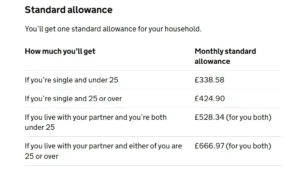
Confirmed Universal Credit standard allowance rates for the 2026–27 financial year.
What Were the Previous Official DWP Cost of Living Payments?
The UK government previously introduced additional support for eligible households during periods of significant inflation and rising energy costs.
Unlike the rumoured £750 payment, those schemes were formally announced and included published payment dates and eligibility rules.
| Payment | Payment period for most eligible DWP claimants | Status |
| £326 | July 2022 | Completed |
| £324 | November 2022 | Completed |
| £301 | April–May 2023 | Completed |
| £300 | October–November 2023 | Completed |
| £299 | February 2024 | Completed |
Eligible households could receive £650 across the two instalments in 2022.
The subsequent three instalments during 2023–24 totalled £900 for people meeting the qualifying conditions for all three payments.
There were also separate disability and pensioner-related Cost of Living Payments under earlier programmes.
For example, an additional £150 Disability Cost of Living Payment was issued to eligible individuals in 2023.
These historical payments should not be confused with a newly announced 2026 entitlement.
The final £299 instalment is particularly relevant because older payment announcements continue circulating online. Our detailed examination of the DWP £299 Cost of Living Payment explains the original qualifying periods and payment arrangements.
Could Someone Still Receive an Old Payment in 2026?
Potentially, yes.
Although the general payment rounds have finished, individual cases can still require corrections.
For instance, a claimant may later be found eligible for an earlier payment because a qualifying benefit was awarded retrospectively.
An appeal, revised entitlement decision or payment-processing issue could also result in an outstanding amount being paid later.
However, this would concern an existing historical entitlement rather than a new £750 programme.
Anyone wondering whether a delayed payment could still arrive can review the circumstances covered in our article on whether another Cost of Living Payment is due.
What Financial Support Is Actually Available in 2026?
Although the £750 payment claim is unsupported, several genuine forms of assistance remain available.
Their eligibility conditions differ, and not every household will qualify.
| Support scheme | Available amount | Main eligibility consideration |
| Universal Credit | Depends on entitlement | Income, household circumstances and qualifying conditions |
| Winter Fuel Payment | £100–£300 | Age, residence and scheme rules |
| Warm Home Discount | £150 | Eligible households and participating energy suppliers |
| Cold Weather Payment | £25 per qualifying seven-day period | Benefits and local temperature conditions |
| Christmas Bonus | £10 | Receipt of qualifying benefits during the qualifying week |
| Crisis and Resilience Fund | Varies locally | Financial hardship and council criteria |
| Budgeting Advance | Depends on circumstances | Existing Universal Credit claim and repayment conditions |
These payments should not be added together and presented as a guaranteed total. Each programme has separate eligibility requirements, payment methods and restrictions.
How Does the Crisis and Resilience Fund Help Households?
A major development since the original £750 rumour emerged is the introduction of the Crisis and Resilience Fund in England.
The programme began on 1 April 2026 and is funded through 31 March 2029.
It replaced the previous Household Support Fund and introduced arrangements for local crisis assistance and financial resilience support.
The programme includes support for people experiencing financial shocks, including sudden income reductions or unexpected essential costs.
Local authorities can also provide housing-related assistance where eligible households face difficulties meeting housing costs.
Importantly, there is no universal £750 award under this programme.
The amount and form of assistance depend on local arrangements and individual circumstances.
Support may involve cash payments, vouchers, housing assistance or other measures.
Another significant point is that some support is available to low-income households that are not already receiving benefits.
The Crisis and Resilience Fund operates in England. Scotland, Wales and Northern Ireland have separate local or devolved assistance arrangements.
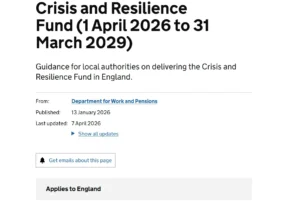
Government guidance explaining the Crisis and Resilience Fund and its support for households facing financial difficulties.
Can Pensioners Receive Additional Help During Winter 2026?
Yes. Eligible pensioners may receive the Winter Fuel Payment for winter 2026–27.
The payment ranges from £100 to £300, depending on qualifying circumstances.
For this winter, the age requirement generally applies to individuals born on or before 27 June 1960.
Most eligible people will receive their payment automatically in November or December 2026, although some must submit a claim.
The government has also introduced an income-based recovery arrangement.
Individuals whose total income exceeds £35,000 may have their Winter Fuel Payment recovered through HMRC.
This makes it important for pensioners to understand both their entitlement and the applicable tax treatment.
We have examined these rules in more detail in our analysis of the Winter Fuel Payment clawback in 2026.
Scotland operates a separate Pension Age Winter Heating Payment scheme.
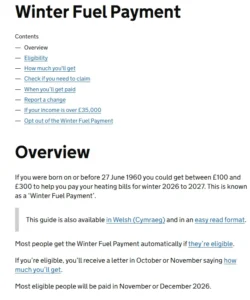
Official Winter Fuel Payment guidance showing the 2026–27 payment range and expected payment months.
What About the £150 Warm Home Discount?
The Warm Home Discount provides eligible households with a £150 reduction in their electricity costs.
Unlike a DWP cash payment, the discount is generally applied directly to an electricity account.
Some prepayment customers may receive assistance through a voucher or another supplier-managed arrangement.
The rules differ between England, Wales and Scotland.
Northern Ireland does not participate in the same Warm Home Discount Scheme.
This means households should check their supplier and regional eligibility before assuming they qualify.
The scheme is particularly relevant to people receiving certain means-tested benefits, including Universal Credit and Pension Credit, where the additional eligibility conditions are satisfied.
Can People Receiving PIP or Disability Benefits Claim £750?
There is no universal £750 payment available simply because someone receives PIP or another disability-related benefit.
However, disabled individuals may qualify for different assistance depending on their award and personal circumstances.
The most important distinction concerns the type of benefit received.
| Benefit or allowance | Automatic £750 payment? | Possible additional support |
| Personal Independence Payment | No | Motability eligibility where qualifying mobility conditions apply |
| Disability Living Allowance | No | Motability eligibility where qualifying mobility conditions apply |
| Attendance Allowance | No | Other applicable pensioner or disability-related support |
| Employment and Support Allowance | No | Applicable benefit uprating and means-tested support |
| Universal Credit disability-related elements | No | Additional UC elements subject to eligibility |
| Adult Disability Payment in Scotland | No | Motability access where qualifying mobility conditions apply |
Receiving one of these benefits does not automatically create entitlement to every associated support programme.
For example, someone receiving the daily living component of PIP but not the enhanced-rate mobility component would not qualify for Motability solely on that basis.
Similarly, a claimant receiving Attendance Allowance cannot assume they are eligible for Motability’s £750 New Vehicle Payment.
Our review suggests that these distinctions are essential when interpreting online announcements.
A headline may describe a payment as disability-related without identifying the actual benefit component, vehicle arrangement or application conditions.
Will the £750 DWP Payment Be Made Automatically?
No automatic payment process exists for the rumoured nationwide £750 DWP Cost of Living Payment.
There is no official application form, qualifying period or scheduled payment date.
Any website claiming that applicants must register their bank details to receive this supposed benefit should therefore be treated cautiously.
For legitimate programmes, arrangements differ.
Universal Credit is generally paid monthly according to the claimant’s established payment schedule.
The Motability New Vehicle Payment follows the separate scheme process for eligible customers.
Winter Fuel Payments are automatic for many eligible pensioners, although some need to claim.
Local crisis assistance often requires an application to the relevant council.
The correct approach is to identify the specific programme before deciding whether any action is necessary.
How Can You Check Whether a DWP Payment Is Genuine?
Our examination of payment announcements suggests that people should verify four essential details before treating a financial offer as legitimate.
- Identify the official organisation. Determine whether the payment comes from DWP, HMRC, a local authority or another recognised scheme provider.
- Check the eligibility rules. Look for clearly published conditions that explain who qualifies and who does not.
- Confirm the payment process. Establish whether the money is automatic, requires a claim or depends on another event.
- Verify the date and amount. Check that the payment window and financial figures appear in an official announcement.
A screenshot of a headline is not enough to demonstrate that a payment has been approved.
Official policy guidance should explain exactly how the money will be administered.
What Are the Warning Signs of a DWP Payment Scam?
Fraudulent messages may refer to government assistance to encourage recipients to reveal personal details.
Common warning signs include:
- Unexpected text messages advertising a £750 payment with an unfamiliar claim link.
- Requests to pay a processing or verification fee.
- Messages demanding bank details or passwords to release supposed government funds.
- Claims that eligibility expires within a few hours.
- Websites impersonating official government services.
- Requests for security codes or identity documents through unverified messaging services.
Not every unexpected message is necessarily fraudulent, and some legitimate government schemes do require applications.
The safest approach is to access the relevant service independently rather than following an unfamiliar link.
People can also compare suspicious communications with the examples discussed in our DWP text message warning article.
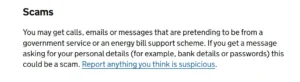
GOV.UK warning about messages impersonating government services or offering financial support.
What Should You Do if You Were Expecting a £750 Payment?
Anyone waiting for a supposed £750 payment should first establish which scheme the information relates to.
If the claim concerns a new nationwide DWP Cost of Living Payment, there is no confirmed payment to chase.
However, people who believe they qualify for an existing programme can follow the appropriate verification process.
| Situation | Recommended action |
| You saw a social media post advertising a £750 DWP payment | Check official government guidance before taking action |
| You are an existing Motability customer | Review your New Vehicle Payment eligibility and online account |
| Your normal Universal Credit payment is missing | Check your Universal Credit account or journal |
| You believe an old Cost of Living Payment was missed | Contact the department responsible for the qualifying benefit |
| You are struggling to pay for essentials | Check council crisis assistance and benefit entitlements |
| You received an unexpected registration link | Do not submit sensitive details until the service is independently verified |
People should also avoid sharing National Insurance numbers, banking details or passwords in public comments or unofficial online forums.
Could the Government Introduce Another £750 Payment in the Future?
Governments can introduce new financial assistance programmes, but future policy decisions should not be confused with existing entitlement.
At present, there is no announced nationwide £750 DWP Cost of Living Payment.
If a new payment were introduced, the government would normally publish eligibility conditions, dates, funding arrangements and administrative guidance.
A new scheme could also have different qualifying rules from previous support programmes.
For instance, an announcement might target particular households, income groups, pensioners or people receiving specific disability benefits.
It would therefore be inappropriate to assume that everyone who received assistance in 2023 or 2024 would automatically qualify for any hypothetical future payment.
Our assessment is that households should make financial decisions based on their current entitlement and confirmed support rather than anticipated announcements.
What Is Our Overall Assessment of the £750 DWP Payment Claim?
After reviewing the official guidance and comparing the advertised payment with existing benefit programmes, we found no evidence supporting a new £750 nationwide DWP payment.
The genuine Motability arrangement explains one legitimate use of the £750 figure, but its eligibility conditions are much narrower than those suggested in some online discussions.
We also confirmed that benefit uprating in 2026–27 has increased Universal Credit standard allowances.
These increases are measurable and meaningful for eligible households, but they are paid through normal entitlement rather than a new £750 bonus.
The introduction of the Crisis and Resilience Fund has also changed the financial support available in England.
Households experiencing a financial emergency may therefore have access to assistance even though the rumoured payment does not exist.
From an evidence-review perspective, the critical difference is between a published financial entitlement and an attractive headline unsupported by official payment rules.
Conclusion: Is the DWP £750 Payment Boost Real?
The DWP has not announced a new nationwide £750 Cost of Living Payment for 2026.
Although the figure has circulated widely, it should not be treated as an upcoming payment for Universal Credit claimants, pensioners or people receiving disability benefits.
A genuine £750 New Vehicle Payment is available to certain eligible Motability customers who meet the historical vehicle-order conditions. However, that arrangement is not a general government cash bonus.
Other support remains available through increased benefit rates, winter assistance, energy discounts and local financial hardship programmes.
Our analysis shows that the most reliable way to identify legitimate payments is to confirm the scheme’s official eligibility criteria, payment method and administering organisation.
For households managing rising living costs, understanding existing entitlements is more useful than planning around an unverified payment announcement.
Frequently Asked Questions
Is the DWP giving everyone £750 in 2026?
No. There is no confirmed nationwide £750 DWP Cost of Living Payment for 2026.
Who is eligible for the £750 Motability payment?
Certain Motability customers who ordered their first vehicle on or before 3 January 2025 may qualify, subject to the scheme’s conditions.
Will Universal Credit claimants receive an additional £750?
No separate £750 payment has been announced. However, Universal Credit standard allowances increased for 2026–27.
Are pensioners receiving a £750 DWP payment?
There is no general £750 payment for pensioners. Eligible individuals may receive support including Winter Fuel Payments and other existing benefits.
Can PIP claimants receive £750 automatically?
No. PIP alone does not provide an automatic £750 payment. Motability’s New Vehicle Payment has separate eligibility conditions.
Is there a £750 DWP application form?
No official application form exists for the rumoured nationwide payment.
What if I missed a previous Cost of Living Payment?
If you believe you met the historical eligibility requirements, contact the department responsible for your qualifying benefit to discuss the situation.
Is the Household Support Fund still available in 2026?
In England, the Household Support Fund was replaced by the Crisis and Resilience Fund from April 2026.
When will the next DWP Cost of Living Payment arrive?
No new nationwide Cost of Living Payments are scheduled under the previous programme.
How can I confirm future DWP payment announcements?
Check official government information and the eligibility guidance published by the organisation administering the relevant scheme.