

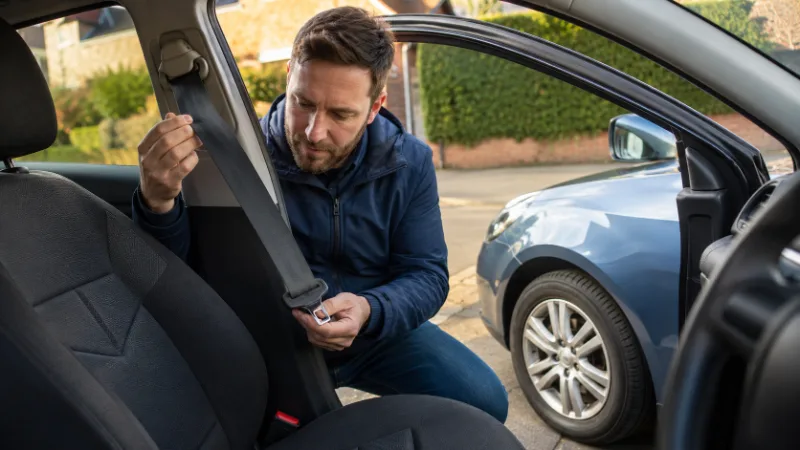
Seat belts are the correct answer to this specific driving theory-test question. They must remain in good condition and work properly. However, your responsibilities extend beyond seat belts. Your car must be roadworthy whenever you drive it, including its brakes, tyres, lights and other safety equipment.
- Theory Test Answer: Seat belts, when choosing between the options in this particular question.
- Everyday Responsibility: Keep the whole vehicle safe and compliant with the requirements that apply to it.
- MOT Reminder: A current certificate does not guarantee that your car remains safe between tests.
Last Updated: 02.09.2026
Why Are Seat Belts the Correct Theory-Test Answer?
Understanding the Question and Its Answer Choices
The question “what part of the car does the law require you to keep in good condition” appears in a multiple-choice format offering door locks, transmission, gearbox and seat belts. The expected answer is seat belts.
The question tests your understanding of safety restraints. A belt must remain capable of protecting its user, with its material, fastening mechanism and mounting points in suitable condition.
Choosing seat belts does not mean that a dangerous fault elsewhere can be ignored. The answer relates to the options in this particular question.
Why Tyres, Brakes and Lights Still Matter Legally?
Tyres, brakes and lights are essential to safe driving and have their own maintenance requirements. They help the vehicle grip the road, stop effectively and remain visible to others.
Confusion arises when a general maintenance checklist is presented as the answer to the specific theory-test question. Remember the seat-belt answer for that question, while treating roadworthiness as a responsibility covering the vehicle as a whole.
What Does Keeping Seat Belts in Good Condition Mean?
Checking the Webbing, Buckles and Retractors
A seat belt needs more than a working buckle. Its material and operating mechanism must also remain suitable for use.
- Webbing: Look for cuts, damage, significant fraying or stretching.
- Buckle: Check that it holds securely and releases correctly.
- Retractor: Check that a retracting belt takes up excess webbing as intended.
These checks can reveal problems, but they do not certify the belt as safe. Have suspected defects professionally assessed.
Recognising Anchorage Problems and Restraint-System Warnings
Loose anchorages or visible damage around mounting points need attention. The DVSA MOT manual treats certain serious anchorage defects as dangerous, while defective buckles, retractors and significantly weakened webbing are major defects.
A seat-belt reminder and an airbag or supplementary restraint system warning are different. An SRS warning indicating a system malfunction is a specific MOT failure item. Consult the handbook when a warning appears.
Which Other Car Parts Must Be Kept in Good Condition?
Several systems contribute to roadworthiness. Some requirements vary with the vehicle’s age, category and equipment, so a rule applying to a modern passenger car may differ from one applying to an older vehicle.
| Car Part | Requirement or Standard | Practical Check |
| Brakes and Parking Brake | Braking systems must function effectively and meet the applicable standards | Treat reduced braking, unusual pedal behaviour or brake warnings as reasons for prompt assessment |
| Tyres | For ordinary cars, at least 1.6mm of tread across the central three-quarters and around the entire circumference, with appropriate pressure and no dangerous damage | Use a tread gauge, inspect visible sidewalls and follow the manufacturer’s pressure guidance |
| Lights, Indicators and Reflectors | Required lighting equipment must meet the applicable operating, visibility and adjustment requirements | Check required lamps work and keep lenses and reflectors clean |
| Windscreen, Wipers and Washers | The driver needs an adequate view, with effective windscreen clearing equipment where required | Check visibility, blade condition, washer operation and fluid supply |
| Mirrors and Rear-View Devices | Required mirrors or approved devices must provide an adequate rearward view | Check they are secure, usable and correctly adjusted |
| Steering and Suspension | Components must remain safe and function correctly | Arrange inspection for unusual looseness, handling changes or concerning noises |
| Exhaust and Emissions Equipment | Exhaust condition, noise and emissions must meet applicable requirements | Investigate leaks, unusual noise, excessive smoke or emissions warnings |
| Number Plates | Registration marks must remain readable and meet the applicable display rules | Remove dirt and check for damage, obscured characters or unsuitable spacing |
Electric cars still need checks covering tyres, friction brakes, lighting, visibility and restraints, even though they do not have a combustion-engine exhaust system.
What Roadworthiness Rules Apply in 2026?
The Legal Framework and Current Official Guidance
In Great Britain, the framework includes the Road Traffic Act 1988, the Road Vehicles (Construction and Use) Regulations 1986 and separate rules covering matters such as lighting and registration plates.
The Highway Code brings together practical maintenance guidance, while the MOT inspection manual sets out how relevant items are assessed during testing.
These serve different purposes, so an MOT classification should not automatically be treated as the penalty for a road traffic offence.
This is guidance for maintaining a vehicle in 2026. The dates in the names of legislation do not mean those requirements have expired.
How Requirements Vary by Vehicle Age and Type?
Mirror fitment is one example. The current MOT manual specifies different arrangements according to vehicle category and date of first use.
For relevant M1 passenger vehicles first used from 26 January 2010, it specifies three mirrors or devices, with an exception where the internal mirror does not provide a rearward view.
Seat-belt fitment and some equipment checks also depend on the vehicle. Avoid assuming every car must have exactly the same equipment.
Differences Between Great Britain and Northern Ireland
The detailed MOT and penalty guidance here focuses on Great Britain. Northern Ireland has its own legislation and testing arrangements, with vehicle testing handled by the Driver and Vehicle Agency.
Drivers in Northern Ireland should use the corresponding DVA and nidirect guidance. The underlying responsibility to keep a vehicle safe remains relevant, but legal references and procedures should not be assumed to be identical.
Does a Valid MOT Guarantee That Your Car Is Safe?
The Difference Between an MOT, Servicing and Ongoing Maintenance
No. An MOT checks specified items at the time of the test. It does not guarantee that faults will not develop afterwards, and it does not replace servicing.
Servicing follows the manufacturer’s maintenance schedule. Regular driver checks help identify problems between workshop visits. For example, damage from a pothole can arise shortly after an MOT pass.
Dangerous, Major and Minor Defects Explained
| MOT Result Item | What It Means | Action |
| Dangerous Defect | A serious problem presenting an immediate risk or other serious impact under the test criteria | Do not drive until repaired |
| Major Defect | A defect serious enough to fail the test | Arrange repairs and check whether taking the vehicle away is lawful |
| Minor Defect | An item that does not cause failure on its own | Repair as soon as possible |
| Advisory | An issue that could become more serious | Monitor it and arrange attention when necessary |
When You Can and Cannot Drive After an MOT Failure?
GOV.UK says you can take a failed vehicle away if its existing MOT remains valid and no dangerous defects were recorded. It must still meet minimum roadworthiness standards.
An unexpired certificate does not authorise driving an unsafe car. If the vehicle cannot be driven lawfully and safely, arrange repairs at the premises or suitable recovery.
How Can You Check Your Car Between MOT Tests?
Before setting off, make sure your view is clear, required lights work and there is no known braking or other safety problem. Adjust your mirrors and fasten the appropriate restraint before moving.
A brief check is particularly useful after someone else has driven the car, when loading changes or before driving in poor visibility.
Maintenance Checks Guided by Your Vehicle Handbook
There is no single inspection timetable suitable for every car and every journey pattern. Follow the handbook and respond to faults whenever they appear.
| Check | When to Check | What to Do if There Is a Problem |
| Visibility and Lights | Before driving, with additional attention in poor conditions | Clean or repair affected equipment before using the car where the defect makes it unsafe or unlawful |
| Seat Belts | When using them and during routine checks | Arrange assessment of damaged or malfunctioning belts |
| Tyres | At handbook intervals and after suspected impact or damage | Correct pressure or arrange inspection and replacement as appropriate |
| Fluids | At the intervals specified for your vehicle | Use the correct product and investigate unexplained losses |
| Warning Lights | Whenever starting or driving the car | Follow the handbook’s instructions for the specific warning |
| Servicing | At the specified mileage or time interval | Book the required maintenance |
What to Do When You Discover a Safety Defect?
Do not continue a journey with a known dangerous defect. If a serious problem develops while driving, stop somewhere safe as soon as you can and seek assistance.
Describe the symptoms clearly to the garage or recovery provider. Avoid attempting roadside repairs that expose you to passing traffic or require equipment and expertise you do not have.
What Are the Penalties for Driving an Unroadworthy Car?
Fixed Penalties, Court Fines and Penalty Points
The outcome depends on the offence and circumstances. There is no universal fine or points total for every defective component.
For driving a vehicle in a dangerous condition in Great Britain, GOV.UK states that penalties can include a fine of up to £2,500, three penalty points and a driving ban.
Separately, failing to wear a seat belt when required can lead to a fine of up to £500. This should not be described as a £500 charge for each defective belt.
Why Multiple Defects Do Not Automatically Mean an Instant Ban?
Do not calculate a guaranteed outcome by multiplying a points figure by the number of faults. Rules govern the attribution of points where offences occur on the same occasion, and disqualification depends on the applicable law and circumstances.
Multiple defects can still have serious consequences. The practical response is to repair them promptly and avoid using an unsafe vehicle.
How Vehicle Condition Can Affect an Insurance Claim?
An unroadworthy vehicle can create problems with an insurance claim, particularly when its condition contributes to the loss. However, a defect does not automatically mean every aspect of a policy becomes invalid.
The Financial Ombudsman Service considers evidence of whether the lack of roadworthiness caused or significantly affected the loss when reviewing a rejected claim. Policy terms and the circumstances matter.
Keep servicing and repair records, and ask the insurer to explain any decision to reject or reduce a claim.
Frequently Asked Questions
Can a Faulty Seat Belt Fail an MOT if Nobody Uses That Seat?
Yes. An unused passenger seat does not generally exempt its fitted belt from inspection. A belt that fails the applicable condition or operation requirements can cause an MOT failure.
Is a Seat-Belt Reminder the Same as an Airbag Warning Light?
No. A reminder normally indicates an unfastened belt. An airbag or SRS warning may indicate a restraint-system fault. Use the handbook to identify the warning and the required response.
Does Every Windscreen Chip Mean an MOT Failure?
No. Size, location and the effect on visibility matter. The manual considers damage exceeding 10mm in Zone A and 40mm elsewhere in the swept area, alongside whether the driver’s view is significantly affected. Have damage assessed before it worsens.
Does Every Car Need the Same Number of Mirrors?
No. Requirements vary with vehicle category and date of first use. Some vehicles use approved camera systems, and exceptions can apply where an interior mirror provides no rearward view.
Can You Drive a Defective Car to a Garage?
A repair appointment does not provide a blanket exemption from roadworthiness requirements. Whether you can drive depends on the defect, MOT position and applicable rules. Arrange recovery if the car is unsafe to drive.
Who Is Responsible for Checking a Borrowed or Company Car?
As the driver, you must make sure the vehicle is safe to use. Do not assume that ownership, a booking or a company maintenance schedule removes that responsibility. Report defects to the owner, hire company or fleet contact and do not drive a dangerous vehicle.