

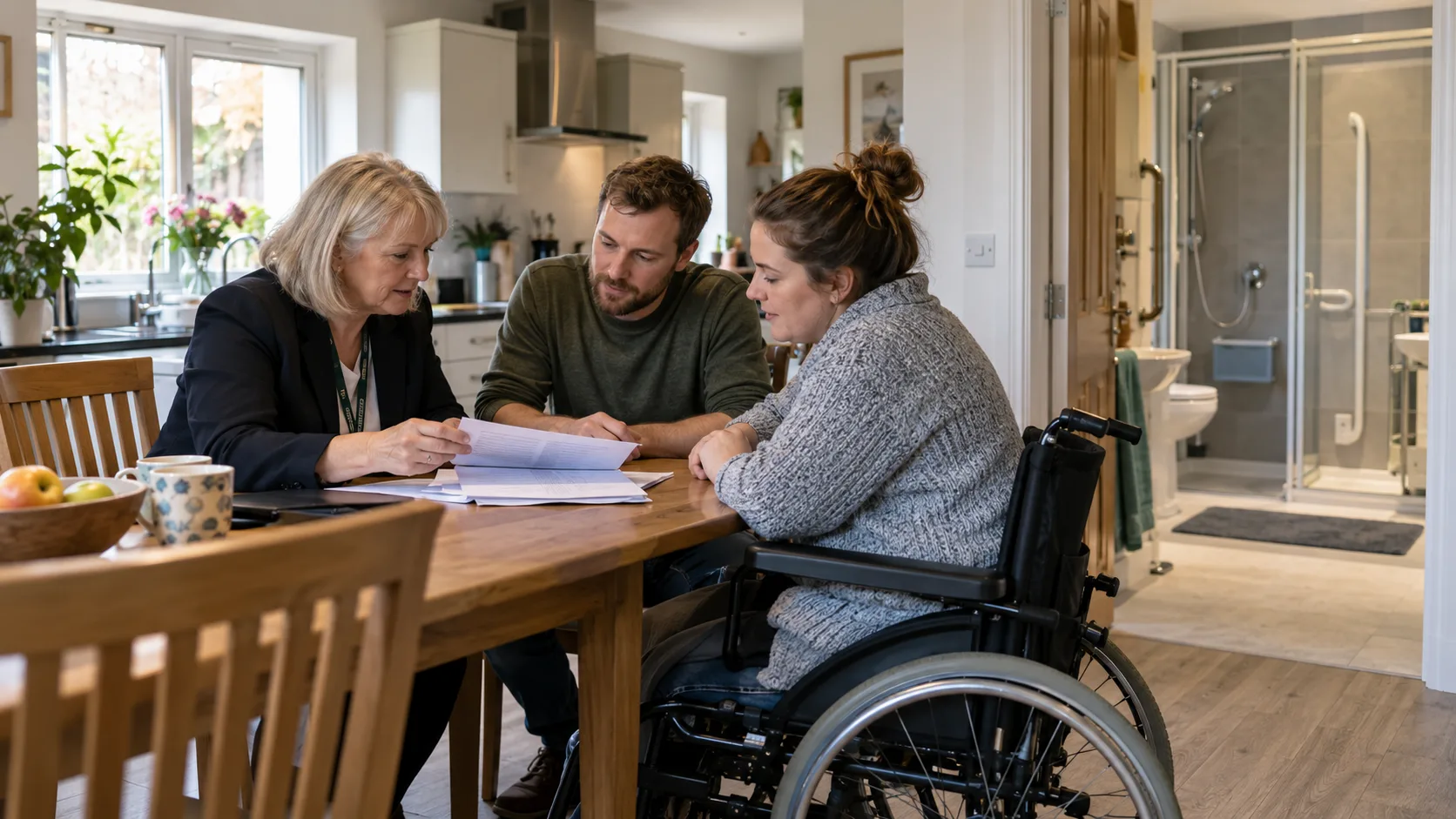
There is no official list of disabilities that automatically qualify someone for a Council Tax reduction.
In most cases, eligibility depends on which Council Tax scheme applies, how the disability affects the person’s daily needs, the facilities or additional space required within the home, and sometimes the household’s income and circumstances.
For the Disabled Band Reduction Scheme, a disabled adult or child may qualify where their main home contains an additional bathroom, kitchen, another room mainly required because of their disability, or sufficient indoor space to use a wheelchair.
Conditions such as cerebral palsy, multiple sclerosis, muscular dystrophy, spinal injuries, severe arthritis, neurological disorders and significant learning disabilities could therefore be relevant, but the diagnosis itself does not guarantee a reduction.
Different rules apply to Council Tax Reduction based on income and to discounts or exemptions connected with cognitive impairment. The exact support available also differs between England, Wales, Scotland and Northern Ireland.
How Were the Qualification Rules for Disabled People Decided?
The rules were designed around a key principle. A household should not face a higher Council Tax bill simply because a disabled resident needs additional space or facilities that make the home larger than it would otherwise need to be.
This explains why the Disabled Band Reduction Scheme does not operate from a long list of approved medical conditions.
Instead, the assessment concentrates largely on the practical effect of disability within the property.
A qualifying home may need:
- An Extra Bathroom Required to meet the disabled resident’s needs
- An Extra Kitchen Required because of the disability
- An Additional Room Mainly used to meet the disabled person’s needs
- Indoor Wheelchair Space Needed so the resident can use a wheelchair inside the property
The disabled resident can be an adult or child and does not have to be the person who pays the Council Tax bill.
This approach also explains why two people with the same condition may receive different outcomes. One person’s disability may require significant additional space within their home, while another person’s circumstances may not satisfy the property requirements.
When Was Disability-Related Council Tax Support Introduced and How Has It Changed?
Council Tax was introduced in Great Britain in April 1993, replacing the Community Charge. Disability-related provisions became part of the Council Tax system so that households requiring additional space because of disability would not necessarily pay more solely because their property fell into a higher valuation band.
The basic principle of the Disabled Band Reduction Scheme has remained recognisable over time. Where a qualifying property falls within Bands B to H, the household is generally charged as though the property were in the band immediately below.
Support for Band A properties was subsequently structured so households already occupying the lowest band could still benefit rather than being excluded simply because there was no lower valuation band.
Another major development came in 2013, when Council Tax Benefit was abolished and replaced in England by locally designed Council Tax Reduction schemes. This made an important distinction increasingly relevant to claimants.
The Disabled Band Reduction Scheme concerns disability-related property requirements, while Council Tax Reduction generally provides means-tested help towards Council Tax bills.
Changes have continued since then. One of the significant developments for 2026 is in Wales, where terminology connected with cognitive impairment has been modernised.
From April 2026, Welsh rules use Significant Cognitive Impairment in place of the previous Severe Mental Impairment terminology for the relevant Council Tax provisions.
What Was the Biggest Change to Council Tax Reduction for Disabled People?
One of the most significant structural changes affecting Council Tax support came in April 2013.
Before this, Council Tax Benefit operated as a national benefit. It was replaced by locally administered Council Tax Reduction schemes, particularly affecting working-age households in England.
This means people now need to distinguish between two very different forms of help.
Disabled Band Reduction is primarily concerned with the property and the additional facilities or space needed by a disabled resident.
Council Tax Reduction generally looks at financial circumstances such as household income, savings, benefits and who lives in the property.
Local Council Tax Reduction schemes can therefore vary. A working-age applicant living in one council area may face somewhat different rules from an applicant with similar circumstances living elsewhere.
Pension-age Council Tax Reduction is subject to a more nationally prescribed framework.
This separation is important because being refused means-tested Council Tax Reduction does not necessarily mean someone cannot receive a Disabled Band Reduction.
How Has Council Tax Support Affected Disabled People and Their Families?
Disability can affect housing needs in ways that are not always obvious from the person’s diagnosis.
Some households need an additional bathroom because transferring between floors is difficult. Others require a dedicated therapy or treatment room. A wheelchair user may require substantially more indoor floor space than would otherwise be necessary.
Without disability-related Council Tax provisions, some households could effectively face a larger tax bill because these essential needs require a larger property.
The Disabled Band Reduction Scheme aims to reduce that disadvantage by calculating the Council Tax bill using a lower valuation band where the qualifying requirements are satisfied.
Other Council Tax rules can also matter. Low-income households may qualify for Council Tax Reduction, while certain people with significant cognitive impairment can be disregarded when determining the number of chargeable adults in a property.
However, these forms of support do not automatically apply. Households normally have to identify the relevant scheme and submit an application.
How Has Disability Council Tax Support Evolved From the Past to 2026?
The system has evolved from a relatively straightforward property-based Council Tax structure into a combination of national legislation, local means-tested schemes and separate disability-related discounts or disregards.
| Period | Key Development | Effect on Disabled Households |
| 1993 | Council Tax began in Great Britain | Disability-related property needs became part of Council Tax relief |
| Later Reforms | Support ensured qualifying Band A homes could benefit | People in the lowest band were not automatically excluded |
| 2013 | Council Tax Benefit was replaced by local Council Tax Reduction schemes | Working-age means-tested support became more dependent on local rules |
| 2020s | Greater emphasis on online applications and local evidence requirements | Claimants increasingly apply directly through their council |
| 2026 | Wales introduced Significant Cognitive Impairment terminology | Welsh terminology became more modern while the core qualifying criteria remained broadly connected to existing requirements |
The modern system therefore provides more than one possible route to support. The challenge for households is identifying which route actually fits their circumstances.
Is There an Official List of Disabilities That Qualify in 2026?
No. There is no definitive nationwide list saying that a particular medical diagnosis automatically qualifies someone for the Disabled Band Reduction Scheme.
Conditions potentially associated with qualifying needs could include:
- Cerebral Palsy
- Multiple Sclerosis
- Muscular Dystrophy
- Spinal Cord Injuries
- Severe Arthritis
- Parkinson’s Disease
- Acquired Brain Injuries
- Learning Disabilities
- Long-Term Neurological Conditions
- Other Substantial and Permanent Disabilities
These examples should not be treated as an approved eligibility list.
A person with multiple sclerosis, for example, does not receive a Disabled Band Reduction simply because they have that diagnosis. Their home must still satisfy the relevant requirements.
Similarly, someone with a condition that is not commonly mentioned in examples could potentially qualify if their disability creates the type of housing need covered by the scheme.
Why Does the Effect of the Disability Matter More Than the Diagnosis?
Council Tax disability rules generally look at what the disabled person needs, rather than only the name of their medical condition.
Consider two people with the same neurological condition.
One might be able to move around their home without additional facilities. The other may use a wheelchair indoors and require substantially more floor space, an additional accessible bathroom or a specialist room.
Their diagnoses may be identical, but their Council Tax circumstances can be different.
For Disabled Band Reduction, the important question is whether the property includes qualifying space or facilities that are necessary because of the disability.
This also means ordinary accessibility improvements do not necessarily qualify on their own.
For example, councils commonly indicate that features such as:
- Grab Rails
- Handrails
- Stairlifts
- A Downstairs Bedroom
- An External Ramp Alone
will not necessarily satisfy the Disabled Band Reduction requirements.
The overall use and necessity of the property feature are what matter.
What Types of Council Tax Help Can Disabled People Get?
There are several forms of Council Tax help that may be relevant to disabled people, and they should not be confused with one another.
| Type of Support | Main Basis |
| Disabled Band Reduction | Additional qualifying space or facilities required because of disability |
| Council Tax Reduction | Income, savings and household circumstances |
| Cognitive Impairment Disregard | Medical and qualifying benefit conditions |
| Carer Disregard | Specific caring circumstances |
| Single Person Discount | Number of adults counted for Council Tax |
A household could potentially be affected by more than one of these rules.
However, discounts should not simply be added together manually. The council calculates the bill according to the applicable legislation and household circumstances.
What Home Features Can Qualify for a Disabled Band Reduction?

The property generally needs at least one qualifying feature that is essential or important for meeting the disabled person’s needs.
An Additional Bathroom Or Kitchen
An additional bathroom or kitchen may qualify where it is required to meet the disabled resident’s needs.
It normally needs to be genuinely additional rather than simply the household’s ordinary bathroom or kitchen.
Another Disability-Related Room
A room other than a bathroom, kitchen or toilet may qualify where it is predominantly used by the disabled resident and necessary because of their disability.
Depending on individual circumstances, this could include a room used for essential therapy, treatment or specialist equipment.
Indoor Wheelchair Space
The property may also qualify where additional indoor floor space is required so the disabled resident can use a wheelchair inside the home.
Wheelchair ownership alone is not enough. The wheelchair normally needs to be required and used indoors.
Does PIP Automatically Qualify You for Council Tax Reduction?
No. Receiving Personal Independence Payment does not automatically give someone a Council Tax reduction.
PIP and Council Tax operate under different eligibility rules.
A person receiving PIP could potentially qualify for the Disabled Band Reduction Scheme, but their property would still need to satisfy the applicable disability-related requirements.
PIP may also be relevant when determining eligibility under certain cognitive impairment rules because entitlement to specified disability benefits can form part of those conditions.
Someone receiving PIP may separately qualify for means-tested Council Tax Reduction if their income and household circumstances meet their local council’s rules.
The key point is that PIP can support eligibility in some situations, but it is not an automatic Council Tax discount.
Do Income, Savings Or Employment Affect Eligibility?
It depends on the type of Council Tax help being claimed.
For the Disabled Band Reduction Scheme, household income and savings are not the central eligibility test. A person can therefore potentially qualify even if they work, run a business or have savings.
Means-tested Council Tax Reduction works differently.
Depending on the applicable scheme, the council may consider:
- Household Income
- Savings And Capital
- Benefits Received
- Partner’s Income
- Other Adults Living In The Home
- Children And Dependants
- Employment Or Self-Employment Income
This distinction is particularly important for working and self-employed disabled people. Having an income does not automatically prevent someone from qualifying for disability-related property relief, although earnings may affect means-tested Council Tax Reduction.
How Much Council Tax Reduction Could a Disabled Household Get?
Under the Disabled Band Reduction Scheme in England, qualifying properties in Bands B to H are generally charged at the rate for the band immediately below their actual valuation band.
For example:
| Actual Property Band | Council Tax Normally Charged At |
| Band H | Band G |
| Band G | Band F |
| Band F | Band E |
| Band E | Band D |
| Band D | Band C |
| Band C | Band B |
| Band B | Band A |
| Band A | Special Reduced Calculation |
For a Band A property, there is no lower valuation band. A separate calculation therefore applies so eligible households can still receive a reduction.
The financial saving varies because Council Tax rates are set locally.
A household receiving means-tested Council Tax Reduction could receive a different amount depending on its financial circumstances and the local scheme.
Are Disability Council Tax Rules Different Across the UK?
Yes. The basic principles are similar in parts of Great Britain, but there are important differences.
England
England operates the Disabled Band Reduction Scheme alongside locally administered Council Tax Reduction schemes.
A qualifying home can generally be charged as though it were in the band immediately below its actual valuation band.
England also has Council Tax disregards relating to severe mental impairment where the required medical and benefit conditions are met.
Wales
Wales has Council Tax arrangements including disability-related reductions and means-tested support.
An important change took effect from April 2026. Welsh Council Tax rules replaced the term Severe Mental Impairment with Significant Cognitive Impairment for the relevant disregard and exemption provisions.
The change was designed to use less stigmatising and more appropriate terminology. The core qualifying approach was not replaced with an entirely new system simply because the terminology changed.
Scotland
Scotland also provides Council Tax reductions where a qualifying disabled resident requires additional space or facilities.
Applications are handled through Scottish local authorities, and other reductions or exemptions may also apply according to the person’s circumstances.
Northern Ireland
Northern Ireland is different because households pay domestic rates rather than Council Tax.
The comparable support is the Disabled Persons Allowance.
It provides a 25% reduction in domestic rates where a person with a disability lives in the property and qualifying adaptations or additional facilities have been provided to meet their needs.
Income and savings do not determine entitlement to this particular allowance.
How Do You Apply for Disability Council Tax Reduction in 2026?
Applications are generally made to the council responsible for the property.
The applicant should first establish which form of support applies because an application for Disabled Band Reduction is different from a claim for means-tested Council Tax Reduction.
For a disability-related property reduction, applicants may be asked to provide:
- Council Tax Details: Including the property’s Council Tax account information
- Resident Details: Information about the disabled adult or child
- Property Information: Details of the additional room, bathroom, kitchen or wheelchair space
- Medical Evidence: Where required to confirm the disability
- Professional Evidence: Such as information from an occupational therapist or social worker
- Benefit Evidence: Where the particular discount or disregard requires entitlement to specified benefits
Some councils may also ask for photographs or arrange an inspection.
Processing times vary between councils, so there is no single national timeframe that applies to every application.
What Happens If Your Application Is Refused?
A refusal does not necessarily mean the matter is finished.
The first step is to read the council’s decision carefully and identify why the application failed.
Common issues could include insufficient evidence, uncertainty about how a room is used or disagreement over whether the property meets the qualifying requirements.
Applicants may be able to:
- Request A Review: Ask the council to reconsider the decision
- Provide More Evidence: Supply medical, occupational therapy or property information
- Explain the Property Use: Clarify why the additional room or facility is essential
- Use the Appeal Process: Follow the appropriate Council Tax appeal route where disagreement remains
Keeping copies of forms, supporting documents, photographs and correspondence can make a review or appeal easier.
Applicants should also check whether another form of Council Tax support is available if they do not qualify for the scheme originally claimed.
FAQs
Does Arthritis Qualify for Council Tax Reduction?
Arthritis does not automatically qualify someone for a Council Tax reduction. A person with severe arthritis may potentially qualify for Disabled Band Reduction if their disability means they require qualifying additional space or facilities in their home.
They may also qualify separately for means-tested Council Tax Reduction depending on their finances.
Does Autism Qualify for Council Tax Reduction?
An autism diagnosis alone does not automatically qualify someone. Eligibility depends on the scheme being claimed.
A household could potentially qualify for Disabled Band Reduction where an autistic adult or child requires qualifying additional space or facilities because of their disability.
Does Dementia Qualify for Council Tax Reduction?
A person with dementia may potentially qualify under cognitive impairment rules if the necessary medical and benefit conditions are satisfied.
Household composition then helps determine the effect on the bill. A separate Disabled Band Reduction may also be relevant where the property itself meets the qualifying disability requirements.
Can You Get Council Tax Reduction On PIP?
Yes, a person receiving PIP could qualify for Council Tax help, but PIP does not automatically reduce the bill. Eligibility may arise through Disabled Band Reduction, means-tested Council Tax Reduction or another applicable disregard or exemption depending on the person’s circumstances.
Can A Disabled Child Reduce Council Tax?
Potentially. The qualifying disabled resident under the Disabled Band Reduction Scheme can be a child.
The child must normally live in the property as their main home, and the household must satisfy the property requirements, such as needing an additional room, bathroom, kitchen or sufficient indoor wheelchair space.
Can Disability Council Tax Reduction Be Backdated?
Backdating can sometimes be possible, but the rules and evidence required depend on the type of Council Tax support and the council involved.
Households that believe they met the qualifying conditions earlier should ask their council whether the award can take effect from an earlier date and provide evidence showing when the qualifying circumstances began.