

Is the UK Government giving pensioners a £2,300 bonus? Who qualifies for additional pension payments, and what financial support is actually available in 2026 and 2027?
These questions have attracted considerable attention as pensioners continue to face higher household expenses, energy costs and uncertainty about retirement income.
The term UK pension bonus has frequently been associated with claims that the Department for Work and Pensions (DWP) introduced a £2,300 tax-free payment for pensioners in 2025.
However, our analysis of official pension rates, government benefit arrangements and the latest announcements found no evidence of a nationwide £2,300 payment under this description.
There are, nevertheless, genuine financial improvements worth understanding.
The full new State Pension increased by approximately 4.8% in April 2026, reaching £241.30 per week. The Government has also announced a further 3.9% increase for April 2027.
Pensioners on low incomes may qualify for Pension Credit, winter heating payments, disability-related benefits and the genuine £10 Christmas Bonus.
We examined how these programmes work, what pensioners can realistically receive and which claims require particular caution.
What Is the UK Pension Bonus, and Is the £2,300 Payment Genuine?
The phrase UK pension bonus does not describe a single established government benefit.
Instead, it is often used informally to refer to additional retirement payments, State Pension increases, Pension Credit, arrears or seasonal financial support.
During 2025, online articles circulated claims that the Government had introduced a £2,300 pension bonus for retirees experiencing financial hardship.
According to those claims, pensioners receiving disability benefits, Pension Credit or reduced retirement income could receive a one-off payment directly into their bank accounts.
Some reports also suggested that the payment would appear under the reference “DWP BONUS“.
Our review found no official DWP scheme confirming these £2,300 payment claims.
The Government has not published an eligibility framework, application procedure or payment timetable establishing that particular bonus.
This distinction matters because pensioners could otherwise make financial decisions based on money they are not entitled to receive.
A legitimate government benefit normally has published rules covering eligibility, payment amounts, qualifying dates and administration.
Without these details, a reported pension payment should not be treated as confirmed.
Why Did the £2,300 Pension Bonus Claim Attract Attention?
Several factors may explain interest in the reported payment.
First, the Government previously introduced Cost of Living Payments to support households during periods of unusually high inflation.
Second, State Pension increases are often reported using annual rather than weekly figures. This can create confusion between an annual improvement in retirement income and a separate lump-sum payment.
Third, some pensioners receive genuine arrears after underpayments or corrections to their National Insurance records.
These arrears can sometimes amount to thousands of pounds, but their value depends on individual circumstances.
We found that the central problem with the £2,300 claim is the absence of a verified government programme rather than a lack of financial support for pensioners generally.
How Much Is the UK State Pension in 2026?
The most significant confirmed improvement in pension income during 2026 came through the annual State Pension uprating.
From April 2026, the full new State Pension increased from £230.25 to £241.30 per week.
That represents an increase of £11.05 per week or approximately £574.60 over 52 weeks for someone receiving the full amount throughout the year.
The full basic State Pension increased from £176.45 to £184.90 per week.
These improvements were introduced through the Triple Lock rather than through a separate UK pension bonus.
UK State Pension Rates: 2025 vs 2026
| Pension Type | 2025/26 | 2026/27 | Annual Increase |
| Full New State Pension | £230.25 weekly | £241.30 weekly | £574.60 |
| Full Basic State Pension | £176.45 weekly | £184.90 weekly | £439.40 |
| New State Pension Annual Value | £11,973.00 | £12,547.60 | £574.60 |
| Basic State Pension Annual Value | £9,175.40 | £9,614.80 | £439.40 |
These figures represent full headline rates. Individual entitlements may be higher or lower depending on National Insurance records, protected pension amounts and other circumstances.
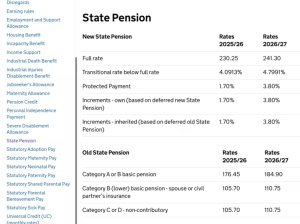
Official DWP figures showing how the full new and basic State Pensions increased in April 2026.
Why Is the Annual Increase Important?
Our analysis suggests that the annual financial value of pension increases is more useful for retirement budgeting than a headline about an alleged lump-sum bonus.
For someone receiving the full new State Pension, the £574.60 annual increase is genuine additional income.
However, it is distributed through regular pension payments rather than transferred as a separate bonus.
The difference is important for people managing monthly spending.
A continuing increase can support household budgeting over several years, while a one-off payment provides temporary assistance.
People following DWP State Pension changes for 2027 should also recognise that future payments depend on which pension scheme they belong to and their individual entitlement.
Will Pensioners Receive Another Increase in April 2027?
Yes. On 28 October 2026, the Government announced a further 3.9% increase to the basic and full new State Pension rates for the 2027/28 tax year.
This is a confirmed uprating announcement, not a new one-off pension bonus.
The new rates are expected to apply mainly from 12 April 2027.
The announcement means the full new State Pension is expected to reach approximately £250.70 per week, while the full basic State Pension is expected to reach approximately £192.10 per week.
Expected State Pension Rates for 2027/28
| Payment | 2026/27 | 2027/28 Indicative Rate | Increase |
| Full New State Pension | £241.30 | £250.70 | 3.9% |
| Full Basic State Pension | £184.90 | £192.10 | 3.9% |
| New Pension Annual Value | £12,547.60 | £13,036.40 | £488.80 |
| Basic Pension Annual Value | £9,614.80 | £9,988.80 | £374.00 |
The indicative weekly amounts are calculated from the announced 3.9% rise and are rounded to the nearest five pence.
In his 28 October 2026 parliamentary statement, Work and Pensions Secretary Pat McFadden confirmed that State Pensions would increase by 3.9%, describing the change as part of the Government’s Triple Lock commitment.
The announcement also confirmed that the Pension Credit standard minimum guarantee would rise to £247.30 a week for single pensioners and £377.40 for couples from April 2027.
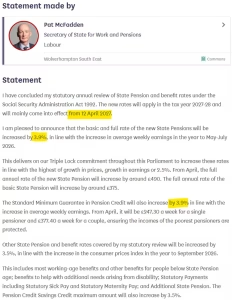
The Government’s October 2026 announcement confirming a 3.9% State Pension increase for 2027/28.
How Does the Triple Lock Work?
The Triple Lock is the mechanism used to determine annual increases to the full basic and new State Pension rates.
It compares three measures:
- Growth in average earnings.
- Consumer Prices Index inflation.
- A minimum increase of 2.5%.
The highest of these measures determines the annual increase under the policy.
In April 2026, the full new State Pension rose by approximately 4.8%.
For April 2027, the announced increase is 3.9%.
From a retirement-planning perspective, this mechanism provides a degree of protection against inflation and earnings growth. However, it does not guarantee that an individual pensioner’s spending power will improve by the same percentage.
Housing, food, healthcare and energy costs can change differently from the inflation measure used for uprating.
Who Can Receive Additional Pension Support in 2026?
Although the reported £2,300 payment is unverified, pensioners can qualify for several established support programmes.
Eligibility depends on income, age, disability, housing circumstances and the particular benefit being claimed.
The most relevant forms of support include Pension Credit, winter heating assistance, Attendance Allowance and the Christmas Bonus.
What Is Pension Credit, and Who Qualifies?
Pension Credit is a means-tested benefit intended to provide additional income to eligible people who have reached State Pension age.
For 2026/27, Guarantee Credit can top up weekly income to:
| Household | Standard Minimum Guarantee |
| Single Pensioner | £238.00 weekly |
| Pensioner Couple | £363.25 weekly |
These figures are income thresholds used in assessing Guarantee Credit, not automatic payment amounts for every applicant.
For example, consider a single pensioner whose assessable weekly income is £190.
If they meet the other conditions and have no additional adjustments affecting the calculation, Pension Credit could provide a £48 weekly top-up.
Over 52 weeks, that would equal £2,496.
This illustrates how a genuine existing benefit can provide more financial support over a year than the widely discussed £2,300 figure.
However, this is an illustrative calculation, not a guarantee of entitlement.
The Government’s Pension Credit eligibility information explains how income, savings, household arrangements and additional needs are assessed.
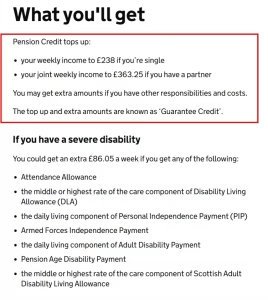
Pension Credit Guarantee Credit rates for 2026/27 and additional financial help available to eligible pensioners.
Can Pensioners With Savings Still Qualify?
Yes. Having savings does not automatically prevent someone from receiving Pension Credit.
For the Guarantee Credit calculation, savings and investments of £10,000 or less are generally disregarded.
Above £10,000, every £500 or part of £500 is treated as producing £1 of weekly income.
For example, someone with £11,000 in savings would normally have £2 per week added to their assessed income through this calculation.
Other income and eligibility rules still apply.
We consider this an important distinction because some pensioners may incorrectly assume that owning a home or maintaining a modest savings account automatically makes them ineligible.
A benefit entitlement check can identify support that might otherwise go unclaimed.
Can Pension Credit Be Backdated?
Pension Credit can normally be backdated by up to three months, provided the applicant met the eligibility conditions during that period.
An application can also be started up to four months before reaching State Pension age.
For someone who has recently become eligible, making a timely application may therefore result in a payment covering an earlier period.
This is a genuine backpayment arrangement, not a special pension bonus.
Can Pensioners Receive a £10 Christmas Bonus in 2026?
Yes. The DWP operates a genuine Christmas Bonus for people receiving qualifying benefits.
The payment is worth £10, is tax-free and is normally paid automatically before Christmas.
The qualifying week is usually the first full week of December.
Relevant benefits include State Pension, the Guarantee Credit element of Pension Credit, Attendance Allowance, Personal Independence Payment and certain other qualifying benefits.
Receiving multiple qualifying benefits does not normally mean receiving multiple Christmas Bonuses.
The payment may appear on a bank statement with the reference “DWP XB”.
Unlike the alleged £2,300 payment, this bonus has official eligibility and payment guidance.
Pensioners should distinguish the genuine £10 Christmas Bonus from exaggerated online claims about much larger seasonal benefits.
Reports about an £800 DWP Christmas Bonus should therefore be checked against the established £10 payment before being treated as a genuine entitlement.
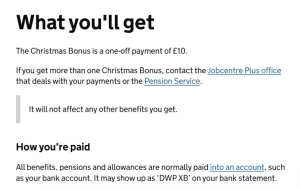
The genuine DWP Christmas Bonus is a £10 tax-free payment for people receiving qualifying benefits.
What Winter Payments Can UK Pensioners Receive in 2026?
Winter financial support is another area frequently confused with pension bonus announcements.
For winter 2026/27, eligible pensioners in England, Wales and Northern Ireland can receive Winter Fuel Payments between £100 and £300.
Eligibility depends on age and other circumstances.
In general, people born on or before 27 June 1960 may qualify.
The relevant qualifying week was 21–27 September 2026.
For an eligible person living alone, the amount is generally:
| Date of Birth | Winter Fuel Payment |
| Before 28 September 1946 | £300 |
| 28 September 1946 to 27 June 1960 | £200 |
Different amounts can apply when living with another eligible person, receiving certain benefits or living in a care home.
Most eligible pensioners receive the payment automatically in November or December 2026.
For individuals with total income above £35,000, HMRC generally recovers the payment through the tax system, subject to the applicable rules and exemptions.
This makes the financial outcome different for higher-income pensioners.
Understanding the Winter Fuel Payment clawback rules for 2026 is particularly important for retirees with taxable private pension income or investment income.
Do Pensioners Need to Apply?
Most do not need to apply if they receive qualifying benefits or State Pension payments.
However, some people must make a claim, including certain pensioners who have not previously received Winter Fuel Payment or have deferred their State Pension.
For winter 2026/27, the claim deadline is 31 March 2027.
This is another reason to avoid advice claiming that every government pension-related payment is always automatic.
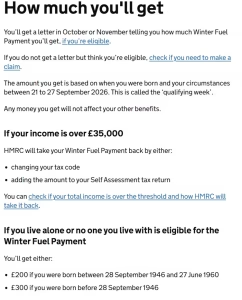
Official Winter Fuel Payment amounts for 2026/27, based on age and household circumstances.
Does Scotland Have a Different UK Pension Bonus Scheme?
Scotland has separate arrangements for certain winter heating benefits.
The main distinction is that Pension Age Winter Heating Payment has replaced Winter Fuel Payment in Scotland.
For winter 2026/27, eligible pensioners can receive between £105.55 and £316.70, depending on age and household circumstances.
Most payments are automatic, with payments beginning in November 2026 and continuing throughout winter.
The £35,000 individual income recovery arrangement also applies.
Scotland additionally operates Winter Heating Payment for eligible low-income households, which is separate from Pension Age Winter Heating Payment.
The main UK-wide and regional differences can be summarised as follows.
| Region | Main Pensioner Winter Support | 2026/27 Amount |
| England | Winter Fuel Payment | £100–£300 |
| Wales | Winter Fuel Payment | £100–£300 |
| Scotland | Pension Age Winter Heating Payment | £105.55–£316.70 |
| Northern Ireland | Winter Fuel Payment | £100–£300 |
The individual amount depends on the claimant’s circumstances.
There is no verified £2,300 pension bonus applying across all four nations.
For pensioners moving between regions, checking the appropriate administration and eligibility requirements is particularly important.
Can Attendance Allowance Increase a Pensioner’s Income?
Yes. Attendance Allowance provides financial support for eligible people who have reached State Pension age and need help or supervision because of a disability or health condition.
Unlike Pension Credit, Attendance Allowance is not means-tested.
For 2026/27, the weekly rates are:
| Rate | Weekly Payment | Annual Equivalent |
| Lower Rate | £76.70 | £3,988.40 |
| Higher Rate | £114.60 | £5,959.20 |
Annual equivalents assume payments at the same rate over 52 weeks.
Eligibility depends on the level and nature of the applicant’s needs.
People who require frequent attention or supervision may qualify for the lower rate, while those with more extensive day-and-night needs may qualify for the higher rate.
The award is not based solely on the name of a medical diagnosis.
Our review suggests that understanding the practical eligibility conditions is more useful than looking for an unverified pension bonus.
Pensioners with relevant care needs should examine which medical conditions and care requirements can qualify for Attendance Allowance.
Receiving Attendance Allowance may also increase entitlement to certain other means-tested benefits in qualifying circumstances.
This makes a full benefits assessment especially valuable.
Can Pensioners Receive Other Financial Support in 2026?
Additional help is available through several established programmes.
However, not all payments are made directly into a bank account, and eligibility is not automatic.
| Support | Amount | Main Purpose |
| Pension Credit | Depends on assessed income | Supports eligible low-income pensioners |
| Christmas Bonus | £10 | Seasonal payment linked to qualifying benefits |
| Winter Fuel Payment | £100–£300 | Heating support in England, Wales and Northern Ireland |
| Pension Age Winter Heating Payment | £105.55–£316.70 | Scottish pensioner heating support |
| Attendance Allowance | £76.70–£114.60 weekly | Support for eligible care or supervision needs |
| Warm Home Discount | £150 | Electricity bill discount for qualifying households |
| Cold Weather Payment | £25 per qualifying period | Support during prolonged cold weather for eligible benefit recipients |
Cold Weather Payments generally apply in England, Wales and Northern Ireland when qualifying temperature conditions are met during the scheme period.
Scotland operates a different Winter Heating Payment arrangement.
The Warm Home Discount is ordinarily applied as a discount on an electricity bill rather than a pension bonus paid into a personal bank account.
There is also no new nationwide Cost of Living Payment scheduled for 2026 under the earlier government programme.
The distinctions between historical support and current entitlements matter when assessing reports of additional Cost of Living Payments.
A household may qualify for more than one form of support, but the combined value will depend on its circumstances.
We would not describe such a combination as a guaranteed pension bonus because eligibility must be assessed separately.
Can Deferred State Pension Payments Be Considered a Bonus?
Some pensioners can receive additional money because they delayed claiming their State Pension.
This arrangement is known as State Pension deferral.
It is a genuine part of the pension system but should not be confused with a universal one-off bonus.
For people who reached State Pension age on or after 6 April 2016, delaying a claim can increase regular pension payments.
Under the current deferral rules, the increase is approximately 1% for every nine weeks deferred, equivalent to just under 5.8% over 52 weeks.
There are also rules allowing eligible people to receive certain arrears when claiming a deferred pension.
For example, someone deferring the full new State Pension for 52 weeks could have a 52-week arrears amount of £12,547.60 based on the 2026/27 full rate.
This is money relating to pension payments not previously drawn, rather than an additional government grant.
Different rules apply to people who reached State Pension age before 6 April 2016, including options involving a lump sum after sufficient deferral.
Deferring can affect other benefits, and additional pension income may be taxable.
Therefore, deciding whether to defer should involve considering personal finances, life expectancy, other income and benefit eligibility.
Could Pensioners Receive Backdated Pension Payments Worth Thousands?
Yes. Some pensioners may receive arrears following corrections to their State Pension entitlement.
These payments arise when the amount previously paid was lower than the amount legally due.
DWP and HMRC have undertaken exercises to identify and correct certain historical State Pension underpayments.
Some cases concern National Insurance records and missing Home Responsibilities Protection.
This protection was designed to help people who spent periods caring for children or others between 1978 and 2010.
Incorrectly recorded periods could affect the pension calculations of certain individuals.
For 2025/26, official estimates put State Pension underpayments at approximately 0.3% of expenditure, with around five in every 100 claims underpaid.
That does not mean five in every 100 pensioners will receive a £2,300 payment.
The amount of any arrears depends on the particular error, the correct pension entitlement and the period affected.
Our assessment is that people concerned about a potential underpayment should investigate their individual pension records rather than assume they qualify for a headline bonus.
Someone who suspects an error can contact the Pension Service and ask for their entitlement to be checked.
How Can Pensioners Check Whether They Are Missing Financial Support?
Rather than relying on viral payment announcements, we recommend a structured review of existing benefits and pension records.
The following steps can help establish what support may be available.
- Check State Pension entitlement: Review the pension award and confirm whether the amount received matches the individual’s entitlement.
- Review National Insurance records: People approaching retirement can check for missing qualifying years or National Insurance credits.
- Check Pension Credit eligibility: Even a relatively small entitlement may help unlock other assistance.
- Assess disability-related support: Pensioners with care or supervision needs may qualify for Attendance Allowance or a relevant Scottish benefit.
- Review winter heating support: Check the rules applying in the relevant UK nation.
- Investigate historic underpayments: Anyone concerned about an incorrect pension calculation can request clarification through official channels.
- Review household finances annually: Changes in income, savings, caring responsibilities and living arrangements can affect benefit entitlement.
People who have not yet claimed their State Pension can use the official forecast service to understand their future entitlement.
Anyone already receiving their pension should instead contact the Pension Service for information about their current award.
In our analysis, an annual entitlement review is more practical than depending on an unannounced one-off payment.
How Can Pensioners Identify Fake DWP Bonus Messages?
Claims involving unexpectedly large government payments can create opportunities for financial scams.
A suspicious message might say that a pensioner has qualified for a £2,300 payment but must first confirm their identity or bank details.
Other messages may refer to urgent application deadlines, temporary government support funds or processing fees.
These claims should be treated cautiously.
Warning Signs of a Possible Pension Bonus Scam
- A text or email claims that a £2,300 pension bonus has been approved without providing verifiable official information.
- The message asks for banking passwords, card details or security codes.
- An unfamiliar website asks for a fee before releasing government money.
- A sender creates pressure by claiming an immediate deadline.
- The message includes unusual links or asks the recipient to download an application.
- The supposed payment cannot be confirmed through official government channels.
The DWP does not require pensioners to pay a processing fee to receive an established benefit.
Unexpected requests for sensitive financial information should be verified independently.
The existence of a genuine government payment programme does not make every message referring to that payment authentic.
Pensioners can also review DWP text message scam warnings before responding to unfamiliar communications.
If someone has disclosed banking information through a suspected scam, they should contact their bank promptly and follow the appropriate fraud-reporting process.
How Will the Latest Pension Changes Affect Retirement Planning?
The difference between a one-off bonus and a recurring pension increase is especially important for household financial planning.
For example, the full new State Pension increased by £574.60 annually in 2026/27.
The announced 2027/28 increase is expected to add another £488.80 annually at the full indicative rate.
Together, these changes could take the full annual new State Pension from £11,973 in 2025/26 to approximately £13,036.40 in 2027/28.
That is an increase of around 8.9% across the two annual upratings, calculated from the rounded headline rates.
It does not represent a single payment, and it does not mean every pensioner receives the full new State Pension.
For households, the continuing increases may help with recurring expenses such as groceries, transport and utility bills.
However, retirement income can also be affected by taxation, private pension withdrawals and eligibility for means-tested benefits.
Someone receiving the full new State Pension in 2026/27 has an annual pension value of £12,547.60.
Other taxable income may affect their overall tax liability.
By comparison, Pension Credit and certain disability-related benefits are subject to different tax and assessment rules.
We therefore consider it important to review total retirement income rather than compare payment announcements in isolation.
What Should Pensioners Expect From the UK Pension Bonus in 2027?
There is currently no verified nationwide £2,300 pension bonus scheduled for 2027.
However, several confirmed or established changes are relevant.
The Government announced a 3.9% State Pension increase for 2027/28.
The Pension Credit standard minimum guarantee is also set to increase from April 2027.
The State Pension age is continuing its phased rise from 66 to 67 between 2026 and 2028, meaning eligibility dates vary according to an individual’s date of birth.
Pensioners should also monitor official announcements concerning taxation, benefit eligibility and regional winter support.
Future policy may introduce new assistance, but any such payment would need to be supported by official eligibility and payment information.
Our assessment is that retirement planning should be based on confirmed income and established entitlements, not speculation about possible bonuses.
Conclusion
The UK pension bonus has attracted interest because many retired households are searching for additional help with rising living costs.
However, the widely reported £2,300 one-off DWP pension payment remains unsupported by an official government scheme.
The financial improvements that can be verified are more specific.
The full new State Pension increased by approximately 4.8% in April 2026, and a further 3.9% increase has been announced for April 2027.
Additional support may be available through Pension Credit, Attendance Allowance, winter heating payments and the genuine £10 Christmas Bonus.
Our analysis indicates that pensioners are better served by checking their entitlement to these established programmes than waiting for an unverified lump-sum payment.
For some households, even a modest weekly Pension Credit award or a corrected pension underpayment could make a meaningful difference over time.
The essential approach is to verify payment claims, review personal eligibility and use official government services when making financial decisions.
Frequently Asked Questions About the UK Pension Bonus
Is the Government Giving Pensioners a £2,300 Bonus?
No official nationwide £2,300 DWP pension bonus has been verified. Pensioners should not treat reports of this payment as confirmation that money is due.
Will There Be a UK Pension Bonus in 2026?
The genuine DWP Christmas Bonus remains £10 for eligible benefit recipients. Other pension support is available, but there is no confirmed general £2,300 bonus.
How Much Did the State Pension Increase in April 2026?
The full new State Pension increased by approximately 4.8%, from £230.25 to £241.30 per week.
How Much Will the State Pension Increase in 2027?
The Government announced a 3.9% increase for 2027/28. This is expected to bring the full new State Pension to approximately £250.70 per week.
Is There a £300 Pensioner Payment in Winter 2026?
Eligible pensioners in England, Wales and Northern Ireland may receive up to £300 through Winter Fuel Payment. The amount depends on age and personal circumstances.
Can Pensioners Claim Pension Credit Alongside Their State Pension?
Yes. Eligible pensioners can receive Pension Credit alongside State Pension income, depending on their assessed income and circumstances.
Does Having Savings Prevent Someone From Claiming Pension Credit?
Not automatically. Savings above £10,000 affect the calculation, but there is no general £10,000 savings ceiling for Pension Credit.
Do Pensioners Need to Apply for the £10 Christmas Bonus?
Usually not. The payment is normally made automatically to people receiving qualifying benefits during the qualifying week.
Can Deferred State Pension Payments Be Paid as a Lump Sum?
Certain arrears and deferral arrangements allow one-off payments, but the rules depend on when the person reached State Pension age and how long they deferred.
How Can Someone Confirm a Genuine DWP Payment?
Check the relevant official government benefit information or contact the Pension Service using independently verified contact details. Do not rely solely on unsolicited messages or unfamiliar websites.