


The winter fuel payment clawback 2026 applies when an eligible person receives a winter payment but their individual total income exceeds £35,000 for the relevant tax year.
In that situation, the payment itself is not treated as taxable income; instead, a separate Winter Fuel Payment Charge can recover an amount equal to the full payment. There is no gradual taper once the £35,000 threshold is exceeded.
For many pensioners, the confusing part is timing. A payment received in winter 2025 may already be being recovered through a 2026/27 PAYE tax code, while the winter 2026 payment is a separate payment with its own charge and later recovery timetable.
Who Is Caught By The £35,000 Winter Fuel Payment Clawback?
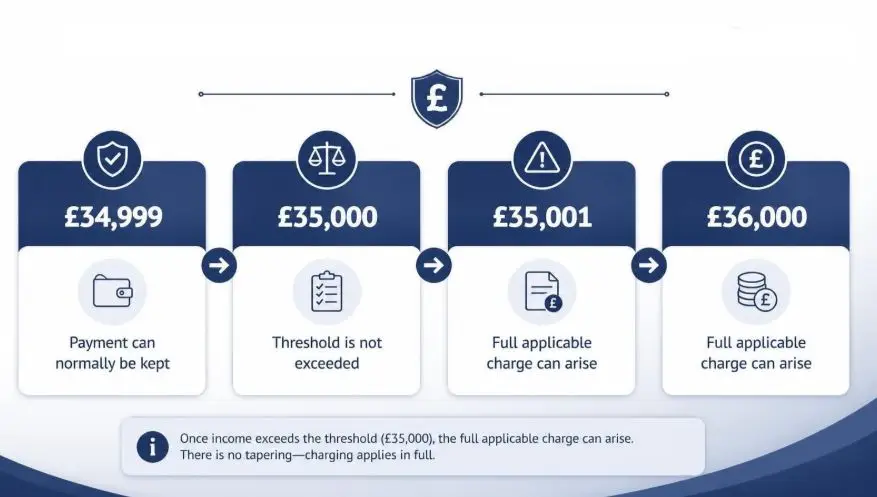
The threshold operates on an individual basis. If total income is £35,000 or less, there is no Winter Fuel Payment Charge under the income test; once income is more than £35,000, the full relevant payment can be recovered.
How the threshold works
| Individual Total Income | General Clawback Position |
| £34,999 | Payment can normally be kept |
| £35,000 | Threshold is not exceeded |
| £35,001 | Full applicable charge can arise |
| £36,000 | Full applicable charge can arise |
There is no taper between £35,000 and a higher figure. A pensioner one pound over the threshold can therefore face the same payment charge as someone substantially above it, subject to the other conditions and exemptions.
Household income is not combined. If one partner has income of £36,000 and the other has £22,000, the first can face the charge while the second can keep their payment.
People receiving certain means-tested benefits during the qualifying week are not liable to the charge. These include Pension Credit, Universal Credit, Income Support, income-based Jobseeker’s Allowance and income-related Employment and Support Allowance.
What Income Does HMRC Count Towards The £35,000 Threshold?
The key figure is broadly the individual’s taxable income for the tax year in which the winter payment is received, rather than household income or adjusted net income. For the winter 2026 payment, that means examining income arising in the 2026/27 tax year.
Income HMRC Generally Includes In The Calculation
Income sources that can count include:
- State Pension income.
- Company, workplace and personal pensions.
- Employment earnings.
- Taxable savings interest.
- Dividend income from shares outside an ISA.
- Taxable state benefits.
- Income from trusts.
- Net self-employment profits.
- Net taxable rental profits.
- The individual’s taxable share of jointly owned income.
Interest received outside an ISA still counts even where the Personal Savings Allowance means no Income Tax is ultimately payable on that interest. Similarly, dividend income can remain relevant to the £35,000 calculation even where a separate dividend allowance applies.
Readers comparing several income sources can use the official income calculation guidance to check which amounts need to be included.
Which Income Counts Towards £35,000?
Select the types of income you receive to see which sources may need to be considered when checking the Winter Fuel Payment income threshold.
The test is based broadly on an individual’s taxable income for the relevant tax year. Tick every income source that applies to you.
Which income sources do you receive?
Select your income sources
Tick the income types above that apply to you. The tool will identify the selected sources that may need to be considered when estimating your individual income for the £35,000 test.
✓ Income that can generally fall outside the calculation
The £35,000 test does not use adjusted net income. Pension contributions and Gift Aid donations therefore cannot simply be deducted from taxable income to move below the threshold.
Which Income Can Fall Outside The Winter Fuel Payment Calculation?
Tax-free income generally does not form part of the calculation. Examples include interest or dividends within an ISA, Premium Bond prizes and non-taxable state benefits such as Attendance Allowance.
The £1,000 trading allowance and £1,000 property allowance can also matter. Where the relevant gross trading or property income falls within the applicable allowance and is not otherwise taxable, it may not add to the figure used for the charge.
Pension Contributions And Gift Aid Do Not Simply Reduce The Test
A common mistake is to treat the £35,000 threshold like other tax rules based on adjusted net income. That is not how this charge works.
Adjusted net income is not used to determine whether the Winter Fuel Payment Charge applies. Pension contributions and Gift Aid donations therefore cannot simply be deducted from taxable income to push the figure below £35,000 for this test.
How Is The Winter Fuel Payment Clawback Collected Through PAYE In 2026?
For someone outside Self Assessment who has a live PAYE source, HMRC can recover the charge automatically by changing their tax code. The winter 2025 payment is being recovered through tax codes for 2026/27, so affected pensioners pay additional tax during the current tax year.
For a typical £200 Winter Fuel Payment, the official estimate is about £17 extra tax each month during 2026/27. If the tax-code calculation produces negative allowances, a K code can be used.
One official basic-rate example uses total income of £37,710, comprising a £25,737 private pension and £11,973 State Pension. After the payment adjustment, the example produces tax code K39. A higher-rate example uses income of £65,300 and produces code 9L.
People already filing Self Assessment normally deal with the charge on their return instead. The online 2025/26 return is due by 31 January 2027, while the paper deadline is 31 October 2026; taxpayers should check that the charge appears and add it if necessary.
Why Could 2027/28 Bring Two Winter Fuel Payment Clawbacks?
The apparent “double clawback” comes from HMRC’s transition between delayed and in-year PAYE recovery. It does not mean the same payment is being reclaimed twice.
How the recovery timeline works
| Winter Payment | Relevant Recovery Timing For PAYE |
| Winter 2025 payment | Collected during 2026/27 |
| Winter 2026 payment | Planned for collection during 2027/28 |
| Winter 2027 payment | Also planned for collection during 2027/28 |
| Winter 2028 onwards | Intended to move to same-year recovery |
Where someone receives £200 in both 2026 and 2027 and both amounts are chargeable, HMRC says the combined recovery would be about £33 extra per month during 2027/28.
From 2028/29 onwards, recovery is intended to move into the tax year in which the payment is received, returning the typical £200 example to about £17 per month.
The temporary increase is therefore a timing issue involving two different winter payments, not a duplicate charge on one payment.
Can Pensioners Opt Out Of The 2026 Winter Fuel Payment Before It Is Paid?

Someone who expects the charge to apply can choose not to receive the winter payment in the first place. Opting out avoids a later clawback, although it should be based on a realistic view of the person’s expected income and benefit position.
2026 Opt-Out Deadlines And Available Routes
For England, Wales and Northern Ireland, the main 2026 deadlines are 11:59pm on 20 September 2026 for the online form or eligible State Pension service, and 6pm on 18 September 2026 for telephone opt-out. A National Insurance number is required when using the form or helpline.
The current process is set out in the official 2026 opt-out guidance.
Scotland uses Pension Age Winter Heating Payment rather than Winter Fuel Payment. The supplied 2026 guidance states that the Scottish online opt-out route remains available until midday on 19 October 2026, with a separate administration process.
What Happens If Circumstances Change After Someone Opts Out?
Opting out is not necessarily permanent, but the person must actively opt back in before the applicable deadline. Someone who opted out of the 2025 payment but wants the winter 2026 to 2027 payment must contact the payment centre before 31 March 2027.
Once a person opts out, future Winter Fuel Payments will not normally resume automatically unless they opt in again.
What If HMRC Uses The Wrong Income Figure Or Tax Code?
PAYE codes can initially be based on estimated information, so the figure used to recover a Winter Fuel Payment Charge may later need correcting. HMRC says it reassesses the position when actual income for the relevant year is confirmed.
Checks worth making
- Identify which winter payment the tax-code adjustment relates to.
- Compare HMRC’s income estimate with actual pension and employment income.
- Check taxable savings, dividend and property figures.
- Look for income sources that have ended or changed.
- Confirm that joint income reflects only the individual’s taxable share.
- Review the coding notice before assuming the deduction is incorrect.
If confirmed income shows that no charge was due, HMRC says it can update the tax code and ask the pension provider or employer to refund extra tax already deducted through the pension or employment.
The important first step is therefore establishing whether the adjustment concerns winter 2025, winter 2026 or a later payment.
How Can Pensioners Tell Genuine HMRC Clawback Contact From A Scam?

The recovery programme has created an opportunity for fraudsters because legitimate tax-code communications and fraudulent repayment demands can arrive around the same period.
Official figures published in April 2026 said there had been more than 25,000 Winter Fuel Payment scam referrals in the previous 12 months.
What Genuine HMRC Contact May Look Like?
Legitimate contact may tell a taxpayer that a PAYE code has changed or explain how the payment will be recovered. Around 1.1 million people were expected to have the winter 2025 payment recovered through tax codes, with roughly 900,000 more dealt with through Self Assessment, according to published estimates.
Myrtle Lloyd, HMRC’s Chief Customer Officer, warned: “Criminals are great pretenders and often use fake letters, emails, calls and texts to impersonate HMRC and trick people into giving them money.”
Warning Signs Around Repayment Requests
HMRC says it will never contact people by text or email asking them to repay their Winter Fuel Payment or provide bank details. The normal PAYE process is automatic, and someone affected by the charge cannot simply return the payment early as a separate lump sum.
Unexpected demands for card details, passwords or an immediate bank transfer should therefore be treated with caution.
Where Recipients Should Verify A Message Safely
A recipient who is unsure should independently check the recovery position rather than using contact details supplied in an unexpected message. The official scam warning guidance explains the current verification and reporting routes.
Suspicious texts claiming to be from HMRC can be forwarded to 60599. A person who believes money has already been stolen should contact their bank immediately and report the incident through the appropriate fraud-reporting route.
What Should Pensioners Check Before The 2026 Winter Fuel Payment Arrives?
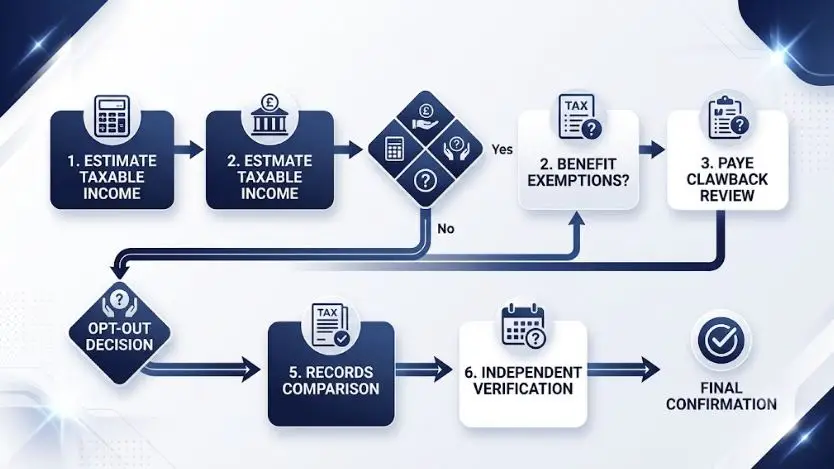
The qualifying week for the winter 2026 payment begins on 21 September 2026, while claims for winter 2026 to 2027 also open from that date. The payment amount depends on age and circumstances during 21 to 27 September 2026.
Pre-payment checklist
- Estimate total individual taxable income for 2026/27.
- Include State Pension, private pensions and taxable savings income.
- Check whether relevant means-tested benefits create an exemption.
- Review any existing 2026/27 PAYE clawback.
- Decide whether opting out is appropriate before the September deadline.
- Keep tax-code notices and payment letters for comparison.
- Verify unexpected repayment communications independently.
Most eligible people should receive an award letter in October or November and payment in November or December 2026, so reviewing the position before the qualifying week can prevent confusion later.
Conclusion
The winter fuel payment clawback 2026 is more complex than a single £35,000 income threshold. Pensioners need to distinguish the winter payment they receive from the separate tax charge, understand which income counts and identify which tax year HMRC is using for recovery.
The key pressure point is the timetable. The winter 2025 payment is already being recovered for many people through 2026/27 PAYE codes, while separate 2026 and 2027 payments can both feed into 2027/28 recovery.
That temporary overlap can look like a duplicate deduction when it actually concerns two different payments.
Checking individual taxable income, benefit exemptions, tax codes and the correct payment year should make it easier to identify whether a deduction is expected or needs correcting.
Frequently Asked Questions
Is The Winter Fuel Payment Itself Taxable Income?
No. The winter payment itself is not taxable, but a separate Income Tax charge equal to the full payment can apply when the clawback conditions are met.
Does Interest Earned Inside An ISA Count Towards £35,000?
ISA interest and dividends are tax-free and are generally excluded from the income calculation for this charge. Taxable savings interest outside an ISA can still count, even where the Personal Savings Allowance means no tax is ultimately payable on it.
Can One Partner Keep Their Payment If The Other Earns Over £35,000?
Yes. Each person is assessed separately, so one partner may face the charge while the other keeps their payment.
Can A Winter Fuel Payment Clawback Result In A K Tax Code?
Yes, where deductions produce negative tax-free allowances, HMRC can use a K code to collect the correct tax. One published basic-rate example produces code K39 after including a £200 charge.
Can The Winter Fuel Payment Charge Be Paid Directly As A Lump Sum?
Not normally where HMRC is collecting it through the specified tax process. Current guidance states that a PAYE taxpayer cannot simply repay the winter payment early as a separate lump sum.
Are Pension Credit Recipients Treated Differently Under The Clawback Rules?
Yes. People receiving Pension Credit or certain other specified means-tested benefits during the qualifying week are exempt from the Winter Fuel Payment Charge.
Do The Same Winter Fuel Payment Clawback Rules Apply In Scotland?
Scotland uses Pension Age Winter Heating Payment rather than Winter Fuel Payment, but the £35,000 Income Tax charge framework applies UK-wide. Payment administration and opt-out arrangements are separate in Scotland.
Note: This article uses “Winter Fuel Payment” for the scheme operating in England, Wales and Northern Ireland. Scotland uses Pension Age Winter Heating Payment; although the £35,000 charge framework applies UK-wide, payment administration and opt-out procedures differ.