

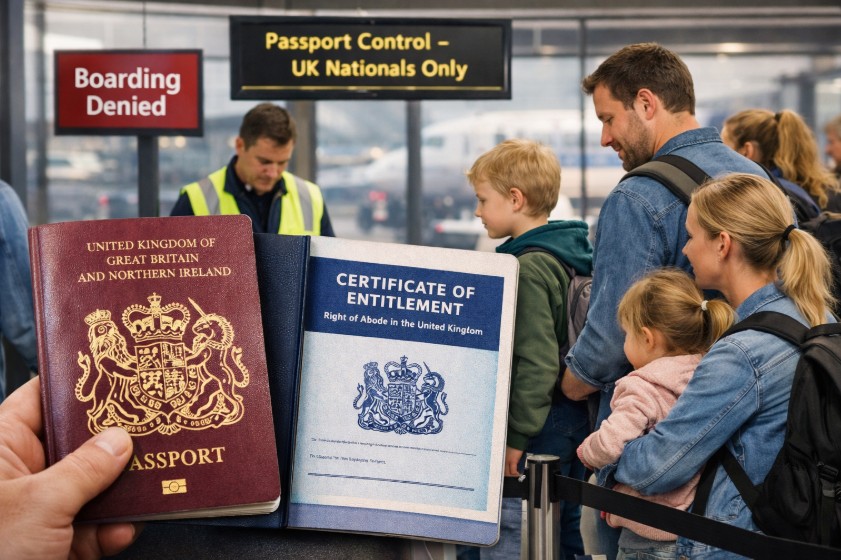
The UK passport rules for dual citizenship are now fully relevant to British dual nationals travelling to the UK following the enforcement of the Electronic Travel Authorisation (ETA) system from 25 February 2026.
British and Irish citizens cannot obtain an ETA. As a result, British dual nationals will normally need to travel with a valid British passport, a valid Irish passport, or another valid passport supported by a Certificate of Entitlement to the right of abode.
There are, however, some important exceptions. In certain circumstances, a carrier may accept an expired British passport, while some people who became British citizens after settling in the UK under the EU Settlement Scheme may be able to travel using their other passport or eligible national identity card.
Key points you need to know:
- A valid British passport remains the simplest proof of British citizenship for travel
- British and Irish dual citizens cannot apply for a UK ETA
- A Certificate of Entitlement currently costs £589
- New Certificates of Entitlement are now digital and do not expire when the linked foreign passport expires
- Limited alternatives exist for certain expired British passport holders and some people with EU Settlement Scheme status
The key issue is therefore not simply which nationalities you hold, but whether your airline or other carrier can verify your right to travel to the UK before departure.
What Are the New UK Passport Rules for Dual Citizenship From 25 February 2026?

Since 25 February 2026, the UK has enforced the requirement for visa-exempt visitors to hold an ETA or another recognised form of permission before travelling. British citizens are not eligible for an ETA because they already have the right of abode in the UK.
For most British dual nationals, GOV.UK says they can travel to the UK using:
- A valid British passport
- A valid Irish passport
- Another valid passport together with a Certificate of Entitlement proving the right of abode
This means British dual nationals should not assume that a foreign passport alone will automatically allow them to board a flight, ferry or international train to the UK.
There are some exceptions. A carrier may permit travel using an expired British passport in qualifying circumstances, and certain people who became British citizens after obtaining status under the EU Settlement Scheme may be able to travel using their other passport or eligible national identity card.
The practical change since February 2026 is that carriers now need to be able to verify that passengers have permission or an exemption before allowing them to travel.
Why Is the UK Changing Entry Checks for British Dual Nationals Now?
The rules are closely connected with the UK’s Electronic Travel Authorisation (ETA) system, which has been fully enforced for eligible non-visa nationals since 25 February 2026.
An ETA is digital permission to travel to the UK for eligible foreign nationals, but British and Irish citizens cannot obtain one, including people who hold British or Irish citizenship alongside another nationality.
This is why a British dual national should generally travel using documentation that allows the carrier to recognise their British citizenship or right of abode, rather than attempting to travel as an ETA-eligible foreign visitor.
The current ETA application fee is £20, following an increase from £16 on 8 April 2026.
Who will Be Affected by the UK Passport Rules Dual Citizenship, And Who Is Exempt?

The new UK passport rules dual citizenship changes affect a broad cross-section of people.
This includes:
- British dual nationals living abroad
- Expats who have not renewed a UK passport in years
- Residents of the UK travelling on a foreign passport
- Newly naturalised citizens who have not yet applied for a British passport
- Children and babies who hold British citizenship
According to 2021 census data, over one million UK residents hold dual nationality. A significant proportion may not currently hold a valid British passport.
Irish passport holders are exempt due to the Common Travel Area arrangements. Other dual nationals, including EU, Swiss, Australian, Canadian and US citizens with British nationality, are affected.
The practical consequence is simple: even if you have lived in the UK for decades, paid taxes and own property, you cannot rely on your foreign passport alone.
What Documents Do You Now Need Under the UK Passport Rules Dual Citizenship Changes?
To comply with the new UK passport rules dual citizenship changes, dual nationals must now present specific documents that clearly prove their right to enter and live in the UK.
For most dual nationals, a valid British passport remains the simplest way to demonstrate British citizenship when travelling to the UK.
As of August 2026, a standard passport applied for online from within the UK costs:
| Document | Current Fee |
|---|---|
| Adult British passport online | £102 |
| Child British passport online | £66.50 |
| Adult British passport by post | £115.50 |
| Child British passport by post | £80 |
People applying from overseas pay different fees. A standard online overseas application currently costs £116.50 for an adult and £75.50 for a child.
Adult passports are normally valid for 10 years, while child passports are normally valid for 5 years.
Certificate of Entitlement
A Certificate of Entitlement proves that someone has the right of abode in the UK and can be used with a foreign passport. The application fee remains £589.
An important change took effect from 26 February 2026. Successful applicants now receive a digital Certificate of Entitlement, accessible through a UKVI account.
Unlike the previous vignette certificate placed inside a passport, the new digital certificate does not expire when the foreign passport expires. Instead, the holder must update their UKVI account when they receive a new passport or when relevant personal details change.
Existing vignette certificates can continue to be used until the passport containing them expires. Eligible holders can also change a valid vignette certificate to a digital certificate without paying another application fee.
Updated Comparison Table
| Feature | British Passport | Digital Certificate of Entitlement | ETA |
| Available to British citizens | Yes | Yes | No |
| Current standard fee | £102 adult online in UK | £589 | £20 |
| Suitable for British dual nationals | Yes | Yes | No |
| Expiry | Usually 10 years for adults | Does not expire | Normally up to 2 years or passport expiry |
| Foreign passport required | No | Yes | Yes |
| UKVI account required | No | Yes | Not in the same way |
For most British dual nationals, obtaining or renewing a British passport will therefore remain considerably cheaper than applying for a Certificate of Entitlement.
How Much Will the New UK Passport Rules for Dual Citizenship Cost You?
Understanding the cost implications is essential, as the new UK passport rules for dual citizenship introduce both direct application fees and additional hidden expenses for many travellers.
Direct Application Costs
The financial impact of the new UK passport rules dual citizenship changes is one of the most controversial aspects.
| Document | Approximate Cost | Who It Applies To | Validity |
| British Passport (Adult) | £100 | British citizens | 10 years |
| British Passport (Child) | Lower than adult fee | British citizen minors | 5 years |
| Certificate Of Entitlement | £589 | Dual nationals using foreign passport | Linked to passport validity |
| ETA (Not Available To British Dual Nationals) | £16 (rising to £20) | Non-British visa-free travellers | Short-term travel |
The contrast between a £16 ETA and a £589 certificate has prompted claims that dual nationals are placed at a financial disadvantage compared with foreign visitors.
Indirect And Hidden Costs
Beyond official fees, there are indirect costs:
- Travel to biometric centres
- Courier fees and notarisation costs
- Lost travel bookings
- Delayed family visits
- Work disruption
For pensioners or families on fixed incomes, these added burdens can feel disproportionate. Campaign group the3million has criticised the rollout.
Its head of policy and advocacy said:
“The Home Office has not done enough to warn dual nationals of the serious impact this will have on them.”
Calls have been made for a temporary grace period or low-cost interim solution, but as of now, the requirement stands.
Can an Airline Refuse You Boarding Under the New UK Passport Rules Dual Citizenship?

A carrier may refuse to let you travel if it cannot verify that you have the necessary permission or right to travel to the UK.
For British dual nationals, the clearest documents are a valid British passport, valid Irish passport, or another valid passport linked to a Certificate of Entitlement.
Current GOV.UK guidance also provides some flexibility.
A carrier may allow you to travel with an expired British passport issued in 1989 or later if you also hold a valid passport from a nationality eligible for an ETA and the personal details on the two passports match. Whether to accept this evidence remains the carrier’s decision.
There is also an important exception for some people who became British citizens after settling in the UK through the EU Settlement Scheme. They may be able to travel using their other valid passport or, where eligible, a national identity card, provided their UKVI account and status are correctly linked.
If a carrier cannot verify someone’s British citizenship or immigration status, GOV.UK guidance published on 23 July 2026 confirms that the carrier can contact the Home Office carrier support hub for assistance.
Anyone relying on an exception should check their documentation before travelling rather than assuming their foreign passport will automatically be accepted.
What Should You Do If You Are Abroad Without A British Passport?
If you are currently overseas and do not hold a valid British passport, your next steps depend on your circumstances.
If you previously held a British passport, you may be eligible to apply for an Emergency Travel Document. This is typically used for urgent situations.
If you have never held a British passport, you should begin an application as soon as possible. Be prepared to provide original documentation and allow sufficient processing time.
If travel is imminent, consider:
- Contacting your airline for guidance
- Checking whether an expired British passport may be accepted
- Applying urgently for the appropriate documentation
Avoid assuming that your foreign passport will suffice.
What About Children Travelling Under the New UK Passport Rules Dual Citizenship Requirements?

The rules apply equally to minors. Even if one parent holds a valid British passport, a dual-national child must present their own British passport or Certificate of Entitlement. This has significant implications for families planning holidays or reunions.
Families have reported cancelling trips or facing unexpected expenses of hundreds or even thousands of pounds to secure certificates for multiple children.
Planning ahead is therefore critical. If your child holds British citizenship but has never had a UK passport, begin the process early.
Are the UK Dual Citizenship Travel Rules Now in Force?
Yes. The relevant ETA enforcement changes have been in effect since 25 February 2026, so travellers should no longer plan around the possibility of a future grace period.
British dual nationals should instead make sure that their carrier can verify their status using the appropriate documentation before they travel.
For most people, this means carrying a valid British or Irish passport or using a foreign passport with a Certificate of Entitlement.
Those relying on an expired British passport or EU Settlement Scheme-related travel arrangements should check the latest GOV.UK guidance and ensure all passport details are correctly recorded before departure.
The government also introduced updated guidance for carriers and travellers in July 2026, giving additional information on what can be done when a passenger’s status cannot initially be verified.
Practical Checklist to Stay Compliant with UK Passport Rules Dual Citizenship
To minimise disruption under the new UK passport rules dual citizenship requirements, proactive preparation is essential. Before booking or undertaking travel to the UK, you should:
- Confirm whether you hold British citizenship
- Check whether your British passport is valid
- Apply early if renewal is required
- Ensure children have individual documentation
- Avoid relying on ETA eligibility
It is also advisable to keep copies of supporting documents and confirmation emails during the application process.
Early action reduces uncertainty and limits the risk of last-minute cancellations or denied boarding. Preparation remains the most reliable safeguard against disruption.
Comparison Table – British Passport Vs Certificate Of Entitlement Vs ETA
Understanding the differences between a British passport, a Certificate of Entitlement, and an ETA is essential if you want to avoid disruption under the new UK passport rules dual citizenship requirements.
| Feature | British Passport | Certificate Of Entitlement | ETA |
| Available To British Citizens | Yes | Yes | No |
| Required For Dual Nationals | Yes (Preferred) | Yes (Alternative) | Not Applicable |
| Cost | ~£100 Adult | £589 | £16–£20 |
| Processing Time | Several Weeks | Several Weeks | Typically Fast |
| Risk Of Boarding Refusal Without It | High | High | Not Relevant |
This comparison clearly shows that, while both a British passport and a Certificate of Entitlement satisfy the legal requirement, renewing or applying for a British passport is generally the most practical, cost-effective, and reliable long-term solution.
Conclusion
The UK passport rules for dual citizenship are now part of the UK’s fully enforced digital travel permission system, making it increasingly important for British dual nationals to ensure their citizenship or right of abode can be verified before travelling.
For most people, the simplest option is a valid British passport. A valid Irish passport or a foreign passport supported by a Certificate of Entitlement can also be used, while British and Irish citizens cannot apply for an ETA.
The position has also become more flexible than some early explanations suggested. Certain expired British passports may be accepted by carriers, and some people who became British after obtaining EU Settlement Scheme status may have additional ways to demonstrate their right to travel.
Travellers should also be aware of the latest costs. A standard adult British passport applied for online in the UK is now £102, a child passport is £66.50, the Certificate of Entitlement remains £589, and the ETA for eligible non-British travellers costs £20.
Checking your nationality status, passport validity and UKVI records before travelling remains the best way to reduce the risk of delays or denied boarding.
FAQs About UK Passport Rules Dual Citizenship
Do Dual British Citizens Need a British Passport to Enter the UK?
A valid British passport is the simplest option, but a valid Irish passport or foreign passport with a Certificate of Entitlement can also be used. Limited additional exceptions apply.
Can a British Dual Citizen Apply for a UK ETA?
No. British and Irish citizens cannot obtain an ETA, even if they also hold citizenship of an ETA-eligible country.
Can I Travel to the UK With an Expired British Passport?
Possibly. A carrier may accept a UK passport issued in 1989 or later alongside an eligible valid foreign passport if the personal details match, but acceptance is at the carrier’s discretion.
How Much Does a British Passport Cost in 2026?
A standard online application from within the UK currently costs £102 for an adult and £66.50 for a child.
Does a Digital Certificate of Entitlement Expire With My Passport?
No. Digital Certificates of Entitlement issued under the 2026 system do not expire when your foreign passport expires. You instead update the passport details in your UKVI account.
Are British-Irish Dual Citizens Required to Use a British Passport?
No. A valid Irish passport is accepted for travel to the UK, and British-Irish dual citizens do not need an ETA.
Do Dual-National Children Need Their Own Travel Documents?
Yes. A British dual-national child should have appropriate evidence of their own status, normally a British or Irish passport or a foreign passport supported by a Certificate of Entitlement.