


Teachers in England are set to receive a further 3% pay rise from September 2027, following the 3.5% salary increase introduced in September 2026.
The two-year settlement marks an important change in how teacher salaries are determined, giving schools greater certainty over workforce costs while raising questions about inflation, recruitment and long-term affordability.
The government accepted the School Teachers’ Review Body’s recommendations on 1 July 2026. The updated School Teachers’ Pay and Conditions Document, published in October, establishes the framework for the pay increases.
Under the settlement, the average teacher salary in England is expected to exceed £52,800 in September 2026 and £54,400 in September 2027. Starting salaries outside London will also exceed £35,000 in 2027.
However, the financial outlook is more complicated than these headline figures suggest. The Office for Budget Responsibility’s October 2026 forecast predicts CPI inflation of 3.4% in 2027, slightly higher than the scheduled pay award.
We analysed the official salary scales, government funding commitments, inflation forecasts and publicly available responses from education sector leaders to assess what the 2027 teacher pay rise means for employees, schools and the wider education workforce.
What Is the Confirmed Teacher Pay Rise for 2027?
The confirmed teacher pay rise in England is 3% from 1 September 2027, following a 3.5% increase from 1 September 2026.
The government accepted both recommendations in July 2026 rather than waiting for separate annual decisions. The October 2026 statutory framework also provides the basis for the 2027 award.
| Pay period | Teacher pay rise | Effective date | Status |
| 2024/25 | 5.5% | September 2024 | Implemented |
| 2025/26 | 4.0% | September 2025 | Implemented |
| 2026/27 | 3.5% | September 2026 | Confirmed |
| 2027/28 | 3.0% | September 2027 | Confirmed in England |
| 2028/29 | 3.0% | September 2028 | Indicative, not final |
The 2026 and 2027 increases produce a compounded salary uplift of approximately 6.61%.
For example, a teacher earning £40,000 before the September 2026 increase would receive:
- September 2026: £41,400
- September 2027: £42,642
- Total annual salary increase: £2,642
This illustration assumes the same salary point, both awards being passed on, and no separate progression or responsibility allowance changes.
Our assessment is that the multi-year agreement improves financial predictability, but the outcome for teachers will depend heavily on inflation and whether schools can absorb their share of rising employment costs.
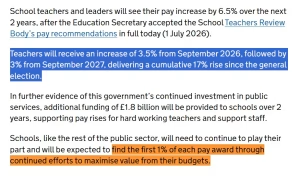
Department for Education confirms the 3.5% teacher pay increase from September 2026 and further 3% award from September 2027.
How Much Will Teachers Earn in 2027?
Teacher salaries in England vary according to location, responsibilities, experience and the school’s pay policy.
The national framework establishes salary ranges, with advisory points commonly identified as M1–M6 for the main pay range and U1–U3 for the upper pay range.
Teacher Pay Scale 2025–2027: England Outside London
| Pay point | 2025/26 | 2026/27 | 2027/28 |
| M1 | £32,916 | £34,069 | £35,092 |
| M2 | £34,823 | £36,042 | £37,124 |
| M3 | £37,101 | £38,400 | £39,552 |
| M4 | £39,556 | £40,941 | £42,170 |
| M5 | £42,057 | £43,529 | £44,835 |
| M6 | £45,352 | £46,940 | £48,349 |
| U1 | £47,472 | £49,134 | £50,609 |
| U2 | £49,232 | £50,956 | £52,485 |
| U3 | £51,048 | £52,835 | £54,421 |
Figures represent published advisory pay reference points, rounded to whole pounds. Actual salaries depend on the applicable statutory range and employer pay arrangements.
The financial difference becomes clearer when comparing the same pay points across two academic years.
A teacher on M1 would see their published annual salary reference point increase from £32,916 in 2025/26 to £35,092 in 2027/28.
That represents approximately £2,176 more annually, or 6.61%.
An experienced teacher at U3 would see an increase from £51,048 to £54,421 over the same period, adding £3,373 to annual gross salary.
These calculations do not include additional pay progression, promotions or responsibility allowances.
Teacher Pay Rise 2027 in London
Teachers working in London receive higher salary ranges to reflect regional recruitment conditions and living costs.
| Location | M1 salary 2026 | M1 salary 2027 | U3 salary 2027 |
| England excluding London/Fringe | £34,069 | £35,092 | £54,421 |
| London Fringe | £35,602 | £36,671 | £55,958 |
| Outer London | £39,196 | £40,372 | £59,864 |
| Inner London | £41,729 | £42,981 | £66,625 |
The difference between starting salaries outside London and in Inner London is approximately £7,889 in 2027.
This reflects the higher regional salary framework, although it does not necessarily compensate fully for differences in housing and other household costs.
For school leaders and trusts, the London pay structure also creates different workforce budgeting challenges because the cash cost of a percentage increase rises with the underlying salary.
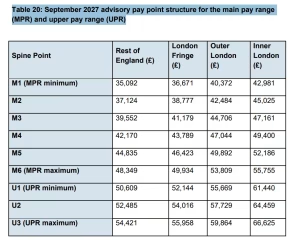
Official school teachers’ pay framework for 2026 and 2027, including salary ranges and allowances.
How Much Extra Money Will Teachers Receive Each Month in 2027?
The September 2027 pay award increases annual gross salary by 3%, but employees will not receive the full increase as take-home pay.
The following table shows how the published reference points affect gross monthly pay.
| Pay point | 2026 annual salary | 2027 annual salary | Extra gross pay per month |
| M1 | £34,069 | £35,092 | £85.25 |
| M3 | £38,400 | £39,552 | £96.00 |
| M6 | £46,940 | £48,349 | £117.42 |
| U1 | £49,134 | £50,609 | £122.92 |
| U3 | £52,835 | £54,421 | £132.17 |
The figures assume a full-time salary and exclude additional progression.
Actual take-home pay depends on:
- Income Tax and National Insurance.
- Teachers’ Pension Scheme contributions.
- Student loan repayments.
- Salary sacrifice and other payroll deductions.
- Tax residency and individual circumstances.
For example, a teacher receiving an additional £117.42 in gross monthly salary may take home significantly less once applicable deductions are calculated.
Teachers can check their wages on HMRC to review PAYE information, reported income, tax codes and employment records.
Our financial analysis suggests teachers should compare the change in net monthly income rather than assuming that a 3% gross salary award automatically creates a 3% improvement in disposable income.
Will the 2027 Teacher Pay Rise Beat Inflation?
One of the biggest concerns surrounding the 2027 teacher pay increase is whether it will protect teachers’ purchasing power.
The October 2026 economic forecast from the Office for Budget Responsibility predicts CPI inflation of 3.4% during 2027.
That creates a potential difference between the scheduled salary increase and the rising cost of goods and services.
| Financial measure | 2026 | 2027 |
| Teacher pay award in England | 3.5% | 3.0% |
| OBR annual CPI inflation forecast | 3.1% | 3.4% |
| Difference in percentage points | +0.4 | -0.4 |
Inflation figures are calendar-year forecasts, whereas teacher pay awards take effect in September. The comparison therefore illustrates broad purchasing-power pressure rather than an exact academic-year real-pay calculation.
If consumer prices increase by 3.4% while salaries rise by 3%, teachers experience an approximate 0.39% decline in real purchasing power over a matching period.
For a household already facing higher mortgage payments, food bills, transport costs or childcare expenses, this difference could matter.
The concern is particularly relevant because income growth must be considered alongside changes to tax thresholds.
The impact of frozen allowances and wider Budget tax changes can reduce the proportion of an additional salary award that employees retain.
Our findings indicate that the 2027 award provides meaningful nominal salary growth but is less convincing as a mechanism for restoring long-term real earnings.
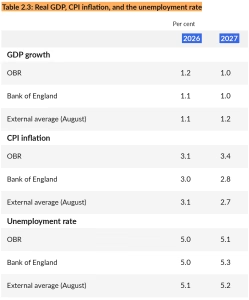
October 2026 economic forecast showing CPI inflation expected to reach 3.4% in 2027.
How Is the Government Funding Teacher Pay Rises in 2026 and 2027?
The Department for Education announced additional funding to support the multi-year teacher pay agreement.
The investment is designed to help maintained schools and other eligible education providers meet increased workforce costs.
| Financial year | Additional school funding |
| 2026/27 | £700 million |
| 2027/28 | £1.115 billion |
| Combined | £1.815 billion |
These allocations are commonly described as approximately £1.8 billion over two years.
However, the government has also stated that schools are expected to absorb approximately the first 1 percentage point of each pay award through existing budgets and efficiency measures.
This means the pay settlement does not remove the need for careful workforce planning.
What Does the Funding Arrangement Mean for School Budgets?
Consider a hypothetical school with a £2 million annual teacher salary bill before the 2026 award.
| Measure | Illustrative amount |
| Original salary bill | £2,000,000 |
| Additional cost from a 3.5% rise | £70,000 |
| Salary bill after 2026 award | £2,070,000 |
| Additional cost from a 3% rise in 2027 | £62,100 |
| Salary bill after both awards | £2,132,100 |
The example shows that the same school could face £132,100 in additional annual teacher salary costs by September 2027, assuming unchanged staffing and no other salary changes.
The calculation excludes employer pension contributions, National Insurance, progression and other staffing expenses.
Importantly, the expectation for schools to absorb the first percentage point of the awards does not mean that an individual school receives a separate reimbursement of every remaining pound. Funding is distributed through wider education funding arrangements.
Our assessment is that larger trusts may have greater opportunities to manage central purchasing and administrative costs, while individual schools with limited financial flexibility could face more difficult decisions.
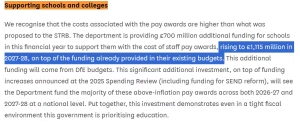
Government funding commitments for the 2026–2027 teacher pay agreement, including £700 million in 2026/27 and £1.115 billion in 2027/28.
Why Are Teaching Unions Still Concerned About the Pay Agreement?
Although the government accepted the independent pay review recommendations, teacher unions have continued to raise concerns about the long-term value of salaries and school funding.
The National Education Union argues that teacher pay has lost substantial purchasing power over the past decade and that increases must be assessed against inflation and alternative graduate career opportunities.
The union has also challenged the expectation that schools should fund part of the award through existing resources.
These concerns do not mean that the 2027 increase has been cancelled. The 3% award remains part of England’s confirmed framework.
Instead, the disagreement centres on whether the settlement is sufficient to restore earnings and protect education budgets.
Owen Jenkins, chief executive of Broad Horizons Education Trust, highlighted the changing financial outlook in comments reported in November 2026.
He warned that almost all of the real-terms improvement initially expected from the settlement was now forecast to disappear.
His assessment reflects a broader issue with multi-year pay agreements: salary certainty is valuable, but inflation forecasts can change considerably between the agreement date and implementation.
Our review suggests that negotiations around workload, recruitment, pension benefits and additional responsibilities will remain important even after the annual salary percentages have been settled.
Will Wales, Scotland and Northern Ireland Receive the Same Teacher Pay Rise in 2027?
Teacher pay is not determined by one identical settlement covering the whole United Kingdom.
England, Wales, Scotland and Northern Ireland operate different pay-setting arrangements.
| UK nation | Latest relevant confirmed award | Position for 2027 |
| England | 3.5% from September 2026 | Further 3% confirmed from September 2027 |
| Wales | 3.5% from September 2026 | Separate 2027/28 review underway |
| Scotland | 3.25% from August 2026 | Current settlement runs to July 2027 |
| Northern Ireland | 4% from September 2025 | Newer award subject to separate negotiations and confirmation |
What Is Happening With Teacher Pay in Wales?
In October 2026, the Welsh Government confirmed a 3.5% uplift to teacher and school leader pay scales, backdated to September 2026.
Unqualified teachers received a separate 5% uplift.
The Welsh Independent Pay Review Body had recommended 4.25% for teachers in 2026, but the government considered that level unaffordable within available budgets.
The government has begun a separate process for the 2027/28 award.
This means teachers in Wales should not automatically assume that England’s confirmed September 2027 increase applies to them.
What Is Happening With Teacher Pay in Scotland?
Scotland’s existing agreement covers August 2025 to July 2027.
The settlement included a 4% increase from August 2025, rising to 4.25% from April 2026, followed by a further 3.25% uplift from August 2026.
The next settlement beyond July 2027 is a separate matter.
What Is Happening With Teacher Pay in Northern Ireland?
Northern Ireland reached a separate 2025/26 agreement providing a 4% increase effective from September 2025.
The Department of Education’s official information reviewed for this update did not establish a final September 2026 or September 2027 award.
Teachers should therefore distinguish the previous confirmed settlement from any subsequent negotiating position.
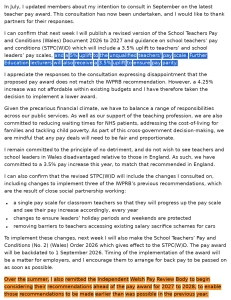
Welsh Government’s October 2026 confirmation of the 3.5% teacher pay award and its separate 2027 review process.
Will Headteachers and School Leaders Receive the 2027 Pay Rise?
School leaders covered by England’s national pay framework are included in the September 2026 and September 2027 awards.
However, headteacher and leadership salaries differ significantly according to school size, location, responsibilities and the applicable leadership pay range.
A 3% award produces a larger cash increase for employees earning higher salaries.
For example:
| Existing annual salary | 3% increase | New annual salary |
| £55,000 | £1,650 | £56,650 |
| £65,000 | £1,950 | £66,950 |
| £80,000 | £2,400 | £82,400 |
| £100,000 | £3,000 | £103,000 |
These are illustrative calculations rather than official leadership scale points.
The government has also introduced additional expectations around senior academy trust executive pay, including controls relating to increases and approval requirements for certain high-paid appointments.
From a financial management perspective, the key issue is ensuring that executive pay remains proportionate to workforce costs and the educational value delivered.
Will Teaching Assistants and School Support Staff Get a Pay Rise?
Teaching assistants, administrative employees, caretakers and other school support staff do not automatically receive the same pay settlement as qualified teachers.
Many are employed under National Joint Council local government pay arrangements.
The confirmed NJC award for 2026/27 is 3.3%, effective from April 2026.
This is separate from the 3.5% teacher award that applies from September 2026 in England.
| Workforce group | 2026 pay increase | Main effective date |
| School teachers in England | 3.5% | September 2026 |
| Many NJC school support employees | 3.3% | April 2026 |
| School teachers in England, next award | 3.0% | September 2027 |
| NJC support employees, next award | Not yet agreed | Subject to 2027 negotiations |
The distinction matters because employees working in the same school may receive different salary increases at different times.
Support staff can compare the latest NJC pay scales to understand the national salary points, backdated payments and 2027 negotiating position.
Schools must also consider the wider wage environment, including changes to the National Living Wage, when budgeting for eligible lower-paid employees.
Will Part-Time, Supply and Unqualified Teachers Benefit?
The 2027 teacher pay settlement affects several categories of teachers differently.
- Part-time teachers: Where the national pay framework applies, basic salary is normally calculated proportionately according to contractual working time. Applicable responsibility allowances may be subject to separate rules.
- Supply teachers: Those employed directly by maintained schools or local authorities under the national framework generally have pay calculated according to the relevant salary arrangements, including statutory daily-rate rules. Agency-employed supply teachers may be subject to different contractual rates.
- Unqualified teachers: The bottom of the unqualified teacher pay range outside London received a special 5% uplift in September 2026, rather than the standard 3.5%.
- That reference point increased from £22,601 in 2025/26 to £23,732 in 2026/27 and is scheduled to rise to £24,444 in 2027/28.
- Academy teachers: Academies have historically had greater pay flexibility than maintained schools, although many follow national arrangements. The developing statutory framework for academies must also be considered when determining obligations for September 2027.
Teachers should check their contract, school pay policy and applicable statutory protections before assuming that their salary will increase automatically by a particular amount.
How Will the Teacher Pay Rise Affect Pensions and Tax?
An increase in pensionable teacher salary can affect both contributions and eventual pension benefits.
Members of the Teachers’ Pension Scheme generally build benefits based on pensionable earnings under the applicable career-average arrangements, with certain protections for earlier service.
A higher pensionable salary can therefore increase the amount of pension built up for the relevant period.
However, a higher salary can also affect employee contribution deductions and, depending on earnings, the applicable contribution tier.
Tax is equally important.
A teacher moving from £49,000 to more than £50,000 may face a different marginal Income Tax treatment on part of their earnings in England, Wales or Northern Ireland. Scottish Income Tax bands are different.
Frozen tax thresholds can also mean that more of a pay increase is subject to higher marginal taxation.
Teachers who personally incur qualifying employment expenses may also wish to review what they can claim back on tax as an employee.
Not every classroom purchase, professional subscription or work-related expense qualifies for tax relief, and employer reimbursement must be considered before submitting a claim.
The financial benefit of a teacher pay rise should therefore be measured through four areas: gross salary, tax, pension contributions and real household purchasing power.
Could the 2027 Teacher Pay Rise Improve Recruitment and Retention?
Teacher recruitment and retention remain central reasons for increasing education salaries.
In July 2026, the government reported that school teacher leaving rates had fallen to 8.5%, the lowest level since at least 2010 when pandemic years are excluded.
It also reported a 13% increase in people training to teach compared with the previous year.
These figures suggest some improvement in the workforce environment, although they do not establish that pay increases alone caused the changes.
Salary competitiveness must be considered alongside workload, professional development, pupil behaviour, career progression and job satisfaction.
For example, a graduate considering teaching against private-sector employment may compare the £35,000-plus starting salary available outside London from September 2027 with the earnings potential in another professional occupation.
Teachers already working in schools may place greater weight on workload, progression opportunities and flexibility.
Our assessment is that the 2027 award improves the attractiveness of teaching at entry level, but retaining experienced teachers will require more than annual percentage increases.
The most effective workforce strategy is likely to combine competitive salaries with manageable workloads, professional recognition and clear progression opportunities.
What Is Our Financial Assessment of the 2027 Teacher Pay Settlement?
We assessed the England settlement across five areas using published financial information and the sector’s current economic conditions.
The following percentage ratings are editorial assessments, not official government statistics or survey results.
| Assessment category | Our rating | Financial interpretation |
| Certainty of scheduled increases | 95% | Two-year award established in advance |
| Improvement in gross salaries | 80% | Clear nominal earnings growth |
| Protection against inflation | 45% | 2027 CPI forecast exceeds the award |
| School budget affordability | 55% | Additional funding, but schools absorb costs |
| Long-term recruitment support | 70% | Higher starting salaries, with other pressures remaining |
Overall editorial assessment: 69%
We calculate the overall score as the simple average of the five assessments. It reflects our judgement of the settlement’s strengths and weaknesses rather than a measured financial return.
The most positive feature is predictability. Teachers and school leaders have more clarity about the next award than they would under an unresolved annual negotiation.
The main weakness is the possibility of limited real-terms salary growth.
For schools, the financial challenge is also considerable. Pay increases are recurring expenditure, whereas individual schools may have limited scope to reduce other operating costs without affecting educational provision.
From a workforce planning perspective, the settlement offers stability but does not eliminate inflation, recruitment or funding risks.
When Will Teachers Receive the September 2027 Pay Rise?
The effective date of the next England teacher pay increase is 1 September 2027.
The date on which the revised amount appears in an employee’s payslip may depend on their employer’s payroll implementation.
Where a revised award is processed after its effective date, eligible teachers should receive the relevant backdated amount under the applicable arrangements.
For example, if a teacher’s annual salary increases by £1,200 and the change is processed two months late, the gross arrears attributable to two full months would ordinarily be approximately £200.
That is an illustration only. Actual arrears depend on the effective date, contractual salary, periods worked, payroll calculations and deductions.
Employees should review their September 2027 payslips and subsequent payroll statements to ensure that any applicable increase has been recorded.
Final Assessment: Is the 2027 Teacher Pay Rise Good News?
The teacher pay rise for 2027 provides another confirmed salary increase for eligible teachers in England, following the 3.5% award implemented in September 2026.
Together, these increases deliver approximately 6.61% nominal salary growth over two years and raise starting salaries outside London above £35,000.
Our analysis finds that the settlement’s greatest strength is financial certainty. Schools can plan staffing costs more effectively, while teachers have a clearer picture of forthcoming salary changes.
However, the October 2026 inflation outlook raises questions about whether the 2027 award will deliver a meaningful improvement in purchasing power.
For teachers, the most useful measure will be the increase in take-home pay after deductions and living costs. For schools, success will depend on whether additional funding is sufficient to support workforce stability without compromising educational provision.
The 2027 award is therefore a significant salary development, but its lasting economic value will depend on inflation, school finances and the wider employment environment.
Frequently Asked Questions About the Teacher Pay Rise 2027
Is the 3% teacher pay rise for 2027 confirmed?
Yes. England’s 3% teacher pay award from September 2027 was accepted by the government in July 2026 and incorporated into the updated pay framework. The position in Wales, Scotland and Northern Ireland is determined separately.
How much will a newly qualified teacher earn in 2027?
The M1 reference salary outside London will be £35,092 from September 2027. London starting salaries will be higher, depending on the applicable region and employer arrangements.
Will teachers receive a 3% pay rise in April 2027?
The confirmed England teacher award begins in September 2027, not April. Separate pay arrangements for school support staff and some other education employees may use April effective dates.
What is the combined teacher pay rise for 2026 and 2027?
A 3.5% increase followed by a further 3% rise produces a compounded increase of approximately 6.61% across the two awards, assuming both increases apply to the same base salary.
Will teachers get a bigger pay rise if inflation increases?
There is no automatic guarantee that England’s scheduled September 2027 award will increase if inflation exceeds 3%. Any change would require further government action. Scotland has separate provisions concerning its settlement.
Are teachers getting a 3% pay rise in 2028?
The School Teachers’ Review Body recommended an indicative 3% uplift for September 2028, but this is not the same as a final confirmed award.
Do teaching assistants receive the same teacher pay rise?
Not necessarily. Many teaching assistants and other school support staff are covered by NJC arrangements, under which the 2026/27 pay increase is 3.3% from April 2026.