

The NJC pay scales have undergone significant changes following two consecutive annual pay agreements, with the latest 2026/27 settlement delivering a confirmed 3.3% salary increase for eligible local government employees.
The National Joint Council (NJC) for Local Government Services reached its latest pay agreement on 24 August 2026. The revised salary rates apply retrospectively from 1 April 2026 and remain applicable until 31 March 2027.
For council employees, school support workers, HR professionals and organisations that benchmark salaries against NJC rates, understanding these changes is essential.
The latest agreement increases the minimum nationally negotiated NJC salary to £25,614 annually, equivalent to approximately £13.28 per hour under the standard 37-hour calculation. This follows the permanent deletion of Spinal Column Point (SCP) 2 from April 2026.
Our analysis of the published pay agreements, employer guidance and trade-union responses highlights important financial implications beyond the headline percentage.
These include backdated salary payments, pension contributions, local grading structures and growing pressure on public-sector employment budgets.
The latest agreement also comes as unions begin developing their priorities for the 2027 pay negotiations.
What Are NJC Pay Scales and Why Are They Important?
NJC pay scales are nationally negotiated salary rates used by local authorities and other employers operating under the National Joint Council for Local Government Services.
The framework is commonly associated with the Green Book, which establishes nationally agreed employment terms and conditions.
More than 1.4 million local government services employees are covered by the NJC framework.
Rather than allowing every council to negotiate its entire salary structure independently, the system establishes nationally agreed pay points while permitting employers to operate local grading arrangements.
How the NJC Salary Framework Works?
Each employee is assigned a salary grade that includes one or more Spinal Column Points.
An employee’s position depends on factors such as:
- The responsibilities and complexity of their role.
- The results of a recognised job evaluation process.
- The salary grade established by their employer.
- Previous experience and applicable recruitment policies.
- Contractual arrangements for incremental progression.
- Locally agreed allowances and working conditions.
For example, an employee appointed at SCP 12 receives a nationally specified salary, but their council determines how that point sits within its local grade structure.
The system encourages consistent pay-setting practices while allowing councils to recognise different job responsibilities.
However, national salary points should not be confused with locally determined grade names. A Grade 5 position in one council may cover different SCPs from a Grade 5 position elsewhere.
What Is the Latest NJC Pay Award for 2026/27?
The latest NJC agreement confirms a 3.3% increase across national pay points SCP 3 to SCP 43.
The agreement covers 1 April 2026 to 31 March 2027 and also includes an increase in specified national allowances.
| Pay Agreement Detail | Confirmed Position |
| Agreement date | 24 August 2026 |
| Effective date | 1 April 2026 |
| Award period | 1 April 2026 – 31 March 2027 |
| Salary increase | 3.3% |
| National pay points | SCP 3–43 |
| Lowest annual salary | £25,614 |
| Lowest hourly rate | £13.28 |
| Highest national SCP salary | £56,293 |
| Allowance increase | 3.3% |
| SCP 2 | Permanently deleted |
| Backdated payment | Applicable from 1 April 2026 |
The 3.3% increase is consolidated, meaning it becomes part of the employee’s ongoing salary rather than being paid as a temporary bonus.
The agreement also provides for a corresponding increase to locally determined pay points above SCP 43 where those posts remain within the NJC framework and are graded below deputy chief officer.
This matters because some councils operate salary structures extending beyond the nationally published pay spine.
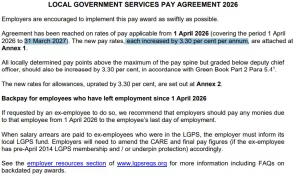
Official NJC Local Government Services Pay Agreement 2026 confirming the 3.3% salary increase effective from 1 April 2026.
What Are the Confirmed NJC Pay Scales for 2025/26 and 2026/27?
The following table compares all nationally negotiated NJC salary points with the previous financial year’s rates.
These are full-time equivalent annual salaries calculated using the NJC standard working week of 37 hours.
Official NJC Salary Table: SCP 3–43
| SCP | 2025/26 Annual Salary | 2026/27 Annual Salary | 2026/27 Hourly Rate |
| 3 | £24,796 | £25,614 | £13.28 |
| 4 | £25,185 | £26,016 | £13.48 |
| 5 | £25,583 | £26,427 | £13.70 |
| 6 | £25,989 | £26,847 | £13.92 |
| 7 | £26,403 | £27,274 | £14.14 |
| 8 | £26,824 | £27,709 | £14.36 |
| 9 | £27,254 | £28,153 | £14.59 |
| 10 | £27,694 | £28,608 | £14.83 |
| 11 | £28,142 | £29,071 | £15.07 |
| 12 | £28,598 | £29,542 | £15.31 |
| 13 | £29,064 | £30,023 | £15.56 |
| 14 | £29,540 | £30,515 | £15.82 |
| 15 | £30,024 | £31,015 | £16.08 |
| 16 | £30,518 | £31,525 | £16.34 |
| 17 | £31,022 | £32,046 | £16.61 |
| 18 | £31,537 | £32,578 | £16.89 |
| 19 | £32,061 | £33,119 | £17.17 |
| 20 | £32,597 | £33,673 | £17.45 |
| 21 | £33,143 | £34,237 | £17.75 |
| 22 | £33,699 | £34,811 | £18.04 |
| 23 | £34,434 | £35,570 | £18.44 |
| 24 | £35,412 | £36,581 | £18.96 |
| 25 | £36,363 | £37,563 | £19.47 |
| 26 | £37,280 | £38,510 | £19.96 |
| 27 | £38,220 | £39,481 | £20.46 |
| 28 | £39,152 | £40,444 | £20.96 |
| 29 | £39,862 | £41,177 | £21.34 |
| 30 | £40,777 | £42,123 | £21.83 |
| 31 | £41,771 | £43,149 | £22.37 |
| 32 | £42,839 | £44,253 | £22.94 |
| 33 | £44,075 | £45,529 | £23.60 |
| 34 | £45,091 | £46,579 | £24.14 |
| 35 | £46,142 | £47,665 | £24.71 |
| 36 | £47,181 | £48,738 | £25.26 |
| 37 | £48,226 | £49,817 | £25.82 |
| 38 | £49,282 | £50,908 | £26.39 |
| 39 | £50,269 | £51,928 | £26.92 |
| 40 | £51,356 | £53,051 | £27.50 |
| 41 | £52,413 | £54,143 | £28.06 |
| 42 | £53,460 | £55,224 | £28.62 |
| 43 | £54,495 | £56,293 | £29.18 |
SCP 1 was deleted in April 2023, while SCP 2 remained in the 2025/26 scale at £24,413 before being permanently deleted from April 2026.
An important distinction is that these figures represent nationally agreed SCP values, not universal council grade boundaries. Individual councils may group these points differently.
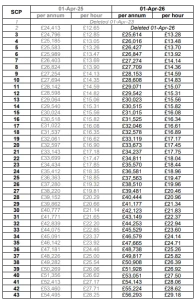
Official NJC pay scales for 2025/26 and 2026/27, showing annual salaries and hourly pay rates from SCP 3 to SCP 43.
How Much Extra Will Employees Earn Under the 3.3% NJC Pay Rise?
Although the percentage increase is the same across the national pay spine, employees receive different cash increases depending on their salary.
A 3.3% increase produces a larger annual monetary gain for an employee earning £50,000 than for someone earning £25,000.
Our comparison of the revised salary tables illustrates the differences.
| NJC Point | Annual Pay Increase | Monthly Gross Increase |
| SCP 3 | £818 | £68.17 |
| SCP 11 | £929 | £77.42 |
| SCP 20 | £1,076 | £89.67 |
| SCP 29 | £1,315 | £109.58 |
| SCP 35 | £1,523 | £126.92 |
| SCP 43 | £1,798 | £149.83 |
Figures are based on the difference between published rounded annual salary rates and show gross pay before deductions.
For an employee on SCP 20, annual salary increases from £32,597 to £33,673. That represents approximately £90 more in gross monthly salary.
However, the actual increase in take-home pay will normally be smaller because additional taxable earnings can increase Income Tax, National Insurance and pension deductions.
Employees can compare their updated payroll information with their tax records when they check their wages through HMRC.
Why a 3.3% Pay Rise May Not Feel Like a 3.3% Income Increase?
Salary increases should be assessed alongside living costs and deductions.
For example, if an employee receives a 3.3% pay increase while their household expenses rise by 4%, their purchasing power may still decline.
This does not mean the salary award has no financial value. It means nominal wage growth and real wage growth are different.
Employees should consider:
- Gross annual salary changes.
- Income Tax and National Insurance.
- Pension contribution adjustments.
- Housing, transport and childcare expenses.
- Eligibility for means-tested benefits.
- Changes to local allowances or working arrangements.
These factors explain why employees on the same NJC point can experience different changes in disposable income.
Why Was NJC Spinal Column Point 2 Removed in April 2026?
One of the most important structural changes was the permanent deletion of SCP 2.
The previous lowest nationally negotiated pay point had already come under pressure because of increases in the statutory National Living Wage.
Removing SCP 2 moved the bottom of the national pay spine to SCP 3.
| Pay Structure | 2025/26 | 2026/27 |
| Lowest active national point | SCP 2 | SCP 3 |
| Lowest annual salary | £24,413 | £25,614 |
| Lowest hourly rate | £12.65 | £13.28 |
| Change in lowest salary | — | £1,201 |
| Increase in lowest salary value | — | Approximately 4.9% |
The approximately 4.9% change represents the difference between the old and new lowest national salary values. It is not the percentage awarded to every employee.
The deletion of SCP 2 was agreed as part of the previous 2025/26 settlement and took effect on 1 April 2026.
For employers, this required a review of positions previously using SCP 2 and any local grade structures that included the deleted point.
Councils must ensure that affected workers are placed on a valid salary point and paid according to their contractual and collectively agreed arrangements.
This also demonstrates the growing interaction between NJC pay negotiations and the statutory minimum wage.
How Are NJC Pay Scales Calculated for Part-Time Employees?
The national pay tables are expressed as full-time equivalent salaries using a standard 37-hour working week.
However, many local government workers are employed part-time or under alternative working arrangements.
Where pay is calculated pro rata against a 37-hour full-time salary, the usual formula is:
Part-time salary = Full-time annual salary × Contracted weekly hours ÷ 37
Consider an employee on SCP 11.
Their full-time annual salary for 2026/27 is £29,071.
If they work 30 hours each week and their employer uses a 37-hour full-time divisor:
£29,071 × 30 ÷ 37 = approximately £23,571 annually.
| Weekly Hours | Illustrative SCP 11 Annual Salary |
| 37 hours | £29,071 |
| 35 hours | £27,500 |
| 30 hours | £23,571 |
| 25 hours | £19,643 |
| 20 hours | £15,714 |
These figures illustrate proportional salary calculations rather than mandatory pay outcomes.
Some employers operate a 35-hour standard full-time working week or have local agreements that preserve the full salary at different contracted hours. Employees should therefore use their employer’s actual full-time hours and contractual salary provisions.
Term-Time Only School Support Staff
School support workers may have a different pay calculation because their contracts cover term-time working with an appropriate holiday-pay arrangement.
Their annual salary often depends on:
- Contracted weekly hours.
- Paid working weeks.
- Holiday entitlement and the applicable calculation method.
- Length of service.
- Local employment agreements.
- The relevant NJC salary point.
A teaching assistant working 30 hours per week during term time should not automatically assume they receive the same annual salary as a year-round employee working 30 hours.
The employer’s term-time salary formula and holiday-pay arrangements need to be checked.
This is particularly important when comparing advertised school salaries with nationally published NJC full-time equivalent rates.
Which NJC Allowances Increased in 2026/27?
The agreement also increased specified nationally negotiated allowances by 3.3%.
These allowances apply to particular duties or qualifying employment arrangements. They are not additional payments automatically received by every NJC employee.
| Allowance | Rate From April 2026 |
| Sleeping-in duty payment | £44.54 |
| Protected special educational needs allowance for nursery staff | £1,590 annually |
| Science laboratory technician certificate allowance | £259 |
| Advanced laboratory technician certificate allowance | £187 |
| Inner fringe area allowance | £1,079 annually |
| Outer fringe area allowance | £753 annually |
| Specified social worker standby allowance | £35.86 per session |
The rates are established through the relevant provisions of the NJC agreement.
Employers must check whether an allowance applies to the employee’s contract, location and duties.
London Weighting and Local Supplements
London weighting requires particular attention because some employees receive locally negotiated salary supplements rather than only the protected fringe allowances listed in the national circular.
An employee working for a London borough may therefore receive a higher total salary than someone elsewhere on an apparently similar pay grade.
However, there is no single universal London weighting figure that can simply be added to every NJC salary.
Employees should consult their employer’s published pay policy, salary schedule and employment contract.
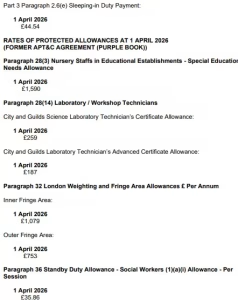
NJC 2026/27 allowances covering sleeping-in duties, protected allowances, fringe-area payments and social worker standby duties.
How Do NJC Pay Scales Compare With the National Living Wage?
The relationship between NJC salaries and the National Living Wage has become increasingly important.
From 1 April 2026, the statutory National Living Wage for employees aged 21 and over increased to £12.71 per hour, representing a 4.1% rise from £12.21.
Meanwhile, the lowest active NJC point became SCP 3 at £13.28 per hour.
| Pay Measure | Hourly Rate From April 2026 |
| National Living Wage, age 21+ | £12.71 |
| NJC SCP 3 | £13.28 |
| NJC SCP 5 | £13.70 |
| NJC SCP 10 | £14.83 |
| NJC SCP 11 | £15.07 |
| NJC SCP 20 | £17.45 |
The lowest nationally negotiated NJC rate is therefore £0.57 per hour, or approximately 4.5%, above the 2026 National Living Wage.
That differential is relatively narrow, which helps explain why the structure of the lower NJC salary points remains a significant issue in pay negotiations.
Employees and employers examining the wider wage environment can compare the latest UK National Living Wage rates for 2026.
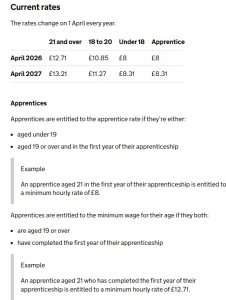
Government National Minimum Wage and National Living Wage rates effective from 1 April 2026.
How Do Local Council Grades Relate to NJC Spinal Column Points?
A common misunderstanding is that NJC pay points directly correspond to the same job titles throughout the country.
In practice, the nationally negotiated SCP salary values sit within local grading structures.
For example, one council might place an administrative officer position within a grade covering SCP 9–12, while another might evaluate a comparable position differently.
The salary point is nationally defined, but the allocation of roles to grades remains an important local responsibility.
Job Evaluation and Incremental Progression
Councils generally use job evaluation processes to establish the relative demands of different roles.
These assessments may consider knowledge, responsibility, decision-making, communication, working conditions and other relevant factors.
Once a position is graded, an employee may be eligible to progress through the grade’s salary points according to the employer’s applicable progression rules.
However, an annual national pay award and incremental salary progression are not the same thing.
An employee could receive a national uplift and a separate increment, but progression is not automatically guaranteed merely because the NJC has agreed a pay award.
Where employees have concerns about their contracted salary grade, the terms of their employment remain important. Understanding employment contracts and workers’ rights can help distinguish contractual benefits from general employment protections.
What Happened to the NJC Pay Agreement for 2025/26?
The previous NJC agreement, covering 1 April 2025 to 31 March 2026, delivered a confirmed salary increase of 3.2%.
The agreement also increased specified allowances by 3.2% and established the deletion of SCP 2 from April 2026.
It is important to distinguish those agreed provisions from the wider pay claim submitted by the trade unions.
The unions sought additional improvements to annual leave, working hours and the minimum hourly rate, but employers rejected those elements.
| Proposed or Agreed Change | 2025/26 Outcome |
| 3.2% consolidated pay increase | Agreed |
| 3.2% increase to specified allowances | Agreed |
| Deletion of SCP 2 from April 2026 | Agreed |
| Additional annual leave day | Rejected |
| Two-hour reduction in working week | Rejected |
| National roadmap to £15 per hour | Rejected |
| Additional school term-time leave flexibility | Rejected |
The distinction matters when employees review older reports of the negotiations.
A proposal included in a union pay claim does not automatically become part of the employee’s contractual entitlement.
The latest 2026/27 agreement similarly did not introduce the requested national two-hour reduction in working hours or universal additional annual leave day.
For employees, the confirmed salary increase and applicable contractual benefits should be treated separately from negotiating objectives.
When Should Employees Receive Their NJC Pay Rise and Backpay?
Although the 2026/27 agreement was reached in August 2026, its effective date is 1 April 2026.
This means eligible employees should receive the revised rates retrospectively from April.
The date on which backpay appears in an employee’s bank account depends on their employer’s payroll implementation.
Some local authorities and maintained schools processed the award in September or October 2026, while others operated different payment schedules.
How to Calculate NJC Backpay?
The basic calculation is:
Estimated backpay = Difference in gross annual salary ÷ 12 × Number of eligible months
Consider an employee on SCP 20.
Their annual salary increased from £32,597 to £33,673.
The difference is £1,076 annually, or approximately £89.67 per month.
If the employee was eligible for the full increase from April through September, six months of estimated gross arrears would be:
£1,076 ÷ 12 × 6 = £538
| NJC Point | Monthly Gross Increase | Illustrative Six-Month Backpay |
| SCP 3 | £68.17 | £409 |
| SCP 11 | £77.42 | £464.50 |
| SCP 20 | £89.67 | £538 |
| SCP 29 | £109.58 | £657.50 |
| SCP 43 | £149.83 | £899 |
These examples assume continuous full-time employment at the same SCP for the entire six-month period.
Actual arrears may vary because of working hours, employment dates, increments, salary changes, allowances and payroll calculations.
What Happens to Backpay for Employees Who Have Left?
The 2026 agreement recommends that employers pay outstanding arrears to former employees who request them, covering the period from 1 April 2026 until their final eligible day of employment.
For example, a worker who left in July 2026 after being employed throughout April, May and June may still be owed the retrospective increase for that period.
Former employees should contact their previous employer’s payroll or HR department to confirm their entitlement and request any outstanding payment.
How Can the NJC Pay Rise Affect Tax, Pensions and Universal Credit?
The difference between gross salary increases and actual disposable income deserves careful attention.
When an employee receives a backdated salary award, several financial adjustments may occur together.
- Income Tax and National Insurance: Additional taxable earnings may increase deductions in the payment period. The amount depends on the employee’s circumstances and applicable tax thresholds.
- Local Government Pension Scheme: Eligible pension contributions and pensionable pay records may need to reflect the revised earnings. An increase can also affect the applicable employee contribution band.
- Universal Credit: A large payment of backpay could reduce a Universal Credit award for the relevant assessment period, depending on the claimant’s circumstances and how the earnings are treated.
- Other deductions: Student loan repayments, salary-related deductions and other payroll arrangements may also be affected.
For this reason, employees should check their full payslip rather than relying only on the announced percentage increase.
If discrepancies arise, reviewing HMRC wage reporting and payroll compliance can provide useful context for understanding how wages are recorded and checked.
What Does the NJC Pay Rise Mean for Local Government Employers?
For local authorities, an agreed salary increase represents a recurring budget obligation.
The financial consequences go beyond the salary uplift itself because employers also need to consider pension costs, employer National Insurance contributions and other employment-related expenditure.
Consider an illustrative department employing 25 full-time workers with an average salary of £32,000.
The annual gross salary budget before the award would be £800,000.
Applying a 3.3% increase produces additional annual gross salary expenditure of £26,400.
| Employer Budget Item | Illustrative Amount |
| Employees | 25 |
| Average previous salary | £32,000 |
| Previous combined salary cost | £800,000 |
| Salary increase | 3.3% |
| Additional annual salary expenditure | £26,400 |
| New annual salary expenditure | £826,400 |
Assuming the full incremental amount is subject to employer National Insurance at 15%, the employer could face a further £3,960 in National Insurance costs, before pension contributions and other adjustments.
This is a simplified scenario, not a forecast for a particular council.
Actual costs depend on workforce composition, National Insurance thresholds, allowances, pension arrangements and employee eligibility.
Our financial assessment indicates that employers should treat pay awards as ongoing workforce cost commitments rather than one-off increases in payroll.
The same budgeting discipline matters to private employers, charities and growing organisations. Rising salary costs, employer contributions and operational overheads are also central to the cost of running a UK business.
Pay Compression and Recruitment Pressures
One challenge created by increases in the lowest pay points is salary compression.
This occurs when the difference between entry-level pay and more experienced or supervisory positions becomes relatively small.
If employees with significantly different responsibilities receive similar pay, employers may face recruitment, retention and progression challenges.
A well-designed salary framework must therefore balance competitive entry-level wages with appropriate differences between grades.
For councils, this may require periodic job evaluation, local grading reviews and careful workforce planning.
What Role Do Trade Unions Play in NJC Pay Negotiations?
The NJC brings together representatives of local government employers and recognised trade unions.
The principal unions involved in Green Book pay negotiations are UNISON, GMB and Unite.
Their role includes developing collective pay claims, representing employee interests and negotiating with the National Employers.
For 2026/27, the unions initially sought an increase of at least £3,000 or 10%, whichever was greater, alongside several improvements to employment conditions.
However, the final award was 3.3%.
The settlement followed a period of disagreement over the employers’ offer, including consultation and industrial-action considerations.
GMB National Officer for Local Government, Will Dalton, stated during the 2026 negotiations:
“We will continue to push for your pay to be in your pockets as soon as possible.”
His statement reflected the union’s emphasis on implementing the agreed salary award without further unnecessary delays.
The wider dispute demonstrates how pay negotiations involve competing financial priorities: employees seek salary growth that protects living standards, while councils must fund increases within their available budgets.
What Is the Latest NJC Pay Position for 2027/28?
As of 2 November 2026, the 2027/28 NJC pay award has not been agreed.
However, union preparations for the next annual pay round are already underway.
In an update published on 23 October 2026, GMB outlined priorities being taken into discussions with the other NJC unions.
These included:
- A proposed inflation-linked pay award of around 5%, expressed as RPI inflation plus 1.6 percentage points.
- A minimum hourly salary rate of £15.
- Ending term-time-only contracts.
- Full funding for the agreed pay award.
- Earlier and more meaningful negotiations with employers.
These are proposals being advanced by GMB, not a confirmed NJC settlement or necessarily the final joint-union claim.
| Pay Year | Confirmed or Proposed Increase | Status |
| 2025/26 | 3.2% | Agreed |
| 2026/27 | 3.3% | Agreed |
| 2027/28 | Around 5% proposed by GMB | Not agreed |
Our assessment is that the next negotiations are likely to focus heavily on the lowest salary points, inflation, pay compression and the financial position of local government employers.
The NJC pay spine review is also important because the relationship between entry-level NJC salaries and the National Living Wage continues to narrow.
Nevertheless, employees should not treat any suggested 2027 percentage as guaranteed until an official agreement is announced.
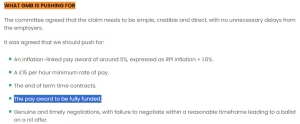
October 2026 GMB update outlining proposed priorities for the 2027 NJC pay claim, including an inflation-linked increase and a £15 minimum hourly rate.
How Can Employees Check Whether Their NJC Salary Is Correct?
Employees should check their pay against both the nationally agreed salary table and their employer’s local grading structure.
The simplest process involves verifying the SCP, contracted hours and relevant payroll details.
Key checks include:
- Salary point: Confirm the SCP shown in your contract or HR record.
- Applicable pay year: Check whether the 2025/26 or 2026/27 salary applies.
- Working hours: Confirm whether the salary is full-time or pro-rated.
- Local allowances: Identify any London weighting, fringe payments or other contractual additions.
- Increment dates: Check whether contractual progression has been applied correctly.
- Backpay: Verify that eligible arrears have been calculated from the correct date.
- Deductions: Compare gross earnings with pension, tax and National Insurance figures.
The legal treatment of employment pay can also depend on the employee’s contractual position. For example, employees who are suspended from work pending an investigation should normally continue receiving their usual contractual pay unless there is a lawful basis for different treatment.
Where salary discrepancies remain unresolved, employees should contact payroll or HR, followed by their recognised union representative where appropriate.
Accurate salary records benefit both employees and employers by reducing payroll disputes and helping maintain confidence in the grading system.
Conclusion: What Do the Latest NJC Pay Scales Mean?
The NJC pay scales for 2026/27 confirm a 3.3% increase, raising nationally negotiated annual salaries to between £25,614 and £56,293 across SCP 3–43. The award applies retrospectively from 1 April 2026, with qualifying employees potentially receiving backpay.
The permanent deletion of SCP 2 represents another important change, reflecting pressure on lower salary points from rising statutory minimum wages.
Our analysis highlights that employees should consider tax, pensions, working hours and local grading arrangements alongside the headline increase. Meanwhile, councils must manage the longer-term financial impact of higher staffing costs. The next focus is the 2027/28 settlement, which remains unconfirmed.
Frequently Asked Questions About NJC Pay Scales
What is the NJC pay rise for 2026/27?
The confirmed NJC pay award is 3.3%, applicable from 1 April 2026 to 31 March 2027. It covers national SCPs 3–43 and specified allowances.
What is the lowest NJC salary in 2026?
The lowest nationally negotiated NJC salary is £25,614 annually at SCP 3, equivalent to approximately £13.28 per hour using the standard 37-hour calculation.
Has NJC SCP 2 been removed?
Yes. SCP 2 was permanently deleted from the national pay spine on 1 April 2026, making SCP 3 the lowest active nationally agreed point.
Will council employees receive backpay for 2026?
Eligible employees are entitled to the revised rates from 1 April 2026. The actual payment date depends on their employer’s payroll implementation.
Do school support staff receive the NJC pay award?
Many school support employees working under NJC Green Book arrangements receive the award. The position depends on the school’s employer and applicable contractual arrangements.
Is the NJC pay rise for 2027 confirmed?
No. As of 2 November 2026, no final NJC pay award has been agreed for 2027/28. Union proposals should not be confused with a confirmed settlement.
Are NJC pay scales the same across every council?
National SCP salary amounts are agreed centrally, but councils may use different grade structures, progression policies and local allowances.
Are NJC salaries based on a 37-hour working week?
The national published salaries and hourly rates use a 37-hour calculation. Individual employees may work different hours under local contractual arrangements.
SEO title: NJC Pay Scales 2025/26 & 2026/27: Full Salary Table, 3.3% Rise and 2027 Update
Meta description: Explore the latest NJC pay scales for 2025/26 and 2026/27, including the confirmed 3.3% pay rise, all SCP salary rates, backpay, allowances and 2027 updates.