


The self-employed electrician hourly rate in the UK typically ranges from £40 to £70 in 2026, with approximately £55 per hour providing a useful benchmark for standard customer-facing electrical work.
Experienced electricians operating in London, completing specialist installations or handling emergency jobs may charge considerably more.
However, the amount an electrician charges a customer is not necessarily what they earn personally.
Unlike employed electricians receiving regular wages, self-employed professionals must pay for business insurance, tools, testing equipment, transport, certification, administration and other operating expenses. They also need to account for Income Tax, National Insurance and periods when they are unable to generate billable income.
Our analysis of published 2026 electrical trade pricing, industry survey findings and the financial requirements of running a trade business suggests that electricians should assess annual profitability rather than hourly charges alone.
A self-employed electrician charging £55 per hour could generate more than £70,000 in annual labour revenue under a reasonably busy working schedule. Yet their actual income after business expenses and personal taxes could be substantially lower.
Understanding this distinction is important for electricians planning their businesses, contractors negotiating day rates and homeowners evaluating electrical quotations.
What Is the Average Self-Employed Electrician Hourly Rate in the UK in 2026?
The average self-employed electrician hourly rate depends on qualifications, experience, the type of contract and where the work is carried out.
Published customer-facing cost guides commonly indicate rates of approximately £40–£70 per hour, although some electrical professionals accept lower rates for longer contracts or charge substantially more for urgent and specialised work.
There is no government-set hourly rate for self-employed electricians. Professionals generally negotiate their own prices according to market conditions and operating costs.
Self-Employed Electrician Rates at a Glance
| Electrician category | Indicative hourly charge | Indicative day rate |
| Newly qualified independent electrician | £35–£45 | £240–£320 |
| General self-employed electrician | £40–£60 | £280–£400 |
| Experienced domestic electrician | £45–£70 | £320–£450 |
| Commercial electrical contractor | £45–£75 | £300–£500 |
| Specialist electrical contractor | £60–£90+ | £400–£600+ |
| Experienced London electrician | £60–£90+ | £400–£600+ |
| Emergency or out-of-hours electrician | £80–£110+ | Usually priced by attendance or job |
These are indicative commercial pricing ranges, not statistically measured averages for every category. Daily rates may reflect discounts for longer bookings and do not necessarily equal eight times the hourly rate. Figures exclude materials and VAT unless otherwise agreed.
Newly qualified electricians may charge less while establishing their customer base, although being newly qualified does not automatically justify a low price if the electrician already has substantial practical experience.
Established electrical contractors can often charge more because they offer additional services, including inspection, testing, certification and responsibility for complex installations.
Our assessment is that an electrician earning £50 per hour through consistent local work may achieve better overall profitability than someone advertising £80 per hour but securing relatively few bookings.
Customer retention, utilisation and operating efficiency have an important influence on annual earnings.
What Does the Latest 2026 Electrician Pricing Research Show?
Published market data provides useful context, but electricians should understand the difference between survey averages and customer-facing pricing estimates.
Logic4training’s June 2026 research, drawing on information from electricians it had trained, reported an average hourly rate of £38 and an average day rate of £312.
Its previous figures were £44 per hour and £335 per day in 2025.
Electrician Pricing Trends: 2025 vs 2026
| Pricing indicator | 2025 figure | 2026 figure | Annual change |
| Survey average hourly rate | £44 | £38 | -13.6% |
| Survey average day rate | £335 | £312 | -6.9% |
| Reported upper day-rate figure | £600 | £600 | No change |
| Customers accepting quoted prices without question | 50% | 41.7% | -8.3 percentage points |
| Customers comparing quotes | 25% | 33.3% | +8.3 percentage points |
The research suggests that customers became more price-conscious, even while electricians continued facing cost pressures.
Importantly, these results do not establish that every electrician experienced a fall in earnings. The survey covered a range of services and professional circumstances.
Customer-facing cost guides can produce considerably higher figures because they focus on what homeowners pay, including the business costs associated with short domestic appointments.
The commercial lesson is that market averages should inform pricing decisions, not determine them automatically.
An electrician quoting £65 per hour should assess whether their local customers will accept the price, whether their skills justify the charge and whether they can generate enough regular work.
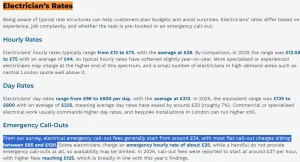
Electrician hourly and daily rate comparison showing the 2025 and 2026 survey figures.
How Much Do Self-Employed Electricians Charge Across Different UK Regions?
Electrician pricing varies across the UK because of differences in local demand, competition, travel expenses, property characteristics and customer budgets.
London and parts of the South East generally command higher prices, particularly for complex installations, premium residential projects and emergency services.
However, electricians outside London may achieve comparable profitability where overheads are lower and booking schedules are more efficient.
Self-Employed Electrician Hourly Rate by UK Region
| UK region | Indicative hourly rate | Indicative day rate |
| London | £60–£90+ | £400–£600+ |
| South East England | £50–£75 | £350–£500 |
| South West England | £45–£70 | £300–£450 |
| West Midlands | £40–£65 | £280–£420 |
| East Midlands | £40–£65 | £280–£420 |
| North West England | £40–£65 | £280–£420 |
| Yorkshire and the Humber | £40–£60 | £270–£400 |
| North East England | £35–£60 | £250–£380 |
| Scotland | £40–£70 | £280–£450 |
| Wales | £35–£60 | £250–£400 |
| Northern Ireland | £35–£60 | £250–£400 |
These regional figures are broad planning estimates based on published market ranges and geographical pricing patterns, not independently surveyed regional averages. Individual quotations may fall outside them.
Why Are London Electrician Rates Generally Higher?
Electricians operating in London often have additional business costs.
These can include expensive parking, longer travel times, congestion-related charges, higher insurance premiums and increased customer acquisition costs.
For example, consider two electricians completing similar domestic work.
| Financial comparison | Regional electrician | London electrician |
| Hourly customer rate | £50 | £65 |
| Weekly billable hours | 30 | 30 |
| Annual working weeks | 46 | 46 |
| Annual labour revenue | £69,000 | £89,700 |
| Revenue difference | — | £20,700 |
| Percentage difference | — | 30% higher |
The London electrician generates 30% more labour revenue in this hypothetical comparison.
However, if their vehicle, parking, travel, insurance and marketing costs are substantially higher, their personal income advantage will be smaller.
This is why regional pricing decisions should be based on local profitability and demand, rather than simply comparing advertised hourly figures.
How Much Is a Self-Employed Electrician’s Day Rate in the UK?
An established self-employed electrician may commonly charge around £280–£450 per day for general work, although specialist services and high-cost locations can command more.
Longer construction contracts sometimes pay lower rates than short domestic appointments because they offer predictable work and reduce travel, marketing and quotation costs.
A day’s work also needs a clear definition.
Some electricians quote for seven working hours, others for eight, while certain subcontractors price according to an agreed site schedule.
How Hourly Rates Translate Into Daily Revenue?
| Hourly rate | Six chargeable hours | Seven chargeable hours | Eight chargeable hours |
| £40 | £240 | £280 | £320 |
| £45 | £270 | £315 | £360 |
| £50 | £300 | £350 | £400 |
| £55 | £330 | £385 | £440 |
| £60 | £360 | £420 | £480 |
| £70 | £420 | £490 | £560 |
| £80 | £480 | £560 | £640 |
These calculations show the mathematical relationship between hourly pricing and chargeable working time.
They do not mean that every electrician charges customers separately for each hour of a full-day booking.
For example, an electrician might advertise a £60 hourly rate but offer a £400 daily rate for a pre-arranged project.
The lower effective hourly charge may make commercial sense when one booking fills the working day and eliminates travel between multiple customers.
Electricians assessing the wider construction market may also find it useful to compare the self-employed carpenter day rate, particularly because both trades frequently operate through construction-site subcontract arrangements.
How Much Do Electricians Charge for Emergency and Weekend Work?
Emergency electrical work normally attracts higher prices because it requires availability outside standard working hours.
Customers may require immediate assistance following electrical failures, dangerous wiring faults or other urgent problems.
Typical emergency hourly charges can reach £80–£110 or more, with additional attendance fees depending on the provider and location.
Electrician Call-Out and Emergency Pricing
| Service category | Indicative charge | Pricing consideration |
| Standard pre-booked electrical work | £40–£70 per hour | Normal working hours |
| Standard attendance or minimum charge | £50–£100 | Travel and initial attendance |
| Emergency call-out fee | £65–£120 | May be separate from labour |
| Emergency hourly labour | £80–£110+ | Urgent or out-of-hours work |
| Weekend electrical work | Agreed premium rate | Depends on availability |
| Bank holiday or overnight emergency | Individually quoted | Can exceed standard emergency pricing |
The charge categories are not necessarily cumulative. Some electricians include initial labour within their attendance fee, while others charge separately.
Why Do Emergency Electricians Charge More?
An emergency appointment may require an electrician to interrupt other commitments, carry additional stock or travel outside their normal service area.
The business must also cover the cost of maintaining availability when no customer calls.
For example, an electrician responding to a 45-minute emergency may spend another hour travelling and completing documentation.
Charging only for 45 minutes of labour would not necessarily recover the full cost of providing the service.
Emergency electricians therefore need transparent pricing arrangements that explain whether the first hour, travel, diagnostic work and materials are included.
The same pricing principle applies to other independent trades, including businesses operating under the self-employed plumber hourly rate model, where short-notice availability and travel significantly influence profitability.
How Much Do Common Electrical Jobs Cost in the UK?
Electricians frequently charge a fixed price rather than billing customers solely according to time.
This is especially common for clearly defined installations, inspections and replacement work.
The final price depends on materials, access, the existing electrical installation, testing requirements and whether any remedial work becomes necessary.
Typical Electrical Job Prices in 2026
| Electrical service | Indicative customer cost | Important consideration |
| Basic socket replacement | £25–£80 | Straightforward replacement only |
| Standard light fitting installation | £40–£120 | Complex fittings cost more |
| Fault finding | £50–£200 | Diagnostic time varies |
| Consumer unit replacement | £780–£1,000 | Board, testing and certification |
| EV charger installation | £950–£1,400 | Equipment and site complexity |
| EICR inspection | From approximately £150–£250 | Property size and circuit count |
| Partial or full property rewire | £1,500–£10,000+ | Scope and property-dependent |
These figures draw on published 2026 electrical pricing examples and are not guaranteed quotations. Inclusion of materials, testing, certification and VAT varies. Some short-job estimates may not include minimum attendance charges.
An electrician replacing a straightforward socket may complete the physical work quickly.
However, a consumer unit replacement involves more extensive responsibilities, including circuit identification, appropriate protection, testing and documentation.
Customers should not evaluate these services purely by dividing the quotation by the estimated installation time.
For electricians, fixed-price jobs can improve profitability when estimating is accurate and work is completed efficiently.
However, unexpected defects, inaccessible wiring or incomplete customer specifications can reduce the margin considerably.
A clearly defined quotation should therefore specify what is included and how additional work will be authorised.
How Does Specialisation Affect an Electrician’s Hourly Rate?
Specialist electrical services can command higher prices because they require additional technical knowledge, equipment, training or responsibility.
However, specialist work does not automatically guarantee higher profits.
The electrician must recover the costs of acquiring and maintaining the relevant capabilities.
EV Charger Installation
Electric vehicle charging installations can involve electrical load assessments, appropriate protective devices, cable routing, testing and compliance with applicable requirements.
Electricians who develop competence in this area may access a more specialised customer market.
Nevertheless, a competitive EV charger business needs reliable equipment suppliers, accurate estimating and efficient installation scheduling.
Solar PV and Battery Storage
Solar and battery work often requires additional system-design knowledge, coordination with other installers and an understanding of the applicable electrical standards.
Projects may be larger than standard domestic appointments.
Some customers also require specified installer accreditation or certification to access particular benefits or schemes.
Commercial and Industrial Electrical Work
Commercial electrical contractors may work on distribution systems, industrial premises, maintenance programmes and larger installations.
These jobs can generate higher project values, but contractual obligations, insurance, documentation and payment delays may also increase.
Electrical Inspection and Testing
Electricians undertaking electrical installation condition reports, fault diagnosis and compliance testing require suitable competence and properly maintained equipment.
Testing can provide an important recurring service for landlords, businesses and property managers.
However, reporting and administration should be included when calculating the profitability of each appointment.
Our analysis suggests that repeatable specialist services with consistent demand can be more valuable than occasional high-priced installations.
The strongest business opportunity depends on customer demand, operational capability and the cost of delivering the service reliably.
How Much Can a Self-Employed Electrician Earn Per Year?
Annual earnings depend on three important variables: the rate charged, the hours invoiced and the number of weeks worked.
A self-employed electrician cannot assume that every hour spent working on the business generates customer revenue.
There will normally be time spent travelling, preparing quotations, purchasing materials, completing electrical certificates, managing accounts and securing future projects.
Annual Electrician Labour Revenue at Different Hourly Rates
The following calculations assume 46 working weeks per year.
| Hourly rate | 20 billable hours per week | 25 billable hours per week | 30 billable hours per week |
| £40 | £36,800 | £46,000 | £55,200 |
| £45 | £41,400 | £51,750 | £62,100 |
| £50 | £46,000 | £57,500 | £69,000 |
| £55 | £50,600 | £63,250 | £75,900 |
| £60 | £55,200 | £69,000 | £82,800 |
| £70 | £64,400 | £80,500 | £96,600 |
These are illustrative labour turnover calculations before business expenses and tax, excluding materials and VAT.
For example, an electrician charging £50 per hour and billing customers for 30 hours each week across 46 weeks would generate £69,000 in annual labour revenue.
This is not equivalent to a £69,000 salary.
Business expenses, unpaid work, taxes, equipment replacement and other commitments must be considered before determining the money available for personal use.
The distinction also matters when comparing self-employment with salaried employment.
An employed electrician may receive paid leave, workplace pension contributions and other employment benefits that a self-employed contractor needs to fund independently.
How Much Does a Self-Employed Electrician Take Home After Tax in 2026?
A self-employed electrician’s take-home income depends on annual profit, not simply the total value of customer invoices.
For sole traders, the usual starting calculation is:
Business turnover − allowable business expenses = taxable trading profit, subject to applicable tax adjustments.
Personal Income Tax and Class 4 National Insurance are then calculated according to the person’s circumstances.
For the 2026–27 tax year, the standard Personal Allowance remains £12,570.
For England, Wales and Northern Ireland, the standard Income Tax rates are generally 20% within the basic-rate band and 40% within the higher-rate band, with an additional rate applying at higher income levels.
Class 4 National Insurance is generally charged at 6% on profits between £12,570 and £50,270, and 2% above £50,270.
Scottish taxpayers have different non-savings Income Tax bands.
Electrician Take-Home Pay Examples for 2026–27
| Financial measure | Early-stage business | Established business | Higher-revenue business |
| Hourly customer rate | £45 | £55 | £70 |
| Weekly billable hours | 24 | 28 | 30 |
| Working weeks | 46 | 46 | 46 |
| Annual labour turnover | £49,680 | £70,840 | £96,600 |
| Assumed business cost percentage | 25% | 25% | 30% |
| Business expenses | £12,420 | £17,710 | £28,980 |
| Trading profit before personal tax | £37,260 | £53,130 | £67,620 |
| Estimated Income Tax | £4,938 | £8,684 | £14,480 |
| Estimated Class 4 NI | £1,481 | £2,319 | £2,609 |
| Estimated annual after-tax income | £30,841 | £42,127 | £50,531 |
| Average monthly equivalent | £2,570 | £3,511 | £4,211 |
Figures are rounded for presentation.
These are hypothetical sole-trader examples using 2026–27 tax rates and assume the individual lives in England, Wales or Northern Ireland, has no other taxable income, receives the full Personal Allowance and has no additional tax adjustments.
The calculations exclude student loan repayments, pension contributions, voluntary National Insurance, payments on account and other personal liabilities. Business expenses are assumed to be fully allowable, and all turnover is treated as labour income excluding VAT.
In the established-business example, the electrician generates £70,840 in annual customer revenue.
After £17,710 in business costs, trading profit falls to £53,130.
Following estimated Income Tax and Class 4 National Insurance, approximately £42,127 remains.
That means the electrician retains around 59.5% of original labour turnover as estimated after-tax personal income.
This percentage is specific to the example rather than an industry-wide measure.
The electrician must still consider pension savings, personal financial commitments and future periods without work.
What Business Expenses Must Self-Employed Electricians Pay?
Operating an electrical contracting business involves costs beyond those directly visible to customers.
These expenses are particularly important because electricians may need specialist testing instruments, suitable insurance and continuing professional development.
A realistic pricing model needs to account for both fixed and variable expenditure.
Illustrative Annual Electrical Business Cost Breakdown
| Expense category | Example annual budget |
| Van, fuel, servicing and travel | £4,800 |
| Business and relevant insurance | £1,000 |
| Scheme registration, training and professional development | £1,100 |
| Tools, testing equipment and calibration | £1,500 |
| Accounting, software, phone and administration | £1,600 |
| Website, advertising and customer acquisition | £1,000 |
| Other operating expenses | £1,000 |
| Total illustrative annual overheads | £12,000 |
This is a hypothetical planning budget, not a published industry average. Real costs vary with business size, vehicle ownership, insurance cover and services offered.
Tools and Testing Equipment
Electricians need appropriate hand tools, electrical testers, protective equipment and specialised instruments.
Certain work also requires calibrated testing equipment and reliable documentation.
Tool replacement and equipment maintenance should be included in pricing decisions even when expenditure does not occur every month.
Vehicle and Travel Expenses
Transport can become a substantial expense for electricians travelling between properties or construction sites.
A van may involve finance payments, insurance, servicing, fuel, tyres and occasional repairs.
Self-employed electricians assessing tax treatment should also understand how much they can claim for a van, including the distinction between business and private use.
Insurance and Professional Costs
Public liability insurance is commonly important for independent electricians, although it is not automatically compulsory for every sole trader.
Commercial contracts and registration schemes may impose additional requirements.
Employers’ liability insurance is normally required where a business employs staff, subject to statutory exceptions.
Electricians should also review any relevant professional indemnity, contract works, tool and vehicle cover.
Administration and Marketing
Quotations, invoices, customer communications, payment reminders and account records all consume time.
Marketing expenditure can include business websites, directories, local advertising and other customer acquisition channels.
As a business grows, accounting systems and administration become more important for managing costs and improving financial visibility.
These requirements are similar to those facing many independent tradespeople, including businesses comparing the self-employed handyman hourly rate.
How Should a Self-Employed Electrician Calculate Their Hourly Rate?
The most commercially reliable approach is to calculate the revenue required to cover business expenses and achieve a realistic pre-tax income target.
A useful formula is:
Required hourly rate = (Target annual pre-tax trading profit + annual business costs) ÷ annual billable hours
This approach is more useful than simply matching the lowest-priced local competitor.
Example: Calculating a £50 Hourly Rate
Suppose an experienced electrician has the following financial targets.
| Financial requirement | Annual amount |
| Desired pre-tax trading profit | £55,000 |
| Estimated operating expenses | £15,000 |
| Total required business revenue | £70,000 |
| Expected annual billable hours | 1,400 |
| Minimum calculated hourly charge | £50 |
The electrician must generate £70,000 annually to achieve the assumed £55,000 pre-tax trading profit after paying £15,000 in business expenses.
Dividing that revenue requirement by 1,400 billable hours gives a minimum hourly charge of £50.
However, the business may need to charge more to account for customer cancellations, unexpected equipment expenses or weaker demand.
The target should therefore be reviewed regularly rather than treated as a guaranteed result.
What Happens If an Electrician Charges Too Little?
Consider an electrician who expects to invoice 1,400 hours annually.
At £50 per hour, the business generates £70,000.
Reducing the charge to £45 produces £63,000.
That represents a £7,000 annual revenue reduction, equivalent to 10%.
If operating expenses remain unchanged, the full reduction affects the amount available as pre-tax trading profit.
A modest hourly discount can therefore become a significant annual financial decision.
Electricians should assess the commercial value of discounts against guaranteed work, reduced travelling and lower marketing costs.
How Many Hours Can a Self-Employed Electrician Realistically Bill?
An electrician might spend 40 hours per week operating their business but invoice customers for considerably fewer hours.
Unpaid business activities commonly include:
- Preparing customer quotations and site estimates.
- Travelling between appointments.
- Ordering and collecting electrical materials.
- Completing testing records and certificates.
- Managing invoices and overdue payments.
- Maintaining tools and undertaking training.
- Advertising and communicating with prospective customers.
For financial planning, an electrician might initially assume 25–30 chargeable hours per week and adjust the estimate using actual booking data.
Example of Electrician Billable Utilisation
| Weekly activity | Hours |
| Customer-facing billable electrical work | 28 |
| Travel between jobs | 4 |
| Quotations and customer communication | 3 |
| Materials, administration and documentation | 5 |
| Total working time | 40 |
| Billable utilisation | 70% |
In this example, 70% of the electrician’s working time directly generates labour revenue.
The remaining 30% supports the business without being separately invoiced.
These are illustrative planning assumptions, not measured industry averages.
Improving billable utilisation can sometimes increase profitability more effectively than raising hourly charges.
For example, scheduling three nearby jobs on the same day can reduce travel time, allowing the electrician to complete additional chargeable work.
This is particularly important for small domestic businesses handling multiple appointments.
Is It Better for an Electrician to Charge Hourly, Daily or Fixed Prices?
The most suitable pricing model depends on the scope and predictability of the project.
Each structure creates different financial advantages and risks.
Comparison of Electrician Pricing Models
| Pricing method | Best suited to | Main commercial advantage | Main risk |
| Hourly rate | Fault finding and uncertain tasks | Payment reflects time spent | Customers may question duration |
| Day rate | Ongoing site work and longer projects | Predictable booking revenue | Unclear work scope can create disputes |
| Fixed project price | Defined installations and upgrades | Clear customer budget | Poor estimating can reduce profit |
| Maintenance agreement | Regular commercial clients | Recurring revenue | Service commitments must be priced correctly |
| Emergency attendance charge | Urgent electrical repairs | Recovers short-notice availability costs | Pricing must be transparent |
Hourly Pricing
Hourly charging is particularly useful for diagnostic work where the time required cannot easily be predicted.
The electrician should clearly explain minimum charges, travel fees and how additional hours are billed.
Day-Rate Pricing
A daily rate can be suitable for construction-site electrical work, larger renovations and ongoing contractor relationships.
The agreement should specify working hours, payment terms, materials responsibility and whether testing or administration is included.
Fixed-Price Installations
Fixed-price quotations can be attractive for customers because they provide greater certainty.
They may also reward efficient electricians who complete the work faster than expected.
However, electricians should carefully account for materials, certification, access difficulties and reasonable contingencies when preparing the quotation.
What Tax Rules Apply to Self-Employed Electricians in 2026?
A self-employed electrician normally operates as a sole trader, through a limited company or under another appropriate business arrangement.
The tax treatment depends on the business structure and the individual’s circumstances.
A sole trader generally pays Income Tax and applicable National Insurance on taxable trading profits.
A limited company is a separate legal entity and has different tax and reporting responsibilities.
Choosing a limited company does not automatically increase take-home income. Accountancy fees, Corporation Tax, salary arrangements, dividend taxation and administrative obligations must be assessed together.
VAT Registration
For 2026, the compulsory UK VAT registration threshold remains £90,000 of taxable turnover under the usual rolling 12-month test.
This is particularly important for electrical businesses supplying both labour and materials.
An electrician might invoice £70,000 for labour and £25,000 for materials during a 12-month period.
If those amounts represent taxable supplies, total taxable turnover would reach £95,000, exceeding the ordinary VAT registration threshold.
VAT registration generally depends on taxable turnover rather than profit.
The standard VAT rate is 20%, although the correct VAT treatment depends on the work and applicable rules.
For current requirements, check the official HMRC VAT registration rules.

Official HMRC guidance showing the £90,000 VAT registration threshold and when a business must register.
Construction Industry Scheme
Some self-employed electricians work as subcontractors under the Construction Industry Scheme, commonly known as CIS.
Where the scheme applies, registered subcontractors normally have 20% deducted from qualifying payments.
Unregistered subcontractors generally face 30% deductions, while approved gross-payment-status subcontractors may receive payment without CIS deductions.
These payments are advance deductions towards tax and National Insurance rather than an additional final tax charge.
Electricians should distinguish construction subcontract work from ordinary domestic customer invoicing because CIS does not apply to every electrical job.
Making Tax Digital for Income Tax
Making Tax Digital for Income Tax began applying to eligible sole traders from April 2026 and is being introduced in stages.
Qualifying income generally refers to gross self-employment and property income before expenses, subject to the applicable rules.
| Qualifying income threshold | Tax year used to assess income | Mandatory start date |
| More than £50,000 | 2024–25 | 6 April 2026 |
| More than £30,000 | 2025–26 | 6 April 2027 |
| More than £20,000 | 2026–27 | 6 April 2028 |
Eligible electricians must maintain digital records using compatible software, provide the required quarterly updates and complete the applicable tax return process.
Full details are available through the official Making Tax Digital for Income Tax guidance.
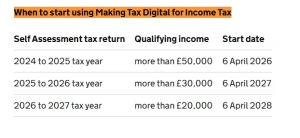
HMRC’s Making Tax Digital timetable showing the £50,000, £30,000 and £20,000 qualifying income thresholds.
Should an Electrician Operate as a Sole Trader or Limited Company?
Business structure affects administration, liability, tax planning and opportunities for growth.
For someone starting a small independent electrical business, operating as a sole trader may involve fewer administrative requirements.
A limited company may become more relevant where the owner expects to employ staff, secure larger contracts, retain profits for investment or manage business risks through a separate legal entity.
Sole Trader vs Limited Company Electrician
| Consideration | Sole trader | Limited company |
| Legal identity | Owner and business are legally the same person | Company is a separate legal person |
| Primary tax treatment | Income Tax and applicable NI on profits | Corporation Tax, plus relevant personal taxes |
| Administration | Generally simpler | More statutory reporting |
| Business liabilities | Owner generally has personal liability | Generally limited, subject to exceptions |
| Taking money from business | Owner’s drawings | Salary, dividends or other lawful arrangements |
| Hiring employees | Permitted | Permitted |
| Suitability | Independent electricians and smaller operations | Businesses needing a company structure |
Neither arrangement is universally better.
The right choice depends on profitability, risk exposure, contractual requirements and future growth plans.
Electricians considering a larger operation should develop a financial plan covering equipment, insurance, marketing and working capital.
A useful comparison is the wider approach to starting a service business, where choosing an appropriate structure and forecasting costs are equally important.
For managing receipts and expenses, reviewing the available business bank accounts can also help identify suitable banking and accounting features.
What Qualifications and Registrations Should Self-Employed Electricians Have?
Electrical work carries significant safety responsibilities.
An electrician should be competent for the work undertaken and understand the applicable technical and legal requirements.
Relevant qualifications and professional development may include an appropriate Level 3 electrical installation qualification, evidence of occupational competence, current wiring regulations knowledge and training for inspection and testing.
Requirements depend on the work and the route through which competence has been achieved.
For certain domestic electrical work in England, Building Regulations Part P is particularly important.
Notifiable work must follow the appropriate notification and certification process. A registered competent person may be able to self-certify work covered by their scheme.
However, Part P requirements and notification arrangements should not be presented as identical across England, Scotland, Wales and Northern Ireland.
Electricians must follow the rules applicable to the relevant UK nation and project.
Professional scheme registration, additional training and compliant documentation can help strengthen customer confidence and support access to certain projects.
Nevertheless, a registration badge alone does not replace verifying that an electrician is competent for the specific work.
Official government guidance explaining electrical safety requirements for domestic installations under Approved Document P.
How Can Self-Employed Electricians Increase Their Earnings?
Increasing an electrician’s income does not necessarily mean increasing working hours.
Sustainable growth often comes from higher productivity, more consistent bookings, better pricing and stronger customer retention.
Improving Chargeable Utilisation
An electrician can reduce unproductive time by concentrating work within manageable geographical areas.
Grouping several local appointments can lower fuel costs and reduce travelling between customers.
This is especially valuable for businesses handling short repairs and routine installations.
Building Recurring Customer Relationships
Commercial maintenance, property management and repeat landlord work can create more predictable revenue.
Recurring work may reduce the time spent acquiring new customers and preparing quotations.
However, any ongoing service agreement should price in response times, availability obligations and administrative responsibilities.
Developing Specialist Expertise
Additional competence in inspection, testing, EV charging systems, renewable technologies or commercial installations may improve access to specialised work.
The financial return from training should be assessed against course fees, equipment investment and actual market demand.
Improving Quotations and Cost Control
A detailed quotation can reduce disputes and protect profit margins.
Electricians should identify labour, materials, certification, travel and additional work clearly.
They should also monitor whether completed projects achieve their expected profit.
The same pricing and cost-control principles apply to other independent trades. Comparing the self-employed painter and decorator hourly rate can provide another useful perspective on labour-intensive service businesses.
Maintaining Reliable Business Records
Keeping accurate financial records makes it easier to understand how much the business earns and spends.
Electricians should regularly review unpaid invoices, tax provisions, equipment spending and cash reserves.
For those establishing or expanding a contracting operation, the financial planning considerations involved in starting a consulting business also demonstrate why pricing must recover non-billable working time.
Is Offering a Discount on Electrician Rates a Good Business Decision?
Discounts can be commercially useful where they lead to longer bookings, lower travel costs or reliable repeat work.
However, a discount should never be assessed using revenue alone.
Consider an electrician charging £60 per hour for 1,300 annual billable hours.
Annual labour revenue would be £78,000.
A 10% discount reduces the rate to £54 per hour.
To recover the same revenue, the electrician would need approximately 1,444 billable hours.
Financial Impact of a 10% Electrician Rate Discount
| Scenario | Hourly charge | Annual billable hours | Annual revenue |
| Standard pricing | £60 | 1,300 | £78,000 |
| 10% discount, same workload | £54 | 1,300 | £70,200 |
| Discount with additional work | £54 | 1,444 | £77,976 |
The discounted rate requires approximately 11.1% more billable hours to recover the original revenue.
That additional workload may be worthwhile if a customer guarantees consistent bookings and eliminates substantial marketing or travel expenses.
However, where the electrician’s schedule is already full, unnecessary discounts can reduce profit without creating any commercial advantage.
A better approach is to evaluate the total value and cost of each customer relationship.
How Can Customers Choose the Right Self-Employed Electrician?
Customers should not select an electrician solely because the hourly rate is the lowest.
Electrical safety, competence, insurance, certification and overall project cost are important considerations.
Before accepting a quotation, customers should assess the electrician’s experience and whether they have completed similar work.
They should also confirm the expected scope, materials, testing requirements and applicable charges.
Customer Checklist Before Hiring an Electrician
| What to check | Why it matters |
| Qualifications and relevant competence | Helps establish suitability for the work |
| Appropriate registration where relevant | Supports compliant notification arrangements |
| Business insurance | Helps manage defined risks |
| Written quotation | Clarifies price and scope |
| Materials and VAT | Avoids unexpected additional charges |
| Testing and certification | Confirms relevant documentation requirements |
| Customer reviews and previous work | Provides evidence of service quality |
| Payment terms | Reduces disputes over deposits and final payments |
| Guarantees and aftercare | Clarifies responsibilities after completion |
Customers planning substantial work should obtain comparable written quotations.
For example, an electrician charging £65 per hour but completing a task in four hours may be less expensive than another charging £45 per hour and taking seven hours.
The first electrician would charge £260 for labour, compared with £315 for the second, assuming identical scope and no additional charges.
Higher hourly pricing does not automatically mean a higher final bill.
What matters is the total cost of completing the work safely and to the agreed specification.
What Should Self-Employed Electricians Expect in 2027 and Beyond?
Future electrical contracting rates will depend on demand for construction and property maintenance, labour availability, business expenses and investment in electrical infrastructure.
Work involving property refurbishment, commercial maintenance, EV charging and energy systems may create opportunities for properly qualified electricians.
However, increasing demand for particular services does not guarantee higher income for every individual contractor.
The 2026 survey findings also demonstrate that prices can move differently across customer groups and work categories.
Electricians should therefore review their businesses using measurable financial indicators.
Electrician Business Performance Indicators
| Financial indicator | What it measures |
| Average realised hourly rate | What customers actually pay |
| Billable utilisation | Share of working time generating labour income |
| Annual turnover | Total invoiced sales |
| Operating cost percentage | Proportion of revenue absorbed by expenses |
| Trading profit | Revenue remaining after allowable business costs |
| Quote conversion rate | Success in converting estimates into bookings |
| Average invoice value | Revenue generated per job |
| Repeat customer percentage | Stability of customer demand |
| Outstanding invoices | Payment delays and cash-flow exposure |
| Cash reserves | Ability to manage unexpected expenditure |
Electricians should review these indicators regularly rather than relying on the assumption that higher hourly rates always produce better financial results.
Expanding an electrical contracting business may also require finance for vehicles, equipment and working capital.
Business owners considering external funding should assess affordability carefully, including the potential costs of a startup business loan.
Borrowing should support a realistic commercial opportunity rather than compensate for consistently underpriced work.
Conclusion
The self-employed electrician hourly rate in the UK generally ranges from £40 to £70 in 2026 for standard customer-facing work, with experienced specialists and emergency providers often charging more.
Our analysis shows that the most important financial consideration is not simply the hourly rate but the income remaining after business expenses, tax and non-billable working time.
An electrician charging £55 per hour can generate substantial annual revenue, but operating costs and personal tax obligations significantly affect take-home income.
A sustainable electrical business should combine competitive pricing, suitable qualifications, efficient scheduling, financial record-keeping and strong customer relationships.
For customers, comparing the complete project quotation is more useful than selecting an electrician based only on an advertised hourly charge.
Frequently Asked Questions
What Is the Average Self-Employed Electrician Hourly Rate in the UK?
Standard customer-facing rates are commonly around £40–£70 per hour in 2026, with £55 providing a useful benchmark. Actual charges depend on location, work type and experience.
Is £50 an Hour Good for a Self-Employed Electrician?
£50 per hour can be commercially viable when the electrician maintains consistent bookings and controls operating costs. Profitability depends on billable utilisation and annual expenses.
How Much Does a Self-Employed Electrician Charge Per Day?
General independent electricians may charge around £280–£450 per day, with specialist work and higher-cost locations sometimes attracting more.
Can a Self-Employed Electrician Earn £70,000 a Year?
Yes, an electrician can generate £70,000 or more in annual business revenue. However, this is not the same as earning £70,000 in personal income after expenses and tax.
How Much Does an Electrician Earn After Tax?
Take-home income varies with revenue, business expenses and personal tax circumstances. In our illustrative established-business scenario, £70,840 of labour turnover produces approximately £42,127 after assumed business costs, Income Tax and Class 4 National Insurance.
Do Self-Employed Electricians Pay National Insurance?
Yes, Class 4 National Insurance generally applies to qualifying sole-trader profits. For 2026–27, the main rates are 6% between £12,570 and £50,270 and 2% above that level.
Do Self-Employed Electricians Need to Charge VAT?
VAT registration is generally compulsory once taxable turnover exceeds £90,000 under the relevant HMRC rules. Businesses below the threshold may be able to register voluntarily.
How Much Do Emergency Electricians Charge?
Emergency hourly charges can commonly reach £80–£110 or more. An additional call-out or minimum attendance charge may apply.
Do Electricians Charge More in London?
London electricians generally charge higher customer-facing rates because of local demand and higher operating costs. However, individual quotations and business profitability vary.
Is It Better to Be an Employed or Self-Employed Electrician?
Self-employment offers control over pricing, customers and working arrangements, but also involves financial risks and business responsibilities. Employment provides greater income predictability and may include paid leave and pension benefits.
Can Electricians Claim Their Tools as Business Expenses?
Qualifying business-use tools, equipment and associated costs may be deductible under applicable HMRC rules. The treatment depends on the purchase, accounting method and business use.
How Many Days Does a Self-Employed Electrician Work Each Year?
The number of working and billable days varies. Financial planning should allow for holidays, administration, training, customer cancellations and gaps between projects.
Do Self-Employed Electricians Need Insurance?
Public liability insurance is commonly advisable and may be required by clients or trade schemes. Additional insurance requirements depend on the business and whether employees are engaged.
What Electrical Work Pays the Highest Hourly Rate?
Specialist commercial work, complex diagnostic services, certain energy installations and emergency electrical work can command higher charges. The most profitable specialisation depends on actual costs and demand.
Will Self-Employed Electrician Rates Increase in 2027?
There is no guaranteed national percentage increase for self-employed electrician rates in 2027. Individual businesses will adjust pricing according to local demand, costs, workload and commercial conditions.