


The self-employed carpenter day rate in the UK typically ranges from £200 to £350 in 2026, with experienced carpenters undertaking domestic projects frequently charging between £240 and £320 per day. Specialist carpenters, bespoke joiners and experienced tradespeople working in London can charge £400 or more, depending on project complexity and demand.
However, there is an important financial distinction between what a carpenter charges a customer and what that carpenter actually earns.
A £300 day rate does not mean £300 in personal take-home pay. Self-employed carpenters must cover equipment, transport, insurance, administration, unpaid working time, Income Tax and National Insurance from their business revenue.
Our analysis of published UK carpenter pricing information indicates that rates vary considerably between domestic projects, construction-site subcontracting and specialist joinery. The nature of the working arrangement can influence earnings just as much as experience or location.
For self-employed carpenters deciding what to charge, and homeowners evaluating quotations, understanding these differences is essential.
What Is the Average Self-Employed Carpenter Day Rate in the UK in 2026?
A reasonable starting point for an experienced, self-employed domestic carpenter is approximately £300 per day, before materials and any applicable VAT.
However, published estimates differ. Some tradesperson pricing directories report average daily rates closer to £200, while broader customer-facing pricing guides place typical rates nearer £300.
This difference is partly explained by the types of jobs covered, geographical variation and whether the data represents advertised prices, actual quotations or subcontract arrangements.
Self-Employed Carpenter Rates at a Glance
| Carpenter category | Indicative day rate in 2026 |
| Newly qualified or early-career carpenter | £180–£230 |
| General self-employed carpenter | £220–£280 |
| Experienced domestic carpenter | £260–£350 |
| Construction-site subcontract carpenter | £200–£270 |
| Specialist finishing carpenter | £300–£400 |
| Bespoke joiner or experienced cabinetmaker | £350–£450+ |
| Experienced carpenter in London | £300–£410+ |
| General hourly carpentry work | £30–£45 |
| Specialist or short-duration work | £45–£60+ per hour |
These are indicative market planning ranges, not government-approved tariffs or guaranteed local prices. Categories overlap, and individual quotations may fall outside these ranges.
A carpenter working on a long-term construction contract may accept a lower daily rate because the work is predictable and requires fewer customer visits, quotations and marketing expenses.
An independent carpenter carrying out one-day domestic installations may need to charge more because each appointment involves additional business administration and travel.
From a commercial perspective, comparing those two rates without considering the working arrangement can produce a misleading picture of earnings.
How Were the 2026 Carpenter Day Rates Assessed?
There is no official government-set day rate for self-employed carpenters in Britain.
To establish a practical benchmark, we compared publicly available tradesperson pricing information, advertised contract rates and industry cost guidance.
The findings reveal three different pricing markets.
- Domestic customer pricing: Established tradespeople providing their services directly to homeowners generally charge enough to cover site visits, quoting, travel, customer communication and project administration.
- Construction subcontracting: Carpenters employed on a self-employed basis by construction contractors may receive lower daily rates in exchange for longer bookings and fewer marketing responsibilities.
- Specialist carpentry and joinery: Businesses producing bespoke furniture, premium finishing work and complex timber installations may charge higher rates or quote a complete project price.
The distinction matters because the lowest advertised day rate is not necessarily the market rate for an experienced independent carpenter.
Equally, a specialist joinery quotation should not automatically be treated as representative of ordinary general carpentry.
Our approach is to use these figures as commercial benchmarks rather than suggest that every carpenter should charge the same amount.
How Do Self-Employed Carpenter Day Rates Vary Across the UK?
Location remains an important influence on carpenter pricing.
Local property demand, competition, travel distances, operating expenses and the availability of skilled tradespeople can all influence what customers are prepared to pay.
Carpenter Day Rate by UK Region
| UK region | Indicative experienced carpenter day rate |
| Central and Greater London | £300–£410+ |
| South East England | £270–£370 |
| South West England | £240–£330 |
| West Midlands | £230–£320 |
| East Midlands | £220–£310 |
| North West England | £230–£320 |
| Yorkshire and the Humber | £220–£310 |
| North East England | £200–£290 |
| Scotland | £220–£330 |
| Wales | £200–£300 |
| Northern Ireland | £200–£290 |
These regional ranges are illustrative budgeting estimates for established self-employed tradespeople, not statistically measured regional averages. Local quotations should take precedence.
Why Are Carpenter Day Rates Higher in London?
London carpenters may face higher operating costs, including parking, congestion charges, travel time, workshop costs and insurance.
There may also be additional demand for high-specification property renovations and bespoke furniture.
For example, consider two carpenters providing comparable second-fix services:
| Pricing factor | Regional carpenter | London carpenter |
| Daily labour charge | £280 | £350 |
| Annual billable days | 180 | 180 |
| Illustrative annual labour turnover | £50,400 | £63,000 |
| Difference in revenue | — | £12,600 |
| Difference in percentage terms | — | 25% higher |
The London carpenter generates 25% more labour revenue in this example.
However, that does not automatically translate into 25% more take-home income. Higher travel, parking, insurance and other business costs can reduce the difference in actual profit.
The same principle applies to regional cities such as Manchester, Birmingham, Bristol and Leeds, where a carpenter’s commercial performance depends on local demand and operational efficiency rather than the headline daily charge alone.
How Do Carpenter Day Rates Differ by Experience and Specialisation?
Experience usually improves a carpenter’s earning potential, but years in the trade are only one part of the calculation.
Technical ability, workmanship, efficiency, project management and the complexity of the service also influence pricing.
Newly Qualified Carpenters
A newly qualified carpenter establishing an independent business may charge around £180 to £230 per day for relatively straightforward work.
Typical activities include fitting skirting boards, basic studwork, repairing timber fittings and assisting with larger carpentry projects.
Early-career carpenters should avoid assuming that a lower customer rate is always beneficial.
Even with limited experience, a self-employed worker must cover transport, tools, insurance and unpaid administration.
Experienced General Carpenters
An established carpenter may charge £260 to £350 per day for common residential work, including internal doors, flooring, stud partitions and finishing installations.
An experienced carpenter can often complete work more efficiently and identify potential problems before they become expensive.
Customers may therefore receive better overall value from a higher-priced professional who completes a project correctly and on schedule.
Specialist Carpenters and Joiners
Specialist carpenters may charge £350 to £450 or more per day where advanced skills, specialist machinery or exceptional finishing standards are required.
Examples include heritage timber restoration, complex staircases, high-end cabinetry, bespoke fitted wardrobes and architectural joinery.
These services should not always be valued solely on installation time.
Design, measurements, workshop production, material selection, finishing and transport can account for a significant proportion of the work.
A fixed-price quotation is frequently more suitable.
What Is the Difference Between First-Fix and Second-Fix Carpenter Rates?
Carpentry work is broadly divided into first-fix and second-fix activities.
First-Fix Carpentry
First-fix work usually takes place during the structural phase of construction and includes:
- Installing floor joists and timber frameworks.
- Constructing stud partitions.
- Fitting roof timbers.
- Installing door linings.
- Preparing staircase structures.
A first-fix carpenter may work as a subcontractor on a project lasting several weeks or months.
The work can be priced per day, per measured quantity or through an agreed subcontract package.
Second-Fix Carpentry
Second-fix carpentry focuses on the visible finishing elements of a building.
This includes internal doors, architraves, skirting boards, window boards, shelving and finished staircase components.
Second-fix carpenters working in occupied homes often require additional preparation, protection and finishing time.
The risk of damaging completed surfaces may also increase the care required.
For this reason, second-fix work is not automatically cheaper or more expensive than first-fix work. The quality specification and working conditions determine the appropriate charge.
How Much Do Common Carpentry Jobs Cost in 2026?
A carpenter’s day rate is only one method of calculating the price of a project.
Many common carpentry services are better estimated using a fixed charge per installation, metre or square metre.
| Carpentry service | Indicative UK cost | Pricing basis |
| Hang a standard internal door | £100–£140 | Labour only, per door |
| Supply and fit skirting boards | £20–£40 | Per linear metre |
| Laminate flooring installation | £40–£50 | Labour per m² |
| Engineered wood flooring installation | £45–£55 | Labour per m² |
| Natural wood flooring installation | £50–£60 | Labour per m² |
| Herringbone flooring installation | £65–£90 | Labour per m² |
| Construct a fitted wardrobe | £800–£1,400 | Indicative standard project |
| General carpentry | £30–£60 | Hourly range |
These figures represent broad pricing benchmarks, not guaranteed quotations. Preparation, design, timber quality, materials, finishing, waste disposal and VAT can change the total.
For example, hanging one internal door may cost more per hour than hanging several doors in the same property.
The carpenter can complete multiple installations while making only one journey and setting up equipment once.
This demonstrates why job-based pricing is often more commercially efficient than automatically multiplying every task by an hourly rate.
How Should a Self-Employed Carpenter Calculate Their Day Rate?
The most sustainable way to determine a carpenter’s daily charge is to calculate the annual revenue required to cover operating expenses and produce the desired pre-tax income.
A useful formula is:
Required day rate = (Annual business costs + target pre-tax profit + contingency) ÷ annual billable days
Example: Calculating a £300 Carpenter Day Rate
Suppose an experienced carpenter estimates the following annual requirements.
| Financial category | Annual amount |
| Van, tools, insurance and business overheads | £12,000 |
| Target pre-tax business profit | £42,000 |
| Additional contingency and reinvestment allowance | £3,000 |
| Total revenue required | £57,000 |
| Expected billable days | 190 |
| Required daily charge | £300 |
The carpenter must generate £57,000 annually to satisfy those assumptions.
Dividing £57,000 by 190 chargeable days produces a required day rate of £300.
However, the £3,000 contingency is a financial planning allocation, not automatically a tax-deductible expense. Whether it remains profit or is spent on qualifying business costs depends on what happens during the year.
The essential commercial lesson is that a day rate must account for the entire business, not only the hours spent physically working with timber.
What Happens If the Carpenter Charges Too Little?
Suppose the same carpenter charges £250 instead of £300.
At 190 billable days:
- £300 per day generates £57,000.
- £250 per day generates £47,500.
- The annual revenue difference is £9,500.
- The lower rate represents a 16.7% reduction in revenue.
That reduction can materially affect the amount available for personal income, equipment replacement and long-term savings.
A carpenter should therefore understand their minimum viable rate before offering regular discounts.
How Many Days Can a Self-Employed Carpenter Actually Charge For?
A common mistake is assuming that every weekday of the year will generate an invoice.
Self-employed carpenters also spend time preparing quotes, travelling, collecting supplies, maintaining tools and managing their accounts.
Holidays, illness, customer cancellations and gaps between jobs must also be considered.
A practical annual planning model might look like this:
| Category | Days |
| Potential working days after planned leave | 225 |
| Chargeable customer or site days | 180 |
| Other business and non-billable days | 45 |
| Billable utilisation | 80% |
In this example, 80% of the available working days generate direct labour revenue.
The remaining 20% still support the operation of the business.
For a carpenter aiming to generate £54,000 in labour revenue:
| Annual billable days | Required average day rate |
| 160 | £337.50 |
| 170 | £317.65 |
| 180 | £300 |
| 190 | £284.21 |
| 200 | £270 |
This calculation highlights how much booking consistency influences the rate a carpenter must charge.
A business with 200 reliable paid days can operate at a lower daily price than a business with 160 paid days while generating the same labour revenue.
However, working more days may leave less time for rest, training, administration or business development.
The objective should be sustainable utilisation rather than maximising workdays at any cost.
What Business Expenses Must a Self-Employed Carpenter Cover?
A self-employed carpenter operates a small business, even when working alone.
Business overheads can be significant, particularly when a reliable vehicle and professional tools are essential.
Common expenses include vehicle insurance, fuel, servicing, tools, blades, batteries, protective equipment, accounting software, public liability insurance and advertising.
Larger carpentry businesses may also have workshop rent, equipment finance and employee costs.
The broader cost of running a UK startup illustrates why revenue should never be confused with business profit.
Example Annual Carpenter Business Budget
| Expense | Illustrative annual cost |
| Van running costs, fuel and maintenance | £4,000 |
| Tools, blades and replacement equipment | £2,000 |
| Business insurance | £800 |
| Protective equipment and workwear | £500 |
| Phone, software and accounting | £1,200 |
| Marketing and customer acquisition | £1,000 |
| Training and qualifications | £500 |
| Storage, parking and miscellaneous costs | £2,000 |
| Total operating costs | £12,000 |
These figures are illustrative rather than industry averages. Businesses using hired workshop space, employing staff or financing expensive vehicles may have considerably higher expenditure.
For a carpenter generating £54,000 in annual labour revenue, £12,000 of overheads represents approximately 22.2% of turnover.
That leaves £42,000 before Income Tax, National Insurance and personal financial commitments.
Which Carpentry Expenses Are Tax Deductible?
Many legitimate business costs can reduce taxable profit where they meet HMRC’s requirements.
Potential qualifying expenses include business-use tools, insurance, consumables, appropriate travel costs, advertising and accountancy services.
However, not every purchase or journey qualifies automatically.
Personal expenditure, ordinary commuting, fines and private-use elements cannot simply be deducted as business expenses.
The tax treatment of vehicles, major equipment and capital purchases may also depend on the accounting method.
Carpenters should maintain detailed purchase records and separate business costs from personal expenditure.
How Much Does a Self-Employed Carpenter Take Home After Tax in 2026?
A carpenter’s actual earnings depend on turnover, allowable expenses, Income Tax and National Insurance.
For the 2026–27 UK tax year, the standard Personal Allowance is £12,570.
In England, Wales and Northern Ireland, the basic Income Tax rate is 20% on taxable income within the basic-rate band, followed by higher rates at the applicable thresholds.
Self-employed Class 4 National Insurance is generally charged at:
- 6% on profits between £12,570 and £50,270.
- 2% on profits above £50,270.
Self-employed people with sufficient profits are normally treated as having paid Class 2 contributions without making a separate compulsory Class 2 payment.
Scotland has different Income Tax bands for non-savings income, so Scottish taxpayers may have different take-home figures.
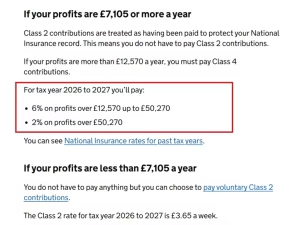
HMRC’s official self-employed National Insurance guidance showing the 2026–27 Class 4 contribution rates of 6% and 2%, together with the relevant profit thresholds.
Example: £300 Per Day After Tax
Consider a self-employed carpenter working 180 billable days during the financial year.
| Calculation | Amount |
| Daily labour rate | £300 |
| Annual billable days | 180 |
| Annual labour turnover | £54,000 |
| Deductible business expenses | £12,000 |
| Taxable trading profit | £42,000 |
| Illustrative Income Tax | £5,886 |
| Illustrative Class 4 National Insurance | £1,765.80 |
| Total Income Tax and NI | £7,651.80 |
| Estimated income after tax and NI | £34,348.20 |
| Average monthly equivalent | £2,862.35 |
The calculation assumes the carpenter is a sole trader resident in England, Wales or Northern Ireland, has no other taxable income, receives the full Personal Allowance and has no additional tax adjustments.
It excludes pension contributions, student loan repayments, voluntary NI, payments on account and other personal deductions.
In this example, the combined Income Tax and National Insurance bill represents approximately 18.2% of the £42,000 trading profit.
The estimated after-tax income is approximately 63.6% of the original £54,000 turnover.
This should not be described as a conventional business net-profit margin, because the sole trader’s own labour remuneration is included in the amount remaining.
Carpenter Take-Home Pay at Different Day Rates
The following figures use 180 chargeable days, £12,000 annual deductible expenses and the same simplified 2026–27 tax assumptions.
| Carpenter day rate | Annual turnover | Profit before personal tax | Estimated after-tax income |
| £220 | £39,600 | £27,600 | £23,692 |
| £250 | £45,000 | £33,000 | £27,688 |
| £280 | £50,400 | £38,400 | £31,684 |
| £300 | £54,000 | £42,000 | £34,348 |
| £350 | £63,000 | £51,000 | £40,891 |
The results show why a carpenter invoicing £63,000 annually cannot reasonably describe that entire amount as personal earnings.
Overheads and taxation can substantially reduce the funds available for household spending.
A self-employed carpenter should also reserve money for pension savings, future equipment replacement and periods without work.
How Does the Construction Industry Scheme Affect Carpenter Day Rates?
The Construction Industry Scheme, commonly called CIS, is particularly relevant to self-employed carpenters working as subcontractors.
Under CIS, a construction contractor may be required to deduct tax from payments made to a subcontractor and pay that amount directly to HMRC.
The standard deduction rates are:
| CIS status | Deduction rate |
| Registered and verified subcontractor | 20% |
| Unregistered or unverified subcontractor | 30% |
| HMRC-authorised gross payment status | 0% |
These deductions are advance payments towards tax and National Insurance liabilities, not an additional tax imposed on top of the final bill.
Example: £300 Carpenter Day Rate Under CIS
Suppose a registered subcontract carpenter completes one day’s labour worth £300.
At a standard 20% deduction:
- Labour charge: £300
- CIS deduction: £60
- Payment received: £240
- Amount remitted to HMRC: £60
The carpenter has invoiced £300, even though £240 is received immediately.
The £60 deduction is recorded against the subcontractor’s tax position.
What Happens When Materials Are Included?
Suppose the carpenter invoices:
| Invoice component | Amount |
| Labour | £300 |
| Qualifying materials purchased by the subcontractor | £120 |
| Total invoice before VAT | £420 |
| CIS deduction at 20% on £300 labour | £60 |
| Net amount paid | £360 |
The illustration assumes the £120 represents qualifying materials directly purchased by the subcontractor, with supporting records, and that no VAT complicates the calculation.
CIS deductions must be calculated according to HMRC’s rules, including the treatment of materials, VAT and certain other costs.
A subcontractor should retain payment and deduction statements and reconcile them against invoices.
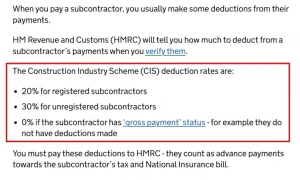
Official HMRC Construction Industry Scheme deduction rates showing 20% for registered subcontractors, 30% for unregistered subcontractors and 0% for approved gross payment status.
Importantly, CIS does not generally apply simply because a homeowner hires a self-employed carpenter directly for ordinary domestic work.
It principally concerns payments made by contractors for work covered by the scheme.
Does VAT Need to Be Added to a Self-Employed Carpenter’s Day Rate?
VAT can significantly change the amount a customer pays.
The compulsory UK VAT registration threshold is £90,000 in taxable turnover, subject to HMRC’s registration rules.
Businesses must monitor taxable turnover on a rolling 12-month basis, rather than looking only at the annual profit figure.
For most ordinary taxable carpentry services supplied by a VAT-registered business, the standard VAT rate is 20%. Some qualifying building work has different treatment.
Example: £300 Day Rate With VAT
| Charge | Amount |
| Carpenter labour charge | £300 |
| VAT at 20% | £60 |
| Total customer charge | £360 |
A VAT-registered carpenter should clearly explain whether advertised prices include or exclude VAT.
The additional £60 is not automatically extra profit. VAT collected must be accounted for under the appropriate VAT rules, subject to allowable input tax and the relevant scheme.
Why Can Materials Cause a Carpenter to Reach the VAT Threshold?
Consider a carpenter who generates:
- £72,000 from labour.
- £20,000 from taxable materials supplied to customers.
- Total taxable turnover of £92,000.
Even though labour sales alone are below £90,000, combined taxable turnover exceeds the registration threshold.
This is especially relevant to carpenters who supply complete kitchens, wardrobes, flooring and other material-intensive projects.
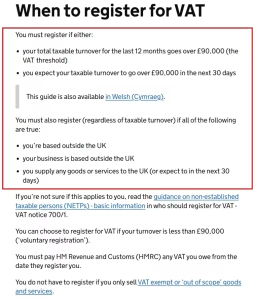
HMRC’s official VAT registration threshold of £90,000 and its rolling 12-month turnover requirements.
VAT-registered construction subcontractors must also consider whether the domestic VAT reverse charge applies.
Where the conditions are met, the customer contractor rather than the subcontractor accounts for VAT. The rules depend on the supply, VAT registration, CIS reporting and end-user status.
These arrangements should be checked before issuing invoices.
Will Making Tax Digital Affect Self-Employed Carpenters?
Making Tax Digital for Income Tax is an important compliance development for sole traders in 2026 and beyond.
Eligible individuals must keep digital records using compatible software and provide the required updates to HMRC.
The staged implementation timetable is:
| Qualifying income | Relevant tax year used to assess eligibility | MTD start date |
| More than £50,000 | 2024–25 | 6 April 2026 |
| More than £30,000 | 2025–26 | 6 April 2027 |
| More than £20,000 | 2026–27 | 6 April 2028 |
Qualifying income generally refers to gross income from self-employment and property sources, rather than profit after business expenses, subject to the detailed eligibility rules.
This makes the distinction particularly important for carpenters with substantial material sales.
A carpenter whose business receives £55,000 in relevant gross income may fall within an earlier MTD phase even where allowable expenses substantially reduce taxable profit.
The first phase has already started, and carpenters should check their eligibility rather than assuming the change only affects large businesses.
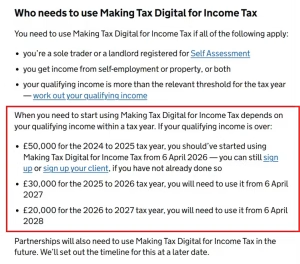
HMRC’s Making Tax Digital for Income Tax implementation timetable showing the £50,000, £30,000 and £20,000 qualifying-income thresholds and corresponding start dates.
Is It Better for a Carpenter to Work as a Sole Trader or Through a Limited Company?
Many self-employed carpenters begin as sole traders because the business structure is comparatively straightforward.
However, a limited company may become relevant as operations expand, employees are recruited or larger commercial contracts are secured.
Sole Trader Versus Limited Company
| Consideration | Sole trader | Limited company |
| Legal structure | Individual owns the business | Separate legal entity |
| Administrative burden | Generally simpler | More filing and reporting duties |
| Taxation | Income Tax and self-employed NI | Corporation Tax and personal taxation on extracted income |
| Personal liability | Generally unlimited | Usually limited, subject to exceptions |
| Accounting requirements | Self Assessment and applicable records | Company accounts, Corporation Tax and related filings |
| Suitability | Often practical for individual tradespeople | May suit expansion and more complex business requirements |
There is no universal tax-saving advantage to incorporation.
The correct decision depends on profits, remuneration strategy, administrative costs, liability and future growth plans.
Carpenters considering incorporation should understand the obligations involved in setting up a limited company in the UK.
Anyone beginning self-employment should also confirm when registration with HMRC is required.
Should Self-Employed Carpenters Charge Hourly, Daily or Per Project?
The appropriate pricing structure depends on the service.
A single pricing method rarely works efficiently for every type of carpentry.
| Pricing method | Suitable work | Main commercial consideration |
| Hourly rate | Small repairs, investigation and uncertain jobs | Travel and setup can reduce profitability |
| Day rate | First-fix work, subcontracting and multi-day work | Requires agreed working-day definition |
| Fixed project price | Doors, wardrobes, cabinetry and specified installations | Requires accurate estimating and scope control |
| Measured rate | Flooring, skirting and repetitive installations | Productivity and site conditions affect profit |
When Does Hourly Pricing Make Sense?
Hourly pricing is useful when a task is small or its duration cannot be confidently predicted.
However, a carpenter should consider a minimum attendance charge.
Travelling for 40 minutes to complete a 30-minute repair may not be commercially viable if only half an hour of labour is invoiced.
It is useful to compare carpentry rates with self-employed handyman hourly rates, particularly where the work overlaps with smaller household repairs.
When Is a Day Rate Better?
Day-rate pricing works well where a carpenter is booked for a full working day and the work is likely to occupy most of that period.
A quotation should clarify whether a day means seven, seven-and-a-half or eight working hours.
For instance, a £300 day rate works out at:
| Chargeable hours | Effective hourly equivalent |
| 6 hours | £50 |
| 7 hours | £42.86 |
| 7.5 hours | £40 |
| 8 hours | £37.50 |
These are mathematical equivalents, not promises that every hour is separately billable.
Unpaid travel, breaks, preparation and administration may make the true return per hour spent operating the business lower.
When Should Carpenters Use Fixed-Price Quotes?
Fixed-price quoting is often appropriate for fitted wardrobes, flooring, kitchen installations and other well-defined projects.
For example, a carpenter may estimate three installation days plus preparation, materials and disposal.
The project price should recover the full cost of delivery rather than only the visible site labour.
The most important factor is defining the scope and how unforeseen changes will be priced.
How Should Materials Be Included in Carpentry Quotes?
Materials can represent a considerable proportion of a carpentry project’s cost.
A professional quotation should distinguish between labour, materials, delivery, handling and additional services.
Consider the following example:
| Project component | Amount |
| Two days of labour at £300 | £600 |
| Timber and hardware | £380 |
| Material delivery | £40 |
| Waste removal | £45 |
| Total before VAT | £1,065 |
| VAT at 20%, where applicable | £213 |
| Total including VAT | £1,278 |
This example demonstrates why a customer should not assume a £300 day rate represents the complete cost of a two-day project.
It is also important to distinguish a materials mark-up from a profit margin.
Suppose materials cost £250 and the carpenter adds a 10% procurement mark-up.
The selling price becomes £275, producing £25 in gross contribution before associated handling costs.
The £25 represents approximately 9.1% of the £275 selling price, not a 10% gross margin.
Understanding this distinction is useful for carpenters managing project profitability.
What Should Be Included in a Carpenter’s Written Quotation?
A written quote reduces uncertainty for both the carpenter and the customer.
It should normally establish the scope, specifications, materials, agreed price and payment conditions.
Particularly important details include:
- The work to be completed and any exclusions.
- Whether labour is charged hourly, daily or at a fixed price.
- Material specifications and who purchases them.
- The expected start date and duration.
- VAT treatment.
- Deposit and payment requirements.
- Who is responsible for waste disposal and final decoration.
- How variations, delays and additional work will be approved.
- Insurance arrangements and any agreed defect-correction terms.
Larger projects benefit from formal agreements because changes to the work can have significant financial consequences.
Understanding what makes a contract legally binding in the UK can help businesses establish clearer contractual arrangements.
For work agreed at a customer’s home or remotely, consumer cancellation and information requirements may also apply. The applicable rights depend on how and where the contract was formed and the circumstances of the work.
How Can Carpenters Increase Their Day Rate Without Losing Customers?
Increasing a daily charge is not simply a matter of choosing a higher figure.
Customers generally expect higher rates to reflect reliable workmanship, specialist competence, efficiency or better service.
From a business-finance perspective, the most effective improvements often involve reducing avoidable costs while demonstrating greater value.
Improve Billable Efficiency
Reducing unnecessary travel, combining nearby appointments and improving material ordering can increase profitable time.
A carpenter who avoids one wasted half-day each week may create additional capacity without increasing working hours.
Build Specialist Skills
High-quality staircase work, heritage restoration, fitted furniture and technically demanding installations may support premium pricing.
Specialisation can also reduce direct price competition because fewer businesses provide comparable services.
Improve Quotation Accuracy
Underestimating materials or labour can destroy the profitability of an otherwise successful-looking project.
Businesses should compare estimated and actual costs after completing work.
Track Customer and Project Profitability
A carpenter should record which types of work generate reliable returns and which regularly involve unpaid visits or unexpected rework.
Customer demand alone does not prove that a service is commercially attractive.
Review Rates Periodically
Pricing should be reviewed when equipment, insurance, fuel, material handling and other costs change.
However, a price increase should be supported by actual business figures rather than an assumed industry-wide percentage.
Is Offering a 10% Discount on a Carpenter Day Rate Worthwhile?
Discounting may help secure longer projects, but it should be assessed carefully.
Suppose a carpenter normally charges £300 per day for 180 billable days.
Annual revenue would be £54,000.
A 10% discount reduces the rate to £270.
To generate the same annual revenue at £270 per day, the carpenter must invoice 200 days.
That represents approximately 11.1% more billable days.
| Pricing scenario | Day rate | Billable days | Revenue |
| Standard pricing | £300 | 180 | £54,000 |
| Discount with no additional work | £270 | 180 | £48,600 |
| Discount with additional work | £270 | 200 | £54,000 |
A lower day rate can make commercial sense where the client guarantees additional work and significantly reduces marketing, travel or administrative costs.
But discounting without additional volume or other savings simply reduces revenue.
The same principle applies to fixed-price work.
How Do Self-Employed Carpenter Earnings Compare With an Employed Carpenter’s Salary?
The National Careers Service lists an indicative carpenter salary range of approximately £24,000 for a starter to £40,000 for an experienced worker.
A self-employed carpenter may generate substantially more turnover, but direct comparisons are misleading.
| Employed carpenter | Self-employed carpenter |
| Receives salary or wages | Receives business revenue |
| Normally receives statutory paid holiday entitlement | Must fund own holidays |
| Employer provides workplace pension arrangements where required | Must arrange own retirement provision |
| May receive employer-provided equipment | Usually funds tools and equipment |
| Has comparatively predictable payroll income | May experience variable monthly revenue |
| Employer handles PAYE deductions | Manages personal tax and business records |
| Usually has fewer customer-acquisition responsibilities | Must secure work and manage clients |
The right comparison is between an employee’s complete compensation package and the carpenter’s income after legitimate expenses and tax, while allowing for benefits, risk and working hours.
For example, a self-employed carpenter generating £54,000 turnover and retaining approximately £34,348 after business costs and personal taxes may not necessarily be financially better off than an employee earning £40,000 with paid leave and employer pension contributions.
However, self-employment can provide greater independence, greater control over pricing and the opportunity to develop a larger carpentry business.
Are Self-Employed Carpenters Always Considered Self-Employed for Tax Purposes?
Not necessarily.
A person can be described as a subcontractor or self-employed carpenter without necessarily meeting the relevant legal tests for self-employment.
HMRC and employment tribunals consider the actual working relationship, including matters such as control, financial risk, personal service and independence.
For example, a carpenter working for several customers, negotiating project prices, supplying their own tools and bearing the financial risk of defective work may demonstrate features consistent with self-employment.
By contrast, a carpenter working exclusively under another business’s control, using its equipment and having limited independence may require a more detailed assessment.
The distinction matters because incorrect classification can create tax liabilities and employment-rights disputes.
CIS registration alone does not conclusively establish employment status.
Where there is uncertainty, businesses can use HMRC’s official Check Employment Status for Tax service.
How Can Customers Tell Whether a Carpenter’s Day Rate Is Fair?
The cheapest quotation is not necessarily the most economical.
A carpenter charging £350 per day who completes a particular job correctly in two days may cost less overall than someone charging £250 per day who requires four days.
For example:
| Carpenter | Day rate | Days required | Labour cost |
| Carpenter A | £250 | 4 | £1,000 |
| Carpenter B | £350 | 2 | £700 |
The higher-priced carpenter costs £300 less in this illustration.
That does not prove expensive carpenters are always faster. It shows why customers should assess the total project price, quality and expected duration.
Homeowners should consider experience, comparable completed work, appropriate insurance, the clarity of the quotation and whether materials and finishing are included.
For substantial work, obtaining two or three comparable written quotations is a sensible approach.
Customers can also check relevant professional credentials and consider the UK Government-endorsed TrustMark scheme where appropriate.
What Should Self-Employed Carpenters Expect Beyond 2026?
Future carpenter rates will depend on construction activity, renovation demand, material prices, labour availability and general business expenses.
There is no guaranteed national percentage increase in self-employed carpenter rates for 2027.
Carpenters should avoid automatically raising prices simply because another business announces an increase.
Instead, a useful annual review should consider the following financial indicators:
| Indicator | Why it matters |
| Average realised day rate | Shows what customers actually pay |
| Billable utilisation | Measures how much available working time produces revenue |
| Annual overhead percentage | Reveals the share of turnover absorbed by operating costs |
| Gross contribution on materials | Assesses whether material sales recover procurement costs |
| Quote conversion rate | Helps assess pricing competitiveness |
| Unpaid invoices | Indicates cash-flow and customer risk |
| Customer repeat business | Measures the stability of demand |
| Profit after costs | Establishes the economic return from self-employment |
These measures are more useful than focusing exclusively on competitors’ advertised day rates.
Carpenters should also review the implications of the next Making Tax Digital phase and changes to construction demand.
Final Thoughts
A realistic self-employed carpenter day rate in the UK in 2026 is generally around £200 to £350, with approximately £300 providing a practical starting benchmark for experienced domestic carpentry.
Specialist carpenters, high-end joiners and tradespeople working in expensive locations may charge considerably more, while long-term subcontract arrangements can attract lower daily rates.
Our financial calculations demonstrate that the most important number is not the amount invoiced per day but the income remaining after business costs, tax and non-billable time.
A carpenter charging £300 for 180 days annually would generate £54,000 in labour turnover. With £12,000 of annual business costs, illustrative after-tax personal income could be approximately £34,348 under the stated 2026–27 assumptions.
For carpenters, the objective should be a sustainable rate that reflects professional skills, operating expenses, working capacity and business risk.
For customers, the objective should be to obtain reliable workmanship at a fair total project cost, rather than selecting a contractor purely because their daily charge is lowest.
Frequently Asked Questions
What is a good self-employed carpenter day rate in the UK?
Around £250 to £350 per day is a useful starting range for an established domestic carpenter in 2026. Location, experience, project complexity and overheads determine the appropriate individual rate.
How much does a self-employed carpenter earn per hour?
General carpentry work commonly attracts quoted rates around £30 to £45 per hour, while specialist work can exceed £50 per hour. These are customer charges rather than personal hourly wages.
Can a self-employed carpenter earn £300 a day?
Yes. £300 is a realistic customer-facing rate for some experienced UK carpenters. However, annual earnings depend on chargeable days, business costs, taxation and payment collection.
How much does a carpenter charge per day in London?
Experienced carpenters in London may charge approximately £300 to £410 or more per day, particularly for specialist domestic and high-specification installation work.
Is £250 a day a good carpenter rate?
£250 can be competitive for general carpentry or longer subcontract arrangements. Whether it is financially sustainable depends on overheads, billable days and the complexity of the work.
How much does a self-employed carpenter take home after tax?
In an illustrative 2026–27 scenario, a carpenter charging £300 for 180 days, with £12,000 of deductible annual expenses, retains approximately £34,348 after Income Tax and Class 4 National Insurance.
Do self-employed carpenters pay 20% CIS tax?
Registered and verified subcontractors normally have 20% deducted from qualifying payments under CIS. This is an advance payment towards tax and National Insurance rather than an additional final tax.
Do self-employed carpenters charge VAT?
VAT-registered carpenters generally account for VAT on taxable services at the applicable rate. Compulsory registration commonly arises when taxable turnover exceeds £90,000 under HMRC’s rules.
How many days does a self-employed carpenter work each year?
A planning assumption of around 160 to 200 billable days may be reasonable for some independent tradespeople, but actual figures vary according to workload, holidays, administration and cancellations.
Is it better to charge a day rate or a fixed price?
Day rates often work well for ongoing site work or variable scopes. Fixed prices can be more appropriate for clearly defined projects such as door installations, wardrobes and flooring.
Do carpenter day rates include materials?
Not necessarily. Many day rates cover labour only, with timber, hardware, delivery, waste disposal and VAT charged separately unless the quotation states otherwise.
Can self-employed carpenters claim tool expenses?
Qualifying business-use tools and equipment may be deductible under HMRC rules. The treatment depends on the item, its use and the accounting arrangements.
Does a self-employed carpenter need public liability insurance?
Public liability insurance is not universally compulsory for every sole-trader carpenter, but it is strongly advisable and may be required by clients, contractors or contractual terms.
Can a carpenter charge more for weekend work?
Yes. An independent carpenter can commercially agree higher rates for weekend, emergency or short-notice work, provided pricing and terms are communicated clearly and comply with applicable consumer law.
What is the difference between a carpenter and a joiner?
Carpenters generally install and construct timber components on-site, while joiners commonly produce timber items in a workshop. Many experienced professionals provide both services.