

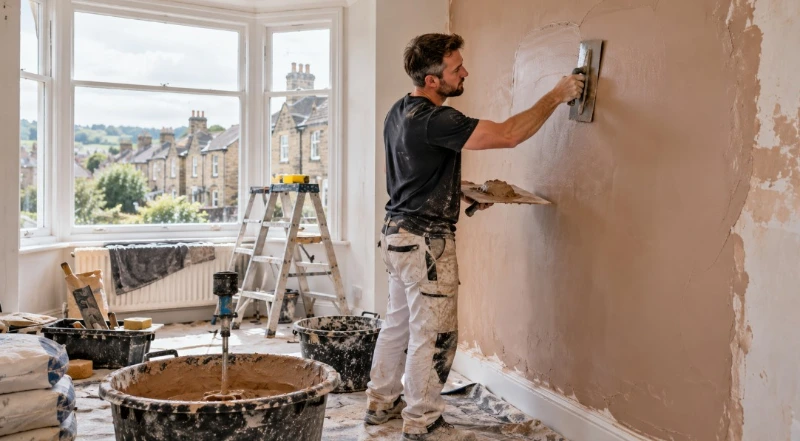
Plastering prices in the UK vary more than a single national average suggests. A straightforward skim in an empty room can be completed quickly, while damaged backgrounds, high ceilings, awkward stairwells, boarding, rendering and specialist finishes can substantially increase labour time.
For 2026, an experienced plasterer will commonly work from a labour-only day rate of roughly £220 to £350 across much of the UK, while London and parts of the South East can be higher.
Many domestic jobs are not finally billed by the day at all. Fixed prices and per-m² quotes are often more practical because they give both the customer and plasterer a clearer total cost.
What Is the Average Plastering Day Rate in the UK in 2026?
A useful 2026 planning range is around £220 to £350 per day for an experienced self-employed plasterer before VAT and materials.
Around £25 to £50 per hour is a reasonable hourly benchmark, although small repairs may carry a minimum charge of about £100 to £200 because travel, protection, mixing and cleaning still take time.
Specialist plasterers, highly experienced tradespeople and businesses operating in high-cost locations can charge above these figures. A plasterer working with a labourer may cost about £400 to £550 or more per day as a team.
These figures should be treated as market benchmarks rather than fixed prices.
Plasterer Day Rates by UK Region
| Region | Indicative Labour-Only Day Rate |
| Greater London | £295–£475 |
| South East England | £255–£400 |
| East of England | £230–£370 |
| South West England | £220–£350 |
| Scotland | £215–£340 |
| West Midlands | £210–£335 |
| North West England | £205–£330 |
| East Midlands | £200–£320 |
| Yorkshire and the Humber | £200–£315 |
| Wales | £195–£310 |
| North East England | £185–£300 |
| Northern Ireland | £180–£285 |
Location is only one pricing factor. Parking, congestion charges, access, property condition, local workload and the type of finish can move a quote above or below these ranges.
Plastering Day Rate in 26 UK Cities
The city figures below use the surrounding regional benchmark as a practical planning range rather than claiming a separate city survey.
| City | Planning Range | City | Planning Range |
| London | £295–£475 | Manchester | £205–£330 |
| Brighton | £255–£400 | Liverpool | £205–£330 |
| Reading | £255–£400 | Leeds | £200–£315 |
| Oxford | £255–£400 | Sheffield | £200–£315 |
| Cambridge | £230–£370 | York | £200–£315 |
| Norwich | £230–£370 | Newcastle | £185–£300 |
| Bristol | £220–£350 | Sunderland | £185–£300 |
| Exeter | £220–£350 | Cardiff | £195–£310 |
| Birmingham | £210–£335 | Swansea | £195–£310 |
| Coventry | £210–£335 | Edinburgh | £215–£340 |
| Leicester | £200–£320 | Glasgow | £215–£340 |
| Nottingham | £200–£320 | Aberdeen | £215–£340 |
| Southampton | £255–£400 | Dundee | £215–£340 |
| Plymouth | £220–£350 | Belfast | £180–£285 |
Should Plastering Be Priced by Day, Fixed Price or Per m²?
A day rate works well where the scope may change, where a plasterer is subcontracting to a builder, or where several small tasks are being completed together.
A fixed price is usually easier for domestic customers because the total cost is agreed in advance. For example, a 35m² bedroom that needs preparation as well as skimming might be quoted at around £650 to £950 as a complete job, depending on condition and location.
Per-m² pricing works best on larger, measurable areas. Typical planning ranges are around £10 to £25 per m² for straightforward skimming, £25 to £60 per m² for boarding or fuller re-plastering, and around £30 to £50 per m² for standard external render. Specialist finishes can be much higher.
A hallway or stair area is often better priced by time because corners, height and access make the square metre figure less useful.
How Much Plastering Can Be Completed in One Day?
Output depends on preparation and layout, but typical working capacity can be approximately:
- Skimming: 20–30m² per day
- Plasterboarding: 8–15 standard boards per day
- Rendering: 10–20m² per day
- Small Repairs: Several separate patches may take most of a day once travel, setup and drying stages are included
Ceilings are normally slower than walls and can carry a labour premium of roughly 10% to 30%, particularly where access or overboarding is required.
Typical Plastering Job Costs in 2026
| Job | Labour | Materials | Typical Total |
| Skim a small or medium room | £300–£550 | £40–£100 | £340–£650 |
| Board and skim a room | £450–£850 | £150–£300 | £600–£1,150 |
| Skim an average ceiling | £220–£450 | £30–£100 | £250–£550 |
| Overboard and skim ceiling | £350–£650 | £100–£250 | £450–£900 |
| Small patch repairs | £100–£250 | £10–£40 | £110–£290 |
| Standard external render, 10–20m² | £300–£650 | £120–£300 | £420–£950 |
These are broad planning figures. Damp treatment, hacking off, mesh, beads, difficult access, scaffolding and waste can increase the final price.
How Much Does It Cost to Plaster Different Room and House Sizes?
| Project | Typical 2026 Cost |
| Box room skim | £300–£550 |
| Standard bedroom skim | £350–£700 |
| Large living room | £550–£1,000+ |
| Full re-plaster of a medium room | £700–£1,200 |
| Three-bedroom house, full skim | £4,000–£7,500 |
| Three-bedroom house, major re-plaster | £7,000–£13,000 |
Whole-house prices vary sharply because a cosmetic skim is very different from removing failed plaster, repairing backgrounds and reboarding rooms.
What Is Usually Included in a Plastering Quote?
A clear quote should say whether it includes surface preparation, protection, plaster, bonding products, plasterboard, beads, labour and normal cleaning.
Common exclusions include:
- Waste Removal: Skip or disposal costs may be separate
- Scaffolding or Towers: High ceilings and external rendering may need access equipment
- Parking and Congestion Costs: Particularly important in major cities
- Radiator Removal: Plumbing work may be separately charged
- Decorating: Painting and mist coating are normally separate
- Unexpected Defects: Loose plaster, damp or damaged substrates found after work begins may become a variation
- Return Visits: Small finishing visits or partial days can carry a minimum charge
Customers should compare quotes on the same scope rather than comparing only the headline day rate.
How Much Do Plastering Materials Cost?
Material prices vary by merchant and trade discount, but useful 2026 planning allowances include:
| Material | Typical Planning Cost |
| Multi-finish plaster, 25kg | £8–£14 |
| Bonding coat plaster, 25kg | £10–£17 |
| Standard 12.5mm plasterboard | About £9–£15 per sheet |
| PVA, 5L | About £10–£20 |
| Angle bead | About £1.50–£4 per length |
| Scrim tape, 90m | About £3–£7 |
Labour normally remains the larger part of a standard plastering bill, especially where the finish requires experience and multiple visits.
Do Lime, Venetian Plaster and Other Specialist Finishes Cost More?
Yes. Specialist finishes should not be compared directly with a standard gypsum skim.
Lime plaster can commonly reach around £40 to £60 per m² because the system and application are more involved. Venetian or polished plaster can start around £100 to £150 per m² and rise further for complex finishes. External rendering also varies according to the substrate, system, mesh, insulation and access.
Older buildings can require breathable lime-based work rather than modern gypsum. Using the wrong system can create moisture problems, so the substrate and building type should be considered before price.
What Should You Know About Artex and Asbestos?
Textured coatings used in older buildings can contain asbestos. Buildings constructed or refurbished before 2000 should be approached carefully where old coatings may be disturbed.
Do not sand, scrape or aggressively remove a suspect coating simply to prepare it for plaster. Depending on the material and the work involved, specialist assessment, controlled working methods or an appropriately licensed contractor may be required.
Overboarding or encapsulating a suitable surface can sometimes reduce disturbance, but the correct method depends on the actual material and condition.
How Long Should Fresh Plaster Dry Before Painting?
There is no reliable rule that every skim needs exactly two days or every plastered room needs three weeks.
A thin skim in warm, well-ventilated conditions can dry within several days, while thicker backing coats, low temperatures, poor ventilation and damp backgrounds take longer. Fresh plaster should be uniformly dry before decoration. Darker patches are a sign that moisture remains.
A mist coat should only be applied once the finish has fully dried. Trying to speed the process with excessive heat can also create cracking or uneven drying.
Do Building Regulations Affect Plastering Work?
Basic cosmetic skimming does not normally become a major Building Regulations project by itself. However, plastering can form part of wider work involving fire resistance, moisture control, insulation, ventilation or structural alterations.
In England, relevant work may interact with Approved Documents such as B for fire safety, C for moisture and L for energy performance. Scotland, Wales and Northern Ireland operate their own building standards systems.
Listed buildings need additional care. Alterations that affect the building’s special character may require listed building consent, and traditional lime systems may be more appropriate than modern materials.
How Should Customers Compare Plastering Quotes?
A good quote should make the commercial scope easy to understand.
Check:
- Labour and Materials: Confirm whether both are included
- VAT: Ask whether the quote includes VAT where applicable
- Preparation: Clarify bonding, repair, boarding and protection
- Waste: Confirm who removes debris
- Access: Check scaffolding, towers and parking
- Payment Terms: Avoid unclear deposits or open-ended stage payments
- Insurance: Ask for evidence of appropriate business insurance
- Variations: Agree how extra work discovered on site will be priced
- Finish Standard: Confirm exactly which walls and ceilings are included
How Should a Self-Employed Plasterer Set a Day Rate?
A sustainable plastering day rate should start with business costs rather than simply copying another plasterer’s price.
Add annual vehicle costs, fuel, tools, insurance, phone, accounting, advertising, training, repairs and non-billable administration. Then add the personal income the business needs to generate and divide the total by realistic chargeable days.
There may be around 260 weekdays in a year, but a sole trader will not bill every one of them. Holidays, sickness, quoting, travel, material collection, bookkeeping and gaps between jobs can reduce realistic billable days to roughly 180–220.
Someone setting their own plastering rate should account for fuel, tools, insurance, travel, quoting time and unpaid administration rather than simply copying another tradesperson’s price.
Similar considerations affect the day rates charged by self-employed carpenters, where location, experience and the type of work can significantly change what is commercially sustainable.
Example Day-Rate Calculation
Suppose a plastering business wants to generate £45,000 before personal tax and has £12,000 of annual business overheads.
Annual revenue needed = £57,000.
At 200 chargeable days, the required average revenue is £285 per billable day before allowing for VAT, materials or subcontractor costs.
That explains why a £200 day rate can look reasonable but still leave a business underpriced after overheads and unpaid working time are included.
What Do CIS, VAT and Business Structure Mean for Plasterers?
Plasterers working as subcontractors in construction may fall within the Construction Industry Scheme. Registered subcontractors are commonly paid after a 20% CIS deduction, while unregistered subcontractors can face a 30% deduction. Gross payment status works differently.
VAT is another important threshold. In 2026, compulsory VAT registration normally applies when taxable turnover goes above £90,000, or when the business expects to exceed the threshold under the relevant forward-looking rule.
Plasterers who price smaller jobs by the hour can also compare how other trades structure labour charges. The approach used when calculating a self-employed plumber’s hourly rate shows why travel, overheads, materials and non-billable time all need to be reflected in the final customer price.
Frequently Asked Questions
What Is the Average Plastering Day Rate in the UK?
Around £220 to £350 per day is a useful 2026 labour-only benchmark for an experienced plasterer, although regional and specialist rates can sit outside this range.
What Is a Plasterer Day Rate in London?
London can commonly sit around £295 to £475 per day, with difficult access, parking, specialist work and high-demand periods pushing quotes higher.
How Much Does a Plasterer Charge Per Hour?
A broad 2026 planning range is around £25 to £50 per hour. Small jobs often cost more per effective hour because of travel, setup and minimum charges.
Are Materials Included in a Plastering Day Rate?
Not automatically. A day rate often refers to labour only, so the written quote should state whether plaster, boards, beads, protection and waste are included.
How Long Does Plaster Take to Dry?
A thin skim may dry within several days in good conditions, while thicker systems or cold and damp rooms can take longer. Paint only when the plaster is fully dry.
Is It Cheaper to Pay a Plasterer by the Day?
Not always. Day rates can work well for flexible work, but a fixed price is often safer for clearly defined domestic jobs because the customer knows the total cost before work starts.
How Much Does a Plasterer and Labourer Cost Per Day?
A combined plasterer-and-labourer team may cost roughly £400 to £550 or more per day depending on location, experience and job type.