

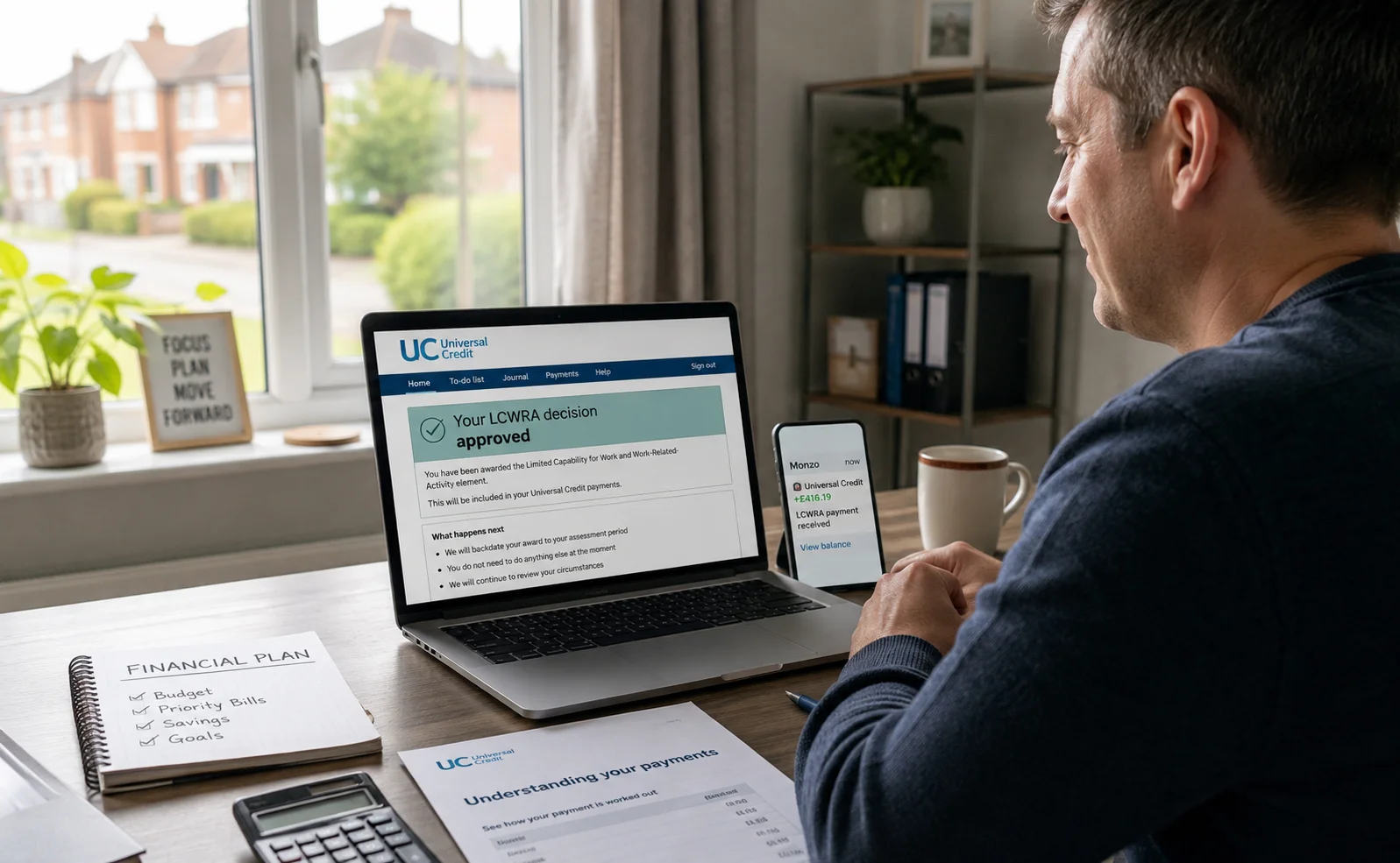
If you have recently been awarded LCWRA, you may be wondering when your first payment will arrive. In most cases, the LCWRA element is added to your Universal Credit after the three-month waiting period ends and your next eligible assessment period begins.
Depending on your circumstances, you may also receive backpay if your assessment took longer than expected.
Key Points:
- LCWRA is not normally paid immediately after approval.
- A three-month relevant period usually applies.
- Payments typically begin from the fourth full Assessment Period.
- Backpay is often paid separately as a lump sum.
- Assessment Period dates are crucial when calculating entitlement.
What Is LCWRA Payment?

LCWRA stands for Limited Capability for Work and Work-Related Activity. It is an additional element within Universal Credit for people whose health condition or disability significantly limits their ability to work or prepare for work.
After a Work Capability Assessment (WCA), the Department for Work and Pensions (DWP) may decide that you qualify for LCWRA.
Once awarded, you receive an additional monthly amount alongside your standard Universal Credit payment, subject to eligibility rules and payment timelines.
The LCWRA payment is designed to provide extra financial support to claimants facing substantial barriers to employment because of long-term health conditions or disabilities.
“Understanding the difference between an LCWRA decision date and an entitlement date is essential when estimating your first payment.” — Universal Credit Case Management Specialist
When Will You Receive Your First LCWRA Payment After the Decision?
The answer depends less on the date of your decision and more on when you first reported your health condition and submitted continuous medical evidence.
In most cases, the DWP applies a mandatory three-month relevant period before LCWRA payments begin. This means the extra payment is generally added to your Universal Credit award from the fourth full Assessment Period after your first fit note.
Many claimants mistakenly assume that payment starts immediately after receiving a positive decision. However, the decision simply confirms your entitlement. The payment schedule is usually based on Assessment Period calculations rather than the decision date itself.
Payment timeline overview:
| Stage | What Happens |
| First fit note submitted | Health condition reported |
| Three full Assessment Periods | Relevant waiting period |
| Fourth Assessment Period | LCWRA entitlement begins |
| Universal Credit payment date | First LCWRA payment received |
As a result, some people receive their first payment shortly after approval, while others may wait longer depending on where they are within their Assessment Period cycle.
How Does the LCWRA Waiting Period Work?
One of the most important factors affecting your first LCWRA payment is the three-month waiting period, officially known as the relevant period. This period consists of three complete Universal Credit Assessment Periods before the LCWRA element can be paid.
The month in which you first submit your fit note does not usually count unless it starts on the first day of your Assessment Period. This is because Universal Credit is calculated using monthly assessment cycles.
For example, if your Assessment Period runs from the 10th to the 9th and you submit your first fit note on the 12th, the waiting period normally begins from the start of the next full Assessment Period.
“The relevant period remains one of the most misunderstood aspects of Universal Credit health-related awards.” — Welfare Rights Adviser
Understanding how the waiting period works can help you estimate when your first LCWRA payment is likely to arrive.
How Do Universal Credit Assessment Periods Determine Your Payment Date?

Understanding your Universal Credit Assessment Period is essential when estimating when your first LCWRA payment will arrive. The timing of your fit note, assessment periods, and waiting period all play a key role in determining when the additional LCWRA element becomes payable.
What Is an Assessment Period?
An Assessment Period is the monthly cycle used by Universal Credit to calculate your entitlement. Every claimant has fixed Assessment Period dates that repeat each month, regardless of changes in circumstances.
During this period, the DWP assesses your earnings, household situation, and benefit entitlement. Your Universal Credit payment is usually issued around seven days after the Assessment Period ends, making these dates important when calculating LCWRA payments.
Why Doesn’t the Month You Submit Your First Fit Note Usually Count?
The DWP generally requires three full Assessment Periods to pass before the LCWRA element can be paid. If you submit your first fit note partway through an Assessment Period, that partial month does not normally count towards the waiting period.
As a result, the relevant period usually begins from the start of the next full Assessment Period. Understanding this rule can help you avoid confusion and set realistic expectations for both your first LCWRA payment and any potential backpay.
How Can You Calculate Your First LCWRA Payment Date?
Calculating your first LCWRA payment date can help you understand when the additional element is likely to be added to your Universal Credit award. While every claim is different, the process usually involves identifying key dates and applying the three-month relevant period.
Information You Need:
To estimate your likely payment date, you will generally need the following details:
- Your first fit note date
- Your Universal Credit Assessment Period dates
- The end of the three-month relevant period
- Your normal Universal Credit payment date
Having this information available makes it easier to work out when your LCWRA entitlement is expected to begin.
Example Calculation Using Realistic Dates
Imagine your Assessment Period runs from the 15th of each month to the 14th of the following month, and you submit your first fit note on 20 January.
Because the fit note was submitted after the Assessment Period had already started, the January period does not normally count towards the waiting period.
The three full Assessment Periods would then be counted as follows:
| Assessment Period | Counts Toward Waiting Period? |
| 15 Feb – 14 Mar | Yes |
| 15 Mar – 14 Apr | Yes |
| 15 Apr – 14 May | Yes |
| 15 May – 14 Jun | LCWRA Entitlement Begins |
In this example, your first LCWRA payment would normally be included in the Universal Credit payment issued after 14 June, subject to processing times and claim updates.
Simple Timeline for Counting the Three Full Assessment Periods
A useful way to estimate your payment date is to count forward from the first full Assessment Period after your fit note was submitted.
Once three complete Assessment Periods have passed, LCWRA entitlement usually begins in the fourth period, and the additional amount is typically included in your next Universal Credit payment.
When Will the Money Reach Your Bank Account?

Once your LCWRA entitlement begins, the additional amount is usually included with your regular Universal Credit payment. However, any backdated money owed to you is often processed separately and may arrive as a separate payment.
Real-World Example:
Sarah submitted her first fit note in January and received her LCWRA decision in July. Although the decision took several months, her entitlement started after the waiting period ended in May.
As a result, she received her updated Universal Credit payment in July, followed by a separate lump-sum backpay payment shortly afterwards. This example shows why the date you receive your LCWRA decision is not always the same as the date your payments become payable.
Will You Receive LCWRA Backpay and How Is It Calculated?
Because Work Capability Assessments frequently take several months to complete, many successful claimants receive arrears. Backpay generally covers the period between the end of the waiting period and the point at which the DWP updates your claim and begins paying the LCWRA element.
Backpay considerations:
- Continuous fit notes are usually required.
- Gaps in medical evidence may affect entitlement.
- Arrears are commonly paid separately from monthly Universal Credit.
- Processing times can vary between cases.
If your assessment took seven months but your waiting period ended after four months, you may be entitled to several months of arrears.
Many claimants receive these arrears within days or weeks of the decision being added to their journal, although processing times can vary. The exact amount depends on your entitlement dates, payment rates, and individual claim circumstances.
How Much Could Your LCWRA Payment Be in 2026?
The amount you receive depends on when your entitlement started and whether you fall into any protected categories.
The following figures are commonly referenced for 2026 eligibility scenarios and should always be checked against the latest DWP guidance.
| Entitlement Category | Monthly Amount |
| Protected entitlement before April 2026 rules | £429.08 |
| New Health Element rate | £217.26 |
| Severe conditions or terminal illness exceptions | £429.08 |
Some claimants remain protected under previous arrangements, while others may receive the newer Health Element amount introduced under updated rules.
Because entitlement dates can affect payment levels, reviewing your decision letter and Universal Credit statement carefully is important.
“Checking the entitlement start date is just as important as checking the payment amount itself.” — Benefits Policy Consultant
Why Is Your LCWRA First Payment or Backpay Delayed?

A delay does not always mean there is a problem with your claim. Several administrative and procedural factors can slow down payments.
Common causes of delay:
- Case manager processing backlogs
- Statement updates not yet completed
- Missing or unclear fit note records
- Assessment Period calculation issues
- Ongoing claim reviews
- System processing delays
In some situations, the decision maker may have approved LCWRA, but the payment section of your claim has not yet been updated. This can result in a temporary delay between approval and payment.
Claimants who have moved from LCW to LCWRA may also experience different payment timelines depending on their circumstances.
If more than a couple of weeks have passed since your decision without any payment update, it may be worth contacting the DWP through your journal.
What Should You Do If Your LCWRA Payment Has Not Arrived?
The first step is to review your Universal Credit account carefully. Many payment questions can be answered by checking your journal messages, statements, and recent notifications.
Useful actions:
- Review your latest Universal Credit statement.
- Check the decision letter in your journal.
- Confirm your Assessment Period dates.
- Verify that all fit notes were submitted without gaps.
- Request an arrears breakdown if needed.
If you believe a mistake has been made, you can send a message through your journal asking for clarification. A simple message might state that you have received an LCWRA award, believe the relevant period has ended, and would like confirmation of when arrears and ongoing payments will be issued.
Taking these steps can help resolve most payment queries without unnecessary delays.
Conclusion
Understanding the LCWRA first payment after decision becomes much easier once you focus on Assessment Periods rather than the decision date itself.
In most cases, the three-month relevant period must pass before payments begin, and the first payment is usually included in your normal Universal Credit award during the fourth full Assessment Period. If your assessment took several months, you may also receive backpay as a separate lump sum.
By checking your fit note history, Assessment Period dates, and Universal Credit statements, you can gain a much clearer picture of when your money is likely to arrive.
Frequently Asked Questions
Can LCWRA be paid before the decision letter arrives?
Generally, no. The DWP must first complete the assessment process and formally award LCWRA before payments can be added to your Universal Credit claim.
Is LCWRA always paid separately from Universal Credit?
No. Ongoing LCWRA payments are usually included within your regular Universal Credit payment, while arrears are often paid separately.
Can you receive LCWRA if you stop submitting fit notes after the assessment?
Requirements can vary depending on the stage of your claim. Many claimants no longer need to provide ongoing fit notes once an LCWRA decision has been made.
Does moving from LCW to LCWRA change the waiting period?
In some circumstances, claimants moving from LCW to LCWRA may be treated differently regarding waiting period rules.
What happens if DWP calculates your arrears incorrectly?
You can request a full arrears breakdown through your Universal Credit journal and challenge any errors you believe exist.
Can LCWRA payments be affected by other benefits?
Your overall benefit circumstances may affect your entitlement calculations, but LCWRA is an additional Universal Credit element rather than a separate benefit.
How can you check whether your LCWRA award has been added to your claim?
The easiest way is to review your Universal Credit statement and journal, where updated entitlement details are normally displayed.