

Starting a delivery business does not necessarily mean building a courier company from scratch. One alternative is joining an established parcel network through an owner-driver model, which is why many aspiring UK entrepreneurs want to know: how much does a DPD franchise cost?
The answer is not as straightforward as a single franchise fee.
Publicly available franchise listings commonly place the entry-level investment for a DPD Owner Driver Franchise at around £1,300 to £2,300 or £2,400, depending on the arrangement. However, this should not be confused with the total amount of money needed to launch and operate the business.
A franchisee may also need money for a suitable van, commercial insurance, fuel, vehicle maintenance and sufficient working capital to cover expenses between payments.
For somebody approaching DPD as a genuine startup rather than simply another driving job, understanding those additional costs is arguably more important than the headline franchise price.
How Much Does a DPD Franchise Cost in 2026?
A sensible answer is that prospective franchisees should separate the franchise entry cost from the overall startup budget.
Current franchise directories commonly advertise a DPD franchise with a minimum investment of approximately £2,300, while other published figures put the entry range at approximately £1,300 to £2,400.
However, DPD does not currently advertise one universal public franchise price that applies to every prospective Owner Driver Franchisee.
This means applicants should obtain the latest figures directly during the application process rather than assuming that an older figure found online will apply to their depot, vehicle and franchise arrangement.
| Cost Area | Approximate Planning Figure |
| Franchise entry/deposit | Around £1,300–£2,400 commonly quoted |
| Van deposit or lease setup | Could run into several thousand pounds |
| Commercial vehicle insurance | Potentially £1,500–£3,500+ annually |
| Fuel | Depends heavily on route and mileage |
| Vehicle maintenance | Regular monthly contingency required |
| Accountancy/admin | Depends on business structure |
| Working capital | Ideally enough for at least 4–8 weeks |
| Total realistic launch budget | Highly dependent on vehicle arrangements |
These figures should be treated as planning estimates rather than a guaranteed DPD price list.
The van is likely to determine whether somebody can start relatively cheaply or needs considerably more capital.
What Is a DPD Owner Driver Franchise?
The opportunity normally associated with the term “DPD franchise” is the Owner Driver Franchise, commonly shortened to ODF.
Rather than opening a shop, warehouse or traditional franchise premises, the franchisee operates a parcel collection and delivery business within DPD’s network.
The owner-driver handles deliveries and collections while operating as an independent business.
DPD provides much of the infrastructure surrounding the delivery operation, including technology, route-related systems, training and depot support.
The model therefore sits somewhere between traditional self-employment and conventional franchising.
For an entrepreneur, this can be attractive because the business already has access to an established parcel network rather than needing to find hundreds of customers independently.
However, the franchisee also takes responsibility for many of the expenses that would normally be covered by an employer.
What Does the Initial DPD Franchise Fee Cover?
One of the biggest problems with online discussions of DPD franchise costs is that different figures are frequently described as the “franchise fee”.
Historically, DPD franchise arrangements have included a relatively small franchise fee alongside a larger deposit.
Older published arrangements referred to combinations such as:
- £1,000 deposit plus a £300 franchise fee.
- £2,000 deposit plus a £300 franchise fee.
- Instalment arrangements for certain deposits.
That created commonly quoted entry totals of approximately £1,300 or £2,300.
These figures have circulated across franchise websites for several years.
They are useful for understanding why DPD is described as a low-cost franchise, but entrepreneurs considering joining in 2026 should not assume the same exact payment structure remains available.
Contract terms, depot requirements and application criteria can change.
The figure that matters is the current written offer provided to the applicant.
Is £2,300 the Total Cost of Starting a DPD Franchise?
No.
This is perhaps the most important distinction for anyone evaluating the opportunity as a startup.
A £2,300 entry figure does not necessarily mean somebody can pay £2,300 and immediately operate a profitable delivery business.
A founder should also consider:
Vehicle Costs
A suitable delivery vehicle is likely to be the biggest expense.
Depending on current DPD requirements and the particular franchise arrangement, a driver may be able to provide a suitable vehicle or obtain one through leasing or financing.
Buying a commercial van outright could require a significant capital investment.
Leasing reduces the initial expense but creates a recurring monthly payment.
Commercial Insurance
Ordinary private motor insurance is not designed for running a parcel delivery business.
A courier operator may require appropriate commercial vehicle cover alongside any other insurance required under the franchise agreement.
Insurance can vary substantially depending on:
- Age.
- Driving history.
- Location.
- Vehicle.
- Annual mileage.
- Claims history.
- Type of courier work.
This means two franchisees could face very different insurance bills.
Fuel
Fuel becomes a major variable operating expense.
Dense urban delivery routes can involve relatively low mileage but considerable stop-start driving, while rural territories could involve substantially more distance between deliveries.
Maintenance and Tyres
Delivery vans experience heavy daily use.
Servicing, MOT costs, brakes, tyres and unexpected mechanical repairs therefore need to be included in the financial model.
A startup that budgets only for its lease payment could quickly experience cash-flow problems when its first major repair arrives.
How Much Working Capital Does a DPD Franchise Need?
Working capital is one area many franchise-cost articles overlook.
DPD’s Owner Driver Franchise model operates on a four-weekly payment cycle, meaning franchisees need sufficient cash to keep operating between settlements.
That makes cash-flow planning particularly important during the first few weeks.
Consider expenses such as:
- Fuel.
- Van payments.
- Insurance.
- Maintenance.
- Business administration.
- Personal living expenses.
- Payments to additional drivers if the business expands.
A new owner should therefore avoid investing every available pound into the initial franchise payment and vehicle deposit.
Maintaining a cash reserve provides considerably more financial resilience.
For many startups, having enough money to comfortably cover four to eight weeks of business expenses would provide a more realistic safety margin.
How Much Can a DPD Franchise Owner Earn?
This is another area where figures found online can be misleading.
Older franchise marketing frequently referred to DPD franchise businesses potentially reaching turnover of around £140,000 to £170,000 after several years.
However, turnover is not the same as salary or profit.
Historically, those larger turnover projections were associated with franchisees expanding their businesses by operating additional routes.
In other words, someone seeing a £170,000 turnover figure should not assume that a single owner-driver receives £170,000 personally.
Revenue must first cover expenses such as:
- Driver wages.
- Vehicle finance.
- Fuel.
- Insurance.
- Repairs.
- Administration.
- Other operating expenses.
More recent DPD contract information has indicated anticipated average Owner Driver Franchisee earnings around £35,000 net of costs but before tax and National Insurance.
Individual results can naturally differ.
Performance, route availability, operating costs, number of routes and the amount of work undertaken can all influence the final figure.
What Is the Difference Between DPD Revenue and Profit?
Suppose a growing franchise generates £100,000 in annual turnover.
That does not mean its owner earns £100,000.
For example, the business might incur expenses for additional drivers, multiple vans, fuel, insurance, servicing and administration.
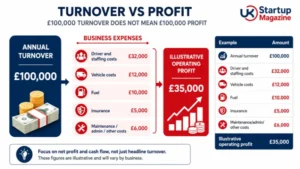
A simplified example could look like this:
| Example | Amount |
| Annual turnover | £100,000 |
| Driver and staffing costs | £32,000 |
| Vehicle costs | £12,000 |
| Fuel | £10,000 |
| Insurance | £5,000 |
| Maintenance/admin/other costs | £6,000 |
| Illustrative operating profit | £35,000 |
These numbers are purely illustrative, but they demonstrate why prospective franchisees should focus on net profit and cash flow rather than headline turnover.
This distinction becomes increasingly important as additional routes are added.
Can a DPD Franchise Become a Multi-Van Business?
Potentially, yes.
This is where the opportunity starts becoming more relevant from a startup and entrepreneurship perspective.
An owner-driver can initially operate the route personally.
Once the business is established and subject to DPD’s requirements and available opportunities, it may be possible to expand by operating multiple routes.
That changes the founder’s role.
Instead of simply delivering parcels personally every day, the owner may eventually need to manage:
- Drivers.
- Vans.
- Insurance.
- Scheduling.
- Staff absence.
- Vehicle breakdowns.
- Payroll.
- Route performance.
- Cash flow.
At that point, the franchise starts to resemble a small logistics company rather than self-employed courier work.
The potential for multi-route operations is one of the biggest differences between DPD’s Owner Driver Franchise model and simply taking a delivery-driver position.
Is a DPD Franchise a Job or a Business?
It can contain elements of both.
A single-route owner-driver will normally be heavily involved in the physical delivery operation.
The founder is effectively buying themselves a business opportunity in which they also perform much of the work.
This means it should not be viewed as passive income.
A successful owner-driver may spend long days on the road while also dealing with the responsibilities associated with operating independently.
The entrepreneurial opportunity becomes clearer when additional routes, vehicles and drivers are introduced.
Someone looking for a traditional nine-to-five driving role may therefore prefer employment.
Someone who wants to build a small logistics operation may find the franchise structure more attractive.
What Costs Should Be Included in a DPD Franchise Business Plan?
Before applying, prospective operators should build a detailed financial forecast.
At minimum, the plan should include:
- Startup capital: Franchise-related payments, vehicle deposits, insurance and initial business setup.
- Monthly fixed costs: Vehicle finance, accountancy, insurance instalments and administrative expenses.
- Variable costs: Fuel, maintenance, tyres and repairs.
- Working capital: Enough cash to operate comfortably between payment cycles.
- Personal drawings: The amount the founder needs to take from the business for living expenses.
- Tax: Money should be reserved for the appropriate business and personal tax liabilities.
- Contingency: A reserve for unexpected costs such as breakdowns or temporary reductions in available work.
This is the difference between treating the opportunity as a driving job and treating it as a startup.
What Should You Ask DPD Before Signing a Franchise Agreement?
Prospective franchisees should obtain detailed answers before committing money.
Questions worth asking include:
- What is the exact current franchise fee?
- Is a refundable deposit required?
- What vehicle specifications apply?
- Can an existing van be used?
- What insurance policies are compulsory?
- How is revenue calculated?
- When are franchisees paid?
- Is there a minimum guaranteed level of work?
- Which costs are deducted before payment?
- Can additional routes be acquired?
- What happens if the main driver becomes ill?
- What happens if the franchise agreement is terminated?
- Are there penalties for failing performance targets?
- What costs apply when leaving the franchise?
The answers should then be incorporated into a cash-flow forecast before any final investment decision is made.
Does DPD Deliver at Weekends?
DPD operates throughout the week, meaning weekend work can form part of the wider delivery operation.
Weekend parcel delivery has become increasingly important as consumers expect faster and more flexible fulfilment from online retailers.
Anyone researching the courier sector can also read this guide explaining whether UPS delivers on Saturday to understand how another major parcel network approaches weekend delivery.
For franchisees, weekend availability can create additional earning opportunities, but it also affects working hours and work-life balance.
What Are the Advantages of Starting a DPD Franchise?
The main advantage is that a founder does not have to create a delivery network from zero.
A franchisee can benefit from:
- An established national brand.
- Existing parcel volumes.
- Delivery technology.
- Training.
- Depot infrastructure.
- Operational support.
- Potential opportunities to expand routes.
- Lower entry costs than many traditional franchises.
Building an independent courier company would normally require the founder to find customers, negotiate commercial delivery contracts and develop their own operational systems.
DPD removes much of that customer-acquisition challenge.
What Are the Risks of Running a DPD Franchise?
Brand recognition does not eliminate business risk.
The owner remains exposed to several costs and operational challenges.
Vehicle breakdowns can interrupt income.
Fuel prices can increase.
Insurance premiums can rise.
Additional drivers create employment and management responsibilities.
The business may also depend heavily on one commercial relationship.
That concentration risk is important.
An independent courier business might eventually build relationships with several customers, whereas a DPD franchise is fundamentally tied to DPD’s network and franchise agreement.
Prospective owners should therefore carefully review termination clauses, performance requirements and restrictions before investing.
Is a DPD Franchise Worth It in the UK?
A DPD Owner Driver Franchise could suit someone who wants to enter the logistics industry without creating an independent courier brand from scratch.
Its relatively low advertised entry investment makes it accessible compared with many restaurant, retail or premises-based franchises.
However, the headline franchise cost does not tell the full story.
A prospective owner needs to consider the van, insurance, fuel, maintenance, tax and working capital alongside the initial franchise payment.
It is also important to understand that large turnover figures associated with established DPD franchises may involve multiple routes and drivers.
For a startup founder, the better question is therefore not simply, “How much does a DPD franchise cost?”
It is:
How much capital will the business need to start, survive its first few months and generate an acceptable profit after every operating expense?
Answering that question through proper due diligence and cash-flow forecasting provides a much stronger basis for deciding whether the DPD franchise opportunity is worthwhile.
Final Thoughts
For UK entrepreneurs looking at low-cost franchise opportunities, DPD provides an interesting route into the logistics industry.
The most widely published entry figures sit around £1,300 to £2,400, but that number should never be treated as the complete startup cost.
The true investment depends heavily on the vehicle arrangement, insurance, operating expenses and the working capital available to keep the business moving between four-weekly payments.
Prospective franchisees should therefore obtain the latest written DPD terms, calculate their expected cost per route and build both optimistic and conservative cash-flow forecasts.
A DPD franchise can provide an established route into business ownership, but its success ultimately depends on the same fundamentals as any startup: controlling costs, protecting cash flow, operating efficiently and scaling only when the economics make sense.
Frequently Asked Questions
How much does it cost to start a DPD franchise in the UK?
Third-party franchise listings commonly quote entry investments of approximately £1,300 to £2,400, with £2,300 frequently advertised as a minimum investment.
However, applicants should obtain the latest pricing directly from DPD because the company does not currently publish one universal franchise fee in its main ODF material.
Is £2,300 enough to start a DPD franchise?
Not necessarily. The figure commonly refers to the franchise-related entry investment. A prospective owner may also need money for a van, insurance, fuel, maintenance and working capital.
Do DPD franchisees need their own van?
DPD’s ODF structure can allow franchisees to supply an appropriate vehicle, although the exact vehicle requirements and available arrangements should be confirmed during the application process.
How often do DPD franchisees get paid?
DPD’s Owner Driver Franchise information states that franchisees are paid every four weeks.
How much can a DPD franchise owner earn?
Earnings vary according to route, operating costs, workload and business size.
DPD contract information has indicated anticipated average ODF earnings of approximately £35,000 net of costs before tax and National Insurance, although this is not a guarantee of individual earnings.
Can a DPD franchise owner operate more than one route?
The Owner Driver Franchise model can allow multi-route operations. Expanding into additional routes can turn a single-driver operation into a larger logistics business employing other drivers.
Can a DPD franchise make £140,000 a year?
Older franchise material referred to turnover of around £140,000–£170,000 after several years. Crucially, this related to growing the franchise through additional routes.
Turnover is also different from the owner’s personal income because operating expenses must be deducted.
Is a DPD franchise passive income?
No. A single-route DPD franchise is a hands-on owner-operator business. Running several routes may eventually shift the owner’s role towards management, but it still requires active oversight of vehicles, drivers, costs and performance.