


The HMRC Microsoft Copilot rollout represents a significant move towards improving workforce productivity and modernising tax administration in the UK.
By deploying Microsoft Copilot to approximately 28,000 staff, HMRC aims to reduce time spent on routine administrative tasks, enhance decision-making capabilities, and create a more efficient, AI-enabled working environment.
This initiative is not merely a technological upgrade but a strategic shift in how public sector operations are delivered.
Key highlights:
- Around 28,000 HMRC staff have been equipped with Microsoft Copilot
- Average time savings of 26 minutes per day per employee
- AI tools are being introduced into “Official Sensitive” workflows
- The long-term ambition is to become a fully AI-enabled tax authority
Overall, the rollout signals a major step forward in the UK government’s broader digital transformation strategy.
What Is the HMRC Microsoft Copilot Rollout and Why Does It Matter?

The HMRC Microsoft Copilot rollout refers to the large-scale deployment of Microsoft 365 Copilot tools across the UK’s tax authority workforce.
This initiative is part of a broader government push to embed artificial intelligence into public sector operations.
At its core, Copilot is an AI assistant integrated into tools like Word, Excel, Outlook and Teams. It helps staff draft documents, summarise information, automate repetitive tasks and analyse data more efficiently.
The significance of this rollout lies in its scale and ambition. Rather than a limited pilot, HMRC is embedding AI directly into everyday workflows.
As HMRC’s Chief AI Officer James Mitton stated:
“We have rolled out 28,000 Copilot licences… the intention is to give the entire organisation some fairly potent AI tools that they can safely play with.”
This reflects a shift from experimentation to operational deployment, marking a key milestone in the UK government’s digital transformation journey.
Why Has HMRC Rolled Out Microsoft Copilot to 28,000 Staff?
HMRC’s decision to roll out Copilot at scale is driven by a combination of productivity goals, workforce modernisation and long-term strategic planning.
The department has already seen significant benefits from earlier AI technologies, reporting around £8 billion in gains through automation tools used to reduce the tax gap. Copilot is seen as the next step in this evolution.
The rollout also aligns with HMRC’s ambition to become:
“The most AI-enabled tax authority on the planet.”
This bold vision highlights the organisation’s commitment to integrating AI not just as a tool, but as a core component of service delivery and policy design.
Another key factor is workforce efficiency. By reducing time spent on repetitive tasks, staff can focus on complex decision-making and taxpayer support.
How Does Microsoft Copilot Work Within HMRC Systems?
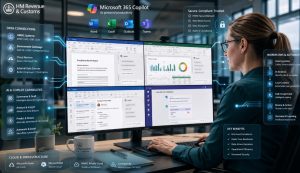
Microsoft Copilot operates within the Microsoft 365 ecosystem, meaning it integrates directly into the tools HMRC staff already use daily.
It leverages large language models and internal data access to provide context-aware assistance. For example, it can summarise long email threads, draft reports, or extract insights from datasets.
The technology also respects organisational permissions, meaning it only accesses data that a user is authorised to view. However, this capability also introduces challenges related to data governance and access control.
What Did the UK Government Copilot Trial Reveal About Productivity Gains?
The HMRC Microsoft Copilot rollout is grounded in findings from a large-scale cross-government trial involving around 20,000 civil servants.
This experiment was designed to evaluate whether AI tools like Microsoft 365 Copilot could genuinely improve productivity across different roles within the public sector.
Key Productivity Insights from the Trial
The results showed clear efficiency gains across departments, particularly in routine and administrative tasks:
- Users saved an average of 26 minutes per day, indicating measurable time efficiency
- Over 70% of participants reported reduced time spent on searching for information and handling repetitive work
- Many users were able to redirect their time towards more strategic and meaningful tasks
These insights suggest that Copilot is particularly effective in reducing low-value work, allowing employees to focus on higher-impact responsibilities.
This section highlights how even modest daily time savings can scale significantly across a large workforce.
How Much Time Can HMRC Staff Actually Save?
When extrapolated over a full working year, the average saving of 26 minutes per day could equate to nearly 13 additional working days per employee.
At an organisational level, this represents a substantial productivity uplift, especially when applied to tens of thousands of staff.
However, it’s important to recognise that these gains depend on how effectively the tool is used. Factors such as training, familiarity with AI, and the type of role all influence the actual time saved. Therefore, while the potential is significant, real-world outcomes may vary.
User Satisfaction and Adoption Trends
The trial also revealed strong user sentiment and high adoption rates, reinforcing the value of the tool:
- 82% of users said they would not want to return to their previous way of working without Copilot
- Adoption levels remained consistently high, with many users engaging with the tool daily or multiple times per week
This level of acceptance indicates that Copilot is not only useful but also well-received by staff. It reflects a broader shift in workplace expectations, where AI assistance is becoming an integral part of daily operations.
Overall, the findings demonstrate that the HMRC Microsoft Copilot rollout is supported by solid evidence of productivity gains, while also highlighting the need for ongoing training, governance, and user engagement to maximise its long-term impact.
How Will the HMRC Microsoft Copilot Rollout Improve Workforce Efficiency?
The HMRC Microsoft Copilot rollout is expected to transform how staff manage their daily workloads. By automating routine tasks, Copilot frees up time for more strategic responsibilities.
For example, instead of manually drafting reports or summarising documents, staff can rely on AI-generated outputs that can be refined and reviewed. This not only speeds up processes but also reduces cognitive load.
Real-time example from HMRC employee experience:
I came across a detailed account from an HMRC staff member involved in the Copilot trial, which really illustrates the impact. They shared:
“Whether I’m drafting communications, summarising meeting notes, or creating presentations, Copilot has consistently proven to be incredibly helpful.”
They also noted that tasks that previously took hours could now be completed significantly faster, allowing them to focus on more meaningful work. This real-world feedback reinforces the broader findings from the trial.
What Are the Key Benefits of Microsoft Copilot for HMRC Operations?

The HMRC Microsoft Copilot rollout is improving daily operations by streamlining administrative work and enhancing how staff use digital tools.
Its value lies not just in automation, but in enabling faster, more informed and collaborative working across the organisation.
Automation and Collaboration Across HMRC Systems
Copilot reduces repetitive tasks such as drafting emails, generating reports, summarising documents and organising data. This allows staff to focus more on higher-value work like compliance checks and taxpayer support.
It also improves productivity across Microsoft 365 tools:
- Automated email drafting in Outlook improves communication
- Faster document creation and editing in Word
- Better collaboration with meeting summaries in Teams
These improvements support more efficient workflows and better service delivery.
How Does Copilot Enhance Decision-Making?
Copilot helps by summarising information, extracting insights and simplifying complex data. It supports staff when reviewing documents or preparing case notes, offering a useful starting point for analysis.
However, it is designed to assist, not replace human judgement. Staff must still verify outputs, especially in sensitive cases. When used correctly, it boosts both efficiency and confidence in decision-making.
What Challenges and Risks Come with HMRC’s AI Adoption?
While the HMRC Microsoft Copilot rollout offers efficiency gains, it also introduces operational, technical and governance challenges.
As AI becomes part of sensitive public sector workflows, managing these risks is essential to maintain trust, accuracy and accountability.
Data Security and System Limitations
A key concern is how Copilot handles “Official Sensitive” data. Since it works based on user access permissions, it can surface any authorised information. Without proper controls, this creates a risk of exposing sensitive data.
Copilot can also struggle with complex tax scenarios that require deep expertise or legal interpretation. Over-reliance on AI outputs in such cases may lead to errors or misjudgements.
Why Is Human Oversight Essential?
To reduce risks, strong human oversight is required:
- Continuous monitoring to maintain accuracy
- Staff validation of AI-generated outputs
- Clear governance for data access and accountability
These measures ensure AI supports decision-making rather than replacing it, balancing efficiency with reliability and public trust.
How Does This Rollout Fit into HMRC’s Wider AI and Digital Transformation Strategy?

The rollout is part of a broader strategy to embed AI across all aspects of HMRC operations. This includes the creation of an AI Centre of Excellence to coordinate initiatives and ensure consistency.
Strategy vs Implementation:
| Strategy Element | Description |
| T-shaped approach | Broad AI access + deep use cases |
| AI Centre of Excellence | Central coordination of AI projects |
| Human-centred design | AI supporting, not replacing, humans |
| Transparency focus | Building public trust |
As Mitton explained:
“We need to think about AI as a tool that can help us, but we must never forget that we have to do it through kindness and operating in the open.”
This strategic approach ensures that AI adoption is both effective and responsible.
Could Microsoft Copilot Help HMRC Close the UK Tax Gap?
Artificial intelligence has already helped reduce the UK tax gap, with HMRC reporting billions in recovered revenue through earlier technologies.
Tools that analyse large datasets and detect irregularities have played a key role in improving compliance and identifying fraud.
Microsoft Copilot could take this further by enhancing data analysis, spotting patterns more quickly, and supporting faster compliance checks. It can also streamline reporting processes, reducing manual workloads and allowing staff to focus on higher-value tasks.
While Copilot alone will not eliminate the tax gap, it can significantly strengthen HMRC’s existing systems.
In effect, it acts as a force multiplier, improving efficiency and helping the organisation respond more effectively to complex tax challenges.
What Does the HMRC Microsoft Copilot Rollout Mean for UK Businesses and Taxpayers?
For businesses and taxpayers, the rollout could lead to faster response times, improved services and more efficient handling of tax-related queries.
However, it also raises questions about transparency and accountability. As AI becomes more embedded in decision-making processes, maintaining public trust will be crucial.
Key Impacts Overview:
| Stakeholder | Impact |
| Businesses | Faster processing and responses |
| Taxpayers | Improved service delivery |
| HMRC staff | Reduced admin workload |
| Government | Enhanced efficiency |
These changes indicate a shift towards a more digital, AI-driven tax system that prioritises efficiency and responsiveness.
Conclusion
The HMRC Microsoft Copilot rollout represents a significant step forward in the evolution of the UK tax system.
By integrating AI into daily operations, HMRC is not only improving efficiency but also redefining how public sector work is carried out.
While challenges remain, particularly around security and accuracy, the benefits are clear. With proper governance and training, Copilot has the potential to transform the tax workforce and deliver long-term value.
FAQs About HMRC Microsoft Copilot Rollout
How does Microsoft Copilot improve productivity in HMRC?
It automates routine tasks, reduces time spent searching for information and allows staff to focus on higher-value activities.
What applications does HMRC use Copilot in?
Copilot is used across Microsoft 365 tools such as Word, Excel, Outlook and Teams.
Is Microsoft Copilot replacing HMRC employees?
No, it is designed to assist staff rather than replace them, enhancing their productivity.
What are the limitations of Microsoft Copilot?
It struggles with complex, nuanced tasks and requires human oversight for accuracy.
How secure is Microsoft Copilot for government use?
It follows enterprise security policies but requires strong data governance to manage risks.
Why is training important for Copilot adoption?
Training helps staff use the tool effectively and maximise its benefits while minimising risks.
What is the future of AI in HMRC?
AI is expected to become a core part of HMRC operations, supporting decision-making and service delivery.