


A typical UK bridging loan interest rate can range from approximately 0.5% to 2% per month in 2026. The latest available industry data for Q2 2026 placed the average monthly rate at around 0.81%, although the rate offered to an individual borrower can be higher or lower.
Lower rates are normally reserved for borrowers with low loan-to-value ratios, conventional property security and a credible exit strategy. Higher-LTV, second-charge, commercial and complex property cases usually cost more.
Borrowers must compare the total amount repayable rather than choosing a loan solely because it has the lowest advertised rate. Arrangement, valuation, legal, broker and exit fees can materially change the final cost.
Last Updated: 07.09.2026
Latest UK Bridging Loan Rates for 2026
Bridging loan rates are usually quoted monthly because the finance is intended to last for a relatively short period. Most facilities run for several months, although terms of up to 12, 18 or 24 months may be available.
Indicative rates in 2026 can be grouped broadly as follows:
| Borrowing Profile | Indicative Monthly Rate |
| Prime Residential Case With Low LTV | 0.50%–0.70% |
| Standard Residential Bridging Loan | 0.65%–0.95% |
| Higher-LTV Or Complex Property Case | 0.90%–1.50% |
| Specialist Or High-Risk Finance | 1.50%–2.00% Or More |
These ranges are illustrative. An advertised rate beginning at 0.5% does not mean every applicant will qualify for it. Lenders assess the complete transaction before providing formal terms.
The latest Q2 2026 market data reported an average monthly bridging rate of approximately 0.81%. It also recorded an average LTV of 55%, an average agreed term of 12 months and an average completion time of 46 days.
The Bank of England base rate can influence lenders’ funding costs, but bridging loan rates do not necessarily rise or fall at the same speed. Property risk, lender competition, available capital and the strength of the exit strategy can have a greater effect on an individual offer.
Bridging Loan Rates By LTV
Loan-to-value compares the loan against the value of the property used as security. Lower-LTV borrowing gives the lender a larger financial buffer if the property must be sold, which can result in a lower rate.
| Loan-To-Value | Likely Pricing Position |
| Up To 50% | Access to some of the most competitive rates |
| 51%–60% | Strong lender choice and competitive pricing |
| 61%–70% | Standard pricing with closer underwriting |
| 71%–75% | Higher rates and fewer available lenders |
| Above 75% | Specialist structure or additional security may be required |
LTV is not always calculated in the same way. Depending on the transaction, a lender may use the purchase price, current market value, 180-day sale value or gross development value.
Borrowers should therefore confirm which valuation basis is being used before comparing offers.
Monthly Versus Annual Interest Rates
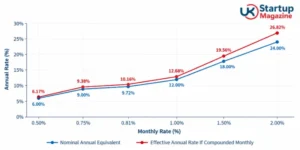
A monthly bridging rate can look small when compared directly with the annual rate on a mortgage. The figures are not presented on the same basis.
| Monthly Rate | Nominal Annual Equivalent | Effective Annual Rate If Compounded Monthly |
| 0.50% | 6.00% | 6.17% |
| 0.75% | 9.00% | 9.38% |
| 0.81% | 9.72% | 10.16% |
| 1.00% | 12.00% | 12.68% |
| 1.50% | 18.00% | 19.56% |
| 2.00% | 24.00% | 26.82% |
The effective annual figures assume monthly compounding. They may not represent the actual cost of a specific bridging loan because serviced interest is normally calculated differently from rolled-up or retained interest.
How Are Bridging Loan Interest Rates Calculated?
For a straightforward serviced loan using simple interest, the calculation can be expressed as:
Loan Amount × Monthly Interest Rate × Number of Months
For example, a £100,000 loan at 0.75% per month would produce:
- Monthly Interest: £750
- Six-Month Interest: £4,500
- Twelve-Month Interest: £9,000
This calculation does not include arrangement, legal, valuation or administration fees.
Rolled-up interest may be added to the outstanding balance. Where interest is compounded, the following month’s charge can be calculated using the increased balance rather than the original loan amount.
The lender’s method must be checked because not every rolled-up facility compounds interest in the same way.
Daily Versus Monthly Interest
Some lenders calculate interest daily, while others charge for each complete month or impose a minimum interest period.
Daily interest can benefit borrowers who repay partway through a month. For example, a borrower redeeming the facility after five months and ten days may only pay interest for the exact number of days used.
With monthly charging, the lender may charge for the whole sixth month. A minimum interest clause could also require the borrower to pay two or three months of interest even if the loan is cleared earlier.
The offer should confirm:
- Whether Interest Is Calculated Daily Or Monthly
- Whether A Minimum Interest Period Applies
- Whether Partial Months Are Charged In Full
- Whether Interest Compounds
- Whether Early Repayment Charges Apply
- Whether Unused Retained Interest Is Repaid
How Is Bridging Loan Interest Repaid?
Bridging lenders commonly offer serviced, rolled-up or retained interest. The appropriate structure depends on the borrower’s available cash flow and planned exit.
| Interest Structure | How It Works | Main Consideration |
| Serviced | Interest is paid every month | The borrower must demonstrate monthly affordability |
| Rolled-Up | Interest is added and repaid at the end | The redemption balance can increase throughout the term |
| Retained | Projected interest is deducted or held within the facility | The net amount released may be lower |
| Hybrid | Two or more methods are combined | The terms can be harder to compare |
Serviced Interest
With serviced interest, the borrower pays the interest each month while the original capital remains outstanding.
This structure can suit established businesses with predictable income or property investors receiving rental income. It can also produce a lower redemption balance because the interest is not left to accumulate.
Missing a monthly payment may place the loan in default, so businesses should test whether their cash flow can support the commitment throughout the term.
Rolled-Up Interest
Rolled-up interest is added to the amount owed and settled when the loan is repaid. There are no regular interest payments, which can help preserve working capital during a purchase or refurbishment.
The disadvantage is that the amount due at redemption will be higher. If interest compounds or the project is delayed, the cost can rise more quickly than expected.
Retained Interest
Under a retained-interest arrangement, the lender reserves enough money from the facility to cover an agreed number of months.
For example, a £300,000 gross facility at 0.8% per month with nine months of retained simple interest could involve:
- Gross Facility: £300,000
- Retained Interest: £21,600
- Arrangement Fee at 2%: £6,000
- Illustrative Net Advance: £272,400
Valuation, legal, broker and administration costs could reduce the usable amount further if they are also deducted.
Borrowers should check whether unused retained interest is refunded when the loan is repaid early. Rebate policies differ between lenders.
What Factors Affect Bridging Loan Interest Rates?
Lenders price bridging finance according to the risk of the individual transaction. Two borrowers requesting the same loan amount may receive very different rates.
Loan-To-Value Ratio
A lower LTV generally gives the lender more security and can unlock more competitive rates. Providing additional property as security may reduce the combined LTV, although it also places another asset at risk.
Property Type And Condition
Standard residential properties in marketable condition are often easier to finance. Commercial premises, land, mixed-use buildings, short leases and properties with structural or title problems can attract higher rates.
Properties that cannot currently be mortgaged may still be eligible for bridging finance, but the lender will consider the refurbishment budget and the likelihood of a successful exit.
Exit Strategy
The exit strategy explains how the loan will be repaid.
Common exits include:
- Selling The Secured Property
- Selling Another Property
- Refinancing Onto A Residential Mortgage
- Refinancing Onto A Buy-To-Let Mortgage
- Moving Onto Commercial Property Finance
- Receiving Proceeds From A Business Transaction
Evidence is important. A mortgage agreement in principle, realistic property appraisal, sale memorandum, refurbishment schedule or confirmed source of funds can strengthen the application.
Credit History
Adverse credit does not automatically prevent approval because bridging lenders focus heavily on the property and exit strategy. However, missed payments, defaults, County Court Judgments and insolvency can reduce lender choice or increase the rate.
Credit problems connected with the proposed exit are especially important. A refinance strategy may not be credible if the borrower is unlikely to qualify for the intended long-term mortgage.
First-Charge Versus Second-Charge Loans
A first-charge bridging loan is the first or only borrowing secured against a property. The lender has priority if the property must be sold to recover the debt.
A second-charge loan sits behind an existing mortgage or secured facility. It commonly costs more because the second lender carries greater recovery risk.
Second-charge bridging can still be useful when a business owner wants to release equity without replacing an existing mortgage with favourable terms.
Regulated Versus Unregulated Bridging Loans
A bridging loan may be regulated when it is secured against a home occupied or intended to be occupied by the borrower or a close family member.
Commercial, investment and limited-company borrowing is frequently unregulated, but the classification depends on the full circumstances.
| Feature | Regulated Bridging | Unregulated Bridging |
| Typical Use | Owner-occupied residential transaction | Investment, commercial or business transaction |
| Borrower | Usually an individual | Individual investor, partnership or company |
| Consumer Protection | FCA mortgage protections may apply | FCA mortgage protections may not apply |
| Common Security | Home or residential property | Investment or commercial property |
| Pricing | Based on risk and lender criteria | Based on risk and lender criteria |
Regulated loans are not automatically cheaper or more expensive. The rate will still depend on LTV, charge position, property, credit profile and exit strategy.
Borrowers should verify the regulatory status of the lender or broker and understand what protections apply before proceeding.
Gross Loan Versus Net Amount Received
The headline loan amount is not always the amount deposited into the borrower’s account.
The gross facility is the total amount approved by the lender. The net advance is the amount released after retained interest and any deducted charges.
Potential deductions include:
- Retained Interest
- Arrangement Fees
- Broker Fees
- Valuation Costs
- Legal Fees
- Administration Charges
- Bank Transfer Fees
A business requiring exactly £250,000 for a property purchase must ensure that the net advance meets that requirement. Requesting a larger gross facility may solve the shortfall, but it could increase the LTV, interest cost and arrangement fee.
Every offer should show the gross facility, net advance, total expected interest and projected redemption balance.
What Additional Bridging Loan Fees Apply?
The interest rate is only one part of the cost.
| Fee | Typical Charging Method |
| Arrangement Fee | Commonly 1%–2% of the facility |
| Valuation Fee | Based on property value, type and location |
| Legal Fees | Borrower may pay their own and the lender’s costs |
| Broker Fee | Fixed amount or percentage of the loan |
| Administration Fee | Fixed charge at completion or repayment |
| Exit Fee | Fixed charge or percentage where applicable |
| Extension Fee | Charged if additional time is approved |
| Transfer Fee | Small fixed charge for releasing funds |
A loan with a lower interest rate can be more expensive overall if it includes a higher arrangement fee or strict minimum-interest requirement.
How Much Does a Bridging Loan Cost?
Consider a business borrowing £100,000 for six months at 0.75% per month using serviced interest.
| Cost | Amount |
| Interest For Six Months | £4,500 |
| Arrangement Fee At 2% | £2,000 |
| Valuation Fee | £600 |
| Legal Fees | £1,500 |
| Administration Fee | £200 |
| Total Illustrative Cost | £8,800 |
The total repayment would be £108,800 if all charges were added to the capital and no other fees applied. If the interest had been paid monthly, the redemption payment would be lower because £4,500 would already have been serviced.
If the term extended from six months to nine months, another £2,250 in simple interest would be added. Any extension or legal fees would increase the cost further.
Minimum Interest Periods And Early Repayment
Many bridging loans allow early repayment, but that does not always mean the loan can be redeemed without additional cost.
Some lenders apply:
- One To Three Months Of Minimum Interest
- A Fixed Exit Administration Fee
- A Percentage-Based Exit Fee
- No Refund Of Unused Retained Interest
- A Charge For Partial Repayment
- A Minimum Notice Period
Borrowers expecting a quick exit should give particular attention to these clauses. A slightly higher daily interest rate with no minimum term could cost less than a lower rate requiring three months of interest.
What Happens If Repayment Is Delayed?
A bridging loan must be repaid by its contractual maturity date. If the exit is delayed, the borrower should contact the lender before the term expires.
The lender may agree to an extension, but this could involve:
- A Higher Monthly Rate
- An Extension Fee
- A New Property Valuation
- Additional Legal Costs
- Updated Exit Evidence
- A Reduction In The Maximum LTV
- Default Interest If No Extension Is Agreed
Persistent non-payment may lead to the appointment of receivers or enforcement against the secured property.
Before borrowing, businesses should test the cost of a three-month delay and consider what would happen if a property sold below its expected value or refinancing produced a smaller offer.
How Can Businesses Use Bridging Finance?
Businesses can use bridging finance when a property-backed transaction must complete before longer-term funds become available.
Common uses include:
- Buying Commercial Premises
- Completing An Auction Purchase
- Refurbishing Business Property
- Funding A Property-Backed Acquisition
- Releasing Equity For A Business Injection
- Covering A Gap Before Commercial Finance Completes
- Purchasing An Unmortgageable Property For Improvement
Bridging finance is less suitable for financing recurring losses or ordinary operating expenses without a defined source of repayment. Speed does not replace the need for a realistic exit.

Is Bridging Loan Interest Tax Deductible?
Bridging loan interest may be deductible where the borrowing is used wholly and exclusively for a qualifying business purpose. The use of the money is normally more important than the property offered as security.
Interest connected with private expenditure is generally not an allowable business deduction. Where borrowing supports both business and personal spending, only an identifiable business proportion may qualify.
Different rules can apply to sole traders, limited companies, commercial landlords and residential property owners. Arrangement and finance-related fees may also receive different treatment depending on the transaction.
Borrowers should obtain advice from an accountant because deductibility is not automatic and depends on the purpose and structure of the finance.
How To Secure A Lower Bridging Loan Interest Rate?
Businesses may improve their pricing by presenting a lower-risk transaction.
- Reduce The LTV Where Possible
- Provide A Realistic Property Valuation
- Supply Clear Evidence Of The Exit
- Resolve Title Or Planning Problems Early
- Prepare Accounts And Bank Statements
- Explain Any Adverse Credit
- Compare The Total Cost Across Several Lenders
- Negotiate Minimum Interest And Exit Terms
- Avoid Borrowing For Longer Than Necessary
- Keep A Contingency For Delays
The lowest advertised rate is not necessarily the best option. The most suitable facility is the one that provides enough net funding, supports the transaction timetable and remains affordable if the exit takes longer than expected.
Alternatives To Bridging Finance
Depending on the purpose and urgency, alternatives may include:
- Commercial Mortgage
- Business Loan
- Secured Business Loan
- Second-Charge Mortgage
- Development Finance
- Invoice Finance
- Asset Finance
- Equity Investment
- Remortgaging
- Delaying The Purchase
Longer-term products usually have lower annual rates but may take more time to arrange. Businesses should compare approval speed, total interest, fees, repayment structure and security risk.
Conclusion
UK bridging loan interest rates commonly range from around 0.5% to 2% per month, with the latest Q2 2026 market average sitting at approximately 0.81%.
The actual rate depends on LTV, property type, charge position, credit history and the strength of the repayment strategy.
Borrowers should look beyond the headline rate. The net amount received, interest method, minimum term, arrangement fees and consequences of a delayed exit can have a greater effect on the final cost.
Bridging finance can solve a time-sensitive funding problem, but it should be used with a documented exit strategy, realistic contingency period and full understanding of the property placed at risk.
Frequently Asked Questions
What Is A Good Bridging Loan Interest Rate?
A rate near the lower end of the market may be considered competitive for a low-LTV transaction with standard property security and a strong exit. The total fees must still be compared.
What Is The Average Bridging Loan Rate In 2026?
The latest Q2 2026 industry data placed the average at approximately 0.81% per month. Individual offers can vary considerably.
How Much Interest Is Charged On A £100,000 Bridging Loan?
At 0.75% per month, simple interest would be £750 per month or £4,500 over six months. Fees and compounded interest could increase the cost.
Can You Negotiate A Bridging Loan Interest Rate?
Rates and fees may be negotiable, particularly for low-LTV loans, larger facilities and well-prepared applications with strong security.
Do Bridging Lenders Charge Interest Daily?
Some lenders calculate interest daily, while others charge monthly. Borrowers should also check for minimum-interest periods.
Can You Repay A Bridging Loan Early?
Most bridging loans can be repaid early, but minimum interest, exit fees or retained-interest rules may still apply.
Are Regulated Bridging Loans More Expensive?
Not necessarily. Pricing depends on the property, LTV, charge position, exit strategy and lender rather than regulatory status alone.