
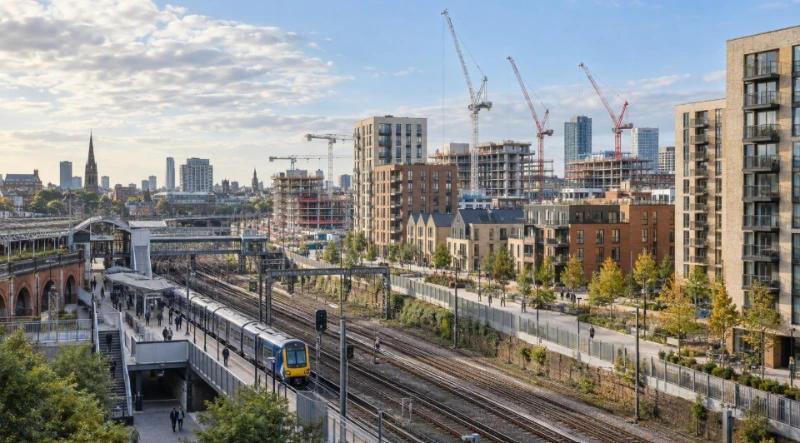
The government-backed plan for 40,000 new homes on brownfield railway land remains a major part of Platform4’s regeneration programme in 2026. The ambition is to unlock up to 40,000 homes over ten years, with more than 15,000 expected within the first five years.
Platform4 was created by bringing together London & Continental Railways and Network Rail’s Property Development business.
The programme is intended to support the government’s wider target of delivering 1.5 million homes while turning surplus railway land into housing, commercial space and new neighbourhoods.
Progress has also become more tangible during 2026. A planning application has been submitted for more than 500 homes at Newcastle’s Forth Goods Yard, while planning approval has now been secured for 425 homes at Cambridge North.
Why Was Platform4 Created?
Platform4 is not simply a new name for an existing railway property operation. It was designed to address a fragmented system for developing surplus railway land.
Before Platform4, London & Continental Railways and Network Rail’s Property team operated separately. According to the government’s original Platform4 housing announcement, this could lead to duplicated work, inefficiencies and missed opportunities to develop sites at greater scale.
Combining property, railway infrastructure and regeneration expertise under one structure is intended to make complicated brownfield sites easier to prepare for development and more attractive to private investors.
The government estimates that the merger could generate an additional £227 million in value through faster and more coordinated delivery. Profits generated by the property operation are intended to be reinvested into Britain’s railway infrastructure.
Transport Secretary Heidi Alexander described the wider rationale by saying:
“Our railways are more than just connections between places – they create economic opportunity and drive regeneration.”
The programme also forms part of the government’s Plan for Change housing agenda, which has a target of 1.5 million homes during this Parliament.
What Are The Main Platform4 Numbers?
The figures can become confusing because they refer to several different parts of the programme. The main commitments can be separated as follows.
| Measure | Platform4 Ambition |
| New homes over ten years | Up to 40,000 |
| Homes expected within first five years | More than 15,000 |
| Initial four-site housing potential | More than 2,700 |
| Development activity announced | £1 billion |
| Additional value from combined structure | £227 million |
| Private investment target | More than £350 million |
| Commercial space ambition | Around 10 million sq ft |
| Longer-term public value ambition | £1 billion per year |
The £227 million figure should not be confused with direct government investment. It represents the additional value expected from bringing the former property operations together and delivering schemes at greater pace and scale.
Which Cities Are Getting The First Railway Land Homes?
Manchester, Newcastle, Cambridge and Nottingham were identified as the first major locations when the programme was announced.
| Location | Housing Plan | September 2026 Position |
| Manchester Mayfield | Around 1,500 homes | Remains one of Platform4’s major regeneration opportunities |
| Newcastle Forth Goods Yard | Originally up to 600 homes | Planning application submitted for more than 500 apartments and town houses |
| Cambridge North | 425 homes | Planning approval secured in August 2026 |
| Nottingham | Around 200 further homes | Follows 348 homes previously delivered at The Barnum |
Newcastle has moved beyond the initial high-level announcement. The Forth Goods Yard planning application submitted in January 2026 proposes more than 500 apartments and several town houses, a 650-space multi-storey car park and the conversion of a disused viaduct into an elevated public park.
Cambridge North has progressed further. Planning approval has been secured for 425 build-to-rent homes on under-used railway land opposite Cambridge North station. Grainger is expected to fund and manage the homes through the blocwork partnership.
Platform4 interim chief executive Andrew Ferguson said the scheme would “bring under-used railway land into active use”.
What Has Changed Between 2025 And 2026?
The headline target has not changed, but several important parts of the programme have progressed.
| Area | July 2025 Announcement | September 2026 Position |
| Housing target | Up to 40,000 homes | Unchanged |
| Five-year milestone | More than 15,000 homes | Unchanged |
| Newcastle | Development opportunity identified | 500+ home planning application submitted |
| Cambridge | 425-home opportunity | 425 homes granted planning approval |
| Planning policy | Further station-led reform expected | New NPPF gives stronger support to housing near well-connected stations |
| Chief executive | Organisation entering launch phase | Andrew Ferguson serving as interim chief executive |
| Chair | Bek Seeley appointed | Bek Seeley remains chair |
One of the most significant changes is the new National Planning Policy Framework published on 17 August 2026.
The updated framework introduces stronger in-principle support for suitable housing within reasonable walking distance of well-connected stations. The government’s announcement described this as a default “yes” approach, alongside minimum density expectations for qualifying locations.
That does not automatically grant planning permission to every Platform4 project. Schemes still have to satisfy planning requirements and site-specific constraints. However, the policy direction is closely aligned with Platform4’s strategy of concentrating homes around established transport connections.
Could Housing Development Affect Rail Freight?
The programme also creates a land-use question that received less attention in the original housing announcement.
Some surplus railway sites could potentially have future value for freight as well as housing. Rail freight operators therefore want development decisions to protect strategically important terminals and avoid new residential development restricting existing freight activity.
Legal analysis of the Platform4 programme from Burges Salmon highlighted the need to balance housing delivery with the availability and operation of rail freight infrastructure.
The Rail Freight Group raised the issue more directly, saying that “rail freight is a critical enabler of that ambition”. It warned that suitable urban freight sites are increasingly scarce and that housing development should not inadvertently restrict terminal capacity or established freight operations.
This does not mean the 40,000-home target and rail freight are inherently incompatible. It means individual sites may require careful assessment so land needed for logistics, railway operations and future freight growth is not lost simply because it is currently underused.
What Does Platform4 Mean For Businesses?
Platform4 is primarily a housing and regeneration initiative, but its economic effect extends beyond residential construction.
Its wider plans include approximately 10 million sq ft of commercial space. Developments around major stations could create demand for construction firms, engineering specialists, professional services, retailers, hospitality businesses and local suppliers.
For existing businesses around railway stations, additional housing can also increase the number of people living and spending within walking distance.
However, opportunities will vary considerably by location. The final mix of retail, offices, leisure facilities and community space will depend on individual planning applications and development agreements rather than one national Platform4 formula.
Who Is Leading Platform4 In 2026?
Bek Seeley was appointed chair when Platform4 was announced. She previously led Lendlease’s European development business and has worked on major transport-led regeneration projects, including as chair of the Euston Housing Delivery Group.
The executive leadership has changed since the organisation’s launch. Robin Dobson stepped down as chief executive in March 2026.
As of September 2026, Andrew Ferguson is serving as interim chief executive. Platform4’s August 2026 project announcements continue to identify Ferguson in that position.
Chair Bek Seeley has said Platform4’s focus is on creating sustainable places and working with local authorities and development partners to deliver housing, employment and regeneration.
Are The 40,000 Homes Reserved For First-Time Buyers?
No. The announcement was presented as benefiting first-time buyers, but the entire 40,000-home programme is not a reserved first-time buyer scheme.
Different locations can contain different housing tenures. Cambridge North, for example, is a build-to-rent development rather than a scheme specifically selling homes to first-time buyers.
Affordable housing requirements, homes for sale, rental properties and other tenure arrangements will therefore need to be checked on a project-by-project basis.
The main argument for first-time buyer benefit is broader. Increasing housing supply in well-connected areas may provide more housing options, but availability, affordability and eligibility will depend on the individual development.
How Can Buyers And Developers Track New Platform4 Sites?
People interested in a particular development should follow the project rather than assuming all 40,000 homes will become available simultaneously.
The most useful sources are Platform4 project announcements, local authority planning portals and the developers or housing providers appointed to individual sites.
Planning applications usually reveal more detailed information on unit numbers, tenure, affordable housing, public space and expected delivery phases.
The Platform4 property programme also provides updates on the wider pipeline as railway land is brought forward.
For businesses and developers, local planning documents can be equally useful because they show when commercial units, construction packages and regeneration opportunities are moving from long-term proposals into deliverable projects.
Conclusion
The 40,000 new homes on brownfield railway land programme has moved beyond its July 2025 launch, although the full target remains a decade-long ambition rather than 40,000 homes already under construction.
More than 15,000 homes are intended to come forward within the first five years. Newcastle has submitted a substantial planning application, Cambridge North has secured approval for 425 homes, and the August 2026 planning framework now gives stronger support to suitable development around well-connected railway stations.
The financial ambitions are also significant, including £1 billion of development activity, an expected £227 million in additional value from the merged property operation and more than £350 million in targeted private investment.
The next test will be delivery. Individual schemes still have to navigate planning, infrastructure, funding and operational railway requirements, including the need to protect important rail freight capacity where relevant.
Frequently Asked Questions
How Many Of The 40,000 Homes Are Expected In The First Five Years?
Platform4’s target is to deliver or unlock more than 15,000 homes during the first five years, with up to 40,000 planned over ten years.
Where Will The First Platform4 Homes Be Built?
Manchester, Newcastle, Cambridge and Nottingham were the four initial locations identified by the government.
How Much Private Investment Is Platform4 Targeting?
The original programme set a target of attracting more than £350 million in private sector investment.
What Is The £227 Million Platform4 Figure?
It is the additional value the government expects the combined Platform4 structure to generate through greater efficiency, pace and scale. It is not a separate £227 million housing grant.
Will The Railway Land Programme Affect Rail Freight?
It could create competing land-use pressures at some locations. Rail industry representatives have called for strategically important freight sites and operating capacity to be protected when housing schemes are planned.
Are All 40,000 Homes For First-Time Buyers?
No. The programme is expected to increase housing supply, but the homes are not all reserved for first-time buyers. Tenure and affordable housing arrangements will vary between developments.
Who Runs Platform4 In 2026?
Bek Seeley is chair of Platform4, while Andrew Ferguson is serving as interim chief executive as of September 2026.