


The new PR rules in UK for 2027 represent one of the most significant proposed changes to British immigration and permanent residency policy in recent years.
Under the government’s revised Earned Settlement framework, the standard qualifying period for Indefinite Leave to Remain (ILR) will increase from five to ten years, although some migrants will qualify after three or five years based on their earnings, occupations and immigration circumstances.
On 2 November 2026, the Home Office published its response to the Earned Settlement consultation, providing important details about salary thresholds, eligibility requirements, existing visa holders and transitional protections.
However, the proposed ten-year settlement framework is not yet legally in force as of 10 November 2026. The government expects to begin publishing the necessary Immigration Rules changes in December 2026, with implementation during 2027.
Our analysis of official immigration policy, parliamentary research and the financial implications for workers and employers indicates that the greatest challenge will be managing the transition between existing settlement rights and the forthcoming contribution-based system.
For international workers, families, entrepreneurs and businesses employing overseas professionals, understanding the distinction between confirmed requirements and future reforms is essential.
What Are the New PR Rules in UK for 2027?
The new UK permanent residency framework introduces a system known as Earned Settlement, designed to link eligibility for permanent residence more closely to an individual’s economic contribution, immigration compliance and integration into British society.
Traditionally, many Skilled Worker visa holders have been able to apply for ILR after five years of qualifying residence.
Under the government’s revised 2026 proposals, the standard period will increase to ten years, representing a 100% increase in the usual qualifying duration.
Nevertheless, the new framework does not mean every migrant will have to wait ten years.
New UK PR Rules: 2026 vs 2027
| Immigration requirement | Current position in November 2026 | Planned 2027 framework |
| Standard Skilled Worker settlement | Generally 5 years | 10-year default |
| Highest earners | Existing route-specific rules | Potential 3-year pathway |
| Higher-income workers | Generally 5 years | 5-year pathway subject to earnings |
| Qualifying public-service workers | Existing route-specific rules | 5-year pathway |
| English language for settlement | Generally B1 on affected routes | B2 from 26 March 2027 |
| Economic contribution | Route-specific employment and salary rules | Wider minimum earnings and contribution criteria |
| Immigration compliance | Existing suitability requirements | Stricter restrictions for breaches |
| Existing visa holders | Current rules apply | Many may be affected when new rules commence |
| EU Settlement Scheme | Separate settlement system | Outside the Earned Settlement reforms |
The crucial distinction is that some requirements, including the March 2027 English-language change, have already been written into the Immigration Rules, while the broader settlement reforms still require implementation.
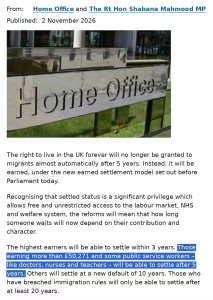
Official Home Office announcement of the Earned Settlement reforms published on 2 November 2026.
Is the New 10-Year PR Rule Already in Force in the UK?
No. As of 10 November 2026, the government has confirmed its revised policy, but the standard ten-year qualifying period has not yet replaced the existing five-year Skilled Worker settlement requirement.
This is particularly important because the government’s policy announcements and legally enforceable Immigration Rules are not the same thing.
Under the current rules, qualifying Skilled Worker and Health and Care Worker visa holders can generally apply for ILR after five years, provided they satisfy the relevant residence, employment, salary, language and suitability conditions.
The position is expected to change once the Earned Settlement framework is incorporated into the Immigration Rules.
The government’s November 2026 announcement clarifies that most people who have not already secured settlement will be assessed under the rules applicable when their applications are considered, subject to the final transitional provisions.
Our assessment is that applicants should avoid either assuming they are automatically protected by the existing five-year route or treating the proposed ten-year model as law before commencement.
For a wider overview of already implemented visa reforms, the new UK immigration law includes changes affecting sponsorship, workers and employers.
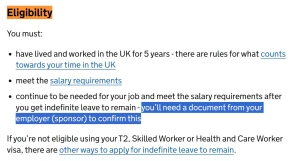
Current government eligibility guidance confirming the existing five-year Skilled Worker settlement pathway.
Who Will Qualify for UK Permanent Residency After 3, 5 or 10 Years?
Under the revised Earned Settlement framework, the qualifying period will depend on a combination of mandatory eligibility conditions and specific contributions or immigration circumstances.
Proposed Settlement Pathways for 2027
| Applicant category | Proposed qualifying period | Important conditions |
| Highest-earning qualifying workers | 3 years | Earnings above £125,140 for the required period |
| Workers earning above £50,270 | 5 years | Qualifying earnings in 3 of the preceding 5 years |
| Certain doctors, nurses and teachers | 5 years | Employment within eligible public-service occupations |
| Eligible partners, parents and children of British citizens | Existing qualifying pathways, including 5 years | Applicable relationship and immigration conditions |
| Certain protected care workers | 5 years | Relevant pre-May 2025 conditions and earnings |
| Most other qualifying workers | 10 years | Mandatory settlement requirements must be satisfied |
| Applicants with specified immigration breaches | At least 20 years | Final definitions and safeguards remain subject to detailed rules |
| Certain refugees | 5–30 years | Depends on protection route and other circumstances |
These periods describe the government’s planned framework, not automatic settlement entitlements.
Three-Year Settlement
The accelerated three-year route is intended for the highest earners, including people earning above £125,140 under the proposed qualifying conditions.
According to the November 2026 policy explanation, qualifying earnings would generally need to be maintained for three years or for three of the four years before application.
Certain Global Talent applicants may also retain accelerated routes, although the interaction with the revised framework requires final confirmation.
Compared with the proposed ten-year standard, a three-year pathway represents a 70% shorter qualifying period.
Five-Year Settlement
Workers earning above £50,270 may qualify after five years where the required earnings conditions are satisfied.
Qualifying doctors, nurses, teachers and other specified public-service professionals may also benefit from a five-year pathway.
This would be 50% shorter than the ten-year default.
Ten-year settlement
Applicants who do not qualify for an accelerated pathway will generally be expected to complete ten years of qualifying residence while satisfying the other mandatory conditions.
Time spent on every type of UK visa will not necessarily count towards this period.
Twenty-Year or Longer Pathways
The proposed framework introduces longer qualifying periods for people with certain immigration breaches or specified public-funds histories.
The exact treatment of particular breaches, exemptions and individual circumstances will require careful examination once the detailed rules are published.
From a financial perspective, the difference between three, five and ten years may influence long-term earning decisions, family expenditure, visa extensions and employment mobility.
What Are the New Eligibility Requirements for UK PR in 2027?
The government intends to introduce stricter minimum conditions that applicants must satisfy before they can qualify for settlement.
These include language proficiency, economic contribution, immigration compliance, criminality requirements and knowledge of life in the UK.
New Mandatory Settlement Conditions
| Requirement | Planned position |
| English language | Generally CEFR B2, subject to exemptions |
| Minimum annual earnings | Generally at least £12,571 |
| Joint earnings for qualifying couples | £25,142 |
| National Insurance | Evidence of sustained contribution |
| Government debt | No disqualifying outstanding debt, including relevant unpaid taxes |
| Criminal record | Significantly stricter suitability requirements |
| Life in the UK Test | Required unless an exemption applies |
| Lawful residence | Qualifying residence under applicable immigration rules |
The government’s proposals include exemptions from certain requirements for qualifying children, older applicants and people unable to meet particular conditions because of a physical or mental condition.
Criminality requirements will be treated differently, and the proposed restrictions are considerably stricter than those currently applied in many settlement cases.
How Will the Minimum Earnings Requirement Work?
The revised framework proposes a general annual earnings requirement of £12,571.
For qualifying couples, earnings may be combined to meet a £25,142 threshold.
This is separate from the higher thresholds used to determine eligibility for accelerated three-year or five-year settlement.
For example:
- A qualifying worker earning £30,000 may meet the proposed minimum economic contribution requirement without qualifying for the five-year higher-earner pathway.
- A qualifying worker earning £55,000 may potentially meet the five-year earnings condition if the required earnings history and other criteria are satisfied.
- A qualifying worker earning £130,000 may potentially qualify for the three-year pathway if the additional conditions are met.
Salary alone will not guarantee ILR. Applicants must still meet the complete immigration requirements.
For entrepreneurs, this highlights the importance of distinguishing personal income from company turnover, retained profits and business valuation.
How Will the New English Language Requirement Affect PR Applicants in 2027?
One of the most important confirmed changes is the increase in the English-language requirement for settlement on specified routes from CEFR level B1 to B2.
The confirmed commencement date is 26 March 2027.
This change was introduced through Immigration Rules amendments published in March 2026.
The requirement applies to several settlement pathways, including Skilled Worker, Scale-up, Global Talent, Innovator Founder and other specified routes, subject to the applicable exemptions.
B2 represents a higher standard of English proficiency than B1. Applicants may need to demonstrate more advanced comprehension and communication abilities through an approved assessment or other accepted evidence.
Importantly, this is separate from the B2 English requirement introduced for relevant new Skilled Worker applicants on 8 January 2026.
Someone who previously qualified for a work visa using B1 English should not automatically assume the same evidence will satisfy their future settlement application.
Our assessment is that applicants approaching settlement in 2027 should review their language evidence early, rather than waiting until their qualifying residence period is almost complete.
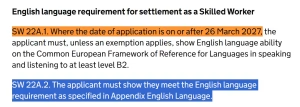
Confirmed B2 English-language requirement for settlement applications from 26 March 2027.
Will the New UK PR Rules Apply to Existing Visa Holders?
Yes, many existing visa holders could be affected by the Earned Settlement reforms when they take effect.
The November 2026 policy response did not introduce a general exemption protecting everyone who entered the UK before the announcement.
Instead, the government has proposed targeted transitional arrangements for specific groups.
This represents an important distinction from earlier speculation that migrants approaching the end of a five-year qualifying period might automatically retain their original settlement timeline.
What Protection Will Existing Care Workers Receive?
The revised framework includes special provisions recognising the contribution of certain overseas care workers.
Workers who entered the relevant care route before 12 May 2025 may remain eligible for five-year settlement if they satisfy specified sponsorship, employment, earnings and other eligibility conditions.
The government has indicated an earnings requirement of at least £25,000 for the protected five-year pathway.
However, the precise evidence and duration-of-earnings requirements still need clarification in the implementing rules.
For some eligible existing care workers who do not satisfy the conditions for the protected five-year route, the government proposes an additional five-year visa opportunity.
Similar transitional provisions are intended for certain healthcare and education workers, including specified nursing auxiliary and teaching assistant roles.
What About Existing Skilled Workers?
Certain Skilled Workers who entered before April 2024 under lower salary thresholds are expected to retain access to transitional extension arrangements until 2035.
The aim is to allow eligible workers additional time to meet a longer settlement qualifying period without automatically becoming subject to higher salary thresholds introduced for newer migrants.
This protection does not mean every existing Skilled Worker will automatically qualify for settlement after five years.
Employers will need to assess individual visa histories, occupation codes, sponsorship conditions and salary eligibility.
For UK businesses, correctly maintaining employee right-to-work checks and sponsorship records will become increasingly important.
What Changed Between the 2025 Proposals and the November 2026 Settlement Policy?
The original Earned Settlement consultation published in November 2025 included several proposals that generated concern among migrants, employers and other stakeholders.
Following more than 200,000 consultation responses, the government announced a revised framework on 2 November 2026.
Our comparison identifies several material changes.
| Policy area | Earlier proposals | Revised November 2026 position |
| Standard settlement period | 10 years | 10 years retained |
| Certain lower-skilled workers | Potential 15-year default | Separate 15-year default removed |
| Community volunteering | Potential reduction in settlement period | Proposed reduction removed |
| Advanced English | Potential route to faster settlement | Not retained as a separate acceleration |
| Dependants of work-visa holders | Potential separate settlement timelines | More family alignment, subject to exceptions |
| Care workers | Concern about lengthy settlement pathways | Targeted five-year transitional protections |
| Welfare after settlement | Potential restrictions considered | Not included in the revised response |
The revisions do not eliminate the financial and legal implications of a longer settlement system.
However, they provide more specific guidance about which applicants may qualify for accelerated routes and how certain existing workers will be treated.
Home Secretary Shabana Mahmood, announcing the revised policy on 2 November 2026, stated:
“Those who contribute most will settle fastest.”
The statement captures the government’s intended approach: settlement eligibility will increasingly be assessed through contribution, compliance and integration rather than residence duration alone.
How Will the New PR Rules Affect Skilled Workers, Students and Entrepreneurs?
The effects will differ substantially depending on the immigration category.
Skilled Workers and Sponsored Employees
Skilled Workers will be among the groups most directly affected by the proposed extension of the standard settlement period.
Many will need to reconsider the length of their expected sponsorship, visa renewal requirements and eligibility for permanent residence.
Workers whose income does not meet an accelerated settlement threshold may need to remain on qualifying temporary permission for longer than previously anticipated.
Employers could face additional sponsorship administration and retention challenges.
International Students and Graduate Visa Holders
The Graduate visa will generally provide 18 months of permission for eligible applicants applying from 1 January 2027, compared with two years for applications made by 31 December 2026.
That represents a 25% reduction in the standard non-doctoral Graduate visa duration.
Applicants with qualifying doctoral degrees can still obtain three years.
Student and Graduate visa time does not ordinarily count towards the proposed new ten-year earned settlement period.
However, the existing ten-year Long Residence route is legally distinct, and qualifying time under different immigration categories may currently be relevant to that route. Applicants should check its rules separately, especially as the government develops the new settlement framework.
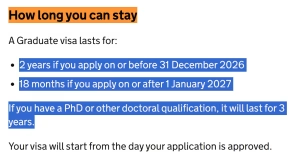
Official Graduate visa guidance showing the change from two years to 18 months on 1 January 2027.
Startup Founders and Entrepreneurs
Entrepreneurs may have access to different settlement pathways depending on their visa and business circumstances.
The Innovator Founder route currently offers qualifying applicants the possibility of settlement after three years, subject to endorsement, residence and other requirements.
Global Talent applicants may also benefit from accelerated pathways.
However, operating a company in the UK does not automatically provide an accelerated route to permanent residence.
Founders considering self-sponsorship and UK founder visa options should carefully assess which immigration category genuinely applies to their business model.
A company’s annual turnover is not necessarily equivalent to its founder’s qualifying personal income for immigration purposes.
Likewise, dividends, director remuneration, employment earnings and retained company profits may be treated differently under the applicable rules.
For business owners, choosing an immigration route solely because it appears to offer faster settlement can create significant legal and financial risk if the underlying eligibility conditions are not satisfied.
How Much Could the New PR Rules Cost Migrants and Families?
Extending the standard route to permanent residence could increase the total cost of remaining lawfully in the UK before obtaining ILR.
Migrants may face further visa extension fees, healthcare surcharge payments, language testing costs and legal expenses.
The overall financial impact depends on the visa category, number of dependants, duration of additional permission and any exemptions.
Current ILR Application Fees
The Home Office fee for a standard ILR application is £3,226 per applicant, according to the fee schedule effective from October 2026.
| Applicants | ILR application fees |
| One adult | £3,226 |
| Two adults | £6,452 |
| Two adults and one child | £9,678 |
| Two adults and two children | £12,904 |
These figures assume every person needs a separately charged ILR application at the stated rate. They exclude optional priority services and other expenses.
Fees may change before an applicant becomes eligible.
What Happens if Settlement Takes an Additional Five Years?
Consider an adult migrant who previously expected to qualify for settlement after five years but instead needs five additional years of temporary permission.
For a visa category where the standard adult Immigration Health Surcharge of £1,035 per year applies, the additional surcharge alone could amount to:
5 years × £1,035 = £5,175
For two adults, the equivalent illustrative surcharge would be £10,350.
| Cost component | Illustrative additional expense |
| Adult IHS for 1 extra year | £1,035 |
| Adult IHS for 3 extra years | £3,105 |
| Adult IHS for 5 extra years | £5,175 |
| Two adults for 5 extra years | £10,350 |
| Visa extension application fees | Additional, route-dependent |
| Professional assistance | Additional, if used |
These are illustrations using the November 2026 surcharge rate, not guaranteed future charges. Some immigration routes and applicants are exempt from the IHS, and actual payments depend on the duration and circumstances of each visa grant.
ILR itself does not ordinarily attract an Immigration Health Surcharge.
Our financial analysis suggests that the principal risk for many families is not merely an increased settlement waiting period, but the accumulated expense of remaining on temporary immigration permission.
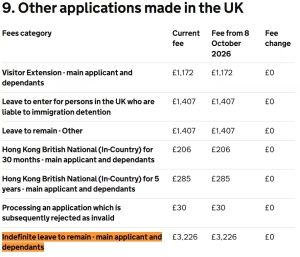
Home Office immigration fee schedule confirming the £3,226 Indefinite Leave to Remain application fee.
How Will the New PR Rules Affect UK Businesses and Employers?
The 2027 Earned Settlement reforms could create significant workforce planning considerations for UK companies that depend on international recruitment.
For startups and expanding businesses, immigration sponsorship already involves financial commitments beyond an employee’s salary.
These may include sponsor licence fees, Certificates of Sponsorship, Immigration Skills Charges, recruitment expenditure and immigration compliance administration.
A longer route to permanent residence could increase the period during which some international workers depend on temporary immigration permission.
Financial and Operational Risks for Employers
| Business concern | Potential effect |
| Longer settlement periods | Extended sponsorship and workforce planning |
| Visa extension requirements | Additional administration and possible costs |
| Employee retention | Greater uncertainty for sponsored workers |
| Salary-based settlement | Increased interest in remuneration structures |
| English requirements | Need for earlier employee preparation |
| Immigration compliance | Greater importance of accurate records |
| International recruitment | Changes to candidate expectations |
Businesses should also consider the possibility that employees whose settlement timelines change may reconsider their long-term career plans.
A sponsored worker’s decision to stay with an employer may be influenced by job security, salary progression, immigration assistance and the feasibility of meeting settlement conditions.
From an entrepreneurial perspective, immigration planning should therefore be integrated with recruitment budgets, payroll forecasting and employee retention strategies.
These additional expenses matter especially when combined with the wider cost of running a UK startup.
Our Immigration Planning Priority Ratings
We have assessed the main planning priorities using their potential legal exposure, financial consequences and urgency for the 2027 transition.
These percentage ratings are editorial assessments of planning importance, not official statistics, survey findings or predictions of visa success.
| Planning priority | Our priority rating |
| Checking current settlement eligibility | 98% |
| Reviewing visa expiry and extension dates | 97% |
| Preparing for confirmed B2 English rules | 95% |
| Auditing sponsorship and immigration records | 94% |
| Modelling future visa and family expenses | 92% |
| Reviewing salary and occupation eligibility | 90% |
| Comparing alternative immigration routes | 85% |
Our assessment: Current eligibility and visa expiry dates deserve the greatest immediate attention because mistakes can affect lawful residence and the timing of a settlement application.
Long-term budgeting is also important, but applicants should avoid making irreversible financial decisions based on proposals that have not yet been implemented.
What Should Migrants Do Before the New PR Rules Take Effect?
Preparation should begin with an accurate assessment of the individual’s current immigration status.
- Check the existing ILR qualifying period: Identify the immigration route, the date qualifying residence began and the earliest date on which a valid settlement application may be submitted.
- Review immigration expiry dates: Anyone whose permission expires before they become eligible for settlement should investigate extension or switching requirements in advance.
- Prepare for the B2 English requirement: Applicants affected by the confirmed 26 March 2027 changes should ensure their English evidence will satisfy the relevant rules.
- Maintain employment and financial records: Keep accessible copies of payslips, relevant tax records, employment contracts, sponsorship documents and other evidence needed for the applicable route.
- Review possible debts and immigration compliance issues: Outstanding government debt and previous immigration breaches may become more consequential under the revised framework. Complex cases warrant regulated professional advice.
- Plan for additional immigration expenditure: Budget for potential extensions and associated expenses without assuming that the current fee schedule will remain unchanged throughout 2027.
- Monitor the December 2026 Immigration Rules announcements:The final wording will determine the legal commencement dates, evidence requirements and transitional arrangements.
For applicants close to eligibility, the most important decision is whether they can properly apply under the rules currently in force. An application should not be rushed or submitted before eligibility is established.
When Will the New UK PR Rules Come Into Effect in 2027?
The changes do not all share one commencement date.
Some immigration reforms have already taken effect, others have confirmed future dates, and the broader Earned Settlement changes remain subject to further implementation.
UK Immigration and Settlement Timeline
| Date | Development | Position |
| May 2025 | Immigration white paper published | Completed |
| 22 July 2025 | Major Skilled Worker eligibility restrictions | Implemented |
| 20 November 2025 | Earned Settlement consultation opened | Completed |
| 8 January 2026 | B2 English for relevant new Skilled Worker applicants | Implemented |
| March 2026 | Settlement B2 amendments published | Confirmed in rules |
| 2 November 2026 | Revised Earned Settlement policy announced | Policy confirmed |
| December 2026 | Further Immigration Rules changes expected | Planned |
| 1 January 2027 | Graduate visa generally reduced to 18 months | Scheduled |
| 26 March 2027 | B2 English requirement for specified ILR routes | Scheduled |
| During 2027 | Broader Earned Settlement implementation | Exact commencement dates pending |
The government’s revised consultation response states that further technical guidance and a full impact assessment will be provided as the framework moves towards implementation.
This means applicants should not assume the entire ten-year settlement model automatically becomes law on 1 January 2027.
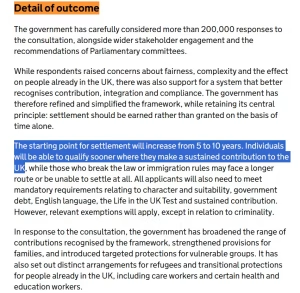
Official consultation outcome confirming the government’s November 2026 response and the next steps for Earned Settlement.
Conclusion
The new PR rules in UK for 2027 will significantly reshape how international workers, entrepreneurs and families plan their long-term future in Britain.
The proposed increase from five to ten years represents a 100% extension of the standard settlement qualifying period, although accelerated three-year and five-year pathways will remain available to qualifying applicants.
The November 2026 policy revision has brought greater clarity about income thresholds, care worker protections and the treatment of existing visa holders. Nevertheless, important legal details remain outstanding.
Our analysis indicates that migrants should focus on confirmed eligibility requirements, documentation, language preparation and long-term financial planning.
For employers, the priority is understanding how the reforms could affect recruitment expenditure, workforce retention and ongoing immigration compliance.
The most important principle for 2027 is to distinguish policy announcements from legally effective Immigration Rules. That distinction will determine whether migrants can proceed under their existing settlement arrangements or must satisfy the new Earned Settlement framework.
Frequently Asked Questions About New PR Rules in UK 2027
What is the new PR rule in the UK for 2027?
The government plans to introduce Earned Settlement, increasing the standard ILR qualifying period from five to ten years while allowing accelerated pathways for qualifying higher earners, certain public-service workers and other eligible applicants.
The broader framework is awaiting implementation through Immigration Rules changes.
Is the UK changing PR from five years to ten years?
Yes, that is the government’s confirmed policy direction. However, as of 10 November 2026, the change has not yet replaced the existing five-year Skilled Worker settlement requirement. The exact implementation arrangements are expected to be published for 2027.
Can someone still get UK permanent residence after five years?
Yes. The existing five-year route remains available to qualifying applicants under the rules currently in force. Under the planned system, five-year settlement will continue for specified eligible groups, including certain higher earners and public-service professionals.
Will existing Skilled Worker visa holders need ten years for ILR?
Many may be affected once the new rules take effect. The government has not announced a general exemption for everyone already on a Skilled Worker visa, although targeted transitional protections and accelerated routes will apply in qualifying circumstances.
What salary is needed for UK PR under the new rules?
The proposed general minimum earnings requirement is £12,571 annually, with qualifying couples potentially able to combine earnings.
A five-year pathway is proposed for workers earning above £50,270 under the relevant conditions, while earnings above £125,140 may support three-year eligibility. Other requirements must also be met.
Does the new UK PR rule affect international students?
Yes, indirectly. Graduate visas will generally become shorter from January 2027, and Student or Graduate visa time will not ordinarily count towards the proposed ten-year earned settlement pathway.
The existing Long Residence system is separate and should not be confused with the proposed framework.
Will UK PR become more expensive in 2027?
The ILR application fee is £3,226 per person as of November 2026, but future fees may change.
The larger potential financial impact comes from additional years of temporary visa permission, including any applicable extension fees, healthcare surcharges and family-related expenses.