


The HMRC Salary Sacrifice Limit is set to change how pension salary sacrifice works for millions of UK workers. From 6 April 2029, only the first £2,000 a year of pension contributions made through salary sacrifice will retain the existing National Insurance advantage.
Salary sacrifice above the £2,000 threshold will remain possible, but both employees and employers will have to pay the relevant Class 1 National Insurance contributions on the excess amount. Income Tax relief on pension contributions will continue under the normal pension tax rules.
The reform was originally announced at Budget 2025 and has since progressed into law through the National Insurance Contributions (Employer Pensions Contributions) Act 2026, which received Royal Assent on 29 April 2026.
HMRC estimates that around 7.7 million employees currently use pension salary sacrifice. Approximately 3.3 million, or 44%, sacrifice more than £2,000 and could therefore be affected if their contribution patterns remain similar when the new rules begin.
What Is The HMRC Salary Sacrifice Limit And When Will It Start?

The HMRC Salary Sacrifice Limit refers to the £2,000 annual threshold that will apply to the National Insurance benefits available when employees give up salary or bonuses in exchange for employer pension contributions.
Under a pension salary sacrifice arrangement, an employee agrees to reduce their contractual cash salary. The employer then pays an equivalent amount, or an agreed amount, into the employee’s pension.
Under the current system, a valid pension salary sacrifice arrangement can reduce the earnings on which employee and employer National Insurance is calculated.
The new rules will apply from 6 April 2029, the beginning of the 2029–30 tax year. Salary sacrificed for pension contributions above the £2,000 annual threshold will then be treated as earnings for Class 1 National Insurance purposes.
There is therefore no change to the existing pension salary sacrifice National Insurance treatment during the 2026–27 tax year.
A major development since the reform was first announced is that the primary legislation has now completed Parliament. The National Insurance Contributions (Employer Pensions Contributions) Act 2026 received Royal Assent on 29 April 2026.
Further regulations and HMRC guidance are expected to deal with some of the detailed administration before April 2029.
How Will The £2,000 HMRC Salary Sacrifice Limit Work?
From April 2029, the first £2,000 contributed through pension salary sacrifice each tax year will continue to receive the existing National Insurance advantage.
Once salary sacrifice exceeds £2,000, National Insurance will become payable on the excess.
For example, if an employee sacrifices £5,000 into their pension during the tax year:
- First £2,000 Remains Within The NIC-Free Salary Sacrifice Limit
- Remaining £3,000 Falls Above The Limit
- Employee Class 1 NICs Can Apply To That £3,000
- Employer Class 1 NICs Can Also Apply To The £3,000
- Pension Income Tax Relief Continues Subject To The Normal Rules
Salary sacrifice itself is not being abolished. Employees will still be able to sacrifice more than £2,000 into pensions. The reform changes the National Insurance treatment of the portion above the threshold.
| Feature | Before 6 April 2029 | From 6 April 2029 |
| Pension salary sacrifice NIC limit | No £2,000 monetary cap | £2,000 annual limit |
| Employee NICs above £2,000 | Generally avoided under a valid arrangement | Payable |
| Employer NICs above £2,000 | Generally avoided under a valid arrangement | Payable |
| Income Tax treatment | Pension relief available subject to rules | Remains available subject to rules |
| Salary sacrifice above £2,000 | Permitted | Still permitted |
| Implementation | Current rules | New rules apply |
HM Treasury has specifically confirmed that employees can continue contributing more than £2,000 through salary sacrifice after 2029. It is the National Insurance advantage above that amount that will be restricted.
Who Will Be Affected By The HMRC Salary Sacrifice Limit?
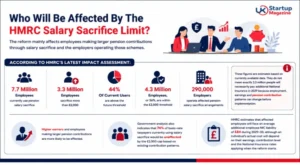
The reform mainly affects employees making larger pension contributions through salary sacrifice and the employers operating those schemes.
According to HMRC’s latest impact assessment:
- Around 7.7 Million Employees currently use pension salary sacrifice
- Around 3.3 Million Employees sacrifice more than £2,000
- Approximately 44% Of Current Users are above the future threshold
- Around 4.3 Million Employees, or 56%, are within the £2,000 threshold
- Approximately 290,000 Employers operate affected pension salary sacrifice arrangements
These figures are estimates based on currently available data. They do not mean exactly 3.3 million people will necessarily pay additional National Insurance in 2029 because employment, earnings and pension contribution patterns can change before implementation.
Higher earners and employees making larger pension contributions are more likely to be affected.
Government analysis also indicates that 74% of basic-rate taxpayers currently using salary sacrifice would be unaffected by the £2,000 cap based on existing contribution patterns.
HMRC estimates that affected employees will face an average additional employee NIC liability of £84 during 2029–30, although an individual’s actual cost will depend on their earnings, contribution level and the National Insurance rates applying when the reform starts.
Why Is The Government Introducing The £2,000 Salary Sacrifice Cap?
The government says the reform is intended to control the growing cost of pension salary sacrifice National Insurance relief while continuing to encourage retirement saving.
The estimated cost of salary sacrifice into pensions was around £2.8 billion in 2016–17 and had been forecast to rise to approximately £8 billion by 2030–31 without reform.
The government argues that larger National Insurance benefits are disproportionately received through pension contributions made by higher earners, while workers earning around the minimum wage may have much less ability to use salary sacrifice.
The £2,000 limit therefore aims to retain the benefit for typical contributions while reducing the advantage available on larger salary sacrifice arrangements.
Pensions were previously protected when many other Optional Remuneration Arrangement tax advantages were restricted in April 2017. Pension contributions remained outside most of those reforms because the government wanted to encourage long-term retirement saving.
The 2029 change represents a partial restriction rather than the removal of that support.
The government has also said it continues to provide more than £70 billion a year in Income Tax and National Insurance relief relating to pension saving.
What Should Employers And Pension Savers Do Before April 2029?

There are still several tax years before the new HMRC Salary Sacrifice Limit becomes operational, so neither businesses nor employees need to abandon pension salary sacrifice now.
However, employers should begin assessing how the change could affect pension schemes and payroll administration.
Employers should consider:
- Identifying Employees Sacrificing More Than £2,000
- Modelling Future Employer NIC Costs
- Reviewing Pension And Salary Exchange Documentation
- Speaking With Payroll And Pension Software Providers
- Monitoring Future HMRC Regulations And Guidance
- Planning Employee Communications Before Implementation
- Training Payroll And HR Teams Where Necessary
HMRC estimates that around 290,000 employers could be affected. Initial government estimates put one-off administrative costs at approximately £20 million, with continuing costs averaging around £30 million per year across affected businesses. These estimates may change as the final operational requirements are developed.
Employees contributing more than £2,000 through salary sacrifice should also review their arrangements before 2029. That does not necessarily mean reducing contributions.
Pension saving will continue to receive important tax advantages, and the right approach will depend on individual income, retirement objectives and workplace pension arrangements.
The change also does not remove the effect salary sacrifice can have on adjusted net income.
HMRC states that salary sacrifice can continue to reduce adjusted net income, which may be relevant to the Personal Allowance taper, Tax-Free Childcare and other income-based thresholds.
Traditional employer pension contributions that are not generated through salary sacrifice will also continue to be free from National Insurance under the announced rules.
Conclusion
The HMRC Salary Sacrifice Limit represents one of the most significant changes to pension salary sacrifice in recent years, but it does not mean salary sacrifice is ending.
From 6 April 2029, the first £2,000 of pension contributions made through salary sacrifice will retain the existing National Insurance advantage. Employee and employer Class 1 NICs will apply to relevant salary sacrificed above that threshold.
Around 3.3 million current users are estimated to contribute above £2,000, while approximately 4.3 million are currently within the limit.
The legal position has also moved forward during 2026. The National Insurance Contributions (Employer Pensions Contributions) Act 2026 has received Royal Assent, giving employers greater certainty that they should prepare for the change.
Businesses should now focus on understanding which employees could be affected, monitoring HMRC’s detailed implementation guidance and ensuring payroll systems can accommodate the new treatment before April 2029.
FAQs
When Does The HMRC Salary Sacrifice Limit Start?
The new £2,000 National Insurance limit is scheduled to take effect from 6 April 2029, covering the 2029–30 tax year onwards.
Is Salary Sacrifice Being Abolished In 2029?
No. Pension salary sacrifice can continue above £2,000, but employee and employer National Insurance will apply to the relevant amount above the limit.
Will The £2,000 Cap Affect Pension Income Tax Relief?
No. The reform targets National Insurance relief. Pension contributions will continue to receive Income Tax relief subject to the normal pension tax rules.
How Many People Could Be Affected By The Salary Sacrifice Limit?
HMRC estimates that 3.3 million of 7.7 million current pension salary sacrifice users contribute more than £2,000, representing around 44% of users.
Does The £2,000 Limit Apply Per Individual Or Per Employment?
The legislation establishes an annual £2,000 contribution limit, while detailed treatment of circumstances such as multiple employments will depend on regulations and HMRC guidance issued before implementation.
Will Employer Pension Contributions Be Subject To National Insurance?
Traditional employer pension contributions outside salary sacrifice remain NIC-free under the announced rules. The change targets amounts arising from salary sacrifice above the £2,000 threshold.
Does Salary Sacrifice Still Reduce Adjusted Net Income After 2029?
Yes. HMRC says the reform does not change salary sacrifice’s effect on adjusted net income, although salary sacrificed for pensions above £2,000 will become subject to the relevant National Insurance contributions.