


The HMRC Christmas party allowance remains £150 per head for qualifying annual staff functions in 2026, but employers should understand an important distinction: it is a tax exemption, not a cash allowance. A Christmas party or similar annual function can normally fall within the exemption when it is annual, available to employees generally and costs no more than £150 per person.
The £150 calculation can include more than the venue and catering bill. VAT and employer-provided transport or overnight accommodation may also count, while everyone attending, including non-employees, is included when calculating the cost per head.
What Is the HMRC Christmas Party Allowance in 2026?
The phrase “HMRC Christmas party allowance” is commonly used, but the legislation provides an exemption from an Income Tax charge for qualifying annual parties and similar functions.
The current 2026–27 employer guidance continues to use a £150-per-head limit, while the relevant Employment Income Manual page shows an update date of 12 August 2026.
HMRC states the distinction plainly:
“The figure of £150 is not an allowance.”
How The Rule Works?
| Point | Current Position |
| Maximum qualifying cost | £150 or less per head |
| Nature of relief | Tax exemption, not cash allowance |
| Typical event | Annual Christmas party or summer function |
| Main conditions | Annual, generally available to employees and within the cost limit |
This distinction matters because £150 cannot simply be deducted from the cost of an event that fails the exemption.
Who Can Qualify for HMRC’s Christmas Party Tax Exemption?
The exemption concerns annual social functions provided for employees. It can apply in businesses of different sizes, including companies with several offices or departments, provided HMRC’s qualifying conditions are satisfied.
Who The Rules Can Cover?
- Employees attending a qualifying annual function.
- Directors attending an event that satisfies the general employee-access rules.
- Employees based at separate business locations.
- Staff attending qualifying departmental events.
- Employees whose guests attend the function, subject to the relevant cost calculation.
A directors-only Christmas event should not automatically be treated as exempt. HMRC’s own example shows that a directors-only function that was not available to staff generally failed the exemption.
Eligibility therefore depends on the nature and availability of the event, not simply on whether the business describes the spending as a Christmas party expense.
What Conditions Must a Christmas Party Meet to Be Tax-Free?
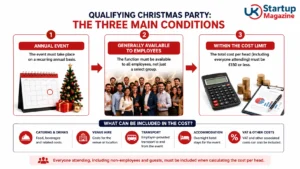
Three core tests normally determine whether a Christmas party can fall within the exemption: the function must be annual, generally available to employees and cost no more than £150 per head. The annual function exemption rules set out these conditions directly.
The Annual Event Requirement
“Annual” means an event that takes place on a recurring yearly basis. A regular Christmas party or summer barbecue can qualify, but a one-off celebration does not become an annual function merely because employees attend it.
HMRC gives the example of a party celebrating a 25th anniversary as a one-off event that would not satisfy the annual requirement.
Must the Christmas Party Be Open to All Employees?
A qualifying function should generally be available to all employees. This concerns the opportunity to attend; it does not mean every employee must actually accept the invitation.
An event restricted to a group for reasons that do not fit the location or departmental rules may therefore require closer consideration.
Separate Locations and Departments
Businesses operating from several locations can hold an annual event open to all staff at one location and still potentially satisfy the exemption.
Separate departmental parties can also qualify where employees have access to an appropriate event and the other conditions are met.
These provisions allow the exemption to work for employers whose workforce cannot realistically attend one central celebration.
How Is the £150 Per Head Christmas Party Limit Calculated?
HMRC calculates the cost per head by dividing the total cost of each function by the total number of people attending, including non-employees.
Cost Calculation
| Calculation Step | Treatment |
| Establish total relevant event cost | Include applicable event expenditure |
| Count everyone attending | Employees and non-employees |
| Divide cost by attendees | Produces the cost per head |
| Compare with exemption | Must not exceed £150 for a single qualifying function |
For instance, the headcount is not restricted to employees when guests are present. This can change the per-person calculation materially.
Employers should complete the calculation using the final relevant costs rather than relying solely on an early venue quotation.
What Costs Count Towards the £150 Per Person Limit?
Employers need to look at the overall cost of providing the function. The calculation is wider than simply the amount paid for employees’ meals.
Costs HMRC Includes
Relevant event expenditure can include the principal costs incurred in providing the annual function. Catering, venue costs and other spending forming part of the event should therefore be considered when determining the total amount to divide by attendance.
The focus is on the cost of providing the function as a whole rather than selecting individual invoices that keep the apparent total below £150.
Do VAT, Transport and Overnight Accommodation Count?
Yes. HMRC states that the cost includes VAT Rates as well as transport and overnight accommodation provided to enable employees to attend. The official cost per head guidance also confirms that the total is divided by everyone attending.
This can be particularly important where an employer provides taxis, coaches or hotel rooms alongside the main Christmas event.
Guests and Non-Employees in the Headcount
Non-employees who attend are counted when determining the cost per head. Consequently, the calculation is based on total attendees, not only the number of employees present.
This should not be confused with giving every guest a separate £150 cash entitlement; the rule remains an exemption applying to the qualifying function.
What Happens If the Christmas Party Costs More Than £150 Per Head?
The £150 limit creates one of the most important tax traps in this area. If a function is outside the exemption because its cost per head exceeds £150, the exemption does not simply cover the first £150.
HMRC says directors and employees can instead be chargeable on the full cost per head, not merely the excess above £150, where the function falls outside the exemption.
The relevant benefit can also include the cost attributable to family or household members attending as guests.
A party costing £151 per head should therefore not be approached as though only £1 is potentially taxable.
Employers planning close to the limit may benefit from leaving room for VAT, transport, accommodation or other final costs that could push the calculation beyond the qualifying threshold.
Can Employers Hold More Than One Tax-Free Annual Staff Event?
Yes, more than one annual function can potentially benefit from the exemption. However, the £150 test must be considered across qualifying annual events rather than treating each event as automatically entitled to its own separate £150 exemption.
Rules For Multiple Events
- Combined qualifying functions can remain exempt where their aggregate cost per head does not exceed £150.
- If the aggregate exceeds £150, the functions that best use the exemption can be selected.
- Other events outside that exempt combination can become taxable.
- An event costing more than £150 per head cannot use the exemption merely by applying unused value from another function.
HMRC’s examples confirm that when two annual functions together exceed £150, one may remain exempt while the other becomes chargeable, depending on which combination best uses the available exemption.
Employers holding both a summer function and Christmas party should therefore review the costs together before deciding their tax treatment.
How Do the Rules Apply to Guests, Directors and Virtual Parties?

The basic exemption can apply across several modern workplace arrangements, but the same annual-event, availability and cost conditions remain important.
Employees’ Guests and Family Members
Guests count towards the number of people used to calculate cost per head. If a function falls outside the exemption, an employee’s chargeable benefit can include the cost relating to family or household members attending as that employee’s guests.
Employers should therefore maintain an accurate attendance count when guests are invited.
Directors and Limited-Company Events
A director does not receive a special standalone £150 Christmas party allowance. The event still needs to satisfy the relevant annual-function requirements.
HMRC’s published example demonstrates the distinction: a party restricted to directors failed because it was not available to staff generally.
For limited companies, this makes the purpose and availability of the event particularly important where directors and employees overlap.
Can a Virtual Christmas Party Qualify?
Yes. The exemption is capable of applying to an annual function provided virtually through information technology, provided the other conditions are satisfied.
This can make the provision relevant to remote and hybrid businesses as well as organisations holding traditional in-person Christmas events.
What Must Employers Report or Pay If a Christmas Party Is Not Exempt?
When an event is not exempt, reporting and National Insurance obligations can arise. Current reporting and National Insurance rules state that the costs of non-exempt events must be reported and that Class 1A National Insurance is payable on the full cost.
Potential Employer Obligations
- Report the relevant benefit on each affected employee’s P11D where required.
- Pay Class 1A National Insurance on the full cost of the non-exempt event.
- Review additional annual events where the £150 exemption has already been used.
- Consider the separate rules that apply where a social function forms part of a salary sacrifice arrangement.
For salary sacrifice arrangements, the amount that must be reported can depend on the salary given up and the event cost.
Accurate records of event costs, attendance and the exemption applied can therefore help employers support the treatment used for payroll and benefits reporting.
Conclusion
The HMRC Christmas party allowance remains commonly described as £150 per person, but the more accurate description is an annual-function tax exemption. Current 2026 guidance continues to apply the £150-per-head threshold where the qualifying conditions are met.
Employers should remember that the party must be annual and generally available to employees, while the full calculation can include VAT and relevant transport or accommodation. Multiple annual events also need to be considered together.
Most importantly, £150 is not a deductible allowance. If an event falls outside the exemption, the full relevant benefit can become taxable rather than only the amount exceeding the threshold.
Calculating costs before booking and retaining appropriate records can help employers avoid unexpected reporting and National Insurance consequences.
FAQs
Can Employers Give Staff £150 in Cash Instead of Holding a Christmas Party?
No. The £150 figure relates to an exemption for qualifying annual functions and does not create a £150 cash entitlement for employees.
Can Unused Christmas Party Exemption Be Carried Forward?
The rules do not describe the £150 exemption as a balance that can be saved and carried into a later tax year. It applies to qualifying annual functions under the relevant conditions.
Does a One-Off Company Anniversary Celebration Qualify?
A one-off anniversary celebration does not satisfy the annual-function test merely because it is organised for employees. HMRC describes an annual event as something occurring yearly on a recurring basis.
Do Employees Have to Attend for the Event to Qualify?
No, the key condition concerns whether the qualifying function is available to employees generally. Employees do not all have to choose to attend.
Can Separate Offices Hold Their Own Christmas Parties?
Yes, separate events can potentially qualify where a business has multiple locations and the relevant staff have access to an appropriate annual function. The other conditions, including the £150-per-head limit, must still be satisfied.
Does Salary Sacrifice Change the Christmas Party Rules?
It can affect reporting. Where a social function forms part of a salary sacrifice arrangement, separate valuation and reporting provisions may apply.
Should Employers Keep Christmas Party Cost and Attendance Records?
Keeping invoices, final costs and attendance details can help demonstrate how the cost per head and exemption treatment were calculated. These records are particularly useful where guests, several annual events, transport or accommodation are involved.
Note: The article uses “HMRC Christmas party allowance” because that is the established search phrase, while distinguishing it from HMRC’s technical treatment as an exemption. Tax treatment depends on the facts of each event, so employers should apply the current rules to their own costs, attendees and arrangements.