
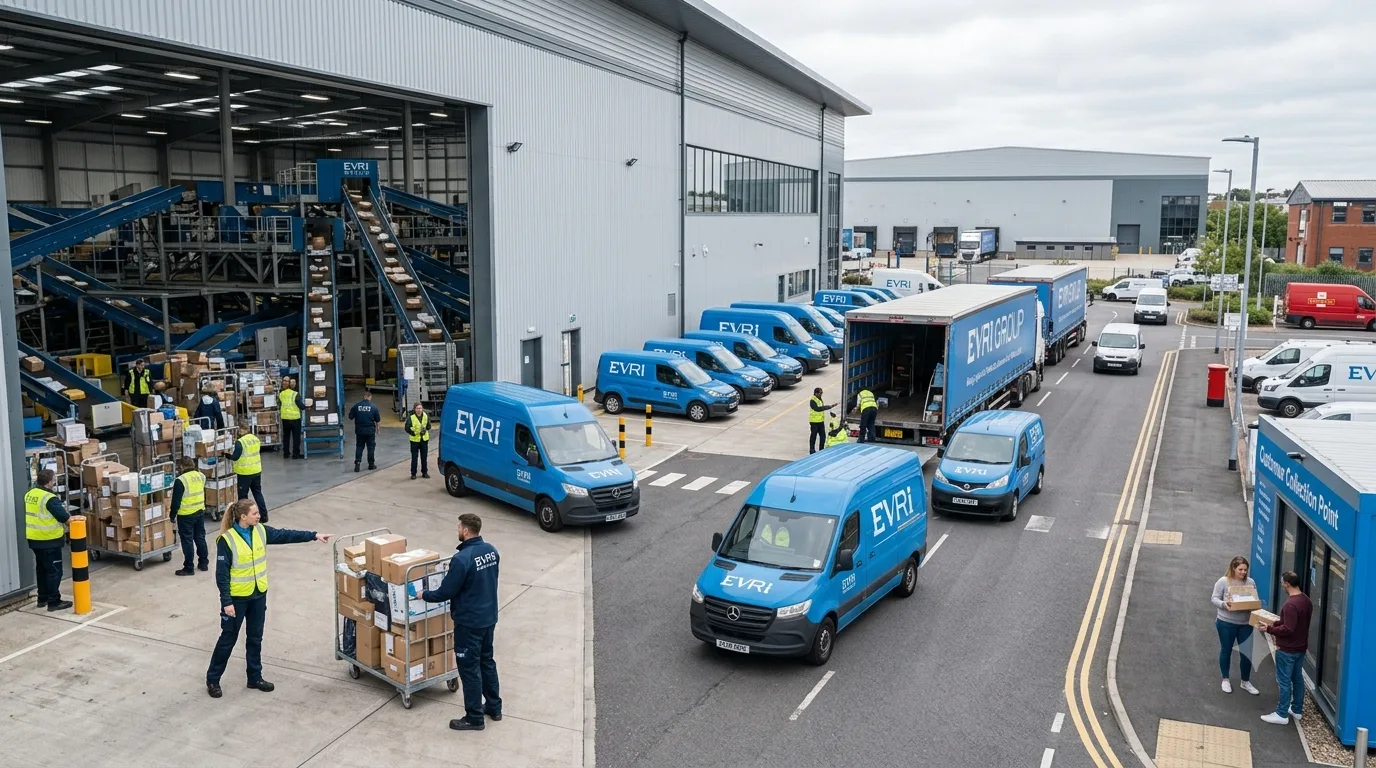
Evri has not gone bust. The parcel company remains operational across the UK and its latest business figures actually point to a significantly larger delivery operation than it had a few years ago.
The confusion appears to have been driven mainly by the collapse of Pedal & Post, an independent cargo-bike delivery company that handled some last-mile Evri parcels in Oxford.
When Pedal & Post stopped trading in early 2026, a small number of deliveries were disrupted, leading some customers to assume that the problems were connected to Evri itself.
They were not.
Pedal & Post subsequently entered creditors’ voluntary liquidation, while Evri continued operating its national network.
Evri has also become substantially larger following its October 2025 merger with DHL eCommerce UK. The enlarged group now handles more than one billion parcels annually and reported approximately £2.38 billion in revenue for the year ending 28 February 2026.
For customers waiting for a parcel, the important point is therefore simple: Evri is still delivering.
For ecommerce businesses, however, there is a broader question worth examining — whether Evri’s finances, ownership, service record and recent expansion make it a dependable long-term delivery partner.
Why Did People Think Evri Had Collapsed?
The main source of confusion was the closure of Pedal & Post.
Pedal & Post was an Oxford-based sustainable delivery company that used bicycles and electric cargo bikes for urban deliveries. Evri partnered with the business to complete some deliveries within Oxford, particularly where lower-emission transport offered an advantage.
When Pedal & Post suddenly stopped operating, parcels connected to that local delivery arrangement were affected.
Evri said the closure occurred without notice and that alternative arrangements were put in place for the relatively small number of customers affected.
National Evri operations continued.
This distinction matters because large parcel companies frequently rely on a wider delivery ecosystem that can include self-employed couriers, regional partners, parcel shops, lockers and specialist logistics businesses.
A subcontractor failing does not automatically mean the company whose parcels it carries is also insolvent.
| Company | Position | Recent development |
| Evri Group | Operating and expanding | Merged with DHL eCommerce UK |
| Pedal & Post | In liquidation | Stopped trading after losing a major contract |
| Zedify | Entered administration | Cargo-bike network struggled with costs and delivery volumes |
| Yodel | Acquired by InPost | Previous financial difficulties ended in a takeover |
| Royal Mail | Operating | Ownership changed following the acquisition of IDS |
Who Was Pedal & Post?
Pedal & Post was founded in Oxford in 2013 and positioned itself as a lower-emission alternative to conventional urban delivery vans.
Its riders used bicycles and electric cargo bikes to deliver parcels, business goods and specialist items around urban areas.
The company eventually worked with major organisations as well as smaller local customers.
Evri was one of those partners.
The arrangement allowed Evri parcels entering Oxford to complete parts of their final journey using cargo bikes, supporting deliveries in areas where reducing vehicle emissions was becoming increasingly important.
Pedal & Post also attempted to fund expansion.
In 2023, the company launched an investment campaign seeking around £500,000 from investors.
However, sustainable logistics does not automatically mean profitable logistics.
Operating a last-mile network involves staff costs, equipment, insurance, premises, technology and administration. A smaller delivery company can become particularly vulnerable when a large percentage of its revenue comes from only a few major customers.
Pedal & Post reportedly lost an important contract connected with micromobility company Voi.
The loss represented a significant part of its business and ultimately contributed to its closure.
Around 60 jobs were reportedly affected across its operations.
Pedal & Post later entered creditors’ voluntary liquidation on 20 February 2026, with investors warned that they were unlikely to recover their money.
What Happened to the Evri Parcels It Was Carrying?
Some deliveries in Oxford were temporarily affected because Pedal & Post had been completing the final stage of those journeys.
Evri reorganised deliveries through alternative parts of its network and said normal service was being restored.
This provides a useful example of how parcel networks actually operate.
A parcel displaying an Evri tracking number does not necessarily spend every stage of its journey with the same driver, vehicle or local operating company.
A national network can involve:
- Sorting hubs and depots
- Self-employed couriers
- Local delivery partners
- Parcel shops and lockers
- Specialist delivery businesses
- Third-party transport contractors
If one part of that chain suddenly disappears, local disruption can occur while the wider network remains operational.
How Strong Is Evri Financially?
Evri’s financial history is more complicated than simply saying the business has always been profitable.
Earlier accounts showed significant pressure.
For the year ending February 2025, reports highlighted turnover of around £1.46 billion alongside a statutory loss of approximately £77 million.
Taken alone, a loss of that size could understandably concern businesses considering Evri as a delivery partner.
But historical figures need to be viewed alongside subsequent developments.
Evri has since undergone major ownership and structural changes, while its parcel volumes and revenues have grown considerably.
For the 52 weeks ending 28 February 2026, the enlarged Evri Group reported:
| Financial or operating measure | FY2025/26 |
| Group revenue | £2.38 billion |
| Revenue growth | 29% |
| Adjusted EBITDA | £402 million |
| Adjusted EBITDA growth | 18% |
| Parcel volume growth | 17% |
| Annual parcel volume | More than 1 billion |
| Investment during the year | More than £80 million |
Adjusted EBITDA is not the same as statutory profit and should not be treated as proof that there are no financial risks.
Nevertheless, increasing revenue, rising parcel volumes and substantial infrastructure investment look very different from the typical warning signs surrounding a business approaching liquidation.
How Did the DHL eCommerce UK Merger Change Evri?
One of the biggest changes was completed on 1 October 2025, when Evri merged with DHL eCommerce UK.
The transaction substantially increased the size of the group.
DHL Group became a significant minority shareholder, while funds managed by Apollo retained majority ownership.
The enlarged operation brought together tens of thousands of couriers, van drivers and employees across a much larger national logistics network.
Parts of the former DHL eCommerce UK operation are also being integrated into Evri’s premium delivery services.
The combination gives the business exposure to standard parcel delivery, premium shipping, business mail and international logistics.
Evri says the network is already processing more than one billion parcels a year and is aiming to increase that figure to approximately 1.4 billion annually by 2030.
UK Startup Magazine has previously covered the DHL eCommerce UK and Evri merger and what the combination means for the delivery market.
What Happened to Reports of a £2 Billion Evri Sale?
Reports from early 2024 said Evri’s then-owner, Advent International, was considering selling the parcel company.
Valuations around £2 billion were discussed at the time.
That development was sometimes interpreted as another sign of instability, but a private-equity owner exploring a sale does not mean a company is entering insolvency.
Apollo-managed funds subsequently agreed to acquire Evri from Advent in July 2024.
The reported transaction value was considerably higher than the earlier suggested valuation.
Evri therefore changed owners, but it did not enter administration.
The business later expanded again through the DHL eCommerce UK transaction.
Is Evri Safe for Ecommerce Businesses to Use?
There is currently no evidence suggesting Evri is about to stop trading.
Its recent expansion, increased parcel volumes, large-scale investment and DHL relationship indicate that the group is pursuing growth.
However, businesses should avoid treating any courier as completely risk-free.
Parcel delivery remains an intensely competitive sector where profitability can be affected by:
fuel costs, wages, National Insurance contributions, failed deliveries, vehicle expenditure, technology investment, depot costs and competition over parcel pricing.
A better question for ecommerce businesses is therefore not simply whether Evri might fail.
It is whether relying entirely on one delivery company creates an unnecessary operational risk.
Businesses shipping substantial volumes may benefit from maintaining relationships with more than one carrier so an alternative is available if there are depot problems, strikes, technology failures, severe weather or local subcontractor disruption.
What Happened to Yodel?
Yodel provides a useful comparison because it did face serious financial problems.
The courier came close to collapse and went through significant ownership and financing changes.
However, articles describing Yodel as currently sitting on the edge of administration are now outdated.
InPost acquired Yodel in April 2025.
Yodel has since been integrated increasingly closely into the wider InPost delivery operation.
The situation demonstrates why financial-status articles about parcel businesses need to distinguish historical financial distress from the company’s current position.
Evri vs Yodel vs Royal Mail
The three companies have very different ownership structures, financial histories and operating models.
| Courier | Current position | Key recent development | Main consideration |
| Evri | Expanding | DHL eCommerce UK merger | Rapid parcel and revenue growth |
| Yodel/InPost | Operating under new ownership | Acquired by InPost | Previous financial difficulties but now part of a larger network |
| Royal Mail | Operating | IDS ownership changed | Huge network but continued pressure on traditional letter operations |
Direct financial comparisons should be treated cautiously because the businesses report different metrics and have different financial years.
For ecommerce companies choosing a delivery supplier, financial size is only one consideration.
Price, claims handling, parcel size limits, collection availability, delivery performance and customer service can be equally important.
Businesses considering different delivery networks can also look at the economics covered in UK Startup Magazine’s guide to DPD franchise costs in the UK.
Does Zedify’s Administration Show a Problem With Green Delivery Startups?
Pedal & Post was not the first cargo-bike delivery business to encounter serious financial difficulties.
Zedify entered administration in January 2025.
The company had built a cargo-bike network across several UK locations and attracted substantial investment.
However, administrators identified problems including insufficient delivery volumes and high operating costs.
Some individual locations reportedly performed better than others, but the overall economics proved difficult.
The cases of Zedify and Pedal & Post highlight an important challenge for sustainable delivery startups.
Cargo bikes can reduce pollution and may work extremely well in dense urban areas, but the business model still needs sufficient parcel density.
A delivery company might have strong environmental credentials and enthusiastic customers while still struggling commercially if the number of parcels carried does not cover its fixed costs.
Pedal & Post also illustrates the danger of customer concentration.
If a large customer represents a substantial percentage of annual revenue, losing that single contract can rapidly turn a viable business into an unsustainable one.
Does Evri’s Customer Reputation Mean It Is Struggling?
Not necessarily.
Evri has faced considerable criticism from customers over the years.
Complaints have frequently centred on missing parcels, delivery locations, damaged goods and difficulties contacting customer support.
MoneySavingExpert has previously ranked Evri poorly in its annual parcel-delivery customer surveys.
That is a relevant indicator of customer satisfaction, but customer dissatisfaction should not be confused with insolvency.
A company can have poor consumer reviews while remaining financially large and operationally active.
Likewise, high revenue does not automatically mean customers receive consistently good service.
The two issues should be assessed separately.
Customers mainly concerned with delivery timing may also find UK Startup Magazine’s information about Evri Sunday deliveries and Evri deliveries on bank holidays useful.
What Is the Evri and BBC Panorama Dispute?
Evri’s reputation has also become the subject of a legal dispute with the BBC.
The company has brought proceedings seeking around £1.2 million in damages connected with claims made in a BBC Panorama investigation about working practices and courier pay.
Evri argues that the programme contained misleading claims and resulted in commercial losses.
The allegations remain subject to legal proceedings.
The dispute is relevant when assessing Evri’s wider business reputation, but it should not be interpreted as evidence that the company is financially insolvent.
There is a clear difference between:
financial risk, operational risk, legal risk and reputational risk.
A company can experience one without experiencing all four.
What Should You Do If an Evri Parcel Is Delayed?
A delayed parcel does not mean Evri has stopped operating.
The first step should normally be checking the tracking information and allowing any stated delivery window to pass.
What happens next depends on who purchased the delivery service.
When You Bought From a Retailer?
Contact the retailer rather than immediately attempting to resolve the issue directly with Evri.
For most consumer purchases, responsibility for getting the goods to the customer remains with the retailer until the delivery is successfully completed.
The retailer may investigate the parcel, issue a replacement or provide a refund depending on the circumstances.
When You Booked the Delivery Yourself?
If you purchased the Evri postage directly, contact Evri through its support or claims process.
Keep evidence including the tracking number, proof of postage, parcel value and any photographs that could support the claim.
Compensation will depend on the service purchased, the contents of the parcel and the level of cover included.
What Should Ecommerce Sellers Learn From the Pedal & Post Collapse?
The main lesson is not that sellers should stop using Evri.
It is that delivery networks contain dependencies that retailers rarely see.
A small ecommerce business may assume that choosing a national courier eliminates operational risk. In reality, that national company may still use local contractors, independent couriers, technology suppliers and other partners.
Businesses should therefore consider contingency planning.
Useful delivery metrics to monitor include:
- Successful first-time delivery rate
- Lost parcel percentage
- Damage claims
- Average delivery time
- Customer complaints
- Cost per successful delivery
- Claims resolution time
The cheapest shipping label can become expensive if failed deliveries repeatedly result in refunds, replacements and customer-support work.
Larger ecommerce sellers may also want an alternative courier account available even if it is not used for every parcel.
That creates a fallback option when disruption occurs.
A Timeline of What Actually Happened
| Date | Event |
| 2013 | Pedal & Post founded |
| 2023 | Company sought around £500,000 from investors |
| January 2024 | Evri announced an Oxford delivery partnership with Pedal & Post |
| July 2024 | Apollo-managed funds agreed to acquire Evri |
| January 2025 | Zedify entered administration |
| April 2025 | InPost acquired Yodel |
| October 2025 | Evri completed its DHL eCommerce UK merger |
| January 2026 | Pedal & Post ceased operations after losing a major contract |
| 20 February 2026 | Pedal & Post entered creditors’ voluntary liquidation |
| July 2026 | Evri reported £2.38bn revenue and more than one billion annual parcels |
| August 2026 | Evri announced further recruitment and expansion plans |
The timeline makes the situation clearer.
Pedal & Post was contracting and ultimately entered liquidation while Evri itself was expanding its national operation.
Frequently Asked Questions
Is Evri still operating in the UK?
Yes. Evri remains operational throughout the UK and handles more than one billion parcels annually.
Which company connected to Evri went bust?
Pedal & Post entered creditors’ voluntary liquidation in February 2026. It was an independent cargo-bike delivery partner rather than part of Evri itself.
Is Evri in administration?
No. Evri Group is not in administration or liquidation.
Why were some Evri parcels affected?
Pedal & Post handled some final-mile Evri deliveries around Oxford. Its sudden closure temporarily disrupted parcels in that area.
Is Evri making a profit?
Evri reported £402 million in adjusted EBITDA for FY2025/26, although adjusted EBITDA should not be treated as the same measure as statutory net profit.
Did DHL buy Evri?
No. Evri and DHL eCommerce UK merged their UK operations, with DHL Group becoming a significant minority shareholder in the enlarged business.
Should ecommerce businesses continue using Evri?
There is no current evidence suggesting Evri is about to stop trading. However, businesses shipping large parcel volumes should consider maintaining more than one courier relationship to reduce operational dependency.