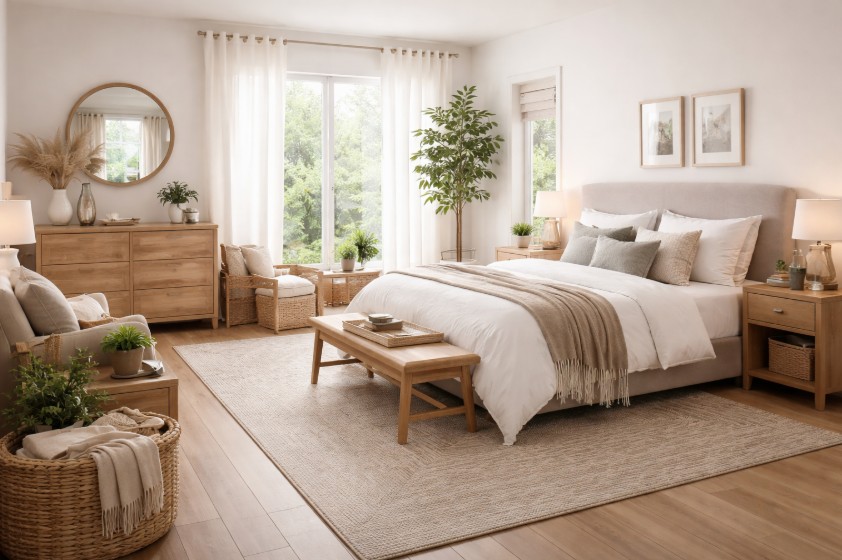
Ever notice how your bedroom can set the tone for your entire day? You might blame a lumpy mattress or harsh lighting when you wake up irritated, but here’s what most people miss: the real problem often lies in how you’ve positioned your furniture and organized your belongings.
Strategic arrangement transforms cramped quarters into genuine sanctuaries, making relaxation feel effortless instead of forced. You hold complete control over two game-changers: bedroom furniture placement and storage systems that cut clutter, enhance circulation, and elevate sleep quality.
Understanding why positioning matters before you shove that dresser around helps you make choices rooted in genuine comfort rather than chasing whatever’s trending on design blogs this month.
How Do Bedroom Furniture Placement and Storage Improve Overall Comfort?
Comfort-Driven Storage Placement: Reducing Visual Stress and Decision Fatigue

Bedroom comfort tips include managing storage visibility strategically. Open shelving succeeds in minimal-clutter zones with intentional styling. Closed storage conceals messy categories electronics, paperwork, laundry overflow without adding visual static.
Morning comfort: faster routines with smarter placement
Outfit staging areas featuring hooks and compact shelving accelerate your routine dramatically. Hamper positioning shouldn’t obstruct closet access. Shoe storage stays clear of main walkways, preventing stumble hazards.
When you’re ready to upgrade your bedroom setup, consider how full size bedroom sets can simplify your furniture placement decisions by ensuring proportional pieces that work together seamlessly from day one.
Nighttime comfort: a calm bedside ecosystem
Maintain essentials within arm’s reach: water bottle, current read, eyeglasses, phone charger. Deploy a small tray or organizer preventing surface scatter. Avoid overflow storage crowding your bedside, which elevates subconscious stress pre-sleep.
Bedroom Comfort Starts With Flow: Layout Signals Your Brain to Relax
Here’s something most design advice skips: the way you navigate your bedroom actually communicates with your nervous system. Open pathways and uncluttered surfaces register as safety. Cramped corners and obstacle courses? Your stress hormones respond accordingly, whether you consciously register it or not.
Comfort pillars to optimize (quick checklist)
Ask yourself if your space supports these five essentials. Clear pathways mean you’re not performing gymnastics during your 6 AM stumble to the bathroom. Visual calm eliminates the stuff noise that keeps your mind buzzing when it should be powering down.
Ergonomic reach places your phone charger, reading light, and essentials exactly where your drowsy hand expects them. Air and light access ensures vents and windows breathe freely, letting temperature and natural brightness work with you instead of against you. Noise reduction tackles those door drafts and hard surfaces that bounce sound around like an echo chamber.
Fast comfort audit before moving anything
Grab a tape measure and map your room’s bones door arcs, window clearances, HVAC vents, electrical outlets. Hunt down friction zones: that corner you always bump, the drawer that barely opens, the closet door you can’t fully swing.
Prioritize based on actual use, whether that’s sleep sanctuary, dressing station, home gym, nursery, or shared quarters. This prevents the classic Instagram-ready but impossible to live in disaster.
With your audit complete and friction points identified, let’s convert those observations into concrete positioning tactics that genuinely improve your rest, not just your room’s photogenicity.
Bedroom Furniture Placement That Improves Sleep Quality (Not Just Style)

Bedroom furniture placement transcends following cookie-cutter templates from shelter magazines. It’s fundamentally about supporting your body’s biological need for undisturbed rest and intuitive access to necessities. Current sleep science continues exploring how physical bedroom conditions measurably influence sleep architecture.
Bed placement strategies that feel better night-to-night
Anchor your headboard against a solid wall and it eliminates that subtle instability sensation. Direct door alignment can trigger low-level anxiety for some people; angling your sightline without blocking entry often feels more secure. Distance your sleeping surface from temperature troublemakers like drafty windows or direct vent blasts that jolt you awake at 3 AM.
Nightstand and lighting placement for true convenience
Height matters enormously: align your nightstand with your mattress surface for effortless reach. Position task lighting to dodge glare, favoring warm-spectrum bulbs that don’t spike alertness. Establish charging stations that won’t become ankle-catching tripwires during night time bathroom runs.
Dresser and wardrobe placement that reduces morning traffic
Situate your dresser adjacent to closets or dressing zones, minimizing your morning shuffle. Confirm drawers achieve full extension without colliding with bed frames or doorways. Mirrors amplify light beautifully, though direct reflections can disrupt sleep for certain individuals.
Strategic positioning establishes your foundation, but accumulated clutter dismantles that work surprisingly fast. The solution involves integrating storage that complements your layout without reintroducing visual chaos or obstructing those carefully optimized pathways.
Small Bedroom Storage Ideas That Remove Clutter Without Shrinking the Room
Small bedroom storage ideas deliver best when they preserve floor real estate and maintain item categorization. Your bedroom deserves sanctuary status, yet clutter sabotages that peace relentlessly.
Vertical storage that keeps floors open
Wall-mounted shelving positioned above collision zones think above dressers rather than dangling over your pillow harnesses height without consuming precious floor space. Ceiling-height wardrobes accommodate top bins for seasonal rotation. Over-door organizers excel on closet or utility doors, though you’ll want to skip the main entry if it creates visual overwhelm.
Closet organization upgrades that create instant comfort
Double-rod systems can revolutionize capacity for anyone with abundant shorter garments. Shelf dividers and transparent containers generate immediate visual calm. Establish a one-touch zone for daily outfit staging; it crushes decision fatigue when you’re barely caffeinated.
Under-bed storage that stays breathable and accessible
Shallow labeled bins prevent overstuffing while maintaining crucial airflow. Position frequently accessed categories at the foot end for streamlined retrieval. Dust control matters: low-profile containers paired with regular cleaning schedules significantly reduce allergen accumulation.
Storage solves your what belongs where puzzle, but authentic comfort emerges from how smoothly you navigate daily. Let’s establish clearance standards and layout frameworks that maintain friction-free routines even in compact quarters.
How to Arrange Bedroom Furniture for Better Movement? (Walkways + Clearances)

How to arrange bedroom furniture hinges on preserving functional space for everyday activities. Even stunning rooms fail spectacularly when you’re perpetually squeezing past bed frames or catching drawer pulls with your hip.
Recommended clearance targets (easy-to-follow rules)
Primary walkways connecting door to bed or closet remain consistently unobstructed. Account for drawer extensions and closet door swings. No-corner-catch spacing prevents those painful hip and shoulder collisions in tighter rooms typically 24 inches minimum along walking sides.
Layout patterns that work in real homes
Classic centered arrangements feature symmetrical nightstands flanking your bed, delivering calm and balance. Space-conscious setups push beds wall-side with floating shelf nightstands, perfect for narrow footprints. Studio or multipurpose layouts separate sleeping zones from dressing areas and workstations without functional overlap.
Universal clearance principles perform beautifully until your specific floor plan introduces complications. Here’s how to adapt movement-focused strategies to narrow dimensions, challenging windows, and non-standard architectural features without sacrificing comfort.
Bedroom Layout Ideas by Room Shape (So You Don’t Fight Your Floor Plan)
Bedroom layout ideas transform based on whether you’re tackling railroad-style narrow dimensions, perfect squares, or awkward elements like bay windows and angled ceilings.
Narrow bedrooms (railroad-style) layout fixes
Evaluate bed orientation thoughtfully, sometimes rotating works, sometimes offsetting proves superior. Adopt slimmer nightstand profiles and wall sconces to reclaim valuable inches. Position tall storage toward the far wall, reducing that tunnel-vision effect.
Awkward features: windows, radiators, sloped ceilings, bay windows
Never obstruct heat sources circulation matters. Leverage low storage beneath slopes and position beds where headroom peaks. Transform bay windows into reading nooks or storage zones rather than blocking them with oversized furniture.
You’ve mastered physical arrangement, but comfort extends beyond where items sit it encompasses how much cognitive load your storage creates. Strategic placement either soothes your mind or generates subtle stress each time you enter.
Final Thoughts on Creating Comfort Through Smart Placement
Bedroom furniture placement and small bedroom storage ideas transcend aesthetics; they directly influence your sleep quality, movement ease, and daily emotional state. Bedroom layout ideas and bedroom comfort tips combine forces to eliminate clutter, enhance airflow, and support smoother daily rhythms.
When you approach how to arrange bedroom furniture as a comfort-driven decision rather than purely aesthetic, your bedroom evolves into a space that authentically supports restoration.
Start with one zone, implement a few deliberate adjustments, and observe how quickly your stress levels drop. Your bedroom should work for you not against you.
Common Questions About Bedroom Layout and Storage
Best bed position for better sleep in a small room?
Position your bed along the longest wall with the headboard secured against it. Maintain 24 inches minimum walkway on at least one side, avoiding placement directly beneath windows where temperature fluctuations disrupt rest cycles.
Should the bed face the door or be placed on the longest wall?
Ideally, position your bed allowing door visibility without direct alignment. This configuration reduces unconscious anxiety while maintaining clear sightlines that register as safe and comfortable.
Best small bedroom storage ideas without making it feel cluttered?
Embrace vertical solutions like wall-mounted shelving and ceiling-height wardrobes. Under-bed bins combined with double-rod closet configurations maximize capacity without devouring floor space, preserving that essential open feeling.