

The UK inheritance tax changes in 2027 represent one of the most significant shifts in family wealth planning in recent years.
Although inheritance tax remains at a standard rate of 40%, changes to pension inheritance, agricultural property relief and business property relief are reshaping how families, farmers, entrepreneurs and company directors pass wealth to the next generation.
The reforms initially introduced under former Chancellor Rachel Reeves have moved beyond political proposals.
Important changes to business and agricultural inheritance tax relief came into effect on 6 April 2026. A further change, bringing most unused pension funds into the inheritance tax calculation, takes effect from 6 April 2027.
There were also additional developments in the Budget delivered on 28 October 2026 by Chancellor John Healey.
Our analysis of the confirmed measures identifies three major financial concerns: frozen inheritance tax thresholds, new limits on business and agricultural reliefs, and the inclusion of unused pensions in taxable estates.
For a family with substantial property, retirement savings or a valuable trading business, the interaction between these rules can create a larger tax liability than expected.
However, the changes do not mean everyone will pay inheritance tax. Understanding the available allowances, exemptions and reliefs remains essential before making major financial decisions.
What Are the Latest Inheritance Tax Changes for 2027?
The inheritance tax reforms affect different assets at different dates. Some rules are already operating in 2026, while others are scheduled for April 2027.
The following table summarises the position as of November 2026.
| Inheritance tax measure | Current position | Effective date |
| Standard inheritance tax rate | 40% on taxable estates | Unchanged |
| Standard nil-rate band | £325,000 | Frozen through 2030/31 |
| Residence nil-rate band | Up to £175,000 | Frozen through 2030/31 |
| Agricultural and Business Relief | 100% relief on up to £2.5 million of combined qualifying assets per person | 6 April 2026 |
| Relief above £2.5 million | Generally 50% on qualifying excess | 6 April 2026 |
| Transferable agricultural/business allowance | Up to £5 million between qualifying spouses or civil partners | 6 April 2026 |
| AIM qualifying shares | Generally limited to 50% Business Relief | 6 April 2026 |
| Most unused pension funds | Included in estates for inheritance tax | 6 April 2027 |
| Inheritance tax on certain trust liabilities | Further anti-avoidance changes announced | Intended effect from 28 October 2026 |
| Standard charitable inheritance tax rate | Reduced to 36% where qualifying conditions are met | Unchanged |
For business owners, the distinction between the 2026 and 2027 changes is important.
The restrictions on Business Relief and Agricultural Relief are already law and operating. The central pension reform has also been legislated through the Finance Act 2026, although some further administrative amendments announced in October 2026 remain subject to legislation.
Our assessment is that business succession and pension planning should no longer be treated as separate financial decisions. A founder’s company shares, retirement investments and private property may all influence their family’s overall inheritance tax position.
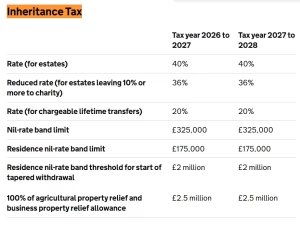
UK inheritance tax rates and allowances for 2026/27 and 2027/28.
Why Did Rachel Reeves Introduce Changes to Inheritance Tax?
Rachel Reeves announced major inheritance tax reforms during the Autumn Budget on 30 October 2024.
The government’s central argument was that existing arrangements allowed substantial business, agricultural and pension wealth to pass between generations with favourable tax treatment compared with ordinary property, savings and investments.
Before the reforms, qualifying business and agricultural assets could often receive 100% inheritance tax relief without the new £2.5 million cap.
Certain pension arrangements could also pass substantial unused funds to beneficiaries outside the deceased person’s estate.
The reforms sought to narrow these differences and increase the inheritance tax contribution from larger estates.
However, the proposals generated opposition from organisations representing family-owned businesses and agricultural enterprises.
Their concern centred on a fundamental financial distinction: the valuation of an asset is not the same as having cash available to pay a tax bill.
A family-owned company might be worth several million pounds because of its land, premises, machinery, contracts or future earnings. Yet the family may have insufficient available cash to meet an inheritance tax liability without borrowing, refinancing or selling assets.
This concern remains relevant even after the government increased the proposed £1 million business and agricultural relief allowance to £2.5 million in December 2025.
The final reforms took effect in April 2026.
Although Reeves left the Treasury in July 2026, the legislation introduced during her chancellorship continues to shape UK inheritance tax policy in 2027.
For wider context, the 2025 Budget tax changes also affected other aspects of long-term financial planning for company owners.
What Are the Inheritance Tax Thresholds in 2027?
The standard inheritance tax threshold remains £325,000 per person in the 2027/28 tax year.
This threshold, called the nil-rate band, is the amount of an estate that can normally pass without inheritance tax before considering other exemptions and reliefs.
Inheritance tax is generally charged at 40% on the taxable value above the available allowances.
The position is more favourable where a qualifying home is inherited by direct descendants because an additional residence nil-rate band may apply.
| Allowance or rate | 2026/27 | 2027/28 |
| Standard nil-rate band | £325,000 | £325,000 |
| Residence nil-rate band | £175,000 | £175,000 |
| Potential total for one person | £500,000 | £500,000 |
| Potential combined allowances for a qualifying married couple | £1,000,000 | £1,000,000 |
| Standard inheritance tax rate | 40% | 40% |
| Qualifying charitable rate | 36% | 36% |
The £1 million combined figure is not an automatic exemption for every couple.
It depends on unused allowances being transferable between spouses or civil partners, the qualifying home passing to direct descendants, the estate’s value and other conditions.
The residence nil-rate band also begins to reduce when the relevant net estate exceeds £2 million.
How Much Inheritance Tax Would Apply to a £750,000 Estate?
Consider a single person who dies in 2027, leaving a qualifying home and other assets worth £750,000 to their children.
Assume they have no chargeable lifetime gifts or other relevant complications.
| Calculation | Amount |
| Total estate | £750,000 |
| Standard nil-rate band | £325,000 |
| Residence nil-rate band | £175,000 |
| Total available allowances | £500,000 |
| Taxable estate | £250,000 |
| Inheritance tax at 40% | £100,000 |
| Remaining inheritance | £650,000 |
The effective inheritance tax burden in this illustration is approximately 13.33% of the estate, rather than 40% of its entire value.
This difference matters because the headline tax rate can make inheritance tax appear more extensive than it is.
However, estates containing expensive homes, investments, business shares or pension savings can face materially different calculations.
How Do the 2026 Business Property Relief Changes Affect Family Businesses?
Business Property Relief, now generally referred to by HMRC as Business Relief, reduces the value of eligible business assets when calculating inheritance tax.
This is particularly relevant to company founders, family-owned manufacturers, agricultural businesses, professional firms and trading companies.
Before 6 April 2026, qualifying business interests could often receive 100% relief without the new overall cap.
Under the current rules, the first £2.5 million of combined assets eligible for 100% Agricultural Relief or Business Relief can normally receive full relief.
Qualifying assets above that allowance generally receive relief of 50%.
This means the taxable portion of assets exceeding the allowance is normally half their value, before other relevant inheritance tax allowances are applied.
Example: A Family Business Worth £4 Million
Suppose an entrepreneur leaves qualifying shares in a privately owned trading company worth £4 million.
For simplicity, assume the full £2.5 million allowance is available, there are no other assets or taxable gifts, and the ordinary £325,000 nil-rate band is unused.
| Calculation | Amount |
| Business valuation | £4,000,000 |
| Qualifying value receiving 100% relief | £2,500,000 |
| Remaining business value | £1,500,000 |
| Relief on remaining value at 50% | £750,000 |
| Value remaining subject to IHT calculation | £750,000 |
| Ordinary nil-rate band | £325,000 |
| Taxable value | £425,000 |
| Inheritance tax at 40% | £170,000 |
In this simplified example, the resulting tax bill is £170,000.
That represents approximately 4.25% of the business’s total valuation, but the effective marginal inheritance tax rate on the qualifying excess above the relief cap is normally 20% once other allowances have been used.
A different mix of assets, prior gifts, debt, transferred relief allowances and beneficiaries can change the outcome significantly.
For business owners preparing succession plans, using an indicative business valuation can help with initial scenario modelling. However, an HMRC inheritance tax valuation must follow the relevant valuation rules and should not rely solely on a general startup calculator.

Business Relief rules from 6 April 2026.
Can Married Couples Still Pass on £5 Million in Business or Agricultural Assets Tax-Free?
Yes, potentially.
The £2.5 million allowance for qualifying business and agricultural property can be transferred between spouses and civil partners where an unused allowance is available.
This means the survivor’s estate could potentially have up to £5 million of qualifying property covered by 100% relief.
However, several important conditions apply.
First, the £5 million figure is a combined ceiling on qualifying relief, not an unrestricted inheritance tax exemption covering all types of assets.
Second, unused relief must be available and the appropriate claim made.
Third, inherited business or agricultural assets must satisfy the rules governing eligibility.
Fourth, prior qualifying transfers may use some of the allowance.
The government has explained that the combined £5 million business and agricultural relief allowance, alongside two unused standard nil-rate bands totalling £650,000, could allow eligible assets worth as much as £5.65 million to pass without inheritance tax.
That does not mean every £5.65 million estate qualifies. In particular, the residence nil-rate band is subject to tapering at larger estate values, and business relief depends on the underlying asset.
We consider this interaction one of the most important estate-planning issues for married business owners in 2027.
How Will Agricultural Property Relief Affect Farmers in 2027?
Agricultural Property Relief protects qualifying agricultural property from inheritance tax, subject to its eligibility conditions.
Eligible property can include certain farmland, pasture, agricultural buildings and farmhouses where the statutory rules are satisfied.
The April 2026 reform changed the financial position for families transferring higher-value farming assets.
The maximum combined amount qualifying for 100% Agricultural Relief and Business Relief is generally £2.5 million per individual, with 50% relief available on the qualifying excess.
Importantly, this is a shared allowance between the two reliefs rather than a separate £2.5 million allowance for each.
A farmer owning both qualifying agricultural land and a separate eligible trading business must therefore consider their combined value.
How Would the Changes Affect a £3.5 Million Farm?
Consider a farm containing qualifying agricultural property worth £3.5 million.
Assume the owner has the full £2.5 million allowance available.
- The first £2.5 million receives 100% relief.
- The remaining £1 million receives 50% relief.
- The value remaining in the inheritance tax calculation is £500,000.
- If the ordinary £325,000 nil-rate band is fully available and no other assets or complications arise, the taxable amount is £175,000.
- At 40%, the illustrative inheritance tax bill is £70,000.
A farm’s actual liability may be different because not all assets necessarily qualify for the same relief, and the personal circumstances of the owner can affect the calculation.
The December 2025 increase in the allowance from £1 million to £2.5 million substantially changed the outcome for many agricultural estates.
NFU President Tom Bradshaw acknowledged the improvement, saying:
“While there is still tax to pay, this will greatly reduce that tax burden for many family farms.”
The National Farmers’ Union has nevertheless continued to oppose aspects of the reforms, particularly where working farms remain exposed to substantial inheritance tax liabilities.
From our financial analysis, a farm’s ability to fund tax from operating cash flow may be more important than its headline valuation.
Agricultural enterprises should therefore assess potential tax liabilities alongside profitability, borrowing arrangements, succession plans and long-term ownership structures.
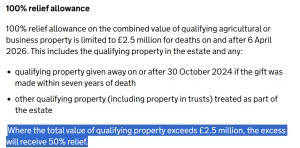
Agricultural inheritance tax relief and transferable allowances.
Which Business Assets Qualify for 100% or 50% Inheritance Tax Relief?
Not every business-related asset qualifies for Business Relief.
HMRC applies specific conditions covering the nature of the business, ownership period and asset use.
Generally, qualifying business interests and unlisted trading-company shares can receive relief where the relevant requirements are satisfied.
A two-year ownership requirement commonly applies, subject to particular exceptions.
Businesses mainly involved in holding investments, dealing in shares, or dealing in land and buildings generally do not qualify simply because they operate through a company.
Similarly, assets not needed for the business may be excluded from relief.
The rules for shares traded on the Alternative Investment Market (AIM) also changed in April 2026.
Qualifying AIM shares are generally restricted to 50% Business Relief rather than receiving 100% relief under the new £2.5 million allowance.
This creates a distinction between qualifying shares in private trading businesses and certain quoted-market investments.
| Asset category | Potential relief from April 2026 |
| Eligible private trading-company shares | 100% within available allowance; generally 50% above |
| Eligible business interests | 100% within available allowance; generally 50% above |
| Qualifying AIM shares | Generally 50% |
| Certain personally owned business premises or machinery | Potentially 50% |
| Assets mainly held for investment | Generally not eligible |
| Ordinary cash and personal savings | No Business Relief merely because they belong to a business owner |
For startup founders, the key planning issue is whether the business genuinely qualifies as a trading business under the relief rules.
There can also be a tax distinction between retaining eligible business shares and selling them for cash.
Following a sale, the proceeds do not automatically retain the Business Relief previously available to the shares.
A founder considering retirement or a company exit should therefore examine the possible inheritance tax implications alongside the capital gains tax consequences of disposing of their shares.
What Will Change to Inheritance Tax on Pensions From April 2027?
The inclusion of unused pension funds in inheritance tax calculations is one of the biggest confirmed changes for 2027.
From 6 April 2027, most unused pension funds and pension death benefits will be brought within the value of a deceased person’s estate for inheritance tax purposes.
The change applies to deaths occurring on or after that date.
Where a pension member dies before 6 April 2027, the previous rules generally continue to apply even if benefits are paid after the new rules begin.
Historically, many defined contribution pension arrangements could pass unused funds outside the estate because pension trustees or administrators exercised discretion over beneficiaries.
The new legislation largely removes this inheritance tax advantage.
However, not every pension benefit becomes taxable.
Important exclusions and exemptions include qualifying death-in-service benefits, certain dependant’s scheme pensions and applicable transfers to spouses or civil partners.
Example: How Much More Inheritance Tax Could a Family Pay?
Consider a single homeowner leaving assets to their children.
Assume the family home qualifies for the residence nil-rate band, the full £500,000 total allowance is available, and there are no other relevant complications.
| Asset | Value |
| Home and non-pension assets | £450,000 |
| Unused pension funds | £300,000 |
| Total combined value | £750,000 |
Before April 2027, assuming the unused pension funds remain outside the inheritance tax estate, the £450,000 of non-pension assets would be covered by the available £500,000 allowance.
The estate would therefore have no inheritance tax liability in this simplified example.
From 6 April 2027, including the £300,000 pension increases the relevant combined value to £750,000.
The calculation would become:
- Combined estate and pension value: £750,000
- Available allowances: £500,000
- Taxable amount: £250,000
- Inheritance tax at 40%: £100,000
The result is a potential additional £100,000 inheritance tax bill.
This example demonstrates why the new rules could materially affect households whose wealth is divided between property and pensions, rather than being concentrated entirely in high-value property.
Our analysis suggests that estate reviews should include all pension pots, not simply the largest retirement account.
This is particularly important for entrepreneurs who accumulate pensions alongside business equity and personal investments.
The wider implications for company directors are covered in the pension inheritance tax changes for startup founders.
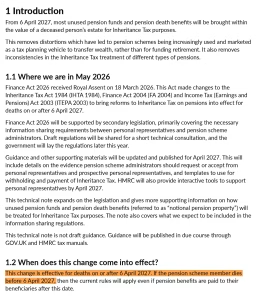
Confirmed pension inheritance tax changes from 6 April 2027.
Can Beneficiaries Face Both Inheritance Tax and Income Tax on Pensions?
Potentially, yes.
Inheritance tax and income tax are different taxes, with different rules.
The inheritance tax reform affects whether unused pension wealth forms part of an estate.
Separately, the income tax treatment of inherited pensions can depend on the member’s age at death, the type of pension benefit, the recipient and how benefits are withdrawn.
Where inherited pension benefits are subject to income tax, a beneficiary may face income tax on the taxable amount after allowing for applicable relief associated with inheritance tax already borne on those benefits.
This creates the possibility of a substantial combined tax burden.
For example, if a pension amount bears inheritance tax at 40% and the remaining taxable benefit is later subject to income tax at a marginal rate of 45%, the combined effective tax burden on that amount can theoretically reach:
40% + (60% × 45%) = 67%.
That is an illustrative maximum-rate scenario, not a universal inheritance tax rate.
Many beneficiaries will face a lower combined burden or no inheritance tax at all, depending on their circumstances.
The important point is that simply withdrawing pension savings before death is not automatically a tax-saving strategy. Withdrawals may trigger income tax, and retaining the money as cash or investments can still leave it within an individual’s estate.
Anyone considering changes to pension withdrawals should weigh income tax, retirement income needs and inheritance tax together.
For more background on wider pension policy, see the analysis of Rachel Reeves’ pension changes.
What Did the October 2026 Budget Change About Inheritance Tax?
The Budget delivered on 28 October 2026 did not reverse the central agricultural and business relief reforms or the scheduled April 2027 pension inclusion.
However, it introduced further measures affecting the administration and operation of inheritance tax.
1. Changes to Inheritance Tax Liabilities in Trusts
The government announced proposals to clarify how liabilities incurred by trustees are treated when calculating inheritance tax.
The objective is to prevent certain arrangements from using debt or liabilities to reduce inheritance tax charges in circumstances not intended by the existing legislation.
The announced provisions are intended to apply to relevant chargeable events from 28 October 2026, subject to the Finance Bill 2026–27.
This is important for families using complex trusts or estate-planning structures.
Ordinary, genuine liabilities may still be deductible where the legal conditions are satisfied, but arrangements intended to obtain inappropriate deductions may face greater restrictions.
2. Further Administration Changes for Inherited Pensions
The Budget also announced technical measures intended to make pension inheritance tax collection more workable.
These include provisions allowing prospective personal representatives to direct pension scheme administrators to pay inheritance tax to HMRC where certain conditions are satisfied.
Additional changes concern how pension property is treated when calculating the reduced inheritance tax rate for qualifying charitable gifts.
The measures are planned to operate alongside the main pension reform from 6 April 2027.
3. Existing Tax-Free Thresholds Remain Unchanged
The main inheritance tax thresholds have not been increased for 2027/28.
The nil-rate band remains £325,000, and the residence nil-rate band remains £175,000.
This matters because frozen thresholds can increase the proportion of estates subject to inheritance tax as property and investment values rise over time.
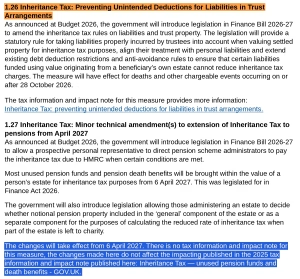
October 2026 Budget inheritance tax announcements.
How Will Inheritance Tax Changes Affect Family Homes?
Homeowners continue to benefit from the residence nil-rate band where the relevant conditions are met.
This allows up to £175,000 of additional tax-free estate value per person where a qualifying residence passes to direct descendants.
For eligible married couples and civil partners, the unused allowance can potentially transfer to the surviving partner’s estate.
However, the additional allowance starts reducing when an estate’s relevant net value exceeds £2 million.
For every £2 above the threshold, the available residence nil-rate band reduces by £1.
For example, consider a single person’s estate worth £2.2 million with a full £175,000 residence nil-rate band otherwise available.
The estate exceeds the £2 million threshold by £200,000.
The residence allowance reduces by £100,000, leaving only £75,000 available.
By £2.35 million, an individual £175,000 residence nil-rate band would be fully tapered away.
Where a deceased spouse’s unused residence allowance is transferred, the combined allowance and tapering calculation can differ.
Another complication is that the value used when considering the residence nil-rate band taper is calculated before deducting Business Relief or Agricultural Relief.
Therefore, an estate containing substantial qualifying business or agricultural assets might lose some residence nil-rate band even though those assets attract significant inheritance tax relief.
Families with substantial property and business holdings should avoid assuming these allowances operate independently.
For a more detailed explanation of transferred allowances, the rules governing inheritance tax when the second parent dies are particularly relevant.
Can Families Reduce Inheritance Tax by Giving Money Away Before Death?
Lifetime gifting remains an important element of legitimate inheritance tax planning.
However, gifts must be assessed under the relevant exemptions and the seven-year rule.
The main annual exemption permits an individual to give away up to £3,000 each tax year without that amount being added to their estate for inheritance tax.
An unused annual exemption may be carried forward for one tax year only.
Other exemptions can apply to small gifts, wedding gifts and regular gifts made from surplus income.
| Type of gift | General inheritance tax treatment |
| Annual gifts | Up to £3,000 per donor each tax year |
| Small gifts | Up to £250 per recipient each year, subject to conditions |
| Wedding gift to a child | Up to £5,000 |
| Wedding gift to a grandchild or great-grandchild | Up to £2,500 |
| Wedding gift to another person | Up to £1,000 |
| Normal expenditure from income | Potentially exempt without a fixed monetary cap if strict conditions are met |
| Larger outright gifts | Generally subject to the seven-year rule |
How Does the Seven-Year Rule Work?
An outright gift to an individual is normally outside the donor’s estate for inheritance tax if the donor survives for seven years, assuming no reservation of benefit or other special complication.
Where a donor dies within seven years, the gift may use some or all of their available nil-rate band.
Taper relief can reduce inheritance tax on certain gifts made more than three years before death, but only where the relevant taxable gifts exceed the available nil-rate band.
It does not automatically reduce tax on the entire estate.
| Time between gift and death | Potential inheritance tax rate on the chargeable gift |
| Less than 3 years | 40% |
| 3–4 years | 32% |
| 4–5 years | 24% |
| 5–6 years | 16% |
| 6–7 years | 8% |
| 7 years or more | Usually 0% |
A particularly important restriction concerns gifts with reservation of benefit.
For example, a parent who gives their house to an adult child but continues to live in it rent-free may find that the property remains relevant to their estate for inheritance tax.
Gifting property can also create capital gains tax, stamp duty or other consequences depending on the circumstances.
Our assessment is that gifting should form part of a documented long-term financial plan rather than an emergency measure taken shortly before death.
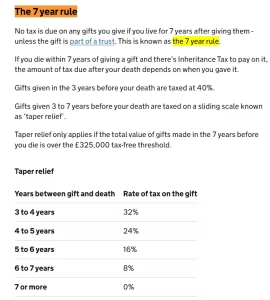
UK inheritance tax gifting allowances and seven-year taper relief.
Do Trusts Still Help With Inheritance Tax Planning in 2027?
Trusts remain a legitimate estate-planning tool, but they are not automatically exempt from inheritance tax.
Depending on the type of trust and the assets transferred, inheritance tax can potentially apply when property is placed into a trust, at periodic anniversaries, when assets leave the trust or when relevant individuals die.
Some transfers into trusts can face a lifetime inheritance tax charge of 20% on the chargeable excess over available allowances, while relevant-property trusts can be subject to periodic and exit charges.
Different rules apply to different trust arrangements.
The new £2.5 million business and agricultural relief allowance also interacts with certain trusts holding qualifying property.
Trusts established before the original October 2024 announcement may be subject to transitional provisions.
The October 2026 Budget added a further reason to review trust structures because of the proposed restrictions on certain liabilities used to reduce inheritance tax.
For entrepreneurs, a trust can help manage succession, protect assets and define how beneficiaries receive wealth.
However, transferring company shares, commercial property or investments into a trust should not be treated as a guaranteed way to eliminate inheritance tax.
A specialist review should consider ownership, control, income requirements, capital gains tax, trust administration and the relevant inheritance tax charges together.
How Should Startup Founders Prepare for Inheritance Tax in 2027?
Startup founders often accumulate wealth differently from traditional property owners.
Their estates may contain valuable company shares, pension savings, investments, intellectual property and cash from previous business disposals.
Some of these assets can qualify for Business Relief, while others may not.
We consider the following areas especially important for founders and company directors.
- First, establish a defensible company valuation: A founder’s equity may become significantly more valuable following investment, acquisitions or sustained growth. A valuation suitable for a funding discussion is not necessarily the same as the value required for inheritance tax.
- Second, confirm whether the company qualifies for Business Relief: A trading company can have different treatment from a company primarily holding investments or property.
- Third, model the company’s succession position: Shareholder agreements, wills and company articles should be reviewed together to establish who can inherit shares and how control will pass.
- Fourth, assess pension exposure: The April 2027 rules mean that unused pensions should be considered alongside other estate assets.
- Fifth, examine available liquidity: A business can be profitable without holding enough cash to fund a significant inheritance tax bill.
- Sixth, review the consequences of any planned business sale: Cash generated by selling qualifying shares may not benefit from the same inheritance tax treatment.
- Seventh, revisit the financial plan regularly: Growth in company value can materially change inheritance tax exposure even when the founder’s personal salary remains unchanged.
Directors should also consider how dividend taxation influences decisions about extracting earnings, building pension savings and retaining wealth within a company.
These are separate tax issues, but they can affect the overall financial outcome of a succession strategy.
Can Businesses Pay Inheritance Tax Over 10 Years?
One important feature of the April 2026 reforms is the extension of interest-free instalment arrangements for inheritance tax attributable to eligible agricultural and business property.
Qualifying liabilities can be paid in equal annual instalments over 10 years, subject to the relevant requirements.
This can help families that inherit valuable trading assets but lack sufficient immediate cash.
For example, consider a family business estate with an inheritance tax liability of £200,000 attributable entirely to qualifying property eligible for the instalment treatment.
If the full amount qualifies, a simple equal-payment illustration would be £20,000 per year over 10 years.
The actual timing, eligibility and payment requirements must be checked.
Certain changes in circumstances, including disposal of relevant assets, can affect how an instalment arrangement operates.
We consider this particularly relevant to businesses with substantial assets but limited cash reserves.
The instalment facility does not eliminate the inheritance tax bill. It changes the funding profile.
Owners should model the potential impact on working capital, borrowing capacity and future investment.
For some businesses, understanding financing costs through a business loan calculation may support initial comparison of funding options, although an interest-free inheritance tax instalment arrangement should be evaluated separately before considering commercial borrowing.
Which Families and Businesses Are Most Exposed to the 2027 Changes?
The reforms do not affect every household equally.
We have assessed the likely planning priorities by examining asset composition, relief eligibility, liquidity and the timing of the legislative changes.
The following percentages are editorial planning-priority ratings, not official HMRC risk probabilities or survey results.
| Estate or ownership profile | Our planning-priority rating | Main concern |
| High-value estate with substantial unused pension funds | 95% | Pension inclusion from April 2027 |
| Trading business exceeding £2.5m of qualifying value | 90% | Reduced relief on excess assets |
| Agricultural estate with limited cash reserves | 90% | Tax funding and succession |
| Estate above £2m containing a qualifying family home | 85% | Residence allowance taper |
| Founder planning a major company sale | 85% | Changing asset and relief eligibility |
| Family relying on lifetime gifts or trust arrangements | 80% | Documentation and tax treatment |
| Estate well below available tax-free allowances | 30% | Mainly record-keeping and future asset growth |
Our interpretation is that families holding substantial pensions and businesses should review their plans first, particularly where several forms of wealth are held together.
However, a low-value estate can still require professional advice where unusual gifts, trusts, overseas assets or complicated ownership arrangements exist.
What Do the Changes Mean for the Wider UK Economy?
Inheritance tax reform has become a broader business-policy issue because it affects capital ownership, investment decisions and intergenerational succession.
Supporters of the reforms argue that preferential treatment for particular forms of wealth can create unfair differences between taxpayers.
From this perspective, agricultural and business assets should not always receive unlimited tax relief while other forms of inherited wealth face inheritance tax.
Opponents argue that the reforms can create additional financial pressure on trading businesses whose value is tied up in productive assets rather than liquid investments.
The main areas of disagreement concern whether the policy will affect business investment, employment, succession decisions and the ability of families to retain ownership.
The House of Commons debate and industry responses also show why the increase in the relief threshold from £1 million to £2.5 million was financially significant.
It reduced potential exposure for many qualifying estates compared with the original proposal, although it did not remove the policy’s impact on larger holdings.
Our analysis suggests that the long-term economic outcome depends on more than headline tax revenue.
It also depends on how affected businesses respond, whether they retain investment capacity and whether succession planning allows productive assets to remain commercially viable.
Earlier industry forecasts of job losses and investment reductions should not automatically be applied to the revised £2.5 million threshold because they may have been modelled against the original proposals.
A reliable assessment needs to distinguish between economic forecasts, business survey findings and the actual outcomes observed after implementation.
What Should Families Do Before April 2027?
The next stage of inheritance tax planning should focus on getting accurate information rather than making rushed changes.
We recommend reviewing the following before the April 2027 pension rules take effect:
- Calculate the current net value of the estate, including relevant property, savings, investments and business interests.
- Obtain up-to-date valuations of significant business and agricultural assets.
- Identify all pension arrangements and confirm their nominated beneficiaries and death-benefit provisions.
- Review wills, shareholder arrangements and existing trusts.
- Check the ordinary and residence nil-rate bands, including any transferable allowances from a deceased spouse or civil partner.
- Review significant lifetime gifts, dates and supporting records.
- Model potential inheritance tax bills both before and after the pension changes.
- Consider whether the estate or business has sufficient liquidity to meet foreseeable tax liabilities.
- Seek regulated financial, tax or legal advice before making substantial gifts, asset transfers or pension withdrawals.
The most effective estate plans are built around the full financial position of the family, rather than any single allowance or tax-saving method.
What Is Our Overall Assessment of the Inheritance Tax Changes for 2027?
The changes introduced under Rachel Reeves have created a more restrictive inheritance tax environment for some larger estates, particularly those holding qualifying business assets and unused pension funds.
However, the increase in the agricultural and business relief allowance to £2.5 million significantly reduced the impact of the initial proposal on many family businesses.
The standard 40% inheritance tax rate remains unchanged, and the £325,000 nil-rate band and £175,000 residence nil-rate band remain available subject to their conditions.
For 2027, the most important development is the inclusion of most unused pension funds in inheritance tax calculations from 6 April.
Our central finding is that the interaction between pensions, business assets, property and transferable allowances matters more than any individual headline tax rate.
For households with modest estates, the existing thresholds and exemptions may continue to prevent inheritance tax from arising.
For wealthier families and entrepreneurs, regular valuations, suitable succession arrangements and realistic liquidity planning will become increasingly important.
The objective should not simply be to reduce a future tax bill. It should be to protect financial security, preserve viable businesses and ensure that assets pass to beneficiaries in a planned and legally effective manner.
Frequently Asked Questions
What are the new inheritance tax rules for 2027?
From 6 April 2027, most unused pension funds and pension death benefits will be included in a deceased person’s estate for inheritance tax purposes. The business and agricultural relief changes introduced in April 2026 also continue to apply.
Will inheritance tax increase to 50% in 2027?
No. The standard inheritance tax rate remains 40% for 2027/28. The 50% figure associated with business and agricultural property refers to the percentage of eligible asset value receiving relief above the £2.5 million allowance, not a new 50% inheritance tax rate.
How much can children inherit tax-free in 2027?
An individual can generally have a £325,000 nil-rate band and an additional residence nil-rate band of up to £175,000 where qualifying conditions are met.
Eligible married couples and civil partners may be able to combine unused allowances to reach £1 million. The final figure depends on the estate and the applicable rules.
Are pension funds subject to inheritance tax from April 2027?
Most unused pension funds and pension death benefits will be included in estates for inheritance tax purposes when the pension member dies on or after 6 April 2027. Certain benefits and exempt transfers are excluded.
Will farmers pay 40% inheritance tax on farms worth more than £2.5 million?
Not automatically. The combined qualifying agricultural and business property allowance permits 100% relief on up to £2.5 million per individual, generally followed by 50% relief on eligible excess value. Ordinary nil-rate bands and other applicable exemptions can further affect the final liability.
Can married couples transfer their inheritance tax allowances?
Yes, qualifying spouses and civil partners can transfer unused standard nil-rate bands and residence nil-rate bands. Unused agricultural and business property 100% relief allowances can also potentially transfer, subject to the relevant rules and claims.
Can inheritance tax be avoided by giving assets to children before death?
Certain gifts can reduce a taxable estate, but the seven-year rule, gift exemptions and gift-with-reservation provisions must be considered. Trusts and property transfers may also have other tax consequences. Families should not assume that a transfer automatically eliminates inheritance tax.