
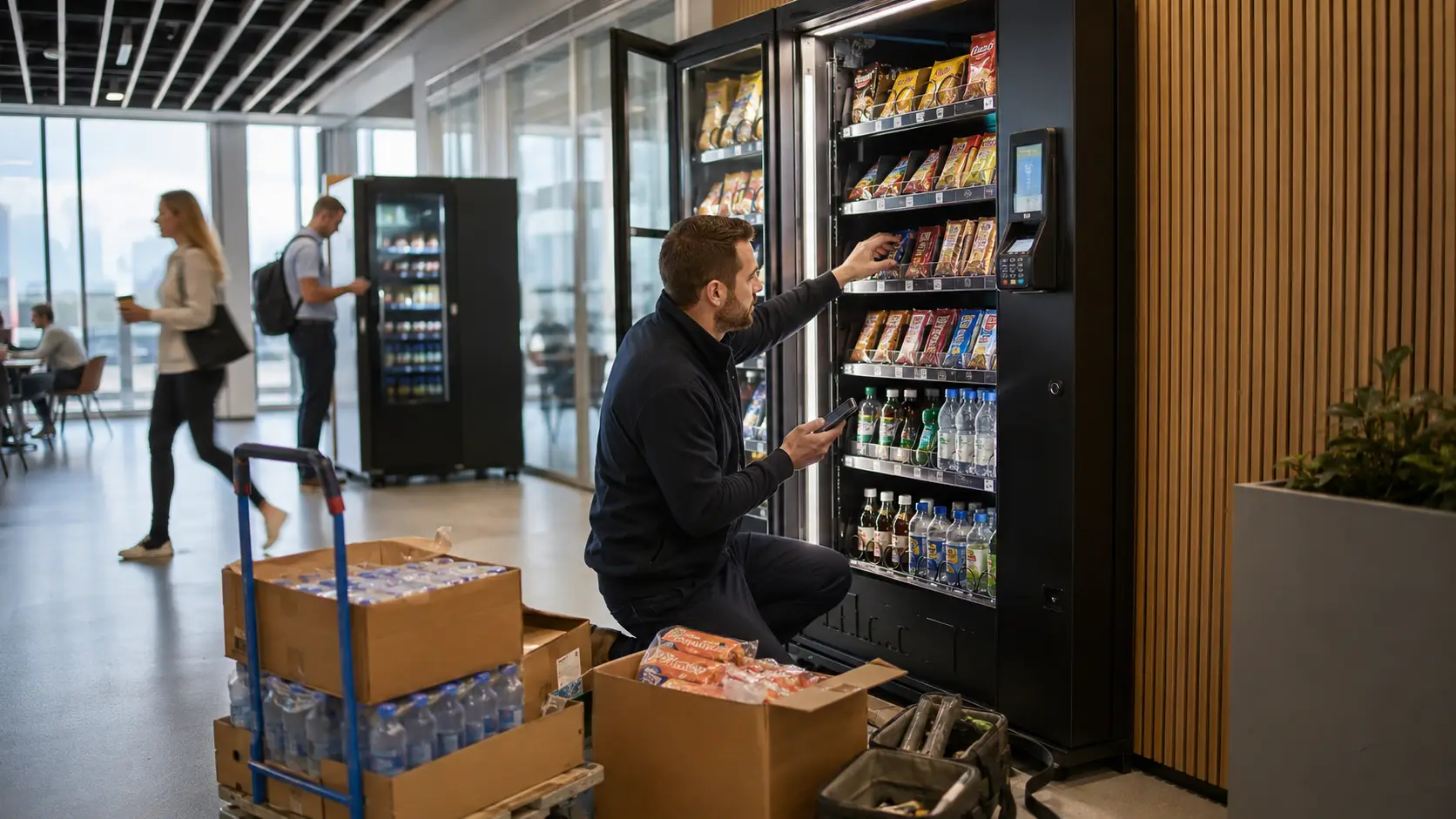
Starting a vending machine business in the UK can be commercially viable, but it is not automatically passive or profitable. Success depends primarily on securing high-quality locations, maintaining reliable machines, controlling stock costs and achieving enough daily sales to cover site commission, payment fees, servicing and travel.
A realistic starting budget for one professionally installed machine is approximately £3,000 to £7,000 for a refurbished setup or £6,000 to £12,000 for a new setup. Larger operators investing in several machines, refrigerated food equipment or smart-fridge technology may need considerably more.
The UK vending, office coffee service and automated retail sector generated approximately £3.78 billion in revenue during 2025, according to reporting based on the latest AVA Census and Market Report. This represented year-on-year growth of around 3.3% and placed the sector above its pre-pandemic revenue level.
Key Takeaways
- A vending machine is an unattended retail outlet, not a guaranteed source of passive income.
- Location quality usually matters more than the number of machines owned.
- A new snack-and-drink machine commonly costs several thousand pounds before stock, delivery and payment equipment.
- Most food vending operators must register their food business with the relevant local authority.
- Tobacco cannot legally be sold from vending machines.
- Cashless payments, telemetry and remote stock monitoring are increasingly standard.
- Break-even can take less than a year at an exceptional site or several years at a weak one.
- Site agreements should always be recorded in writing.
What Is the UK Vending Machine Market Like in 2026?
The modern vending sector includes much more than traditional chocolate and fizzy-drink machines. Operators now use automated retail equipment to sell fresh meals, premium coffee, protein products, personal protective equipment, electronics, beauty products and workplace essentials.
The main market segments include:
- Snack and cold-drink machines
- Hot-drink and bean-to-cup coffee machines
- Refrigerated fresh-food machines
- Healthy and sports-nutrition vending
- Smart fridges and micro-markets
- Non-food retail vending
- Workplace consumables and PPE machines
Cashless capability is particularly important. Reporting based on the AVA’s 2025 Census indicates that approximately 95% of paid vending machines now accept cashless payments, while mobile wallets represent a substantial proportion of digital vending transactions. expect to pay by contactless card, phone or smartwatch. A machine that accepts only coins may therefore lose sales, particularly in offices, universities, hospitals and transport locations.
Is a Vending Machine Business Profitable in the UK?
A vending machine business can be profitable when its sales volume is sufficient to cover both product costs and operating expenses.
Profitability depends on:
- The number of transactions per day
- Average selling price
- Wholesale product cost
- Site rent or commission
- Card-processing fees
- Electricity consumption
- Spoilage and theft
- Restocking time and travel costs
- Maintenance and finance payments
A machine generating £1,500 in monthly sales is not producing £1,500 in profit. Stock alone may consume 40% to 55% of revenue, before commission and operating costs are considered.
Illustrative Monthly Profit Calculation
The following example is a planning model rather than an earnings guarantee.
| Item | Assumption |
| Sales per day | 30 |
| Average transaction | £1.80 |
| Trading days | 30 |
| Monthly revenue | £1,620 |
| Stock cost at 48% | £777.60 |
| Site commission at 12% | £194.40 |
| Payment fees at 2.5% | £40.50 |
| Waste and stock loss at 2% | £32.40 |
| Electricity, telemetry and maintenance reserve | £140 |
| Estimated operating contribution | £435.10 |
The estimated £435.10 is before deducting:
- The owner’s time
- Fuel and vehicle costs
- Insurance
- Loan or lease repayments
- Accountancy costs
- Income Tax or Corporation Tax
Use a unit economics calculator to test different selling prices, margins and transaction volumes before purchasing equipment.
Vending Machine Profit Calculator
Estimate the monthly revenue, operating profit, profit margin and potential break-even period for a UK vending machine.
Monthly calculation breakdown
This calculator provides an illustrative planning estimate and does not guarantee earnings. It excludes Income Tax, Corporation Tax, VAT, loan or lease repayments and the value of the operator’s time unless those amounts are entered under other monthly operating costs. Actual performance will depend on the location, customer demand, selling prices, downtime, stock losses and operating efficiency.
How Much Can One Vending Machine Earn?
There is no dependable national average because vending performance is highly location-specific.
Using an average transaction value of £1.80:
| Daily Transactions | Illustrative Monthly Revenue |
| 10 | £540 |
| 20 | £1,080 |
| 30 | £1,620 |
| 50 | £2,700 |
| 80 | £4,320 |
These figures represent sales, not profit.
A busy distribution centre operating around the clock may outperform a small office that is occupied only three days per week. Equally, a site with high footfall may still perform poorly when customers have easy access to a supermarket, subsidised canteen or free workplace refreshments.
What Are the Best Types of Vending Machines?
Snack and Cold-Drink Machines
Combination machines sell confectionery, crisps, bottled drinks and other packaged products from one cabinet.
They are often suitable for:
- Offices
- Warehouses
- Factories
- Leisure centres
- Student accommodation
- Waiting areas
A combination machine is frequently the most practical starting point because it can test several product categories without requiring two separate machines.
Coffee Vending Machines
Coffee machines may dispense instant drinks, fresh-brew coffee or bean-to-cup beverages.
They work best where customers:
- Remain on site for long periods
- Work early, late or overnight shifts
- Have limited access to cafés
- Value speed and convenience
Coffee can offer an attractive gross margin, but cleaning, ingredient quality, water filtration and maintenance are critical. Poorly maintained milk systems or internal components can create hygiene and reliability problems.
Refrigerated Fresh-Food Machines
These machines can sell sandwiches, salads, wraps, yoghurt, prepared meals and chilled drinks.
Fresh food can increase average transaction value, but it also introduces:
- Shorter shelf lives
- More frequent restocking
- Temperature-control obligations
- Greater spoilage risk
- More complex allergen management
Healthy and Sports-Nutrition Machines
Protein drinks, bars, hydration products, low-sugar snacks and supplements may work well in gyms, universities and health-focused workplaces.
Product selection should be based on customer demand rather than assumptions about what constitutes a healthy range.
Smart Fridges and Micro-Markets
A smart fridge allows customers to unlock a cabinet, remove products and pay automatically. A micro-market normally combines open shelving, refrigeration and self-checkout technology.
These formats can offer a wider selection than conventional vending, but require more space, security and sophisticated stock controls.
Non-Food Vending Machines
Automated machines can also sell:
- Phone chargers and cables
- PPE and workplace equipment
- Toiletries
- Umbrellas
- Flowers
- Books
- Travel accessories
- Beauty products
Non-food vending may avoid some food-safety obligations, although consumer law, electrical safety, product safety and clear pricing requirements still apply.
How Much Does It Cost to Start a Vending Machine Business?

Machine prices vary according to age, condition, capacity, refrigeration, payment hardware, warranty and installation requirements.
Published UK pricing indicates that refurbished machines may begin at around £1,500, while new combination machines commonly cost between approximately £3,500 and £8,000. One current high-capacity combination model has been advertised at £5,595 excluding VAT before optional configurations. ine Startup Budget
| Expense | Estimated Planning Range |
| Refurbished combination machine | £1,500–£3,500 |
| New combination machine | £3,500–£8,000+ |
| Delivery and installation | £150–£600 |
| Cashless reader and telemetry | £300–£800 |
| Initial stock | £250–£800 |
| Branding and signage | £100–£500 |
| Insurance | Obtain individual quotations |
| Cleaning and basic tools | £100–£300 |
| Repair contingency | £500–£1,500 |
A lean refurbished setup may therefore require approximately £3,000 to £7,000. A new, fully equipped machine may require £6,000 to £12,000 or more.
VAT can materially affect the amount paid when purchasing equipment. Operators who are not VAT registered cannot normally reclaim the VAT charged by suppliers.
Should You Buy, Lease or Rent a Vending Machine?
Buying
Purchasing a machine provides ownership and avoids long-term rental payments.
It may be appropriate when:
- The location has already been secured
- Demand has been tested
- Sufficient repair reserves are available
- The machine has a meaningful warranty
- The operator intends to retain the equipment for several years
Leasing
Leasing spreads the equipment cost over an agreed period.
Before signing, check:
- Total payable over the full term
- Interest or finance charges
- Early termination costs
- Maintenance inclusions
- Ownership at the end of the agreement
- Personal guarantees
- Restrictions on moving the machine
A business loan calculator can help compare monthly repayments with the cash contribution expected from the machine.
Renting
Rental may lower the initial commitment and sometimes includes servicing. However, it can cost more over the full operating period.
Do not commit to long-term machine finance before obtaining a signed location agreement.
How Do You Start a Vending Machine Business?
1. Choose a Specific Customer and Location Type
Avoid targeting “anywhere with footfall”. Different locations have different purchasing patterns.
For example:
| Location | Likely Requirements |
| Gym | Protein products, water, low-sugar drinks |
| Office | Coffee, snacks, breakfast products |
| Warehouse | Filling food, energy drinks, 24-hour availability |
| Hospital | Broad choice, allergen clarity, reliable operation |
| Student accommodation | Affordable snacks, drinks and late-night access |
| Hotel | Toiletries, drinks, travel essentials |
| Factory | Fast meals, hot drinks and shift-friendly stock |
The location should determine the machine and stock. Buying a machine first and searching for somewhere to place it later increases financial risk.
2. Validate the Location Before Buying Equipment
Inspect the proposed site and collect evidence about:
- Daily footfall
- Number of employees or visitors
- Opening hours
- Shift patterns
- Existing food and drink options
- Nearby shops
- Security and CCTV
- Mobile signal or internet connectivity
- Electrical supply
- Delivery and restocking access
Ask the site manager whether another vending operator previously used the location and, when possible, why that arrangement ended.
A good site should solve a clear convenience problem. Positive comments alone do not prove that customers will buy regularly—one of the recurring reasons some startups succeed while others fail.
3. Prepare a Site Proposal
A site proposal should explain:
- What machine will be installed
- Its measurements and electrical requirements
- Who owns and insures it
- The proposed product range
- How frequently it will be restocked
- How faults and refunds will be handled
- Whether the site receives rent or commission
- How performance will be reviewed
- Whether the arrangement is exclusive
Offer evidence that the machine will be clean, maintained and professionally managed. Site owners are often more concerned about complaints, mess and breakdowns than the machine’s technical features.
4. Agree the Commercial Terms in Writing
Common site arrangements include:
- No rent where the machine is treated as an employee amenity
- A fixed monthly location fee
- A percentage of gross sales
- A minimum guaranteed payment
- A combined minimum payment and sales commission
The agreement should address:
- Contract length
- Notice period
- Commission calculation
- VAT treatment
- Electricity costs
- Machine ownership
- Damage and vandalism
- Restocking access
- Product restrictions
- Refund responsibilities
- Relocation rights
- Data access
- Removal costs
- Exclusivity
A verbal agreement is difficult to enforce and can leave the operator with financed equipment but no viable place to use it.
5. Choose a Business Structure
Many small operators begin as sole traders because administration is relatively straightforward. A limited company is legally separate from its owner but has additional reporting, accounting and director responsibilities.
Anyone deciding between the two should review the practical implications of registering a business with HMRC and setting up a limited company.
A sole trader with gross trading income above the £1,000 trading allowance will generally need to register for Self Assessment.
ifying sole traders and landlords with annual self-employment and property income above £50,000 are required to use Making Tax Digital for Income Tax, subject to eligibility and exemption rules.
ital incorporation fee increased to £100 on 1 February 2026. Limited companies must also comply with ongoing filing and identity-verification requirements. Business Where Required
Businesses that store, distribute or sell food and drink will normally need to register with the appropriate local authority.
Food-business registration is free and should generally be completed at least 28 days before trading. Operators working across several premises should ask the relevant local authorities which storage, distribution and vending locations must be registered. Requirements and responsible agencies differ in Scotland, England, Wales and Northern Ireland. same as holding a paid vending licence. There is no single UK-wide vending licence covering every ordinary snack-and-drink machine. The required permissions depend on the products, location and way the business operates.
7. Comply With Food Hygiene and Allergen Rules
Food operators are responsible for ensuring that products are:
- Stored at safe temperatures
- Within their use-by or best-before dates
- Protected from contamination
- Traceable to an appropriate supplier
- Labelled correctly
- Withdrawn promptly when recalled
Prepacked products should remain in their original compliant packaging wherever possible.
If an operator prepares or packages food for direct sale, additional ingredient and allergen labelling requirements may apply under Natasha’s Law. The Food Standards Agency provides detailed allergen guidance for food businesses. in:
- Supplier invoices
- Batch and recall information
- Cleaning records
- Temperature records where appropriate
- Expiry-date checks
- Allergen documentation
- Fault and complaint records
8. Understand Product-Specific Restrictions
Certain products should not be treated like ordinary packaged snacks.
Tobacco and Nicotine Products
The sale of tobacco from automatic vending machines is prohibited. It is not simply a matter of obtaining an additional licence. ct 2026 also introduces further controls affecting vaping and nicotine products, including vending-machine restrictions. Operators should check the commencement dates and current regulations before considering any age-restricted product. cohol normally requires an appropriate premises licence, a designated premises supervisor and suitable age-verification controls. An unattended machine creates significant compliance challenges and should not be introduced without specialist licensing advice.
y Drinks
The government has confirmed that sales of high-caffeine energy drinks to children under 16 will be prohibited in England from April 2027. The announced restriction explicitly includes vending machines. Operators placing machines in schools, leisure facilities or other child-accessible sites should prepare their product and age-control policies in advance.
Different licensing rules can apply when hot food is sold during late-night hours. Hot drinks sold directly from customer-operated vending machines may qualify for an exemption, but hot food can be treated differently. Check the local authority’s licensing position before installation. early
The price shown to the customer should be the total amount payable, including applicable taxes and unavoidable charges.
From a practical perspective:
- Display the price beside each selection.
- Ensure the displayed price matches the amount charged.
- Explain any temporary card verification clearly.
- Provide visible refund contact details.
- Do not add an unexpected fee during payment.
Current government and Competition and Markets Authority guidance requires businesses to present total prices clearly and at the appropriate stage of the purchasing decision. With Appropriate Features
Assess:
- Capacity
- Product flexibility
- Refrigeration range
- Energy consumption
- Cashless compatibility
- Telemetry
- Remote pricing
- Stock-level reporting
- Sales reporting
- Warranty
- Parts availability
- Engineer coverage
- Accessibility
- Anti-vandal construction
Request the machine’s service history when buying refurbished equipment. Confirm that the payment system still uses supported mobile connectivity and can receive security or software updates.
11. Find Reliable Stock Suppliers
Potential supply channels include:
- Cash-and-carry wholesalers
- Food-service distributors
- Specialist vending wholesalers
- Direct manufacturer accounts
- Local bakeries and fresh-food suppliers
Compare the cost per unit after including:
- VAT
- Delivery charges
- Minimum-order quantities
- Promotional discounts
- Short-dated stock
- Damaged-product allowances
- Storage requirements
Do not buy excessive stock merely to obtain a lower unit price. Unsold inventory ties up cash and increases expiry risk.
Entrepreneurs working with a restricted budget may benefit from principles used when starting a business with limited funds, such as testing demand before committing substantial capital.
12. Set Prices From Costs, Not Competitors Alone
Calculate the full cost of each sale:
Selling price − product cost − site commission − payment fee − wastage allowance = contribution per sale
Suppose a drink costs £0.72 and sells for £1.80:
| Calculation | Amount |
| Selling price | £1.80 |
| Product cost | £0.72 |
| Site commission at 12% | £0.22 |
| Payment fee at 2.5% | £0.05 |
| Waste allowance at 2% | £0.04 |
| Contribution before fixed costs | £0.77 |
That £0.77 must contribute towards electricity, telemetry, servicing, insurance, travel, finance and owner remuneration.
13. Install, Test and Launch the Machine
Before launch:
- Secure the machine correctly.
- Check electrical safety.
- Test every selection.
- Test card and mobile-wallet payments.
- Confirm that prices match the payment screen.
- Check refrigeration temperatures.
- Add refund contact details.
- Photograph the installation.
- Record initial stock.
- Confirm remote monitoring.
- Explain fault reporting to the site manager.
Avoid filling every product column immediately. Begin with a focused range and use sales data to refine the assortment.
14. Monitor Performance Every Week
Track:
- Sales by product
- Sales by day and hour
- Gross margin
- Stockouts
- Expired stock
- Refunds
- Machine downtime
- Card-reader failures
- Restocking time
- Mileage
- Site commission
- Cash contribution per visit
Remove products that sell slowly unless they provide essential variety. Increase capacity for products that repeatedly sell out.
A strong vending route minimises travel while maintaining high availability. Adding distant low-performing machines can increase revenue while reducing overall profit.
What Are the Best Vending Machine Locations?
The best location has a combination of demand, limited alternatives and reliable access.
Offices
Offices can work well when they have sufficient daily occupancy. Hybrid working should be assessed carefully because total headcount may be much higher than the number of people normally present.
Warehouses and Factories
Industrial locations can be attractive because of shift work, long opening hours and limited nearby retail. Filling products and hot drinks may perform better than impulse confectionery alone.
Hospitals and Healthcare Sites
Hospitals provide long operating hours and diverse customer groups, but procurement, fire safety, nutrition policies and contractual requirements can be demanding.
Gyms and Leisure Centres
Gyms may support protein products, water, sports drinks and healthier snacks. Avoid assuming every gym customer wants premium nutrition products; test demand by price point.
Universities and Student Accommodation
These sites can provide long hours and repeat customers. Tendering rules, seasonal occupancy and institutional nutrition policies may apply.
Transport Locations
Stations and airports offer substantial footfall but frequently involve formal procurement, high commissions, security requirements and competition from established operators.
Hotels and Residential Developments
Machines selling drinks, snacks, toiletries and chargers can meet late-night demand where nearby shops are closed.
How Do You Approach a Business About Installing a Machine?
A concise proposal should focus on the site’s needs rather than on the operator’s desire to place equipment.
Explain:
- The customer problem being solved
- The proposed product range
- The machine’s appearance and footprint
- Service frequency
- Fault-response process
- Financial offer
- Trial period
- References or previous performance
Where no trading history exists, consider offering a three-month trial with agreed performance criteria and a straightforward removal clause.
What Insurance Does a Vending Business Need?
Insurance requirements depend on the business model and contract.
Common covers include:
- Public liability insurance
- Product liability insurance
- Equipment and stock insurance
- Business interruption insurance
- Commercial vehicle insurance
- Employers’ liability insurance
- Cyber or data cover for connected systems
Employers’ liability insurance is generally compulsory when a business employs staff, subject to limited exemptions. Public liability insurance is not universally mandatory, but many property owners require it contractually.
Do not rely on generic online premium estimates. Insurers will consider machine values, products, locations, turnover, claims history and security arrangements.
When Must a Vending Business Register for VAT?
A business generally needs to register for VAT when its taxable turnover exceeds £90,000 over a rolling 12-month period or when it expects to exceed the threshold within the relevant forward-looking period.
Voluntary registration is possible below the threshold, but it changes pricing, reporting and record-keeping obligations. tration is advantageous depends partly on:
- Whether customers are consumers or VAT-registered businesses
- The VAT paid on machine purchases
- Expected turnover
- Product VAT treatment
- Administrative capacity
Food and drink VAT can be complex. Seek advice from a qualified accountant rather than assuming that every vending product has the same VAT treatment.
How Long Does It Take to Break Even?
Break-even should be calculated from actual cash contribution rather than revenue.
Break-even period = total startup investment ÷ monthly cash contribution
Using a £5,500 initial investment and the earlier assumptions:
| Transactions Per Day | Monthly Revenue | Estimated Contribution | Approximate Break-Even |
| 15 | £810 | £148 | 37 months |
| 30 | £1,620 | £435 | 13 months |
| 50 | £2,700 | £819 | 7 months |
These figures exclude owner labour, tax, vehicle costs and finance repayments. A lower-performing machine can take much longer to repay its investment or may never recover its full cost.
Claims that every vending machine breaks even within 6 to 18 months should therefore be treated cautiously.
Should You Buy a Vending Franchise?
A franchise can provide equipment, branding, training, products and an operating system. In return, the franchisee may pay an initial fee, ongoing charges or product mark-ups and operate within contractual restrictions.
Current examples include:
| Franchise | Model | Publicly Advertised Entry Information |
| Tubz Brands | Confectionery and tower vending | Packages advertised from approximately £4,000; verify current terms directly |
| Snack in the Box | Workplace vending route | Official site advertises a £20,500 package plus VAT |
Snack in the Box states that its package includes vending equipment, training, a territory and customer-location support. Tubz promotes a lower-cost tower-vending model. Availability and package terms can change, so neither should be treated as an automatic recommendation. eak to several current and former franchisees.
- Request full earnings evidence.
- Confirm whether projected figures are gross or net.
- Check territory exclusivity.
- Review compulsory supplier pricing.
- Understand renewal and resale rights.
- Identify every ongoing fee.
- Have the agreement reviewed by a franchise solicitor.
- Verify company status at Companies House.
The British Franchise Association recommends thorough due diligence, including speaking to franchisees and obtaining specialist review of the franchise agreement.
ations with the broader risks and benefits of UK franchise business opportunities before committing funds.
How Can You Reduce Startup Risk?
The most effective methods are:
- Secure the site first. Do not finance a machine based solely on a possible location.
- Start with one machine. Validate sales and servicing requirements before expanding.
- Buy with a warranty. Cheap unsupported equipment can create expensive downtime.
- Use cashless telemetry. Remote data reduces unnecessary visits and stockouts.
- Negotiate a trial period. Test the site before accepting a long-term commitment.
- Maintain a repair reserve. A machine that cannot take payments cannot generate revenue.
- Model downside performance. Calculate the outcome at 10, 20 and 30 daily sales.
- Keep routes compact. Travel time can destroy the economics of low-volume machines.
- Review each site regularly. Relocate persistently weak machines where the contract permits.
- Scale from evidence. Follow the same financial and operational discipline required when scaling a business without losing quality.
Is a Vending Machine Business Worth Starting in 2026?
A vending machine business may be worth starting when the operator has:
- Access to a credible location
- Enough capital to absorb repairs and slow initial sales
- A realistic understanding of margins
- Time to restock and maintain equipment
- Reliable suppliers
- A clear site agreement
- Appropriate food-safety controls
- A plan for measuring performance
It is less suitable for anyone seeking guaranteed passive income or buying equipment without first validating demand.
A well-managed vending route can become scalable because each additional machine uses similar purchasing, monitoring and servicing processes. However, expansion should follow proven location economics rather than optimistic revenue forecasts.
Frequently Asked Questions
Do I Need a Licence for a Vending Machine in the UK?
There is no single licence covering every ordinary vending machine. Food-business registration, premises permission, allergen rules, product restrictions and local licensing requirements may apply depending on what is sold and where the machine operates.
Do I Need to Register a Vending Machine as a Food Business?
Businesses selling or distributing food and drink will normally need to register with the appropriate local authority at least 28 days before trading. Ask the local authority which premises and vending locations should be included.
How Much Does a Vending Machine Cost in the UK?
A refurbished machine may cost approximately £1,500 to £3,500, while a new combination machine can cost around £3,500 to £8,000 or more. Payment hardware, delivery, installation and stock are normally additional.
How Much Money Can One Vending Machine Make?
Revenue depends on transaction volume and average selling price. At 30 daily transactions averaging £1.80, monthly revenue would be approximately £1,620 before stock, commission and operating costs.
Is Vending-machine Income Passive?
Not entirely. Operators must find locations, purchase stock, refill machines, check expiry dates, clean equipment, process refunds, resolve faults and maintain site relationships. Telemetry can reduce administration but does not eliminate operational work.
Can I Put a Vending Machine Anywhere?
No. Permission from the property owner or authorised occupier is required. Planning, electrical, fire-safety, procurement or licensing requirements may also apply at certain sites.
Can Vending Machines Sell Cigarettes?
No. Tobacco sales from automatic vending machines are prohibited.
Can Vending Machines Sell Energy Drinks?
They can currently sell legally permitted energy drinks, subject to site policies and existing product rules. England will prohibit sales of qualifying high-caffeine energy drinks to under-16s from April 2027, including sales through vending machines.
Is Cashless Payment Necessary?
It is not always legally required, but it is commercially important. Most paid UK vending machines now support cashless transactions, and many customers expect contactless and mobile-wallet payment.
Is It Better to Start Independently or Buy a Franchise?
Independent operation provides greater control over pricing, products and suppliers. A franchise may offer training, equipment and an established system but introduces fees and contractual restrictions. Compare total costs and speak to existing franchisees before deciding.
How Many Machines Should a Beginner Buy?
Starting with one professionally supported machine is usually safer. Add further machines only after the first location demonstrates reliable sales, manageable servicing requirements and positive cash contribution.