

Starting a travel agency in the UK requires more than finding holiday deals and building a booking website.
Before accepting customer payments, entrepreneurs must understand whether they need a travel agent licence, how ATOL protection works, what ABTA membership provides and which financial obligations apply to their business model.
The important distinction is that the UK does not require every travel agent to obtain a general travel agent licence.
However, businesses organising certain flight-inclusive packages, selling flights or independently retailing National Rail tickets may need specific authorisation or a legally recognised exemption.
In October 2026, licensing decisions have become particularly important because new package-travel regulations are scheduled to take effect on 6 April 2027.
Our analysis of current regulatory requirements and published industry commentary also indicates that the biggest financial challenge is not always the application fee.
It is maintaining sufficient working capital, meeting financial-protection obligations and operating profitably while customer bookings fluctuate.
Key Takeaways
- General travel agent licence: Not universally required in the UK.
- ATOL: Required for licensable air-travel sales unless a recognised exemption applies.
- Small Business ATOL: New application fee of £1,538 under the April 2026 fee schedule.
- ABTA membership: Voluntary, although relevant financial protection remains compulsory for qualifying packages.
- Rail licence: Required for businesses undertaking certain direct National Rail retailing activities.
- 2027 changes: Revised package-travel rules begin on 6 April 2027.
Do You Need a Travel Agent Licence to Start a Business in the UK?
No. There is no single government-issued travel agent licence that every UK travel agency must obtain before starting.
The legal requirements depend on the products sold, the business’s contractual responsibilities and whether the agency acts as an intermediary or a travel organiser.
For example, a travel consultant arranging holidays as an authorised agent for an established ATOL holder may not require a separate ATOL of their own.
However, an independent operator creating and selling flight-inclusive packages in its own name generally needs an appropriate ATOL unless an exemption applies.
| Travel business activity | Is a separate licence required? | Main requirement |
| Travel consultant working for an agency | Usually no personal licence | Employer training and compliance |
| Agent selling packages for an ATOL holder | Not normally a separate ATOL | Valid agency arrangements |
| Independent flight-inclusive package organiser | Generally yes | ATOL authorisation |
| Non-flight package organiser | Not generally ATOL | Qualifying insolvency protection |
| Hotel-only booking intermediary | Usually no general travel licence | Consumer and agency obligations |
| Corporate National Rail ticket retailer | Relevant rail authorisation | Rail Delivery Group licence |
| Home-based travel agent | Depends on services | Same rules as other agencies |
One of the most common misunderstandings is assuming that every business using the word travel agent has identical licensing obligations.
From a financial perspective, identifying the correct legal role before launching can prevent unnecessary application costs while ensuring that customer protection is not overlooked.
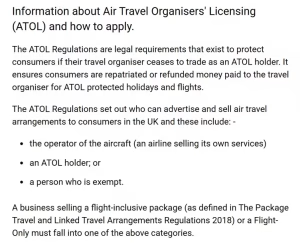
Official Civil Aviation Authority guidance explaining which air-travel sellers require ATOL authorisation and which exemptions may apply.
What Is an ATOL Licence and How Does It Protect Customers?
ATOL stands for Air Travel Organisers’ Licensing. It is a statutory financial-protection scheme administered by the UK Civil Aviation Authority.
Its purpose is to protect eligible customers when an ATOL holder becomes insolvent.
Depending on the circumstances, ATOL protection may provide refunds for protected bookings that cannot proceed or assistance with completing a trip and returning home.
Importantly, ATOL protection is not the same as travel insurance.
Travel insurance may cover selected medical emergencies, cancellations or other insured risks. ATOL addresses particular financial consequences of an ATOL holder’s failure.
Which Businesses Need ATOL?
ATOL requirements can apply to businesses selling:
- Flight-inclusive package holidays in their own name.
- Flight-only arrangements that fall within ATOL licensing rules.
- Other qualifying air-travel arrangements offered to UK consumers.
However, the law also provides exemptions, including certain arrangements involving authorised agents of ATOL holders, accredited bodies and airline ticket agents.
Selling a holiday containing a flight does not automatically mean the retail agent must personally hold ATOL authorisation.
The contractual relationship determines whether the business is operating as a principal, a disclosed agent or under another recognised arrangement.
Does an ATOL Certificate Need to Be Issued?
For a qualifying ATOL-protected booking, the customer must receive the appropriate ATOL Certificate.
This identifies the ATOL protection associated with the transaction and the responsible licence holder.
Travel businesses should ensure that customer documents, website descriptions, payment confirmations and contractual terms accurately reflect who provides the protection.
Using another company’s ATOL number without a valid authorisation arrangement is not an acceptable substitute for compliance.
What Types of ATOL Licences Are Available in 2026?
The CAA provides several ATOL arrangements to accommodate different operating structures.
Our examination of the options suggests that choosing the correct category is particularly important for founders who want to minimise financial exposure during their first year.
| ATOL arrangement | New application fee | Suitable for |
| Standard ATOL | £2,606 plus 16.35p per authorised passenger/seat | Independent operators requiring broader capacity |
| Small Business ATOL | £1,538 | Smaller operators within specified limits |
| Franchise ATOL, under 1,001 passengers | £981 | Qualifying franchise members |
| Trade ATOL | £2,606 plus 16.35p per authorised passenger/seat | Operators selling to other ATOL holders |
| Accredited-body arrangement | Provider-dependent | Businesses meeting the accredited body’s requirements |
These are new-application charges under the CAA’s fee schedule effective from 1 April 2026, not the total costs of running a licensed business.
Small Business ATOL
The Small Business ATOL, commonly called SBA, is designed for qualifying smaller operators.
The relevant CAA conditions include:
- An annual limit of 500 licensable passengers.
- A maximum of £1 million in annual licensable revenue.
- A minimum £50,000 bond.
- Financial and personal fitness assessments.
- A minimum £30,000 paid-up share capital requirement for limited companies.
- A £1,250 advance ATOL Protection Contribution payment.
The licence is subject to restrictions, including the specified passenger and revenue limits for a minimum initial period.
A £50,000 bond should not be confused with a £50,000 application fee. Nevertheless, arranging a bond may require security, collateral, financing capacity or guarantees.
Similarly, paid-up share capital is business capital, not money paid to the regulator as a licence charge.
These distinctions make an enormous difference when estimating startup costs.
Standard ATOL
Standard ATOL is more appropriate where an operator needs broader trading capacity and can satisfy the associated financial conditions.
The CAA identifies a bond requirement of 15% of licensable revenue, subject to a £50,000 minimum, alongside other applicable financial criteria.
Consequently, a larger operation can face financial commitments substantially beyond its application charge.
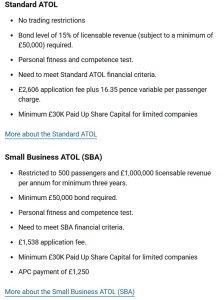
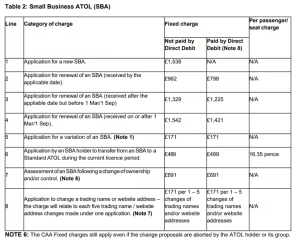
Official 2026 ATOL licence categories, application charges and financial requirements published by the Civil Aviation Authority.
How Much Does a Travel Agent Licence Cost in the UK?
The cost varies considerably depending on whether an entrepreneur works under an existing licensed business, establishes an independent agency or becomes a package organiser.
A home-based booking consultant may spend relatively little on business establishment compared with an independent ATOL holder.
However, the lowest advertised joining fee is not necessarily the lowest total business cost.
Breakdown of Important Costs
| Expense | Amount or pricing basis | Financial consideration |
| Limited company incorporation | £100 online | Statutory company-registration fee |
| New Small Business ATOL | £1,538 | Non-refundable application charge |
| New Standard ATOL | £2,606 plus relevant passenger charge | Depends partly on licensed capacity |
| SBA advance APC | £1,250 | Advance contribution, not a separate licence fee |
| SBA bond | Minimum £50,000 | Financial security, not necessarily an upfront cash payment |
| SBA company share capital | Minimum £30,000 | Capital requirement for qualifying limited companies |
| ABTA membership | Individually assessed fees | Depends on eligibility and arrangements |
| Rail Travel Agents Licence | £300 plus VAT | Relevant for qualifying direct rail retailers |
| ICO data protection fee | Commonly £52 or £78 annually where payable | Exemptions may apply |
| Website, software and marketing | Variable | Depends on operating model |
The figures illustrate why founders should separate three different categories:
- Regulatory fees: are amounts paid to apply for or maintain authorisation.
- Financial security requirements: establish protection for potential liabilities and may involve bonds, guarantees, insurance or trust arrangements.
- Operating costs: include subscriptions, marketing, staff, technology, professional services and customer support.
Confusing these categories can produce an unrealistic startup budget.
For entrepreneurs comparing capital requirements, the real cost of running a UK startup provides broader context on how recurring expenses affect business sustainability.
How Do You Apply for a Travel Agent Licence and ATOL in the UK?
Businesses requiring their own ATOL must apply through the CAA’s application system.
The process involves more than completing a registration form because the authority evaluates financial suitability, business controls and the competence of the individuals responsible.
Step 1: Identify Your Business Model
Before starting an application, establish whether the business will act as:
- An independent package organiser.
- An agent acting for an existing ATOL holder.
- A franchise member.
- A member of an accredited body.
- A non-flight package organiser.
This initial decision determines which authorisations and financial arrangements may be necessary.
Step 2: Prepare the Business Structure
Select an appropriate business structure, establish ownership details and prepare the necessary company records.
Limited companies register through Companies House, while sole traders and partnerships have different legal and tax obligations.
For a limited company, directors and relevant people with significant control must meet applicable identity-verification requirements.
Businesses must also maintain their statutory records, including Companies House confirmation statements.
Step 3: Create an ATOL Online Account
Applicants requiring their own licence must register with the CAA’s online application service.
The application generally requires business information, proposed travel activities, passenger projections and financial documentation.
Step 4: Submit Financial Information
The CAA assesses the applicant’s financial position.
For startups, this can include a certified opening balance sheet and financial projections covering at least 12 months.
The authority may also assess the owners’ fitness and competence, proposed financing and financial security arrangements.
Step 5: Complete Assessments and Training
A director or partner may be required to complete the ATOL Accountable Persons online course.
A formal meeting with the CAA is normally part of the process.
Applicants should be prepared to explain the business’s financial assumptions, operational arrangements, customer-money handling and ability to meet its obligations.
Step 6: Meet the Licence Conditions
After assessment, the CAA may issue a formal decision setting out the requirements that must be satisfied before the licence is granted.
Businesses must complete these requirements before operating in a way that requires the authorisation.
The CAA indicates that applications take around 12 weeks on average to reach a decision, although individual cases vary.
Entrepreneurs should therefore avoid committing to launch dates or accepting licensable bookings before the appropriate authorisation is in place.
What Is the Difference Between an ATOL Licence and ABTA Membership?
ATOL and ABTA are frequently mentioned together, but they do not perform identical functions.
ATOL is a statutory licensing and financial-protection scheme for qualifying air-travel arrangements.
ABTA is a travel trade association that provides industry services, standards and support. It also operates financial-protection arrangements for qualifying members.
| Feature | ATOL | ABTA |
| Organisation | Civil Aviation Authority | Travel trade association |
| Primary role | Air-travel licensing and financial protection | Industry representation, standards and member services |
| Legally mandatory? | Where the regulations require it | Membership is voluntary |
| Insolvency protection | For qualifying ATOL-protected bookings | Depends on the booking and protection arrangements |
| Membership services | Regulatory administration | Industry support and dispute-resolution arrangements |
| Can one automatically replace the other? | No | No |
A crucial distinction is that ABTA membership itself does not automatically establish that every product sold by a member is financially protected.
The applicable protection depends on who contracts with the customer, the booking type and the member’s arrangements.
ABTA assesses applicants according to their role as an agent, principal or both.
Its membership process includes financial and eligibility checks, with application, joining and annual subscription fees.
Unlike some older online descriptions, there is no reason to assume every applicant will pay an identical total amount.
Is ABTA Membership Worth Paying For?
From a business perspective, ABTA membership may be valuable where consumer reassurance, supplier relationships, operational support and industry recognition are important.
However, entrepreneurs should measure these advantages against membership fees, financial-security requirements and contractual obligations.
In ABTA’s October 2026 consumer research, 38% of respondents who had booked overseas holidays in the preceding year had used a travel professional, compared with 34% in the previous survey.
The main reasons included ease of booking at 60%, saving time at 45% and obtaining value for money at 44%.
These percentages suggest that customers increasingly see professional travel advice as a service worth considering, particularly when travel planning becomes complicated.
ABTA Chief Executive Mark Tanzer commented in October 2026:
“When times are uncertain, booking with an expert ABTA member gives holidaymakers added confidence.”
For entrepreneurs, the commercial lesson is that industry recognition and expertise can contribute to trust. Nevertheless, membership alone cannot compensate for poor service, unsuitable products or weak financial management.
What Financial Protection Do Travel Agencies Need for Package Holidays?
Package-travel obligations are determined by the nature of the holiday sold and the responsibilities of the business organising it.
Under the Package Travel and Linked Travel Arrangements Regulations 2018, qualifying UK package organisers must provide insolvency protection.
For packages without flights, the available routes can include:
- Appropriate bonding arrangements.
- Qualifying insolvency insurance.
- Trust-account arrangements meeting the regulations.
Additional protection may be required where passenger transport and repatriation responsibilities arise.
The objective is to ensure that eligible customer payments and relevant repatriation costs are protected if an organiser becomes insolvent.
However, an ordinary business savings account is not automatically an acceptable substitute for a properly structured statutory trust arrangement.
Likewise, ordinary professional indemnity or public liability insurance should not be treated as equivalent to package-travel insolvency protection.
What Makes a Holiday a Package?
A package generally involves a qualifying combination of different travel services for the same trip, subject to the relevant statutory conditions.
Examples may include flight and accommodation, accommodation and car hire, or other qualifying combinations of travel services.
Whether a booking is a package depends on factors including how the services are selected, advertised, combined, contracted and sold.
It is not determined simply by whether a travel agency uses the word package on its website.
This distinction is especially important for online businesses that allow customers to book multiple elements through a connected purchasing process.
What Changes to Travel Agency Regulations Are Coming in April 2027?
One of the most important developments for businesses planning to operate during 2027 is the Package Travel and Linked Travel Arrangements (Amendment) Regulations 2026.
The amendments were made in April 2026 but are scheduled to come into force on 6 April 2027.
They change the treatment of linked travel arrangements and certain combinations of travel services.
Linked Travel Arrangements Will Be Removed
The existing separate linked travel arrangement framework will be removed for relevant new transactions from the commencement date.
Instead, the definition of a package will be expanded to cover certain arrangements involving separately contracted travel services selected and paid for during a single visit or contact with a trader’s point of sale.
That means some booking structures that businesses currently distinguish from packages may fall within the revised package definition.
This could affect booking websites, customer documentation, insolvency protection and operational responsibilities.
New Supplier Refund Obligations
The amendments also introduce provisions addressing refunds from travel-service suppliers to organisers or relevant retailers when specified services are cancelled or not performed.
Where the new statutory conditions apply, the supplier must refund qualifying payments within 14 days.
These provisions are relevant to cash-flow planning because travel organisers can face pressure when customers require refunds before money has been recovered from suppliers.
Importantly, the amendments do not retrospectively apply to qualifying contracts entered into before 6 April 2027.
For an agency launching in late 2026, reviewing its booking structure and customer contracts ahead of the commencement date is a sensible investment.
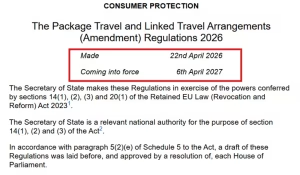
UK legislation confirming that the 2026 package-travel amendments come into force on 6 April 2027.
Can You Become a Travel Agent Without Experience or Your Own ATOL?
Yes. Previous travel-industry employment and a personal travel-agent qualification are not universal legal prerequisites for becoming a travel consultant.
However, training, product knowledge and a suitable commercial arrangement remain essential.
New entrants commonly consider working through an established travel agency, a host organisation, a managed branch or a franchise.
Under the appropriate arrangements, the individual may be able to sell qualifying holidays through the principal company’s existing protection and infrastructure rather than obtaining their own ATOL.
The business must still comply with its contractual and regulatory responsibilities.
Training should cover:
- Understanding package-holiday protections.
- Booking systems and travel documentation.
- Supplier contracts and payment processes.
- Visa and passport information.
- Cancellation and refund procedures.
- Customer complaints and escalation.
- Data protection and payment security.
Our analysis suggests that a hosted arrangement can be attractive where the founder has strong customer-service or sales experience but limited regulatory knowledge.
However, contracts should be examined carefully before joining.
Some organisations charge initial membership fees, recurring subscriptions or a percentage of commissions.
A business that advertises low startup costs may still become expensive if it retains a significant portion of each sale.
Which Travel Agency Business Model Is Best for New Entrepreneurs?
Different travel-business structures offer different combinations of independence, financial exposure and earning potential.
We evaluated five common models against startup accessibility, financial commitments, administrative complexity and growth flexibility.
The following ratings are editorial suitability assessments, not verified customer-satisfaction ratings or results from a survey of travel agents.
| Business model | Our suitability rating | Primary advantage | Main limitation |
| Home-based hosted travel agent | 90% | Lower initial complexity | Commission-sharing obligations |
| Managed branch or established network | 86% | Existing operational infrastructure | Reduced independence |
| Independent non-flight specialist | 75% | Niche positioning | Package protection may still apply |
| Independent ATOL-holding agency | 65% | Greater commercial control | Substantial financial requirements |
| Specialist corporate rail retailer | 62% | Corporate customer opportunities | Rail licensing and system obligations |
Home-Based Hosted Agency
A home-based hosted agency can reduce the need to invest immediately in expensive booking infrastructure.
Instead of establishing a completely independent operation, entrepreneurs may access established travel systems, supplier relationships and customer-protection arrangements.
The disadvantages can include commission splits, restrictions on branding and dependence on another company’s systems.
Independent Travel Agency
An independent agency gives its owners greater control over positioning, customer relationships and commercial agreements.
The potential benefit is retaining a larger share of revenue.
However, ownership also introduces responsibility for licensing where applicable, financial protection, supplier contracts, compliance and business continuity.
Specialist Agency
A specialist may focus on luxury holidays, cruises, accessible travel, business travel, destination weddings or other defined markets.
Specialisation can strengthen the commercial proposition because customers may be willing to pay for knowledge that is difficult to obtain from a basic online booking platform.
The right niche should still be evaluated against customer demand, supplier availability, acquisition costs and expected margins.
How Much Money Can a Travel Agent Make in the UK?
Travel agency income depends on sales volume, supplier commission, service fees, network arrangements and operating expenses.
One of the biggest mistakes new business owners make is treating the total booking price as business revenue.
For example, selling a £3,000 holiday does not mean the agency earns £3,000.
If the agency receives a 10% commission, the initial commission would be £300.
If a commercial network retains part of that commission, the business owner’s earnings will be lower.
Example: Travel Agency Commission Calculation
Consider a hypothetical booking:
| Financial measure | Amount |
| Holiday selling price | £2,000 |
| Assumed supplier commission | 10% |
| Gross commission | £200 |
| Assumed host-network share | 30% of commission |
| Agency retained commission | £140 |
The agency therefore retains £140 before its own operating expenses and tax.
These percentages are illustrative assumptions, not guaranteed industry commission rates.
How Many Bookings Are Needed to Break Even?
Assume a home-based travel agent has monthly operating expenses of £1,400 and earns an average retained contribution of £140 per completed booking.
The break-even calculation becomes:
£1,400 ÷ £140 = 10 bookings per month.
That covers the modelled operating expenses, but it does not necessarily provide a salary for the owner or cover every possible tax, refund, cancellation or financing cost.
If the owner also wants to generate £2,100 a month before personal tax and other adjustments, the combined target rises to £3,500.
At £140 per booking, approximately 25 bookings would be needed to reach that amount.
This example demonstrates why travel agents should assess customer acquisition and retained commission before deciding whether a business model is sustainable.
Entrepreneurs can compare these assumptions with the wider factors involved in becoming profitable during the first year.
Why Are Customers Still Using Travel Agents in 2026?
The growth of online booking platforms has changed how travel businesses operate, but it has not eliminated demand for professional travel advice.
The latest ABTA Holiday Habits 2026–27 findings indicate that 88% of surveyed UK adults had taken a holiday during the preceding 12 months.
Around 62% had travelled abroad, while 70% planned to take an overseas holiday in the following year.
The research also found that 63% of respondents who took an overseas holiday had booked a package.
For travel entrepreneurs, these figures indicate an established market, although they do not guarantee success for any individual agency.
Customers may seek professional assistance when arranging complicated itineraries, dealing with disruption or evaluating unfamiliar destinations.
This is particularly relevant as artificial intelligence becomes more prominent in travel research.
In October 2026, ABTA reported that 14% of consumers used AI tools for holiday inspiration, up from 8% in 2025.
Mark Tanzer, ABTA’s Chief Executive, also observed:
“Travel is, by its nature, a highly personal business.”
His observation highlights a commercial distinction worth considering: digital tools can support research and administration, but customer reassurance and judgement remain important parts of the service.
Our assessment is that agencies combining efficient technology with specialist expertise may have a stronger proposition than businesses attempting to compete on booking price alone.
Do Travel Agents Need a Separate Licence to Sell Train Tickets?
Businesses wanting to retail National Rail products directly must examine the licensing framework administered by Rail Delivery Group.
Unlike general holiday-agency activity, direct rail retailing has specific arrangements depending on the services offered and the customers served.
The Travel Agents Licence is aimed particularly at corporate travel management companies selling National Rail products to business customers.
Other retailing models may require different authorisations, including Third Party Investor or Inclusive Tour licences.
The Travel Agents Licence should therefore not be confused with a universal licence required by every travel business arranging rail-inclusive holidays.
Main Rail Travel Agents Licence Requirements
The published requirements include:
| Requirement | Details |
| Application charge | £300 plus VAT |
| Expected first-year rail sales | Minimum £25,000 |
| Financial cover | Based on projected sales, minimum £10,000 |
| Staff qualifications | At least two qualified staff or 20% of relevant staff, whichever is greater |
| Qualification | Certificate of Rail Agent Competency (CORAC) |
| Ticketing | Appropriate accredited ticket-issuing arrangements |
The application process is generally described as taking approximately six to eight weeks once the required information has been received.
Commercial system charges and other operating expenses may apply separately.
Businesses using an authorised retailer under a properly approved sub-agent or affiliate arrangement may face different direct licensing requirements.
The appropriate option depends on whether the agency sells directly, acts through an established retailer or incorporates rail into a wider travel package.
What Tax, Insurance and Legal Requirements Must UK Travel Agents Meet?
Obtaining an appropriate licence is only one part of establishing a compliant travel business.
Owners also need to consider company administration, customer payments, insurance, data protection and applicable tax rules.
Business Registration and Tax
Limited companies must comply with Companies House registration and filing requirements.
Sole traders and partnerships have their own HMRC registration and tax obligations.
The appropriate structure depends partly on financial exposure, ownership, operational responsibilities and tax circumstances.
VAT and the Tour Operators’ Margin Scheme
Travel businesses should examine whether the Tour Operators’ Margin Scheme, known as TOMS, applies to their transactions.
The treatment differs between businesses acting as disclosed agents and those supplying certain travel services in their own name.
Under the current rules, qualifying TOMS transactions involve special VAT treatment of the operator’s margin.
It would be incorrect to assume that every travel-agent commission is subject to TOMS or that every travel booking follows ordinary VAT accounting.
There is also a significant development for future planning.
On 28 October 2026, HMRC opened a call for evidence on the VAT treatment of travel services, including whether TOMS should be retained, reformed or simplified.
The consultation is scheduled to close on 31 January 2027.
This is a consultation, not an announcement that the existing scheme has already been replaced.
Travel startups should monitor its outcome before making long-term decisions about VAT systems and accounting arrangements.
Insurance
Depending on the activities undertaken, relevant cover may include professional indemnity insurance, public liability insurance, employers’ liability insurance where required, and cyber insurance.
Specialist package-travel insolvency protection must be assessed separately.
Data Protection
Travel agencies typically process customer names, contact details and travel information, with some handling more sensitive documentation.
Businesses must meet their applicable UK data protection obligations.
They should also check whether they must pay the ICO data protection fee or qualify for an exemption.
Appropriate payment processing, access controls, privacy notices, supplier agreements and data-retention procedures can reduce operational risk.
What Are the Biggest Financial Risks of Starting a Travel Agency?
The travel sector has several financial characteristics that founders should understand before accepting deposits or entering long-term commercial agreements.
Delayed Commission Income
Some commission arrangements do not release earnings immediately when the customer makes a booking.
The timing can depend on the supplier, departure date, contractual terms and cancellation conditions.
A business can therefore generate bookings without receiving sufficient immediate income to cover its monthly operating costs.
Customer Refund Exposure
Refund obligations can place pressure on working capital, particularly where suppliers delay returning funds.
Operators should establish clear refund procedures and understand who is contractually responsible for paying the customer.
Supplier Failure
Airline, accommodation or other supplier disruption can create customer-service obligations and administrative costs.
Financial protection, supplier selection and contractual controls all matter.
Excessive Fixed Costs
Premises, staffing, advertising subscriptions and booking technology can create expenses that continue even when bookings decline.
Julia Lo Bue-Said, Chief Executive of The Advantage Travel Partnership, described the visitor economy in published commentary in July 2026 as:
“Our visitor economy is an interconnected ecosystem.”
Her wider commentary identified business overheads, employment costs and economic uncertainty among the challenges facing smaller travel businesses.
This reinforces the importance of keeping a new agency’s financial commitments proportionate to its expected sales.
Entrepreneurs requiring additional capital should evaluate startup business loan options carefully, particularly where the borrowing creates personal repayment obligations.
What Common Mistakes Should New Travel Agents Avoid?
A successful travel agency needs reliable systems as well as attractive holiday products.
Our regulatory and financial analysis identifies several avoidable mistakes.
- Assuming every travel agent needs an individual ATOL. The correct answer depends on the seller’s role and exemptions.
- Using another company’s ATOL without an authorised arrangement. Customer protection must match the actual contractual structure.
- Confusing application fees with financial guarantees. Bonds and capital requirements can create a much larger financing challenge.
- Assuming ABTA membership replaces statutory financial protection. Membership and package-protection responsibilities must be considered separately.
- Ignoring the 2027 regulatory changes. Booking processes and contracts may need updating before the rules commence.
- Treating booking turnover as profit. Commission, supplier payments and overheads must be separately calculated.
- Failing to assess supplier and cancellation risks. A profitable booking can still generate cash-flow pressure when something goes wrong.
These risks do not necessarily make travel agencies unsuitable businesses. They show why regulatory knowledge and financial planning should form part of the startup process from the beginning.
How Can You Successfully Start a Travel Agency in the UK?
The strongest approach is to match the business model to available experience, finance, customer demand and regulatory capacity.
For a founder with limited startup capital, joining an established travel organisation may provide a practical way to develop commercial experience while benefiting from its infrastructure.
An entrepreneur with substantial industry knowledge, established customers and sufficient finance may prefer greater independence.
Before launching, we recommend:
- Choosing a clearly defined customer market.
- Confirming the legal role of the agency in each type of booking.
- Establishing required licences or exemptions.
- Checking supplier and network agreements.
- Building a 12-month cash-flow forecast.
- Calculating retained earnings per booking.
- Setting aside appropriate operating reserves.
- Establishing cancellation and refund procedures.
- Preparing for the April 2027 package-travel amendments.
A travel agency is more likely to build a sustainable operating model when its financial assumptions are grounded in actual customer demand rather than optimistic sales projections.
Conclusion
Obtaining a travel agent licence in the UK is not a universal requirement for everyone entering the travel industry.
The legal framework depends on whether a business acts as an agent, organises flight-inclusive packages, sells non-flight packages or retails particular products such as National Rail tickets.
In 2026, the financial implications of ATOL authorisation extend well beyond the application fee, with bonds, capital requirements and ongoing reporting forming part of the regulatory landscape.
Meanwhile, the package-travel amendments taking effect in April 2027 create an additional reason for new operators to review how their services are structured and sold.
Our overall assessment is that the most suitable route for a new travel entrepreneur is the one that combines lawful operations, manageable financial exposure and sufficient retained earnings per booking.
Rather than pursuing independence or the cheapest advertised joining fee automatically, founders should establish which model can support long-term profitability while delivering the consumer protection customers expect.
Frequently Asked Questions About Travel Agent Licences
Do You Need a Licence to Be a Travel Agent in the UK?
There is no universal travel agent licence. However, ATOL, rail licensing or other legal obligations may apply depending on the business model and products sold.
Can I Start a Travel Agency From Home?
Yes. Home-based agencies are permitted, but they must still meet the same relevant legal, financial-protection and data-protection requirements as other agencies.
How Much Is a Small Business ATOL Licence in 2026?
The new application fee is £1,538 under the CAA’s April 2026 fee schedule. Additional financial requirements and protection contributions apply.
Is ABTA Membership Compulsory?
No. ABTA membership is voluntary, although qualifying package organisers must still comply with statutory financial-protection requirements.
Can I Sell ATOL-Protected Holidays Without My Own ATOL?
Yes, potentially, when operating under a valid agency, accredited-body or other recognised exempt arrangement.
How Long Does an ATOL Application Take?
The CAA indicates that an application takes around 12 weeks on average to reach a decision, although the actual period varies.
Do I Need Qualifications to Become a Travel Agent?
There is no universal personal travel-agent qualification requirement. However, employers, networks and specialist retailing arrangements may require training or specific qualifications.
What Happens to Package Travel Rules in 2027?
From 6 April 2027, amendments will change the package definition, remove the separate linked travel arrangement framework for relevant new contracts and introduce certain supplier refund obligations.
Is Running a Travel Agency Profitable?
It can be, but profitability depends on retained commission, booking volume, customer acquisition, overheads and the contractual structure of the business.
Can I Start a Travel Agency With Very Little Money?
A hosted or managed arrangement may require less initial funding than independently holding an ATOL. However, all founders should budget for operating expenses and unexpected costs.