


The debate surrounding Rachel Reeves’ UK defence funding strategy has escalated from a complex budgetary negotiation into a full-blown political crisis. With the imminent publication of the government’s long-awaited Defence Investment Plan (DIP) ahead of the upcoming NATO summit in Ankara, Chancellor Rachel Reeves and Prime Minister Keir Starmer find their economic framework under intense global and domestic scrutiny.
The boiling point arrived in June 2026 with the shock resignation of Defence Secretary John Healey and Armed Forces Minister Al Carns. Healey’s departure has laid bare the deep fracture between the Ministry of Defence (MoD)—which demanded an additional £18.5 billion over four years to counter explicit British intelligence warnings of a potential Russian attack on a NATO country by 2030—and a Treasury fiercely committed to fiscal discipline.
At the heart of the Rachel Reeves UK defence funding debate is a fundamental question of economic trade-offs: How can the UK scale up its military readiness without relying on inflationary borrowing or triggering severe cuts to a heavily strained domestic infrastructure?
What Is Rachel Reeves’ Position on UK Defence Funding?

Rachel Reeves’ position on UK defence funding is defined by an unyielding commitment to fiscal discipline, even at the expense of severe cabinet friction. In her Spring Forecast speech, Reeves explicitly emphasized that “stability in our public finances is the single most important precondition for economic growth,” a hardline stance that directly shaped her response to the Ministry of Defence (MoD).
As Chancellor, Reeves has refused to fund the military expansion through increased international borrowing or by altering her core fiscal rules, warning that global markets would punish the UK with higher interest rates.
When the MoD requested an additional £18.5 billion over four years to fulfill the commitments outlined in the Strategic Defence Review, Reeves initially capped the Treasury’s offer at £12 billion. Following heavy intervention from Prime Minister Keir Starmer, a compromise package of £13.5 billion was agreed upon.
However, Reeves insisted this funding must be structurally absorbed without expanding the national deficit—solidifying her position that defence cannot be treated as an exempt, bottomless budget item.
Why Is UK Defence Spending Now a Major Political Issue?
UK defence spending has become a major issue because the Government is trying to balance national security with tight public finances.
The UK faces pressure from several directions:
| Issue | Why It Matters |
| NATO commitments | The UK is expected to maintain strong defence spending as part of alliance obligations. |
| Global instability | Conflicts and security threats have increased pressure on military readiness. |
| Public finances | Higher defence spending must be funded through taxes, cuts, borrowing, or reallocations. |
| Public services | Any shift in spending can affect departments such as health, education, transport, and welfare. |
| Business confidence | Defence investment can support UK industry but may also raise concerns over tax rises. |
For ordinary readers, this matters because defence funding decisions may affect household taxes, local services, jobs, and wider economic stability.
How Could Rachel Reeves Fund Higher UK Defence Spending?
Rachel Reeves could fund higher UK defence spending through a combination of departmental savings, tax decisions, reduced overseas aid, borrowing restraint, and changes to future spending plans.
The main options are:
- Cutting or slowing spending in other departments
This is politically difficult because it may affect public services. - Raising taxes
This could provide extra revenue but may be unpopular with households and businesses. - Borrowing more
This may ease short-term pressure, but Reeves has signalled caution around additional borrowing. - Reallocating existing budgets
This may include shifting money from other priorities towards defence. - Supporting defence industry growth
Investment in UK defence manufacturing may create jobs, though it does not remove the need for upfront funding.
What Are the Concerns About “Salami-Slicing” Departmental Budgets?

“Salami-slicing” means applying smaller cuts across several departments instead of making one large cut in a specific area. In the context of the current Rachel Reeves UK defence funding crisis, this is no longer a theoretical concern—it is active government policy.
To fill the multibillion-pound gap left by the MoD’s funding demands, the Treasury has ordered Whitehall departments to cut approximately 1% from their hard-won capital infrastructure budgets.
This approach has provoked widespread anger across the cabinet:
Infrastructure Delays: High-spending capital departments—specifically Transport and Energy—have been forced to absorb the deepest cuts. While Transport Secretary Heidi Alexander successfully fought to protect immediate funding for buses, trains, and HS2, other long-term regional infrastructure and green-energy programs are facing mandatory delays.
The “Peace Dividend” Reversal: Critics argue that slicing domestic capital budgets to fund the military effectively reverses the post-Cold War “peace dividend.” Instead of public funds driving domestic growth and reinforcing public services, resources are being actively diverted to sustain hardware procurement.
Loss of Treasury Control: In exchange for providing the extra £13.5 billion, Reeves has leveraged the situation to take direct Treasury control over high-profile military assets, including the multi-billion-pound future fighter jet programme—a clear sign that the Treasury deeply distrusts the MoD’s long-term cost management.
Confirmed Facts, Proposed Changes and Misinformation
Confirmed Facts
- The £13.5 Billion Settlement: The Treasury has legally locked in a £13.5 billion funding increase for the MoD spread over the next four years.
- The 1% Whitehall Squeeze: Non-frontline government departments have been ordered to slice 1% from their capital investment budgets to offset defence costs.
- The Treasury Reserve Injection: Rachel Reeves has deployed £3.5 billion directly from the central Treasury reserve to cover critical military projects that the MoD was previously expected to self-fund.
- Delayed Publication: The final, detailed publication of the full Defence Investment Plan (DIP) has been officially delayed until the upcoming NATO Summit in Ankara.
Proposed or Discussed Changes
The 3.5% GDP Timeline: While the government maintains a nominal pledge to hit 3.5% of GDP spending on defence by 2035, the current fiscal framework contains no concrete funding mechanism to achieve the necessary £30 billion annual structural shift required to get there.
Alternative Funding Mechanisms: Outside the Treasury, figures like former Prime Minister Gordon Brown have proposed creating a specialized, collective alliance borrowing scheme alongside NATO or European allies. This vehicle would allow the UK to finance defence projects “off-balance-sheet” without violating Reeves’ domestic fiscal rules—though No. 11 currently resists the plan due to market stability risks.
Misinformation and False Claims
It would be misleading to say that every public service cut is automatically caused by defence funding. Government budgets are complex, and spending decisions are influenced by inflation, growth forecasts, borrowing costs, welfare pressures, NHS demand, and political priorities.
It would also be misleading to suggest that higher defence spending always weakens the economy. Defence investment can support manufacturing, technology, engineering, cyber security, shipbuilding, and regional jobs. The economic impact depends on how the money is raised and where it is spent.
How Could Higher Military Investment Affect the UK Economy?
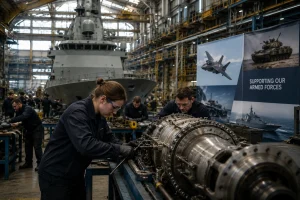
Higher military investment could affect the UK economy in both positive and challenging ways.
On the positive side, defence spending can support:
- British manufacturing
- Shipbuilding and aerospace
- Cyber security firms
- Engineering jobs
- Research and development
- Regional supply chains
- Long-term industrial capability
For businesses, especially those in advanced manufacturing, technology, logistics, and security, increased defence funding may create new contracts and investment opportunities.
However, there are risks. If defence funding is paid for through higher business taxes, reduced infrastructure investment, or cuts to other growth-supporting departments, the wider economic benefit may be limited.
What Does Rachel Reeves UK Defence Funding Mean for Businesses?
Rachel Reeves UK defence funding could matter significantly for UK businesses, particularly those connected to defence, technology, construction, engineering, and supply chains.
Large defence firms may benefit from direct government contracts. Smaller businesses may benefit indirectly by supplying parts, software, logistics, maintenance, materials, or specialist services.
A real-life example would be a Midlands engineering company that supplies precision components. If the Government expands defence manufacturing, that company may receive more orders, hire more staff, and invest in new machinery. But if taxes rise or public infrastructure projects are delayed, the same business may face higher costs elsewhere.
This is why the funding method matters as much as the spending commitment itself.
Why Are Tax Rises Being Discussed?

Tax rises are being discussed because higher defence spending requires reliable funding.
If the Government does not want to borrow significantly more, it must either raise more revenue or reduce spending elsewhere. That makes taxation part of the public debate.
For households, this could raise concerns about income tax, national insurance, VAT, or other duties. For businesses, the concern may be corporation tax, employer costs, investment allowances, or sector-specific taxes.
At this stage, not every tax option discussed in the media should be treated as confirmed policy.
Could Defence Funding Affect Public Services?
Yes, defence funding could affect public services if money is moved from other departments or if future spending growth is limited.
This does not necessarily mean immediate cuts to frontline services. However, it could mean slower increases, delayed projects, reduced capital investment, or tighter departmental settlements.
The key question is whether the Government can increase defence spending while still protecting health, education, policing, transport, housing, and welfare priorities.
Future Outlook for Rachel Reeves UK Defence Funding

The future of Rachel Reeves UK defence funding will depend on three main factors: the security environment, the strength of the UK economy, and the Government’s willingness to make difficult fiscal choices.
If global threats increase, pressure for faster defence spending rises may grow. If economic growth improves, the Government may have more room to increase defence spending without sharper tax rises or cuts. If growth remains weak, the trade-offs will become harder.
For UK readers, the most important thing is to separate confirmed decisions from political speculation. Defence spending is likely to remain a major issue, but the final impact on taxpayers, businesses, and public services will depend on detailed budget decisions.
Conclusion: Understanding Rachel Reeves UK Defence Funding
Rachel Reeves UK defence funding is about more than military spending. It is about how Britain balances national security, public services, taxation, borrowing, and long-term economic growth.
The confirmed direction is that defence spending is rising in importance. The unresolved question is how the Government will fund those commitments without placing too much pressure on households, businesses, or other departments.
For the UK public and business community, the issue should be watched carefully, calmly, and with attention to confirmed policy rather than speculation.
FAQs
What does Rachel Reeves UK defence funding mean?
It means the debate around how Chancellor Rachel Reeves and the UK Government plan to fund higher defence spending while managing taxes, borrowing, and public services.
Will UK taxpayers pay more for defence spending?
Tax rises have been discussed, but not every option is confirmed. The final impact will depend on future Budget and Spending Review decisions.
Could defence spending cuts affect the NHS?
Defence spending does not automatically reduce NHS funding. However, if money is reallocated across departments, wider public spending choices may become more difficult.
Why is NATO important in this debate?
NATO matters because member countries are expected to maintain strong defence capabilities. UK spending decisions are partly shaped by these alliance commitments.
Can defence funding help UK businesses?
Yes. Defence investment can support manufacturers, technology firms, cyber security companies, engineering businesses, and regional supply chains.
Is higher defence spending bad for the economy?
Not necessarily. It can support jobs and industry, but the economic effect depends on whether it is funded through taxes, cuts, borrowing, or growth.
What is “salami-slicing” in government spending?
Salami-slicing means making smaller reductions across several departments rather than imposing one large cut in one area.
Is Rachel Reeves cutting all departments to fund defence?
Reports suggest departmental pressures are part of the debate, but broad claims should be treated carefully unless confirmed in official Budget documents.