

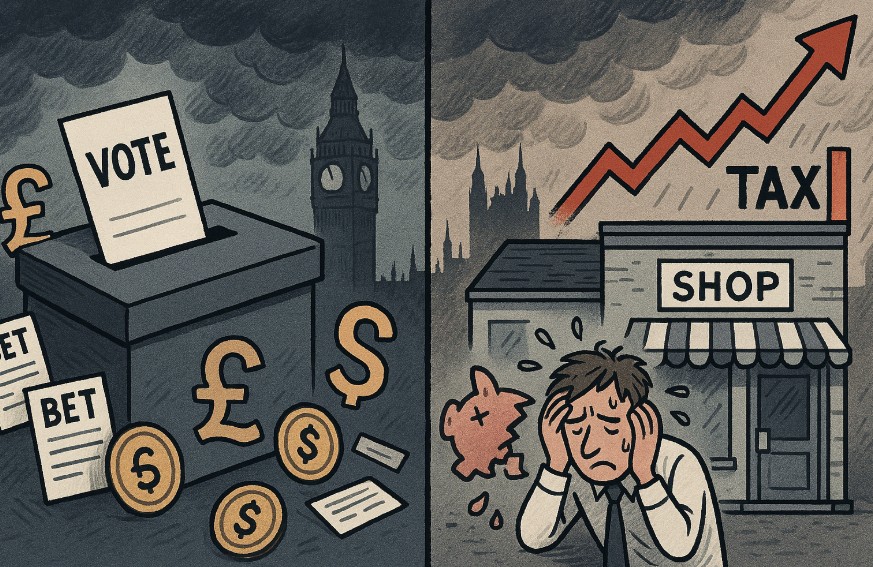
The fallout from betting on the timing of the 2024 UK General Election is still developing. The Gambling Commission originally charged 15 people in April 2025 over alleged cheating involving confidential information about the election date.
On 29 June 2026, former Conservative MP Craig Williams and Amy Hind pleaded guilty to cheating offences under Section 42 of the Gambling Act 2005. Trials involving 12 remaining defendants are scheduled for September 2027 and January 2028.
For UK businesses, however, political controversy is only one part of a wider climate of uncertainty. Companies are also dealing with higher employment costs, increased dividend tax rates and major changes to business rates in England. The main Corporation Tax rates themselves have not increased in 2026, with the 19% small profits rate and 25% main rate remaining in place.
Against this background, businesses need to distinguish political headlines from the policy changes that directly affect payroll, profits, property costs and financial planning.
Why Are General Election Bets Under Greater Scrutiny In The UK?
Betting on political events, including election outcomes and election timing, is available through licensed betting operators in Great Britain. The key legal issue is not political betting itself, but whether someone cheats or assists another person to cheat.
Section 42 of the Gambling Act 2005 makes cheating at gambling, or enabling or assisting another person to cheat, a criminal offence. The Gambling Commission can investigate suspected offences and bring prosecutions where appropriate.
The 2024 General Election case has increased attention on the use of confidential political information in betting. In December 2025, the Gambling Commission also published an updated policy setting out how it approaches potential misuse of inside information, including information connected with non-sporting events on which bets can be placed.
How Is the Gambling Commission Responding to Election Betting Offences?
The Gambling Commission charged 15 people on 14 April 2025 following its investigation into alleged cheating connected with bets on the timing of the 2024 General Election. The investigation focused on allegations that confidential information about the proposed election date was used to obtain an unfair betting advantage.
The case has since progressed substantially. On 29 June 2026, Craig Williams and Amy Hind pleaded guilty at Southwark Crown Court to cheating offences contrary to Section 42(1)(a) of the Gambling Act 2005. The Commission said both had used confidential information relating to the election date when placing bets.
Amy Hind is due to be sentenced at Southwark Crown Court on 23 October 2026, while Craig Williams is due to be sentenced at a later date. Trials involving 12 remaining defendants are scheduled for September 2027 and January 2028.
The case demonstrates that misuse of confidential information in betting can move beyond an ethical or reputational issue and result in criminal proceedings.
What Do the Latest UK Tax Increases Mean for Small Businesses?
UK businesses face several important tax and employment-cost changes in 2026, but Corporation Tax itself has not recently increased.
For the financial year beginning 1 April 2026, the Corporation Tax main rate remains 25% for profits above £250,000, while companies with profits of £50,000 or less generally qualify for the 19% small profits rate. Marginal Relief may apply between those thresholds.
Other changes are more significant for business owners and employers:
| Area | 2026 Position | Business Impact |
|---|---|---|
| Corporation Tax | 19% small profits rate and 25% main rate | Rates remain unchanged |
| Employer National Insurance | 15% above the £5,000 Secondary Threshold | Higher employment costs than before April 2025 |
| Dividend Tax | 10.75% basic rate and 35.75% higher rate | Higher tax for many owner-directors taking dividends |
| Dividend Allowance | £500 | Limited tax-free dividend income |
| Business Rates | New 2026 revaluation and multipliers in England | Property costs depend on new rateable values and applicable multiplier |
Employer National Insurance remains 15% for 2026/27, with the Secondary Threshold at £5,000 a year. Eligible employers can reduce their National Insurance liability through an Employment Allowance of up to £10,500.
Dividend tax also changed from 6 April 2026. The ordinary rate increased from 8.75% to 10.75%, while the upper rate rose from 33.75% to 35.75%. The additional rate remains 39.35%.
How Are Economic And Political Uncertainty Affecting UK Businesses?
The election-betting case has important implications for political accountability and gambling regulation, but businesses should avoid assuming that the scandal itself is directly responsible for changes in investment, lending or consumer spending.
Current evidence shows that broader economic uncertainty and labour costs are more immediate concerns for many firms.
The Office for National Statistics reported on 20 August 2026 that economic uncertainty was the most commonly reported challenge affecting turnover, cited by 29% of trading businesses. Among businesses with 10 or more employees, 35% identified labour costs as their most reported challenge affecting turnover.
Businesses therefore face several overlapping pressures:
- Higher Employment Costs: Employer National Insurance and wage costs can put pressure on payroll budgets.
- Higher Dividend Tax: Some company owners may retain more profit within their businesses rather than extracting it as dividends.
- Property Cost Changes: England’s April 2026 business-rates revaluation can increase or decrease bills depending on rateable value and eligibility for relief.
- Economic Uncertainty: Uncertainty can make forecasting revenue, recruitment and investment more difficult.
- Compliance And Reputation: Businesses operating in regulated industries need strong controls around confidential information and employee conduct.
The 2026 business-rates revaluation took effect on 1 April 2026. England also introduced new multipliers, including lower rates for qualifying retail, hospitality and leisure properties with rateable values below £500,000.
How Can UK Businesses Navigate Political and Economic Uncertainty?

Businesses cannot control political events or government policy, but they can reduce their exposure to sudden financial and regulatory changes through better planning.
Strategies For Navigating Uncertainty
- Review Payroll Costs: Factor the 15% employer National Insurance rate and the £5,000 Secondary Threshold into recruitment and workforce budgets.
- Check Employment Allowance Eligibility: Eligible employers can reduce their employer National Insurance liability by up to £10,500 in 2026/27.
- Review Dividend Planning: Owner-directors should account for the 10.75% and 35.75% dividend tax rates applying from April 2026.
- Check Business Rate Valuations: Businesses with premises in England should check their new 2026 rateable value and whether relief or a retail, hospitality and leisure multiplier applies.
- Strengthen Compliance Controls: Organisations handling commercially or politically sensitive information should have clear policies governing confidentiality, conflicts of interest and employee conduct.
- Maintain Financial Headroom: Cash-flow forecasting and scenario planning can help businesses respond to changes in labour, tax, energy and financing costs.
These measures provide businesses with a more practical response to uncertainty than reacting to individual political controversies or short-term headlines.
Conclusion
The UK General Election betting investigation has moved significantly beyond its position in 2025, with two defendants pleading guilty in June 2026 and further trials scheduled for 2027 and 2028.
At the same time, businesses are dealing with more immediate financial pressures including employer National Insurance, higher dividend tax rates and the 2026 business-rates revaluation.
For business owners, the priority should be accurate forecasting rather than reacting to political headlines. Reviewing payroll costs, tax extraction strategies, business rates, cash reserves and compliance procedures can make companies better prepared for further economic or policy changes.
FAQs About General Election Bets, Tax Changes, and UK Businesses
Are General Election Bets Legal In The UK?
Political betting itself can be offered legally by licensed operators. However, cheating or helping another person cheat at gambling is an offence under Section 42 of the Gambling Act 2005.
What Is The Latest Update On The 2024 General Election Betting Case?
Craig Williams and Amy Hind pleaded guilty to cheating offences on 29 June 2026. Trials involving 12 remaining defendants are scheduled for September 2027 and January 2028.
Did Corporation Tax Increase In 2026?
No. For 2026, the main Corporation Tax rate remains 25%, while the small profits rate remains 19% for qualifying companies with profits of £50,000 or less.
What Is The Employer National Insurance Rate In 2026?
The standard employer National Insurance rate is 15% above the relevant threshold, with the Secondary Threshold set at £5,000 a year for 2026/27.
What Are The Dividend Tax Rates For 2026/27?
The ordinary dividend rate is 10.75%, the upper rate is 35.75% and the additional rate remains 39.35%. The dividend allowance remains £500.
Did Business Rates Change In April 2026?
Yes. England’s latest business-rates revaluation took effect on 1 April 2026, alongside new multipliers including reduced multipliers for qualifying retail, hospitality and leisure properties.
What Is Currently Affecting UK Businesses Most?
ONS data published on 20 August 2026 showed economic uncertainty was cited by 29% of trading businesses as a turnover challenge, while 35% of businesses with 10 or more employees cited labour costs.