

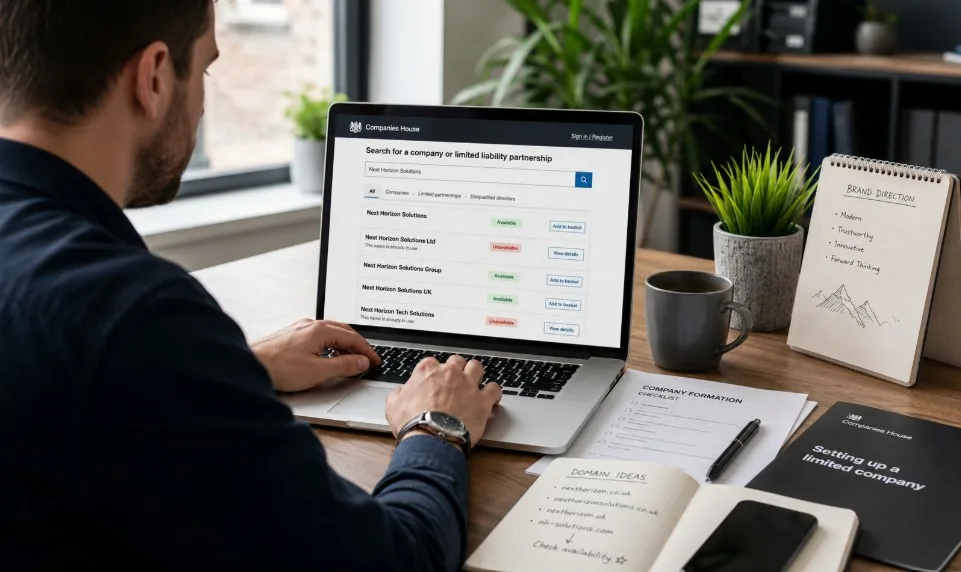
You can check name availability on Companies House before registering your business by using the official GOV.UK company name checker.
The tool helps you determine whether your proposed company name is already registered or considered legally too similar to an existing UK business.
However, a proper company name check should go beyond Companies House and include trademarks, naming rules, domains, and brand availability.
In this guide, you’ll learn how to verify a company name correctly and avoid costly registration mistakes.
Key takeaways:
- Check Companies House before submitting incorporation documents
- Review exact matches and “too like” names
- Search UK trademarks separately
- Confirm domain and social media availability
- Follow UK company naming regulations
Choosing the right company name at the beginning can save significant time, legal expense and rebranding effort later.
Why Should You Check Name Availability on Companies House Before Registering?
Before you register a company in the UK, checking whether your chosen business name is available is one of the most important steps in the process.
Companies House does not allow businesses to register names that are identical to existing companies or so similar that they may confuse the public. A rejected application can delay your launch and force unexpected changes to your branding.
Your company name also becomes part of your legal identity. It appears on official records, invoices, contracts and public searches.
“A company name should create clarity for customers and confidence in the register. Names that mislead or create confusion undermine trust.” — Companies House guidance principle
Benefits and risks comparison:
| Checking Before Registration | Skipping the Check |
| Reduces incorporation rejection | Application delays |
| Protects brand identity | Rebranding costs |
| Identifies naming conflicts | Trademark disputes |
| Supports digital consistency | Customer confusion |
Checking availability early gives you a stronger foundation for building a recognisable and compliant UK business.
What Is the Companies House Name Availability Checker?
The Companies House Name Availability Checker is the official GOV.UK tool used to search existing company records and determine whether a proposed business name may be accepted.
The tool searches against registered company data and helps identify whether names are identical or potentially too similar.
It provides immediate access to:
- Active companies
- Dissolved companies
- Historical company names
- Partial matches
- Existing registration details
Although many founders assume this search guarantees legal clearance, it does not check trademarks or reserve names. This means your preferred company name could appear available but still conflict with intellectual property rights.
“Availability on the company register does not replace trademark due diligence.” — UK Intellectual Property guidance principle
You should treat Companies House approval as the first validation stage rather than the final approval of your business identity.
How to Check Name Availability on Companies House? – Step by Step
Checking company name availability only takes a few minutes, but doing it properly requires more than entering a phrase into a search box and choosing the first result you see.
Many founders assume that if a name appears available, it can be used immediately. In reality, Companies House checks naming compliance, while additional legal and branding checks should also be completed before incorporation.
Following a structured process reduces the chance of rejection and helps you secure a name that works both legally and commercially.
Step 1: Enter Your Proposed Company Name
Visit the official Companies House company information service and type your preferred business name. Search your exact version first, then test variations. Avoid checking only one spelling. Businesses often discover similar names after reviewing alternatives.
Real-time search example:
Imagine you search: “ABC Digital Solutions”
Possible outcomes:
| Search Result | Meaning | Action |
| Available | No direct conflict found | Continue checks |
| Already registered | Exact conflict | Create alternatives |
| Similar names appear | Potential rejection risk | Review carefully |
If “ABC Digital Solutions Ltd” already exists, variations such as “ABC Digital Limited” or “ABC Digital Solutions UK Ltd” may still be rejected because Companies House may classify them as too similar.
Completing this first search carefully gives you a stronger starting point before moving into legal and branding checks.
Step 2: Review Exact and Similar Name Results
Once results appear, review them carefully rather than assuming availability means approval. Companies House examines more than direct duplicates.
Their review process considers whether a proposed name could create confusion for customers or imply association with another organisation.
Companies House typically examines:
- Exact matches
- Similar sounding names
- Similar meanings
- Historical names
- Existing legal entities
Do not focus only on active businesses.
Dissolved companies may still influence availability depending on timing, legal protections and naming regulations. Previous company names may also appear in the results and should be reviewed before making a final decision.
If several businesses already use similar wording, it may be worth adjusting your branding early instead of risking rejection later.
Taking a few extra minutes at this stage can prevent incorporation delays and reduce future naming conflicts.
Step 3: Check Whether the Name Is Safe to Use
A company search should not end with Companies House. Even if the system does not flag your chosen name, additional validation is essential to confirm that the name is commercially usable and legally safer.
Complete validation should include:
| Validation Area | What to Check |
| Companies House | Name availability |
| UK IPO | Trademark conflicts |
| Domains | Website availability |
| Social Platforms | Brand consistency |
Trademark checks help identify intellectual property issues that Companies House does not review. Domain and social media checks ensure customers can find your business consistently across digital platforms.
Before finalising your choice, search for your proposed business name online and review whether competitors already dominate search visibility.
Once all checks are complete, you can move confidently into incorporation knowing your company name has been properly validated.
What Makes a Company Name “Same As” or “Too Like” an Existing UK Business?
One of the most misunderstood parts of UK company registration is the difference between “same as” and “too like”.
Many business owners believe changing punctuation, adding a location or altering a single word makes a name acceptable. In practice, Companies House applies broader similarity rules designed to reduce public confusion.
A name can still be rejected even if it is not identical.
“Same as” names usually differ only by:
- Punctuation
- Symbols
- Generic additions
- Minor formatting
“Too like” names are different but still likely to confuse the public because they appear visually or phonetically similar.
Examples:
| Existing Name | Likely Rejected |
| Hands Ltd | Hands UK Ltd |
| Easy Electrics For You Ltd | EZ Electrix 4U Ltd |
| Apex Solutions Ltd | Apex Solution Ltd |
Companies House ignores many superficial changes. Using numbers instead of words, adding punctuation or slightly changing spelling rarely creates uniqueness.
The registrar may also review pronunciation, public perception and overall business identity when assessing conflicts.
Exceptions may apply where:
- Companies belong to the same group
- Written consent exists
Choosing stronger differentiation reduces delays, protects your brand and improves long-term recognition.
Which Company Name Rules Could Cause Companies House to Reject Your Application?
Availability does not guarantee approval. Companies House applies additional naming standards designed to protect the public and maintain confidence in the register.
Restricted and Sensitive Words Requiring Approval
Certain words require permission before use.
Examples include:
- British
- Royal
- Trust
- Authority
- Institute
- Tribunal
- Chartered
These terms can imply status, regulation or official connections. If approval is required, supporting documentation may need to accompany your application.
Misleading, Offensive and Non-Compliant Company Names
Names may be rejected if they:
- Suggest government links
- Promote unlawful activity
- Cause offence
- Create false credibility
- Appear deceptive
Recent reforms have also increased scrutiny of names that obscure company identity.
“Company names should communicate identity transparently and avoid misleading the public.” — UK business registration guidance
Private Limited Company Naming Requirements and Legal Suffix Rules
Private limited companies generally must end with:
- Limited
- Ltd
Exceptions apply to certain company structures such as qualifying charities and companies limited by guarantee. Ensure suffixes align with your incorporation type before submission. Following these requirements improves approval chances and avoids unnecessary resubmissions.
Why Should You Check UK Trademarks Before Using Your Company Name?

Companies House does not verify trademark ownership. That means another organisation could hold legal rights to your chosen name even if your registration succeeds.
Trademark disputes can result in:
- Legal notices
- Forced rebranding
- Financial loss
- Loss of customer trust
Search the UK Intellectual Property Office database before registration.
Look for:
- Exact matches
- Similar business categories
- Similar sounding brands
Trademark registration may also strengthen your long-term business protection. A legally available company name is not always a commercially safe one.
Should You Check Domain Names and Social Media Availability Before Incorporation?
Modern businesses are discovered online first. Even if your company name passes Companies House requirements, digital availability should influence your final decision.
Customers expect consistency between:
- Registered company name
- Website address
- Social media accounts
Real-world founder insight:
A discussion shared within a UK small business community showed how a founder approached this process before launch.
The founder asked:
“How do I check if my name for a business is already taken and how do I acquire a website domain for my business?”
Several experienced business owners recommended a practical sequence:
- Check Companies House
- Search trademarks
- Review domain availability
- Secure branding before incorporation
One response summarised the approach simply: “As for company name just check Companies House.”
Use domain platforms and social availability tools before committing. This reduces the risk of owning a registered company that lacks a usable online identity. After completing digital checks, your registration decision becomes more future-ready.
What Can You Do If Your Preferred Company Name Is Already Taken?

Finding out your preferred company name is unavailable can be frustrating, but it does not mean you need to start again. A small adjustment can often help create a stronger and more distinctive brand identity.
Ways to Modify Your Company Name
- Industry Identifier: Add words related to your services or niche
- Location Reference: Include a city, region, or UK-based term
- Word Rearrangement: Change the order of words for uniqueness
- Brand Modifier: Add terms like “Group,” “Solutions,” or “Services”
- Simplicity: Keep the name easy to remember and spell
You can also use a trading name separately from your registered company name if it complies with UK regulations. Thoughtful changes often result in better branding and stronger market recognition.
How Do You Choose a Strong, Compliant and Future-Proof Company Name in the UK?
A great company name balances compliance, memorability and long-term flexibility. Your name should work legally and commercially. Avoid creating something that feels restrictive if your business expands later.
Strong company names are usually:
- Easy to pronounce
- Distinctive
- Legally compliant
- Search-friendly
- Broad enough for growth
Final naming checklist:
- Passed Companies House search
- Trademark reviewed
- Domain secured
- Social profiles available
- Naming rules verified
Before making your final decision, say the name out loud, search it online and imagine how it will appear across branding materials.
Conclusion
Checking name availability on Companies House is one of the most important early decisions when starting a UK business. The official checker allows you to identify existing names and reduce registration delays, but a complete process should go further.
Verify trademarks, review naming rules, secure digital assets and ensure your chosen name supports future growth. Taking a structured approach now can protect your business identity and help you launch with greater confidence.
FAQs About Checking Name Availability on Companies House
Can dissolved companies affect company name availability in the UK?
Yes. Dissolved companies can sometimes influence registration decisions depending on protection periods and similarity assessments.
Does adding symbols or punctuation make a company name unique?
No. Companies House usually ignores punctuation and superficial formatting differences.
Can I register a company and use a different trading name?
Yes. Your trading name may differ from your registered name provided it complies with legal rules.
How long does Companies House take to approve a company name?
Approval timing varies but is usually processed during incorporation submissions.
Can I use words such as “British” or “Institute” in my company name?
These may require approval and supporting documentation before acceptance.
Is there a way to protect my company name before incorporation?
You cannot reserve a company name separately, but trademarks and domain registration may provide interim protection.
What happens if another business complains about my registered name?
Companies House may review the complaint and request changes if the name breaches rules.