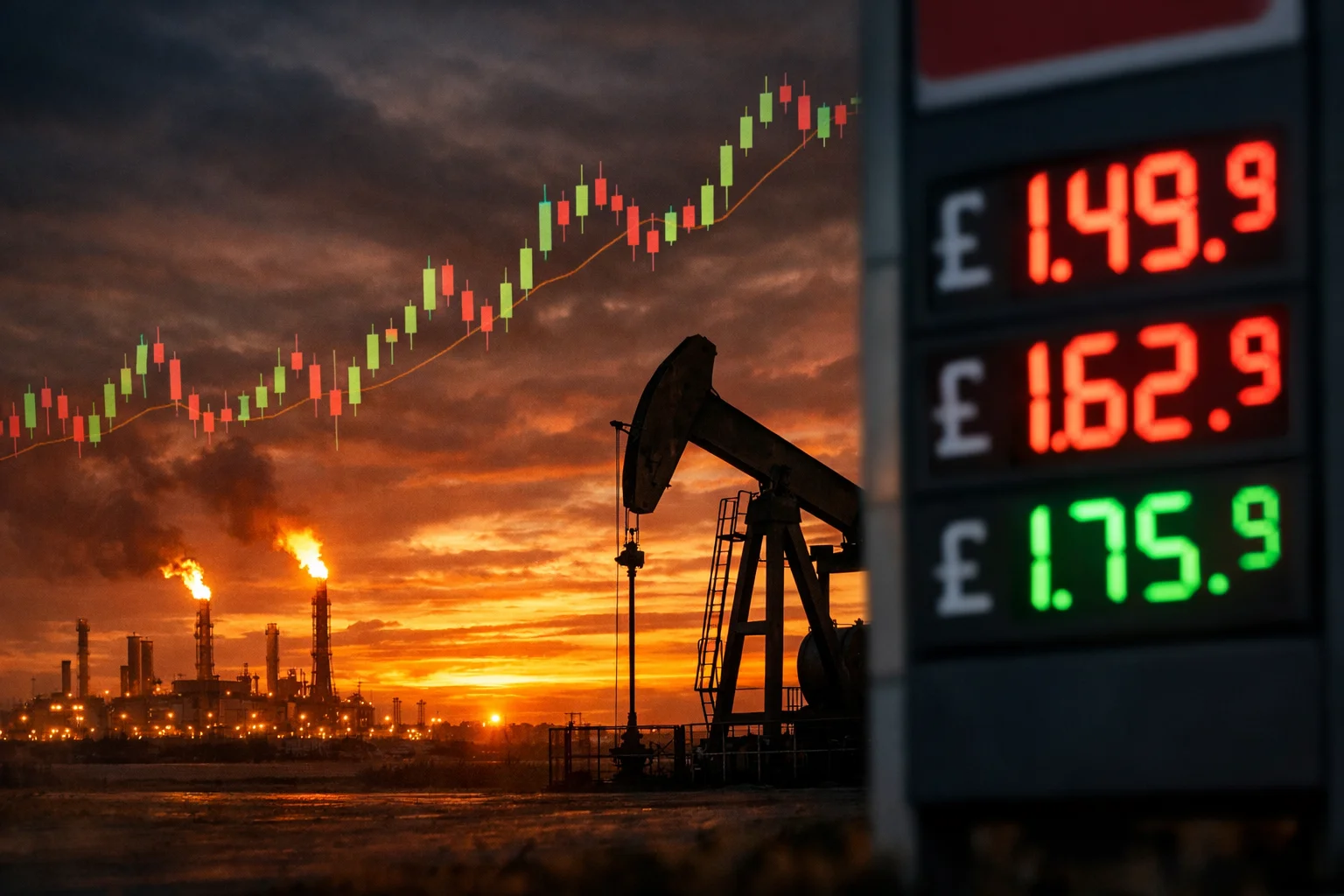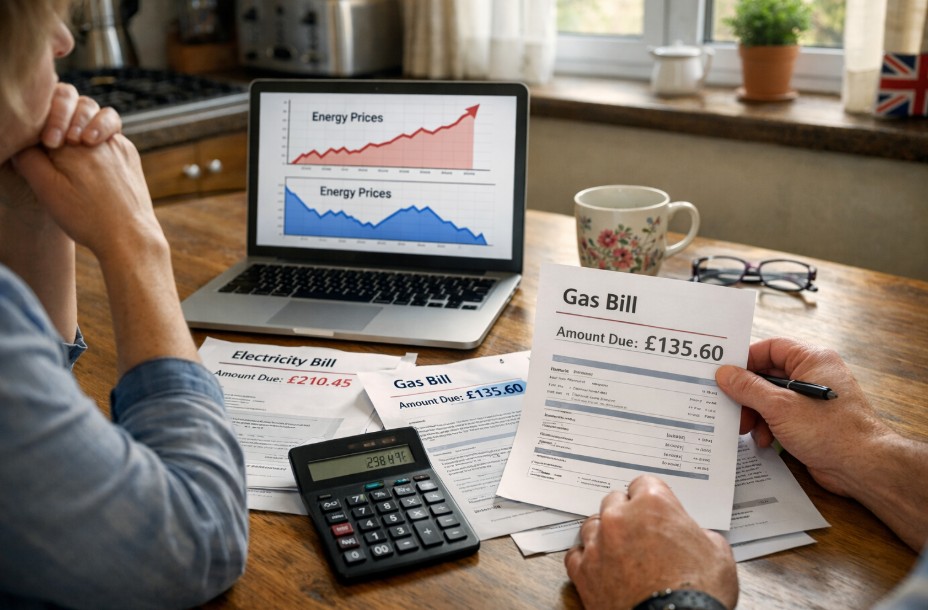
Are energy prices going up or down in the UK right now? The short answer is that energy prices are falling in early 2026, with the Ofgem energy price cap dropping to about £1,641 per year from April 2026, but forecasts suggest they could rise again later in the year depending on global gas markets and geopolitical events.
For UK households, this means short term relief on energy bills, although the situation remains uncertain. Prices are still significantly higher than they were before the energy crisis that began in 2021.
Key points you should know:
- The Ofgem energy price cap drops by around 6.7 percent from April 2026
- Average annual bills fall to £1,641 for a typical dual fuel household
- Analysts expect possible increases from July 2026
- Global gas prices and geopolitical tensions can quickly affect UK bills
- Energy costs remain much higher than pre 2021 levels
Understanding these changes can help you plan your household energy costs more effectively.
Are Energy Prices Going Up or Down in the UK Right Now?

If you are wondering whether energy prices are going up or down in the UK, the latest data shows that prices are currently falling slightly in early 2026. Ofgem announced that the energy price cap will decrease from April to June 2026, reducing the average household bill for customers paying by Direct Debit.
For a typical dual fuel household, the annual energy bill will fall to around £1,641, which is about £117 less than the previous cap level. This change reflects lower wholesale energy costs and adjustments in how some policy costs are applied to energy bills.
Although this reduction provides some relief, energy bills remain high compared with the period before the energy crisis.
Important factors affecting current energy prices include:
- Lower wholesale gas prices compared with peak crisis levels
- Government adjustments to certain policy costs in energy bills
- Stabilisation in global energy supply after major disruptions in recent years
- Market competition between UK energy suppliers
Another key point to understand is that the energy price cap does not limit your total bill. Instead, it limits the maximum amount suppliers can charge per unit of energy and for daily standing charges. Because of this, what you actually pay still depends on how much gas and electricity your household uses.
While prices are decreasing at the moment, many analysts warn that the situation could change later in 2026. Energy markets remain sensitive to global events and fluctuations in gas supply, which means UK households should remain prepared for possible changes in future price cap periods.
What Is the Ofgem Energy Price Cap and How Does It Affect Your Bills?
The Ofgem energy price cap plays a major role in determining what millions of UK households pay for gas and electricity. If you are on a standard variable tariff, which is common across the UK, the price cap sets the maximum rate energy suppliers can charge for each unit of energy.
The cap is updated every three months, which means your energy costs may change several times throughout the year depending on market conditions. Around 65 percent of households in England, Scotland and Wales are currently on tariffs affected by the price cap.
How the Price Cap Actually Works?
The energy price cap is designed to protect consumers from excessively high charges while still allowing energy suppliers to cover their costs.
Instead of limiting the total amount you pay, the cap regulates two main components of your energy bill:
- Unit rates for gas and electricity measured per kilowatt hour
- Daily standing charges which cover the cost of maintaining the energy network
Your final energy bill therefore depends on how much energy you use. If you use more electricity or gas than the typical household, your annual bill will be higher even if the price cap remains the same. The cap is calculated using a detailed formula published by Ofgem.
This formula considers several factors such as:
- Wholesale energy prices
- Network costs
- Environmental and social policy costs
- Supplier operating costs
Because wholesale energy prices change frequently, the cap is adjusted quarterly to reflect the latest market conditions.
Typical UK Energy Costs Under the Current Cap
The price cap has changed significantly in recent years. During the energy crisis, bills increased sharply before gradually falling again as wholesale gas prices stabilised.
The latest confirmed figures show the following changes for typical households:
| Period | Typical Annual Bill | Change |
| Jan–Mar 2026 | £1,758 | Baseline |
| Apr–Jun 2026 | £1,641 | ↓ 6.7% |
| Jul–Sep 2026 (forecast) | ~£1,710 | Possible rise |
Under the current cap period from January to March 2026, average unit prices are roughly:
- Electricity is about 27.69p per kWh
- Gas about 5.93p per kWh
Households also pay standing charges which are daily fixed costs for being connected to the energy network:
- Electricity standing charge is around 54.75p per day
- Gas standing charge around 35.09p per day
These figures vary slightly depending on your region and payment method.
Although the cap has decreased in April 2026, the key takeaway is that it simply limits the price per unit rather than the total bill. That means reducing energy usage remains one of the most effective ways to lower household costs.
Why Are Energy Prices Falling in April 2026?
The drop in the UK energy price cap in April 2026 is mainly linked to changes in wholesale energy costs and government policy adjustments.
After several years of extreme volatility during the energy crisis, wholesale gas prices have eased compared with the peaks seen in 2022 and 2023. Since wholesale gas plays a major role in electricity generation in the UK, lower gas prices often lead to lower electricity prices as well.
Several factors contributed to the April 2026 price cap reduction:
- Wholesale gas prices stabilised compared with previous crisis levels
- Government decisions shifted certain costs away from household energy bills
- Energy markets became less volatile compared with earlier years
- Improved supply conditions across European energy markets
These changes allowed Ofgem to reduce the price cap by around 6.7 percent, giving households modest financial relief. However, the reduction does not mean the energy crisis is fully over.
Energy prices are still significantly higher than they were before 2021, and the UK continues to rely on global gas markets for a large share of its energy supply.
Because global markets can change quickly, the fall in prices during early 2026 should be viewed as a temporary improvement rather than a permanent trend.
Could Energy Prices Rise Again Later in 2026?
Although energy prices are falling in early 2026, many forecasts suggest that bills could increase again later in the year. Energy markets remain unpredictable, and even small changes in global supply or demand can affect UK household bills.
Energy analysts and suppliers regularly publish forecasts for future price cap periods based on Ofgem’s public calculation method. These predictions give an idea of where prices may move, although they can change quickly as market conditions evolve.
July 2026 Price Cap Forecasts
Early forecasts suggest that the price cap may rise again from July 2026. Some projections estimate an increase of around 4 percent, which could raise the typical household bill to roughly £1,706 to £1,714 per year. This potential increase is mainly linked to recent rises in wholesale gas prices.
Several developments could push prices higher:
- Increased global demand for natural gas
- Supply disruptions affecting liquefied natural gas exports
- Geopolitical tensions influencing energy markets
- Rising costs within energy networks and infrastructure
Because the assessment period for the July cap only began recently, predictions remain uncertain. Energy traders and analysts emphasise that price forecasts can change significantly during the calculation period.
October 2026 Predictions
Forecasts for the final price cap period of 2026 are even more uncertain because the assessment window is further away. Some predictions suggest prices could stabilise around £1,700 to £1,720 per year, while others indicate small increases depending on market conditions.
Key factors influencing the October price cap include:
- Future wholesale gas price trends
- Weather conditions that affect energy demand
- Global energy supply disruptions
- Changes in UK energy infrastructure costs
The further into the future analysts try to forecast, the less accurate predictions become. Energy markets can change rapidly due to economic events, geopolitical tensions, or unexpected disruptions in global supply.
For UK households, this means the current drop in energy bills should be seen as short term relief rather than a guarantee of lower costs throughout the year. Monitoring price cap announcements and reviewing energy tariffs regularly can help you manage potential increases later in 2026.
How Global Events Could Push UK Energy Prices Up?
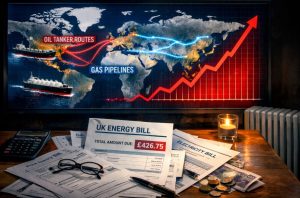
Global events play a major role in determining whether energy prices go up or down in the UK. Even though households receive energy from domestic suppliers, the UK energy market is closely connected to international gas and oil markets.
When global energy supply becomes uncertain, wholesale prices often increase. These increases eventually affect the Ofgem price cap and the amount households pay for gas and electricity.
Recent geopolitical tensions in the Middle East highlight how quickly energy markets can change. The region is a key supplier of global oil and liquefied natural gas, and disruptions there can influence energy costs worldwide.
Important global factors that can push UK energy prices higher include:
- Conflicts or political tensions in major energy producing regions
- Disruptions to liquefied natural gas exports
- Shipping risks in critical trade routes such as the Strait of Hormuz
- Sudden spikes in global demand for gas or oil
- Production interruptions at major energy facilities
When supply disruptions occur, wholesale gas prices can rise rapidly. The UK imports a significant share of its gas, which means global price changes can quickly affect domestic energy markets.
Higher gas prices also influence electricity costs because gas fired power stations often determine the price of electricity generation.
For UK households, this means global political or economic events can eventually translate into higher energy bills. Even if the price cap remains stable in the short term, prolonged market volatility may lead to future increases.
Why Energy Bills Are Still High Compared With 2021?
Although the price cap is falling in 2026, energy bills are still much higher than they were before the energy crisis began in 2021. During that period, wholesale gas prices surged dramatically due to several global developments.
One of the biggest factors was the disruption of gas supplies following geopolitical conflicts and reduced imports from major suppliers. At the same time, demand for energy increased as economies reopened after pandemic restrictions. Even though wholesale prices have declined since their peak, they remain above the levels seen before the crisis.
Other factors keeping energy bills higher include:
- Ongoing investment in energy infrastructure
- Increased network and system costs
- The UK’s continued reliance on imported gas
- The cost of transitioning towards cleaner energy sources
Because of these factors, energy costs have not returned to pre crisis levels. Many households are therefore still paying almost double what they paid for energy before 2021.
What These Energy Price Changes Mean for Your Household Bills?
Changes to the energy price cap directly affect how much many households pay for gas and electricity each year. When the cap falls, the maximum price suppliers can charge per unit decreases, which usually lowers average household bills.
For example, the April 2026 price cap reduction means a typical household could save about £117 per year compared with the previous cap period.
However, the exact amount you pay depends on several factors:
- How much energy your household uses
- Your payment method such as Direct Debit or quarterly billing
- Your regional standing charges
- Whether you are on a fixed tariff or a variable tariff
Households that use more energy will naturally pay higher bills even under the same price cap. If forecasts for July 2026 increases prove accurate, some of the savings from the April reduction could disappear later in the year. Monitoring tariff options and managing energy usage can therefore help keep costs under control.
Should You Fix Your Energy Tariff Now or Stay on the Price Cap?
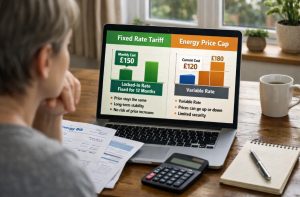
One of the biggest questions many households face is whether to fix their energy tariff or remain on a variable tariff protected by the price cap. The best choice depends on your personal circumstances and expectations about future energy prices.
The recent drop in the price cap has created new opportunities for households to consider fixed deals, although the decision should be made carefully.
When Fixing a Tariff Could Help?
Fixing your energy tariff means agreeing to a set price for gas and electricity over a specific period. This usually ranges from one to two years.
Fixing a tariff can provide several advantages:
- Protection against future price cap increases
- Greater certainty about monthly energy costs
- Easier budgeting for household expenses
- Stability during periods of market volatility
If forecasts suggesting higher prices from July 2026 are accurate, households with fixed tariffs could avoid paying those higher rates.
Some fixed deals are already priced close to the current price cap level. In certain cases, they may even be slightly cheaper depending on your location and energy usage.
However, fixed tariffs can also include exit fees if you want to leave the contract early. This means you should carefully compare available deals before switching.
When Staying on the Price Cap May Be Better?
Remaining on a standard variable tariff means your energy prices follow the Ofgem price cap as it changes every three months.
There are situations where staying on the cap could be beneficial:
- If you believe energy prices may fall again later
- If you prefer flexibility without long term contracts
- If fixed tariffs are currently more expensive than the cap
Some households prefer the flexibility of a variable tariff because it allows them to switch suppliers easily if better deals appear.
Energy experts often recommend regularly comparing tariffs and reviewing forecasts before making a decision. Since energy markets remain uncertain in 2026, both fixed and variable tariffs have advantages depending on future price movements.
Ultimately, the most suitable option depends on your risk tolerance and whether you prefer price stability or flexibility.
How You Can Reduce Your Energy Bills in 2026?
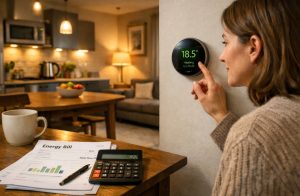
Even with the price cap falling slightly, energy bills remain a significant expense for many households. Fortunately, there are several ways you can reduce your overall energy costs in 2026.
One of the most effective strategies is simply using less energy through efficiency improvements and better household habits.
Simple actions that can help reduce your energy consumption include:
- Lowering your thermostat slightly during winter months
- Turning off appliances when they are not in use
- Improving home insulation to reduce heat loss
- Using energy efficient appliances and lighting
- Monitoring usage through smart meters
Switching tariffs can also help some households save money. Comparing suppliers regularly allows you to identify deals that may offer lower unit rates than your current tariff.
Another helpful step is choosing the right payment method:
- Paying by Direct Debit can often be cheaper than quarterly billing
- Some suppliers offer discounts for certain payment methods
- Fixed monthly payments can help spread costs throughout the year
If you are struggling with energy costs, you may also qualify for financial support schemes provided by energy suppliers or government programmes.
Reducing energy consumption combined with choosing the right tariff can significantly lower your household energy expenses over time.
Long Term Outlook: What Could Happen to UK Energy Prices After 2026?
Looking beyond 2026, the long term outlook for UK energy prices will depend on how the country’s energy system evolves.
Several major changes are expected in the coming years as the UK works towards improving energy security and reducing carbon emissions. A key goal is reducing reliance on imported fossil fuels, particularly natural gas.
Several developments could influence future energy costs:
- Expansion of renewable energy sources such as wind and solar
- Increased investment in domestic energy generation
- Improvements in energy storage technology
- Upgrades to national electricity networks
- Greater energy efficiency across homes and businesses
If renewable energy capacity continues to grow, the UK may become less exposed to volatile global gas markets. This could help stabilise energy prices over time.
However, the transition to cleaner energy also requires significant investment. Some of these costs may initially be reflected in energy bills.
Overall, while short term price fluctuations are likely to continue, long term reforms aim to create a more stable and resilient UK energy market.
Conclusion
Energy prices in the UK are currently falling slightly in early 2026, with the Ofgem price cap dropping to around £1,641 per year for a typical household from April. This reduction offers short term relief after several years of extremely high energy bills.
However, forecasts suggest the situation may change later in the year. Analysts expect possible increases from July 2026 if wholesale gas prices rise or global supply disruptions continue.
The key point for households is that energy markets remain unpredictable. Global events, gas supply changes, and market demand can all influence future price cap decisions.
Although prices are lower than recent peaks, they remain significantly higher than pre crisis levels.
Staying informed about price cap updates, comparing tariffs, and reducing energy usage can help you manage household energy costs more effectively.
FAQs
Why do UK energy prices change every three months?
The Ofgem energy price cap is updated every three months to reflect changes in wholesale energy costs and supplier expenses. This ensures that prices stay aligned with current market conditions.
What is the typical UK household energy usage used for price cap calculations?
Ofgem calculates the typical household bill using average consumption of about 2,700 kWh of electricity and 11,500 kWh of gas per year. Actual bills vary depending on individual household usage.
Are energy prices expected to fall further after 2026?
Future price trends depend on global gas markets, supply conditions, and energy demand. While prices could stabilise, significant reductions are uncertain in the short term.
Do fixed energy tariffs protect you from price cap changes?
Yes, fixed tariffs lock in your energy price for a set period so your rates will not change if the price cap rises. However, you may not benefit if the cap falls during your contract.
How do wholesale gas prices affect electricity costs in the UK?
Gas fired power stations often set the market price for electricity in the UK energy system. When wholesale gas prices increase, electricity costs typically rise as well.
Will global conflicts increase UK energy bills?
Conflicts in major energy producing regions can disrupt supply and increase global energy prices. These increases can eventually lead to higher UK energy bills.
What is the best way to lower your energy bill in the UK?
Reducing energy consumption through efficiency improvements and choosing competitive tariffs are two of the most effective ways to lower bills. Regularly comparing energy suppliers can also help identify cheaper deals.