


UK founders have watched the rules change fast. Corporation tax sits at 25% on profits above £250,000, the non-dom regime disappeared in April 2025, and inheritance relief on trading businesses has been capped for the first time in decades.
Many are now putting spare capital into Dubai property instead of another UK asset.
British buyers are the second largest group of international purchasers in Dubai’s property market this year, drawn by rental yields UK landlords have not seen in a generation.
Here is what is actually pulling entrepreneurs towards the emirate, and what the process of purchasing there involves once you look past the headlines.
Key Takeaways
- UK corporation tax is now 25% on profits above £250,000, with marginal relief up to 26.5% in between.
- Dubai’s average gross rental yield runs 6% to 9%, against roughly 3% to 4% in London.
- An AED 2 million property purchase can unlock a 10 year UAE Golden Visa.
- There is no personal income tax or capital gains tax on Dubai property in the UAE.
- British buyers now rank second among all overseas purchasers in the Dubai property market.
Why UK Founders Are Looking Beyond Britain?
The tax landscape for UK entrepreneurs has shifted more in the past two years than in the previous decade. The non-dom regime ended on 6 April 2025, replaced by a four year Foreign Income and Gains regime that mainly benefits genuinely new arrivals to the UK.
For founders who already built their businesses here, that change removed a long standing option for sheltering foreign income and gains.
- Corporation tax: 25% main rate above £250,000, 19% up to £50,000, with marginal relief between the two
- Non dom regime: abolished from 6 April 2025, replaced by the residence based Foreign Income and Gains regime
- Business Property Relief: 100% relief now capped at £2.5 million combined with agricultural property, with 50% relief above that from 6 April 2026
Key stat: From 6 April 2026, only the first £2.5 million of qualifying business assets passes free of inheritance tax. Anything above that faces an effective 20% charge on the excess.
None of this makes running a UK company unworkable. It does make diversifying overseas look different than it did five years ago, and property in a market with no personal income tax is one of the more straightforward places to start.
That is why more founders are researching how to buy a house in Dubai as a way to move part of their wealth into an asset class that behaves very differently from a UK portfolio.
Why the Numbers Favour Dubai?
Rental yields are where the comparison gets stark. Dubai’s average gross yield across all communities runs between 6% and 9%, and mid market areas such as Jumeirah Village Circle regularly clear 8% to 9%. London, by contrast, averages closer to 3% to 4%, and net returns for higher rate taxpayers often sit well below that.
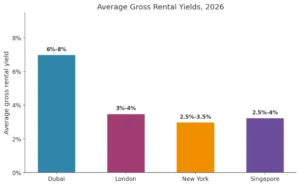
Two structural differences explain most of the gap. The UAE charges no personal income tax on rental income and no capital gains tax when a property is sold. UK landlords pay income tax on rent at their marginal rate and capital gains tax of up to 24% on any profit when they sell.
Average gross yields in Dubai run at more than double London’s rate, before UK income tax and capital gains tax are even factored in.
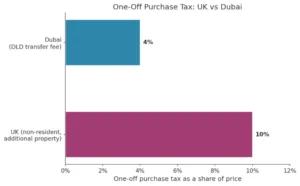
A one off Dubai Land Department transfer fee of 4% applies at the point of purchase, and that largely covers the transactional tax burden in the UAE. There is no annual property tax and no stamp duty in the way UK buyers are used to.
How UK Entrepreneurs Are Actually Buying?
Foreign nationals, including UK citizens, can buy freehold property in designated areas of Dubai without needing a UAE visa or a local sponsor. Popular freehold zones include Business Bay, Downtown Dubai, Dubai Marina, Palm Jumeirah, Dubai Hills Estate and Jumeirah Village Circle.
- Confirm the property sits inside a designated freehold area
- Agree terms and pay a reservation deposit, typically around 10%
- Sign the Memorandum of Understanding and complete anti money laundering checks
- Transfer funds through a regulated route and complete registration at the Dubai Land Department
- Register the title deed, which cash buyers can often finalise in 2 to 4 weeks
Pro tip: Send large transfers through a regulated FX broker rather than a UK high street bank. The spread on a six figure transfer can run into thousands of pounds either way.
For founders already weighing up the cash impact of a major purchase, the real cost of running a UK startup in 2026 is worth reading alongside any figures a Dubai agent gives you.
Anyone still assuming the old rules apply should also check how the current Foreign Income and Gains regime treats income and gains brought back into the UK, since the rules changed substantially in 2025.
Property as a Route to Residency
A growing number of buyers are not only chasing yield. Property worth AED 2 million or more, roughly £430,000 at current exchange rates, still qualifies for the UAE’s 10 year Golden Visa even after wider 2026 reforms to shorter term investor visas.
| Requirement | Detail |
| Minimum property value | AED 2,000,000 (roughly £430,000) |
| Visa length | 10 years, renewable |
| Multiple properties | Can be combined to reach the threshold |
| Family sponsorship | Spouse, children and parents can be included |
| Off plan and mortgaged property | Both count, provided total value meets the threshold |
Full eligibility rules sit on the Dubai Land Department’s Golden Visa service page, including the paperwork needed from mortgage lenders.
The visa itself grants residency, not citizenship, and it does not automatically change a UK entrepreneur’s tax position at home. Anyone planning to spend serious time in Dubai should take advice on the UK’s statutory residence test before assuming their UK tax bill falls too.
What Buyers on the Ground Are Finding?
The experience of first time buyers matters as much as the headline numbers.
One review of Intra Capital Estates on the property review platform GetAgent describes a first time buyer who found the team confidently answered questions a larger, more corporate agency struggled with, rating the personal service well above a major mainstream London chain.
That kind of individual attention matters even more when a purchase sits in a different country and legal system, which is exactly the gap Dubai focused agencies are built to close for UK buyers.
Getting the Structure Right
None of this replaces proper advice. A UK entrepreneur buying in Dubai should involve a UK tax adviser, a Dubai based conveyancer, and ideally a currency specialist before any deposit changes hands.
This video walks through the practical steps of buying in Dubai as an overseas investor, from area selection to closing.
Founders juggling company profits with a personal purchase like this often find it useful to run the numbers through a UK corporation tax calculator first, so the two decisions do not get mixed up.
It is also worth checking likely UK liabilities with a capital gains tax calculator before assuming a Dubai sale years down the line will be entirely tax free back home.
Bought correctly, a Dubai property sits alongside a UK business rather than competing with it. Bought in a hurry, it becomes another line item a founder has to unpick later.
The Bottom Line
UK tax changes have not created a golden ticket to Dubai, but they have narrowed the gap between staying put and diversifying abroad.
Combined with returns British landlords have rarely matched at home and a genuine route to residency, Dubai property has moved from a lifestyle purchase to a considered part of many founders’ portfolios.
Anyone weighing it up should treat the numbers with the same rigour they would apply to a UK acquisition, get proper advice on both sides of the transaction, and remember that a strong yield on paper is only ever the start of the calculation.
Frequently Asked Questions
Can UK citizens buy property in Dubai without a visa?
Yes. Overseas nationals can own freehold units in Dubai’s approved zones without holding a UAE visa or using a local sponsor. A visa only becomes relevant if you plan to live there or apply for residency through the Golden Visa route.
How much do UK investors need to invest for a Dubai Golden Visa?
You need property worth at least AED 2 million, around £430,000, to qualify for the 10 year Golden Visa. Multiple properties can be combined to reach that threshold, and both ready and approved off plan units count.
Do UK investors pay tax on Dubai rental income?
The UAE applies no personal income tax to rental income and no capital gains tax when a property sells. UK residents still need to declare Dubai income and gains on their UK tax return under normal residence based rules.
Are Dubai rental yields really higher than London?
Generally yes. Dubai’s typical gross yield sits between 6% and 9%, compared with roughly 3% to 4% in London. Net returns depend heavily on service charges, financing costs and the buyer’s UK tax position.
What areas of Dubai can foreign buyers own property in?
Freehold ownership for foreign buyers is limited to designated areas, including Business Bay, Downtown Dubai, Dubai Marina, Palm Jumeirah, Dubai Hills Estate and Jumeirah Village Circle. Buying outside these zones as a foreign national is not permitted.