

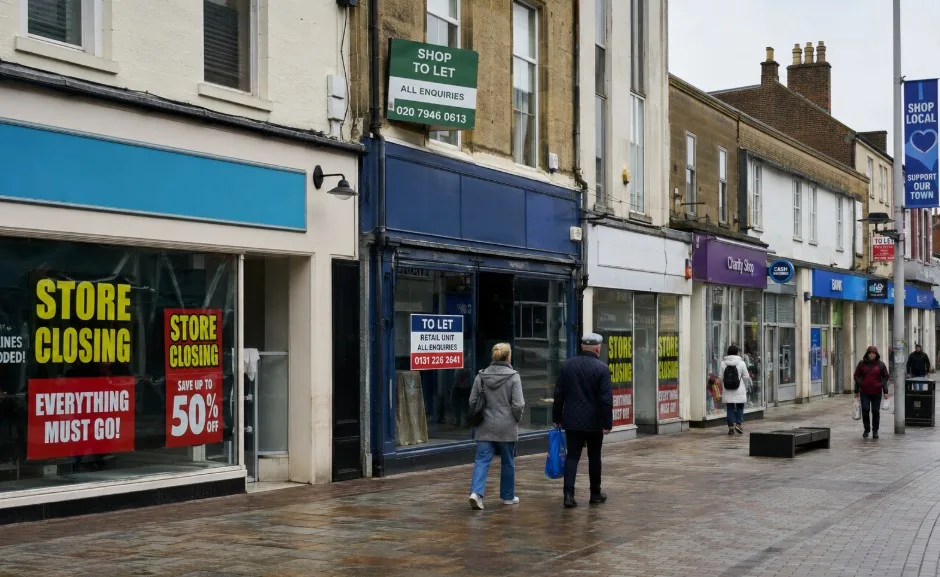
UK high street store closures are continuing at a significant pace in 2026, with major retailers, banks, supermarkets and charity organisations announcing hundreds of branch and store shutdowns across Britain.
The main reasons include rising operating costs, changing consumer spending habits, increased online competition and ongoing efforts by businesses to improve profitability.
While these closures are creating challenges for local communities and employees, they also highlight a broader transformation of the UK retail landscape rather than the complete decline of the high street.
Key points:
- Quiz is closing all remaining standalone stores following its administration process.
- Morrisons Daily is set to close around 100 convenience stores across the UK.
- Lloyds Bank, Halifax, NatWest and RBS are continuing branch closure programmes as digital banking usage rises.
- British Heart Foundation and Cancer Research UK have announced significant charity shop closures amid rising costs.
- River Island, Phase Eight, Claire’s and other high street retailers are reducing store numbers as they adapt to changing consumer behaviour.
- The UK high street is evolving towards a more experience-led and digitally integrated future.
Why Are UK High Street Store Closures Accelerating In 2026?
The current wave of UK high street store closures is being driven by a combination of economic and consumer trends. Retailers are facing higher operating costs than at any point in recent years. Increased National Insurance contributions, wage growth, energy bills, commercial rents and business rates continue to squeeze profit margins.
At the same time, consumer habits have changed significantly. More shoppers are purchasing online, using click-and-collect services, or choosing digital banking instead of visiting branches.
Drivers behind 2026 closures:
| Factor | Impact on Businesses |
| Rising wage costs | Higher staffing expenses |
| Energy price increases | Reduced profitability |
| Online shopping growth | Lower store footfall |
| Business rates | Increased operating costs |
| Inflation | Reduced consumer spending |
| Digital banking adoption | Less need for physical branches |
A senior UK retail consultant recently observed:
“The challenge for retailers is no longer simply attracting customers into stores. It is creating a reason for customers to visit physical locations at all.”
These pressures have encouraged companies to focus investment on their strongest-performing locations while closing underperforming sites.
Which Major UK Brands Are Closing Stores In 2026?
Several well-known brands have announced closures or restructuring programmes during 2026. The affected businesses span fashion retail, banking, grocery convenience stores and charitable organisations.
Fashion Retailers Facing Store Closures
Fashion retailers remain among the hardest-hit sectors. Quiz has become one of the most high-profile examples, with all remaining standalone stores scheduled to close following administration proceedings.
Other retailers facing store reductions include:
- River Island
- Phase Eight
- Ted Baker
- Whistles
- Claire’s
- House of Fraser
Many of these businesses are adjusting to changing consumer behaviour and growing competition from online-only retailers.
Banks, Supermarkets and Charity Shops Reducing Branches
Banks continue to reduce their physical presence as digital banking adoption grows. Lloyds Banking Group, Halifax, NatWest and RBS have all announced further branch closures.
Meanwhile, Morrisons plans to close approximately 100 Morrisons Daily convenience stores, while major charities such as the British Heart Foundation and Cancer Research UK have announced plans to reduce retail locations.
Notable brands affected:
| Sector | Brand | Reported Closure Activity |
| Fashion | Quiz | All remaining standalone stores |
| Fashion | River Island | Selected stores |
| Grocery | Morrisons Daily | Around 100 stores |
| Banking | Lloyds Group | Multiple branch closures |
| Banking | Halifax | 48 branches |
| Charity | British Heart Foundation | Up to 150 shops |
These developments highlight how widespread restructuring has become across the UK retail landscape.
Why Are Fashion Retailers Such as Quiz, Phase Eight and River Island Under Pressure?
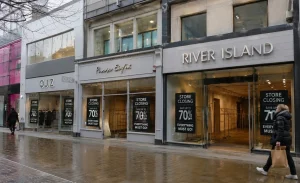
Fashion retail has arguably experienced some of the most dramatic disruption. Consumers increasingly compare prices online, order multiple sizes for home delivery and return unwanted items with ease.
Many traditional retailers are therefore managing two expensive operations simultaneously: maintaining physical stores while investing heavily in digital infrastructure.
For brands like Quiz, financial challenges eventually led to administration. Meanwhile, other retailers are reducing their physical presence to concentrate on profitable locations and online sales channels.
Retail analysts point to several ongoing challenges:
- Intense online competition
- Rising logistics costs
- Reduced discretionary spending
- High property expenses
- Changing shopping behaviour among younger consumers
The result is a sector that continues to undergo significant transformation throughout 2026.
How Are Bank Branch Closures Changing Access to Financial Services?
Bank branch closures remain one of the most significant developments affecting local communities. While digital banking adoption continues to grow, many customers still rely on physical branches for everyday financial services.
Lloyds, Halifax, NatWest and RBS Branch Closure Plans
Major banking groups have announced extensive closure programmes extending into 2026 and 2027. Lloyds Banking Group alone has announced dozens of additional branch closures, while NatWest and RBS are also reducing their networks.
Banking closure overview:
| Banking Group | Planned Closures |
| Lloyds Bank | 31 branches |
| Halifax | 48 branches |
| NatWest | 12 branches |
| Royal Bank of Scotland | 6 branches |
What Banking Closures Mean for Older and Vulnerable Customers
Many older customers continue to prefer face-to-face banking services. Rural communities can be particularly affected when a local branch closes, potentially requiring longer travel times for essential banking activities.
Consumer groups have raised concerns about financial inclusion and accessibility as branch networks continue to shrink.
The Role of Banking Hubs and Post Office Services
To address accessibility concerns, banks have increasingly supported shared banking hubs and expanded partnerships with the Post Office network.
A spokesperson from a UK financial services body noted:
“Banking hubs are becoming a critical bridge between digital services and face-to-face support for local communities.”
While these solutions help, they may not fully replace the convenience of traditional branches for some customers.
What Is Driving Charity Shop Closures Across The UK?
Charity retailers are facing many of the same challenges as commercial businesses. Rising staff costs, energy prices and reduced footfall are affecting fundraising operations across the sector.
British Heart Foundation plans to close approximately 150 shops, while Cancer Research UK has announced plans affecting around 90 locations.
Charity retail pressures:
| Challenge | Effect |
| Rising wages | Increased operating costs |
| Energy bills | Reduced fundraising surplus |
| Lower footfall | Fewer sales opportunities |
| Online resale competition | Reduced market share |
| Inflation | Higher overall expenses |
Many charities rely heavily on shop income to fund essential services. Consequently, closures can have implications far beyond retail.
Despite these challenges, many organisations are investing in e-commerce platforms and online marketplaces to diversify revenue streams. This adaptation may help charities remain sustainable in a changing retail environment.
How Are Morrisons Daily and Convenience Store Closures Affecting Local Communities?
The closure of around 100 Morrisons Daily stores has attracted significant attention because convenience stores often serve as important community assets.
Loss-Making Stores and Retail Restructuring
Many of the affected locations originated from Morrisons’ acquisition of McColl’s stores. Despite efforts to improve performance, some sites reportedly remained loss-making.
Businesses increasingly evaluate individual store profitability rather than maintaining large networks for brand visibility alone.
Why Post Office Counters Matter in Smaller Towns?
Several convenience stores also provide access to Post Office services. When these stores close, residents may lose nearby access to postal services, bill payments and banking transactions.
Community concerns include:
- Longer travel times for essential services
- Reduced local shopping options
- Lower footfall for neighbouring businesses
- Potential job losses
These concerns are particularly relevant in smaller towns where alternative facilities may be limited. Consequently, store closures often have wider social implications than many people realise.
What Do UK High Street Store Closures Mean for Jobs, Landlords and Local Economies?
Store closures create ripple effects throughout local economies. Employees face uncertainty, landlords experience vacant units, and nearby businesses may lose passing trade.
Economic impact overview:
| Stakeholder | Potential Impact |
| Employees | Redundancies or relocation |
| Landlords | Vacant retail units |
| Local councils | Reduced business activity |
| Nearby retailers | Lower footfall |
| Consumers | Reduced choice |
For town centres already facing economic challenges, multiple closures can accelerate decline. However, many councils are responding through regeneration projects designed to attract new businesses and services.
Can Online Shopping, Resale Apps and Changing Consumer Habits Explain the Decline?
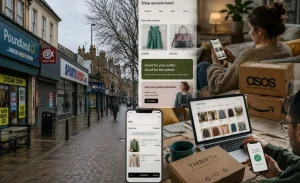
Changing consumer behaviour plays a major role in the evolution of the high street. Platforms such as Vinted, Depop, eBay and Facebook Marketplace have transformed how people buy and sell products.
Younger consumers increasingly prioritise convenience, value and sustainability. Rather than visiting multiple shops, many now compare products online within minutes.
A retail sector analyst recently commented:
“The future of retail belongs to businesses that seamlessly combine digital convenience with compelling in-store experiences.”
This shift does not necessarily signal the end of physical retail. Instead, it highlights the need for businesses to offer experiences that online platforms cannot replicate.
What Is the Future of the UK High Street Beyond 2026?
Despite the growing number of UK high street store closures, the future is not entirely negative. Retail experts increasingly view the high street as evolving rather than disappearing.
Future town centres are likely to feature a broader mix of uses, including healthcare facilities, leisure venues, hospitality businesses, flexible workspaces and community services.
Retailers that remain on the high street are expected to focus on:
- Experiential shopping
- Personalised customer service
- Click-and-collect convenience
- Community engagement
- Omnichannel retail strategies
As consumer expectations continue to change, successful high streets will likely become destinations that offer more than traditional shopping alone.
Conclusion
UK high street store closures in 2026 reflect a significant shift in how businesses operate and how consumers shop.
While major brands across retail, banking, supermarkets and charity sectors continue to reduce their physical presence, the high street is not disappearing entirely. Instead, it is evolving to meet changing consumer expectations and economic realities.
Businesses that successfully combine digital innovation with strong local engagement are likely to thrive, while town centres increasingly transform into multi-purpose destinations focused on services, experiences and community needs.
FAQs About UK High Street Store Closures
Are all UK high street store closures permanent?
Not always. Some closures are temporary, while others involve relocations, restructurings or rebranding initiatives.
What should customers do if a store closes before they use a gift card?
Customers should review the retailer’s terms and conditions and use gift cards as soon as possible where closure announcements have been made.
Can employees claim redundancy if their retail store shuts?
Employees may be entitled to redundancy rights depending on their employment status, length of service and company circumstances.
Will more UK banks close branches after 2026?
Many industry forecasts suggest branch consolidation is likely to continue as digital banking adoption increases.
Are charity shops being replaced by online resale platforms?
Not entirely. While online platforms create competition, charity shops continue to offer community value and support charitable causes.
How can local councils support struggling high streets?
Councils can encourage regeneration projects, support small businesses, improve infrastructure and attract mixed-use developments.
Which types of retailers may still grow on the UK high street?
Convenience retail, health services, hospitality businesses, leisure operators and experience-focused retailers are expected to perform strongly.