
Power plants and utility companies keep the lights on, water flowing, and cities running. But behind the scenes, the systems that control turbines, grids, and substations are facing growing cyber risks.
These operational technology (OT) systems were built for safety and uptime—not for today’s connected world. As more equipment goes online, attackers now have more ways to get in, disrupt service, or cause real-world damage.
For power generation and utilities, OT security is no longer just an IT issue. It’s a business, safety, and public trust issue. Understanding these risks is the first step to protecting critical infrastructure
Understanding the Expanding Attack Surface
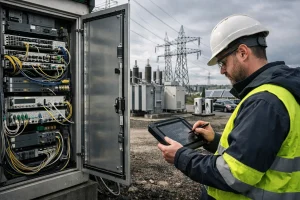
The notion of isolated power systems? Gone. Distributed energy installations, microgrid implementations, electric vehicle charging infrastructure, and smart meter deployments have woven a massive interconnected fabric that reaches far beyond conventional control rooms.
Cloud analytics, digital twin simulations, SaaS-based historian platforms all bring tremendous operational value while simultaneously introducing exposure you can’t ignore.
Remote operations aren’t the exception anymore; they’re standard procedure.
Field technicians troubleshoot from tablets, third-party vendors tunnel in for scheduled maintenance, and your corporate network often has direct pathways into operational zones. Every single one of these connection points is something adversaries actively probe.
If you’re managing the ot security, you need to accept this: the perimeter dissolved years ago, and that air gap everyone relied on is effectively extinct across most utility infrastructures.
Why are OT security risks accelerating at this pace? Start by examining who’s launching these attacks—and recognize how fundamentally the grid itself is transforming.
Threat Landscape Shaping Utility OT Cybersecurity (2024–2026)
Nation-State Actors and Criminal Groups
Nation-state teams aren’t just testing defenses they’re planting footholds for future activation. Objectives span intelligence gathering to establish persistent backdoors deployable during geopolitical crises.
Criminal organizations, on the other hand, have figured out that utilities absolutely cannot tolerate downtime. Ransomware paired with data extortion? Extremely profitable.
Hacktivist operations and automated scanning against publicly exposed OT services have exploded in frequency. These attackers often lack sophistication, but they compensate through persistence and opportunism exploiting whatever misconfigurations or sloppy access policies they stumble across.
Grid Modernization Increasing Exposure
Renewable integration and grid-edge proliferation mean vastly more endpoints, more communication protocols, and more remote management channels. Inverter-based generation and battery storage installations frequently depend on networked control software never architected with adversarial scenarios in mind.
Common Entry Points
Remote access solutions VPNs, jump servers, RDP sessions, VNC connections represent premium targets. Vendor maintenance pathways routinely use static credentials and receive inadequate oversight.
Poorly segmented networks where corporate IT merges directly with OT create express lanes for lateral movement once attackers breach the perimeter.
Now that we’ve charted the threat actors and attack surfaces transforming utility OT cybersecurity, let’s pinpoint the specific OT security risks carrying the gravest operational, safety, and reliability implications across generation infrastructure and transmission assets.
Highest-Impact OT Security Risks Across the Power Generation Lifecycle
SCADA Security Gaps
SCADA security breakdowns typically begin with weak authentication and zombie accounts nobody’s audited in years. Default credentials remain shockingly prevalent, and protocols like Modbus, DNP3, IEC-101/104, and OPC Classic sit exposed, allowing adversaries to communicate directly with industrial controls. Engineering workstations and HMIs configured with excessive permissions make things worse.
Asset Visibility Blind Spots
Undocumented IIoT sensors, cellular gateways buried in equipment cabinets, and serial-to-Ethernet adapters create shadow OT that security programs never touch. Contractor laptops connecting temporarily and untracked maintenance gear further erode what little visibility you have.
Patch Constraints and Legacy Systems
Obsolete Windows instances and unpatched embedded controllers are endemic across generation sites and substations. Scheduled outage windows rarely sync with security patch availability, forcing reliance on compensating controls that may or may not actually mitigate risk.
Identity and Access Weaknesses
Shared operator logins on HMI screens and SCADA consoles? Still everywhere. Poor privilege boundaries between operators, engineers, and external vendors multiply exposure unnecessarily, and multi-factor authentication rarely protects remote access to operational networks.
Understanding where vulnerabilities exist is only part of the equation next, let’s trace how attackers string these weaknesses together, progressing from initial breach to direct manipulation of power grid cybersecurity operations.
Realistic Attack Paths Against Grid Operations

From IT Foothold to OT Impact
Initial compromise usually happens via email phishing, VPN exploitation, or vulnerable internet-facing devices. Attackers then steal credentials and pivot laterally toward OT jump hosts. Once they’re inside operational segments, they map infrastructure, interact with industrial protocols, and execute control commands.
SCADA Compromise Scenarios
Suppressing alarms, corrupting historian records, and feeding false sensor data can trick operators into dangerous decisions. Protocol replay attacks and unauthorized breaker operations represent direct physical-impact pathways that you should absolutely rehearse during tabletop exercises.
Attack progression varies dramatically depending where adversaries establish their initial foothold generation plants face different threat scenarios than transmission substations or distribution circuits.
OT Security Risk Hotspots by Utility Domain
Generation Facilities
Turbine controls, generator excitation systems, balance-of-plant automation, and emissions monitoring equipment all depend on networked control systems.
Renewable facility controllers and inverter interfaces pose unique challenges often newer technology, but frequently less hardened than decades-old legacy platforms.
Transmission and Substations
Substation local networks, IEC 61850 deployments, and protective relay engineering access concentrate significant risk. Teleprotection circuits and telecommunications infrastructure MPLS networks, microwave links, fiber backbones represent critical dependencies attackers can sever.
Distribution Networks
Field devices like automated reclosers, capacitor banks, and fault location systems are routinely accessible remotely with minimal authentication. Advanced metering head-ends require strict segregation from operational control networks.
With domain-specific exposures mapped, you need a framework that translates OT security risks into quantifiable impacts on safety, reliability, and regulatory compliance language your leadership actually understands.
Risk Quantification for Critical Infrastructure Cybersecurity
Consequence-Driven Scoring
Critical infrastructure cybersecurity investment decisions should rank threats by safety impact, service interruption potential, physical equipment damage, and environmental consequences. Regulatory penalties and brand damage matter, sure but operational outcomes must drive prioritization.
Translating Events into Reliability Metrics
Customer interruption minutes, SAIDI/SAIFI degradation, and mean-time-to-restore translate security incidents into metrics executives recognize. Cascading failures and black-start complications make OT incidents fundamentally different animals than IT data breaches.
Armed with consequence-based prioritization, you can now implement practical defenses that reduce power grid cybersecurity exposure without crippling 24/7 operations.
Key Strategies for Reducing OT Security Risks
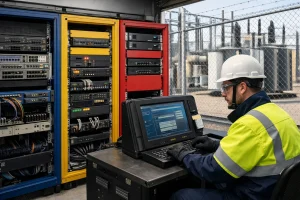
Network Segmentation and Secure Conduits
Zones-and-conduits architectures separate control centers, substations, generation facilities, and DMZ environments. Unidirectional gateways and hardware data diodes protect historian feeds and telemetry streams. Microsegmentation combined with protocol filtering chokes off lateral movement.
Remote Access Hardening
Multi-factor authentication paired with endpoint health validation and just-in-time provisioning dramatically shrinks vendor and workforce attack surfaces. Privileged access management tailored for OT accounts, session recording, and time-limited vendor permissions stack defenses attackers must overcome sequentially.
Detection and Monitoring for SCADA Security
Passive network monitoring establishes protocol behavior baselines without touching production systems. Centralized logging enriched with OT context generates actionable alerts logic modifications, relay parameter changes, firmware updates, unexpected remote sessions that warrant immediate investigation.
Technical controls deliver maximum value when aligned with regulatory mandates here’s how to make SCADA security investments satisfy NERC CIP, IEC 62443, and NIST frameworks without descending into a checkbox compliance theater.
Final Thoughts on Protecting Power Operations
OT security risks affecting power generation and utility operations aren’t abstract concerns they’re immediate operational realities impacting safety, reliability, and public confidence daily.
The IT-OT convergence, explosive growth of renewable and distributed energy technologies, and relentless pressure from nation-state and criminal adversaries create enormous challenges.
But utilities emphasizing visibility, segmentation, access governance, continuous monitoring, and incident preparedness can operate with confidence as threats evolve. The grid’s future hinges on security that functions in actual operational contexts not just PowerPoint presentations.
Common Questions About Utility OT Security
What are some examples of security standards for OT?
Standards provide frameworks for protective measures. Key examples: ISO/IEC 27019:2017 targeting energy utilities, ISO/IEC 15408-1:2009 for information security evaluation, ISA/IEC 62443 addressing industrial automation security. Each defines control requirements suited to operational constraints.
What is a major challenge of cybersecurity in power systems?
Attack vectors targeting distribution and transmission infrastructure. Adversaries exploit multiple pathways to compromise transmission or distribution system operator networks, aiming to trigger blackouts or severe grid instability.
How can utilities secure legacy PLCs and DCS systems that cannot be patched?
Deploy compensating controls: network segmentation isolates vulnerable assets, unidirectional gateways prevent unauthorized commands, application allowlisting blocks malicious executables, and passive monitoring identifies anomalies. Maintain write-protected configuration backups enabling fast restoration.