

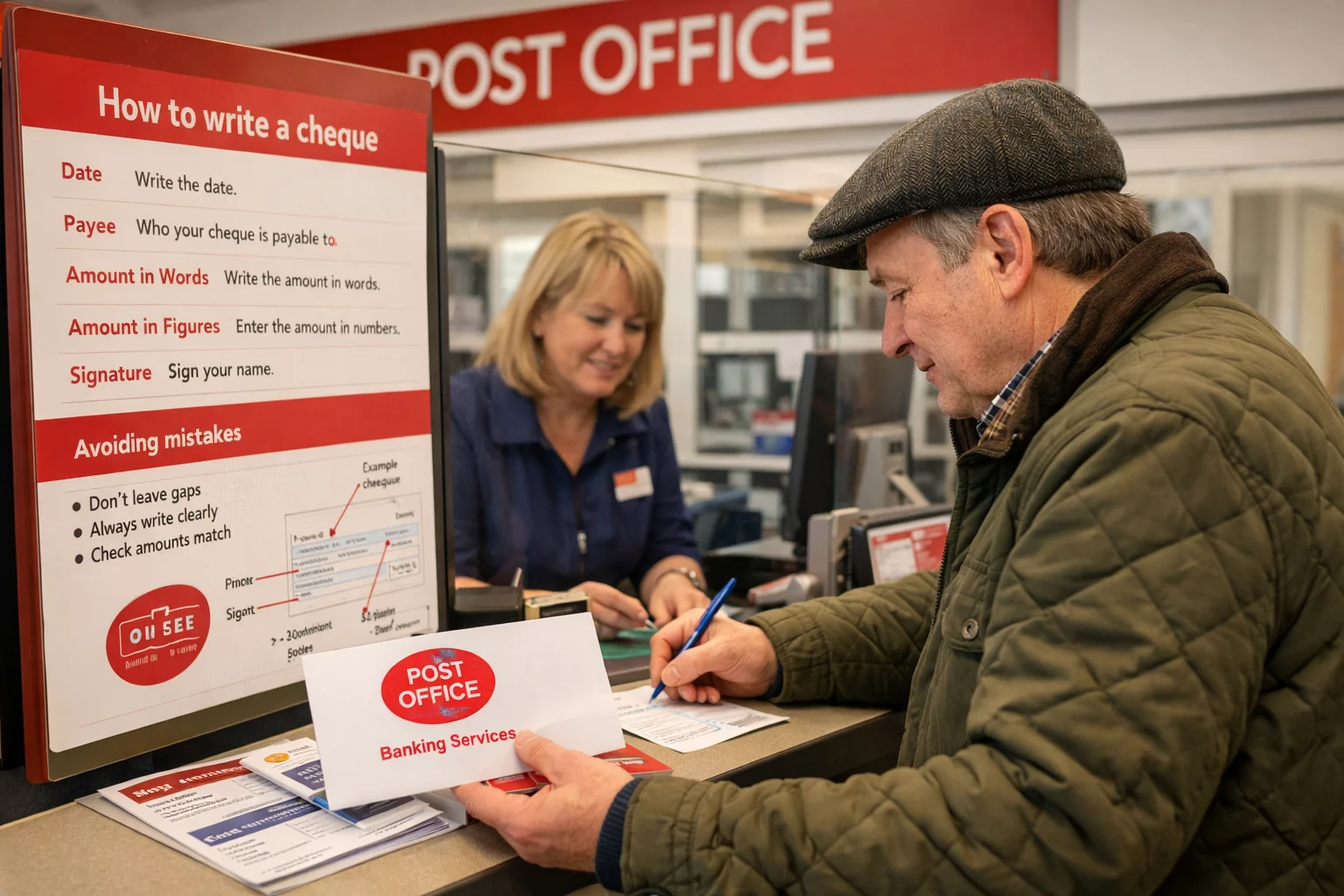
Banking should be convenient, especially when it comes to something as routine as paying money into your account. With more traditional bank branches closing across the UK, I wanted a reliable way to manage deposits without travelling far. That’s when I looked into using the Post Office, and discovered just how practical it really is.
Yes, you can deposit both cash and cheques into your UK bank account at most Post Office branches. It’s a secure, accessible option that supports a wide range of personal and business accounts.
Here’s what you need to know:
- Cash deposits require your debit card and PIN
- Cheques need a paying-in slip and bank-branded envelope
- Most major UK banks are supported, with defined limits and processing times
So, if you’re wondering exactly how it works, what you need, and which banks are supported, this article breaks it all down clearly and simply. Let’s get started.
Is It Possible to Deposit Money into My Bank Account at the Post Office?
Yes, it is entirely possible, and even encouraged in many cases. The UK Post Office has partnered with over 30 banks to support a wide range of personal and business banking services, including paying in cash and cheques. This is especially helpful in areas where traditional bank branches have closed.
Whether you’re managing your household budget, running a small business, or simply prefer face-to-face banking, the Post Office offers a secure and accessible alternative. I’ve personally used it when my local bank branch was shut down, and the process was seamless.
As one online forum user put it:
“With my nearest bank 20 miles away, the Post Office has been a lifeline.”
Thousands of UK Post Offices now act as everyday banking hubs, allowing you to handle core financial tasks during regular working hours.
What Types of Payments Can I Make at the Post Office?

The Post Office supports a range of everyday banking transactions that go beyond simply paying in money. These services are designed to cover the most common needs of both personal and business customers.
- Cash deposits into eligible bank accounts using a debit card and PIN or, in some cases, a paying-in slip
- Cheque deposits using a bank-branded envelope and paying-in slip
- Cash withdrawals, usually with a daily limit applied
- Balance enquiries, allowing you to check available funds
- Basic business banking, including paying in daily takings
While not every bank supports every service in exactly the same way, the core functions are widely available. This flexibility explains why the Post Office has become such an important alternative for people who prefer in-person banking or handle physical cash regularly.
How Do I Pay Cash Into My Bank Account at the Post Office?
This is one of the most frequently used Post Office banking services and also one of the simplest to access. In my experience, cash deposits are handled quickly and efficiently, provided you bring the correct items, follow the required steps, and visit during normal opening hours.
Cash Deposits Using a Debit Card and PIN
Most banks allow you to deposit cash at the Post Office using your debit card and PIN. This method is widely preferred because it is both fast and secure.
Once the transaction is completed, the money is usually credited to your account immediately, making it ideal if you need quick access to funds or same-day availability.
Cash Deposits Using a Paying-In Slip
Some banks, particularly for business and charity accounts, require a barcoded paying-in slip to process cash deposits.
This method is still straightforward, but processing times can be slightly longer, typically taking up to one or two working days, depending on bank cut-off times and verification procedures.
Key Points to Remember:
- Debit card and PIN deposits are usually credited instantly
- Paying-in slips may delay processing by one or two working days
- Coins under £1 must be sorted into full denomination bags before depositing
- Cash and cheque deposits must always be processed separately at the counter
Cash Deposit Methods at the Post Office:
| Deposit Method | What You Need | Typical Processing Time | Best For |
| Debit card & PIN | Debit card and PIN | Immediate | Personal banking |
| Paying-in slip | Barcoded paying-in slip | 1–2 working days | Business banking |
By choosing the correct deposit method and preparing in advance, paying cash into your bank account at the Post Office remains a simple and reliable option.
Can I Deposit Cheques into My Bank Account at the Post Office?
Despite the growth of digital payments, cheques remain part of everyday life in the UK. I still see them used for refunds, insurance payments, club memberships, and personal gifts. Fortunately, the Post Office continues to support cheque deposits for most banks.
The process is secure but slightly more involved than cash deposits. You’ll need a bank‑specific envelope and a paying‑in slip, both of which are typically available at the counter.
After sealing the cheque and slip inside the envelope, you hand it over and receive a receipt. This receipt is important, as it serves as proof until the funds are credited to your account.
“Cheque deposits feel old-fashioned, but the Post Office makes it surprisingly straightforward,” as one forum contributor put it.
Processing times vary, but cheques are usually added to your account within a few working days, followed by the standard cheque clearing cycle.
Cheque Deposit Timeline
| Deposit Timing | Bank Receives Cheque | Funds Start Clearing |
| Before cut-off | Same working day | Within 2 working days |
| After cut-off | Next working day | 3+ working days |
Which UK Banks Are Supported by the Post Office?
The Post Office works with most major UK banks, making it a convenient option for everyday banking when visiting a traditional branch isn’t possible.
Major UK Banks Supported by the Post Office
The Post Office partners with the majority of high street banks, allowing customers to carry out essential transactions such as cash and cheque deposits. These services are available at thousands of Post Office branches across England, Scotland, Wales, and Northern Ireland, although the exact services offered may vary by bank.
Supported banks include:
- Barclays
- Lloyds
- Halifax
- NatWest
- Santander
- TSB
- Virgin Money
- Bank of Scotland
- Nationwide
Accounts and Locations That May Not Be Eligible
While most standard UK accounts are supported, some accounts may not qualify for Post Office banking services. This is usually due to how and where the account is registered rather than the bank itself.
You may not be eligible if your account is:
- Registered in the Channel Islands or Isle of Man
- Linked to an international or offshore branch
- Held with certain digital-only banks that do not support cash or cheque services
How to Check If Your Bank Is Supported?
If you are unsure whether your account can be used at the Post Office, it’s best to check in advance. You can confirm eligibility by contacting your bank directly or using the Post Office banking locator to avoid an unnecessary trip.
Overall, Post Office banking remains a reliable alternative for many UK customers, especially in areas where access to local bank branches is limited.
Are There Any Limits or Restrictions for Deposits?
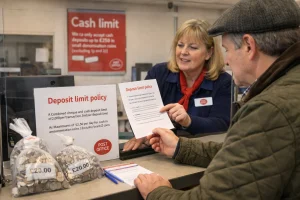
Yes, there are deposit limits and restrictions in place, and these often differ depending on the bank and the method used. These rules are necessary for security reasons and to ensure smooth processing of high volumes of transactions across thousands of Post Office branches.
Most personal accounts have a daily cash deposit limit, commonly around £3,000, while coin deposits are usually restricted to £250 per transaction. Banks may also set monthly or annual thresholds, for instance, a total cash deposit limit of £24,000 per year.
Cheque deposits are not usually subject to set value limits at the Post Office, but your bank’s internal processing rules may still apply, especially for unusually large cheques.
“I had to split my deposit over two days because of the daily limit. It wasn’t a big deal, but I wish I had known earlier,” someone noted in a forum conversation.
Familiarising yourself with these limits in advance ensures your deposit goes through without unnecessary delay or disruption.
How Long Does It Take for the Money to Reach My Bank Account?
The time it takes for your money to appear in your account depends on the type of deposit, the bank’s internal processing system, and the time of day you make the transaction.
Cash deposits using a debit card are generally credited immediately, meaning you can access your funds the same day. This is ideal for urgent payments or topping up an account with low balance.
Cash deposits made with a barcoded paying-in slip, on the other hand, may take 1 to 2 working days to reflect, especially if the transaction is completed after the local cut-off time.
For cheque deposits, you should expect a processing window of 2 to 5 working days, which includes the time it takes for the Post Office to send the cheque to your bank and for the bank to complete the standard cheque clearing cycle.
Cut-off times can vary by branch, so it’s always best to ask at the counter or check online for the specific hours that apply.
What Should I Bring When Visiting the Post Office?

Visiting the Post Office to make a deposit is a smooth process, as long as you come prepared. Arriving with the correct documentation and materials ensures that your transaction can be completed quickly and without interruption.
- For cash deposits, you’ll need your debit card and be ready to enter your PIN to verify the transaction. This is standard for most UK banks, and it provides a layer of security for the user.
- For cheque deposits, you must bring a paying-in slip and use a bank-branded envelope. These are typically available at the Post Office counter. Make sure the envelope is properly sealed and that all the required account details are filled in accurately.
If you’re depositing coins, ensure they are bagged correctly by denomination, this is a commonly overlooked requirement and one that often leads to delays.
“I once forgot the envelope for my cheque and had to queue again the next day. Never again!” said one user on a popular UK personal finance thread.
Being prepared saves time and ensures your money gets to the right place, faster.
What Are the Differences Between a Post Office and a Banking Hub?
Although both locations offer essential banking services, Banking Hubs provide a broader and more in-depth level of support compared to standard Post Office counters.
Banking Hubs have been introduced in response to widespread bank branch closures and are designed to support communities that no longer have easy access to traditional banking facilities.
| Feature | Post Office | Banking Hub |
| Primary Purpose | Everyday basic banking services | Replacement for closed bank branches |
| Cash & Cheque Deposits | Yes | Yes |
| Cash Withdrawals | Yes | Yes |
| Balance Checks & Transactions | Limited support | More comprehensive assistance |
| In-Person Banking Advice | Not available | Available via scheduled community bankers |
| Private Meeting Space | No | Yes |
| Best Suited For | Personal day-to-day banking | Small businesses and advice-led banking |
| Availability | Widely available across the UK | Limited but expanding in underserved areas |
While traditional Post Offices continue to meet most everyday banking needs, Banking Hubs add a valuable layer of personalised and bank-specific service.
This makes them particularly useful for small business owners, individuals who prefer face-to-face financial advice, and communities affected by bank branch closures in the UK.
Are There Any Alternatives to Post Office Deposits?
Yes, there are several alternatives if you can’t, or prefer not to, use the Post Office for deposits. Depending on your bank and account type, you may be able to choose from other convenient options:
- Mobile cheque deposits via banking apps, where supported
- ATM cash deposit machines offered by some banks
- Bank transfers from another account
Each alternative has its own limitations. Mobile deposits often have lower limits, while cash deposit ATMs are only available to customers of specific banks. For many people, particularly those who value face-to-face service, the Post Office remains the most flexible solution.
Final Thoughts
From personal experience, I can say that the Post Office has become more than just a postal service, it’s a reliable extension of everyday banking. The ability to deposit cash or cheques into my bank account, especially in areas where traditional banks are closing, is a genuine advantage.
Whether you’re dealing with personal finances, managing a small business, or just need a simple way to pay in a cheque from a birthday card, the Post Office can help.
And if you ever feel unsure, don’t hesitate to ask at the counter, they’re typically well-informed and very approachable.
Frequently Asked Questions
What do I need to deposit a cheque at the Post Office?
You’ll need a paying-in slip and a bank-branded envelope, both of which are available at the counter.
How long does it take for cheque deposits to clear via the Post Office?
Typically 2–5 working days, depending on the bank and cut-off time.
Can I pay coins into my bank account at the Post Office?
Yes, but coins below £1 must be in full denomination bags. The maximum coin deposit is usually £250 per transaction.
Is there a fee for depositing cash at the Post Office?
The Post Office does not charge a fee, but some banks may apply deposit fees, check with your provider.
Can I deposit money into someone else’s account via the Post Office?
In most cases, no. Deposits should be made into accounts where you are the named holder.
Which banks don’t allow deposits via the Post Office?
Some digital-only banks and accounts registered in the Channel Islands or Isle of Man may not support Post Office deposits.
Can I use the Post Office if I don’t bank online?
Absolutely. The Post Office is ideal for those who prefer not to use online or mobile banking.