

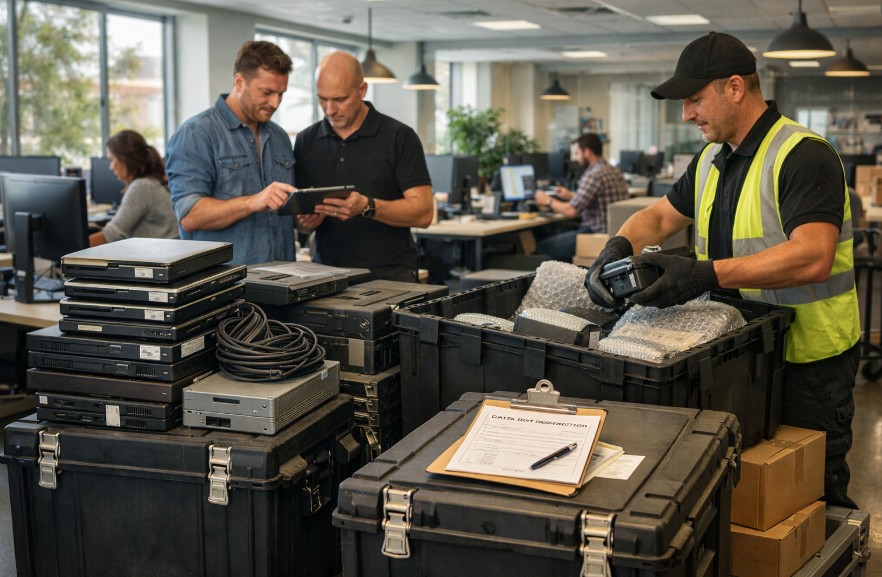
Startups are good at buying technology. They are considerably less good at getting rid of it. In the early stages, equipment decisions are driven by urgency, whatever gets the team productive fastest.
But as the business grows and hardware gets replaced, the question of what to do with the old kit tends to fall into a gap between IT, operations, and finance that nobody quite owns. That gap is more expensive than most founders realise.
The Hidden Liability in Your Office Cupboard

A typical startup that has been operating for three to five years will have been through at least one full hardware refresh cycle. Early-stage laptops have been replaced.
The original office desktops are sitting in a cupboard. Maybe there is a decommissioned server or two gathering dust in a corner. None of it is inventoried. None of it has been wiped. And all of it still contains data.
Under GDPR, the business remains the data controller for every piece of personal data on those devices until that data is verifiably destroyed.
That includes customer records, employee information, financial data, and anything else that falls within the regulation’s scope. A stolen laptop from a storage cupboard triggers the same breach notification obligations as a hack on a live system.
Why Startups Are Particularly Exposed?
Larger organisations typically have formal IT asset management processes, dedicated compliance teams, and established relationships with disposal providers.
Startups generally have none of these. Equipment is bought on credit cards, tracked in spreadsheets (if at all), and disposed of informally when it stops working or gets replaced. The result is a compliance blind spot that grows larger with every hardware cycle.
This matters increasingly as startups scale. Enterprise clients conducting due diligence will ask about data handling practices. Investors performing environmental, social, and governance assessments will want to see documented IT disposal processes.
Regulatory audits, particularly in fintech, healthtech, and edtech, will expect evidence that data-bearing assets are being managed through their full lifecycle.
The Leeds and Northern Tech Scene

The growth of tech hubs outside London has amplified this problem. Cities like Leeds, Manchester, and Edinburgh have seen rapid expansion in their startup ecosystems, with co-working spaces, accelerators, and scale-up programmes generating demand for IT recycling Leeds businesses and startups can access locally.
The same pattern is emerging across the North of England, where a growing density of tech companies means increasing volumes of redundant IT hardware that needs to be managed compliantly.
For startups in these regions, the challenge is finding disposal solutions that fit their scale. They do not have the volumes to justify enterprise-level contracts, but they have the same compliance obligations.
The solution is typically a provider that offers flexible collection, handling anything from a handful of laptops to a full office clearance, with the same certification and documentation regardless of volume.
Making It Work Financially
The good news for cash-conscious startups is that IT disposal does not have to be a cost centre. Equipment that is less than four years old and in working condition has genuine resale value on the refurbished market.
Business-grade laptops can recover £80 to £200, depending on specification and condition. Even equipment with no resale value can be recycled at no cost, with the provider recovering their costs through materials extraction.
Professional computer recycling providers will typically offer free collection, handle all data destruction and certification, and return a share of the resale value for equipment that enters the remarketing channel.
For a startup disposing of 20 to 50 devices, the net position can be cash-positive, turning a compliance headache into a small but welcome revenue line.
What Founders Should Do Now?
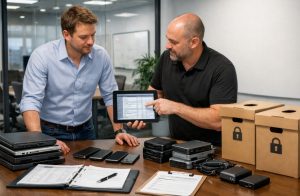
First, audit what you have. Walk the office and count every device, not just the ones on desks, but the ones in drawers, cupboards, and storage rooms. Record the make, model, and approximate age. This is your starting asset register.
Second, stop stockpiling. Every device in storage is a depreciating asset and an active data liability. Set a policy that decommissioned equipment enters the disposal process within 30 days.
Third, choose a certified disposal partner. Look for ADISA certification, ISO 27001, and an Environment Agency waste carrier licence. Ensure they provide individual certificates of data destruction for every device, not just a batch certificate for the consignment.
Finally, build disposal into your procurement process. When you buy new equipment, plan for its end of life from day one. It takes five minutes to add to a procurement checklist and saves weeks of scrambling when the equipment eventually needs to go.
For startups, responsible IT disposal is one of those operational basics that is easy to ignore until it becomes a problem. The businesses that get ahead of it spend less, reduce risk, and present a more credible face to clients, investors, and regulators. Those that do not are accumulating a liability that only grows with time.