


On 8 April 2025, a major shift in UK company law took effect as Companies House launched its new identity verification system. For the first time, individuals who register, run, or manage UK companies must prove their identity either directly through GOV.UK One Login or via a registered Authorised Corporate Service Provider (ACSP).
This rollout forms part of the wider Economic Crime and Corporate Transparency Act 2023, a landmark reform intended to disrupt economic crime, enhance data integrity, and reinforce the UK’s global reputation as a secure and transparent place to do business.
With identity verification soon to become mandatory by autumn 2025, the implications for business owners, directors, and corporate service providers are significant. But how does the system work, and what steps must be taken to comply?
What Is the Companies House Identity Verification Launch?

The identity verification launch introduces a formal requirement for individuals involved in company formation and management to verify who they are. The move is aimed at deterring the misuse of UK companies for fraudulent or illegal purposes by ensuring that only genuine, identifiable individuals are allowed to form and control companies.
Verification is currently voluntary but will become mandatory by late 2025 for:
- Directors of new and existing companies
- People with Significant Control (PSCs)
- Individuals filing on behalf of companies
- Members of Limited Liability Partnerships (LLPs)
- Authorised Corporate Service Providers (ACSPs)
The reform applies equally to individuals verifying directly with Companies House and those using third-party agents. Both routes must meet the same high standard of identity assurance.
Why Has Companies House Introduced Identity Verification in 2024?
The new system is rooted in a need for greater corporate transparency. For too long, the UK’s relatively open and low-cost company registration system has been exploited by criminals to set up fake companies, launder money, and commit fraud often without scrutiny.
The introduction of identity verification addresses this vulnerability. It enables Companies House to:
- Prevent false or stolen identities from being used in corporate filings
- Improve the accuracy and reliability of data in the register
- Support law enforcement and financial regulation efforts
- Foster trust in UK business by improving transparency
Companies House CEO Louise Smyth CBE stated that the reform “will play a key role in improving the quality and reliability of our data and tackling misuse of the companies register.”
Who Will Be Required to Verify Their Identity Under the New Rules?

Identity verification will be required for anyone involved in the running or registration of a UK company. This includes:
- Directors (new and existing)
- People with Significant Control (PSCs)
- Members of LLPs
- Individuals filing company information
- ACSPs and their agents
From 8 April 2025, individuals can verify their identity through GOV.UK One Login or with the help of a registered ACSP. From autumn 2025, identity verification will be compulsory, with Companies House confirming that failure to comply will be considered an offence, potentially resulting in penalties or restrictions on company formation and filings.
How Does Identity Verification Through an ACSP Work?
Verifying identity through an Authorised Corporate Service Provider (ACSP) offers an alternative to self-verification via GOV.UK One Login, especially useful for individuals seeking professional support or managing multiple filings. However, the process is not simply outsourced ACSPs have significant responsibilities and must meet stringent legal and procedural standards.
ACSPs play a key role in maintaining the integrity of the Companies House register. They are trusted intermediaries who must follow a defined identity verification standard, ensuring all checks are performed consistently, securely, and in line with government regulations.
To act as an ACSP, a business must be:
- Supervised under UK anti-money laundering (AML) regulations, by a recognised supervisory body (e.g. HMRC, FCA, or the Insolvency Practitioners Association)
- Formally registered with Companies House as an authorised agent (from 18 March 2025)
- Willing and able to keep secure, long-term records of identity checks
- Responsible for verifying the identity of individuals intending to register, control, or file for UK companies
The ACSP Verification Workflow
1. Initial Registration as an ACSP

To begin providing verification services, the business must:
- Apply using the ‘Register as a Companies House authorised agent’ service
- Complete an identity check for the individual registering the business
- Provide details about the organisation, AML supervision, and roles
- Pay a £55 registration fee
Once approved, Companies House assigns the ACSP a unique digital identity number and access to a secure agent account. Additional employees can be added as authorised users.
2. Collecting Required Information from the Individual

The ACSP begins by gathering specific information from the person whose identity they are verifying. This includes:
- Full legal name (including previous names)
- Date of birth
- Current home address
- Residential history covering the past 12 months
- A working email address
This foundational data is used to cross-reference identity documents and ensure consistency throughout the verification process.
3. Document Collection and Evidence Verification
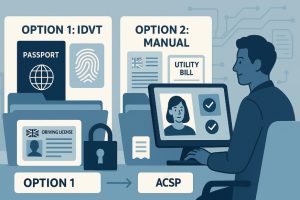
Depending on how the ACSP performs the verification (manual vs. technology-assisted), there are two methods:
Option 1: Verification with Identification Document Validation Technology (IDVT)
If the ACSP uses IDVT, they can accept specific identity documents, including some that have expired, as long as their cryptographic security features can still be validated.
Acceptable documents under this method include:
- Biometric or machine-readable passport (up to 6 months expired)
- UK, Channel Islands, Isle of Man, and EU driving licences (full or provisional)
- Irish passport cards
- EU, EEA biometric identity cards
- UK Biometric Residence Permits (BRPs), Biometric Residence Cards (BRCs), and Frontier Worker permits (up to 18 months expired)
The ACSP must collect and securely retain:
- The document reference number
- Expiry date
- Country or authority of issue
The technology must perform all verification steps, if it does not, the ACSP must manually complete the remaining parts.
Option 2: Manual Verification (Remote or In-Person)
Where IDVT is not used, ACSPs must carry out a manual verification, which requires two identity documents:
- Two Group A documents, or
- One Group A and one Group B document
Group A (Photo and Government-Issued)
Examples include:
- Valid or recently expired passports
- UK/EU photocard driving licences
- UK Biometric Residence Permits or Cards
- HM Forces ID cards
- Firearms licences
- Government-issued photographic work permits or visas
Group B (Proof of Address or Civil Identity)
Examples include:
- Birth or adoption certificates
- Marriage or civil partnership certificates
- Utility bills
- Council tax statements
- Mortgage or tenancy agreements
- Non-photographic visas or immigration documents
- Bank or building society statements
Group B documents must confirm the individual’s current address but do not require the submission of document reference numbers or expiry dates.
4. Authenticating Documents

Whether digital or manual, ACSPs must ensure the documents:
- Are genuine (not altered, forged, or tampered with)
- Accurately reflect the identity details provided
- Belong to the person presenting them
Manual reviewers must be trained in fraud detection, using methods aligned with the Home Office’s best practice guidance. If there are concerns, they should contact issuing authorities, embassies, or authoritative databases.
5. Confirming Real Identity

Verification goes beyond confirming document validity. ACSPs must ensure:
- The person matches the photo in the documents
- Facial recognition is accurate (if using IDVT)
- The individual is a real, live person, not a synthetic identity
In some cases, ACSPs may request additional documents showing:
- Address history
- Activity linked to the identity (e.g. recent bank or utility statements)
- Evidence of passport use or travel activity
This helps reduce the risk of fraudulent or synthetic identities passing verification.
6. Making a Verification Decision

Once all steps are complete, the ACSP must determine whether they are satisfied the individual is who they claim to be.
If they are:
- They must notify Companies House via the agent account
- Provide details of the identity documents used
- Confirm that the verification met Companies House’s required standard
If the ACSP is not confident in the individual’s identity:
- They must keep records of all checks and evidence for seven years
- The individual will be responsible for resolving the issue or re-attempting verification
No individual can be listed as a director, PSC, or company agent until their identity is successfully verified.
Legal Accountability and Ongoing Obligations
ACSPs are legally accountable for the checks they perform. If their processes fall short of the Companies House verification standard, Companies House has the authority to suspend or remove their authorised status.
Furthermore:
- ACSPs must evidence their verification processes
- They must be able to explain the technology used and the basis of their decisions
- Even when using third-party platforms, ACSPs retain full responsibility for compliance
These obligations ensure that only trustworthy and competent providers handle identity verification protecting the integrity of the Companies House register.
What Are the Key Changes in the UK Company Registration Process for 2024?
The launch of identity verification coincides with other critical updates under the Economic Crime and Corporate Transparency Act, including:
| Change | Description | Effective Date |
| Identity Verification | Required for directors, PSCs, and agents | From 2025 (phased) |
| Registered Office Requirements | No PO Boxes allowed, must be a physical UK address | April 2024 |
| Registrar Enforcement Powers | Companies House can reject or remove false data | 2024 |
| Digital-Only Filing | All company submissions to move online | Late 2024 |
These changes strengthen regulatory oversight and increase the accuracy of the corporate register.
What Impact Will Identity Verification Have on Startups and Small Business Owners?

While the changes may introduce new steps for company registration, the long-term benefits far outweigh the minor administrative burden.
Impacts include:
- The need to verify directors and PSCs before incorporation
- Additional compliance responsibilities for agents
- Improved trustworthiness for investors and partners
Shevaun Haviland, Director General of the British Chambers of Commerce, commented:
“Protecting the names of good firms and making it harder for those with dishonest motives to set up a business can only be a good thing.”
What Do Experts Say About the Companies House Reforms?
The reforms have received strong support across business, legal, and transparency sectors.
Justin Madders MP, Minister for Employment Rights, said:
“This is good for business, lenders and transparency and will give companies, consumers and lenders more certainty about who they are doing business with.”
Feryal Clark MP, Minister for AI and Digital Government, stated:
“By embracing digital identity checks, we’re reducing red tape while strengthening our defences against abuse of the system.”
Patrick Walsh, Chair of BIPA, added:
“These are crucial steps towards realising the enhanced security and transparency that the Act aims to achieve.”
The Law Society of England and Wales praised the staggered implementation, allowing businesses time to adapt, while Transparency International and Open Ownership highlighted the reform’s alignment with international anti-fraud standards.
What Should Business Owners and ACSPs Do Next?

To ensure compliance and avoid delays in company operations, business owners and agents should:
- Begin voluntary identity verification via GOV.UK One Login
- Register as an ACSP if acting on behalf of clients
- Train staff on proper ID verification and fraud detection
- Integrate identity checks into onboarding processes
- Maintain full records of all verifications for seven years
Companies House encourages early action during the voluntary window to ensure a smooth transition.
Is the Identity Verification Launch a Burden or a Boost for UK Businesses?
Though the new rules require businesses to adjust their processes, they are largely viewed as a positive and necessary step. The move increases data accuracy, public trust, and the UK’s resilience against economic crime.
By integrating identity checks into regular filings like the annual confirmation statement, Companies House also aims to minimise disruption for existing directors.
As Thom Townsend of Open Ownership noted:
“This will make the information on Companies House more accurate, reliable, and ultimately more useful.”
Frequently Asked Questions
Will identity verification become mandatory in 2025?
Yes, by autumn 2025, it will be legally required for all relevant individuals.
Can I use a PO Box as my company’s registered office?
No. A physical address is required from April 2024 onward.
What is an ACSP and why is registration necessary?
An ACSP is a supervised agent who can verify identities on behalf of clients. Only registered ACSPs can legally carry out this role.
What documents can be used for identity verification?
Options include passports, driving licences, biometric residence permits, and utility bills depending on whether verification is digital or manual.
How long must identity records be kept?
Seven years from the date of verification.
Will this apply to LLP members and agents too?
Yes, identity verification will apply to all key individuals across company structures.
What happens if identity verification isn’t completed?
You will not be able to form a company, file legally required documents, or act as a director.